Investors often use the term ‘priced for perfection’ to indicate when high expectations are reflected in a share price. In an editor’s note several weeks ago I pondered the investor expectations for the US market and in particular the wider AI narrative.
Chip maker Broadcom is very much caught up in the hype. On 9 June 2025 the shares were trading at $244. By the 2 June 2026 they were trading at $488 after doubling in price in less than a year.
Since reporting results on 3 June the shares have fallen about 20%. This is a significant move for the sixth largest company in the S&P 500 with a market cap of approximately $1.86 trillion after the steep drop in the share price.
The price swing is indicative of an increasingly volatile market and optimistic AI investors who expect news to keep getting better.
Specifically, what spooked investors was Broadcom’s AI revenue guidance for 2027. In March the company issued guidance that AI revenue in 2027 would total $100 billion. Three months later Broadcom maintained their guidance.
It is hard to see this announcement as bad news since Broadcom didn’t reduce guidance. But when it comes to AI the numbers are supposed to keep getting bigger.
Who is investing in AI?
Groucho Marx famously joked that he would never join a club that would have him as a member. I often think of this quote when contemplating the impact of herd mentality in investing.
Who is investing in particular shares and what they want matters. If you understand the motivations of different types of investors their behaviour is less surprising.
There are several reasons Bitcoin is not an investment that I would consider. I’m an income investor and since Bitcoin doesn’t provide income it is a non-starter. But I’ve also always been concerned about who was investing in Bitcoin and how they would likely behave.
Bitcoin advocates have argued about the importance of the underlying technology and the benefits of the decentralised nature of Bitcoin. I accept these arguments and ultimately what gives anything value is simply the acceptance among people that it is valuable.
But I don’t think any specific attributes of Bitcoin are motivating most people buying and selling Bitcoin. They are speculating that Bitcoin will rise in value quickly and significantly.
When the only reason you buy something is because you think it will go up a significant amount quickly you don’t tend to have much patience. This can lead to high levels of volatility.
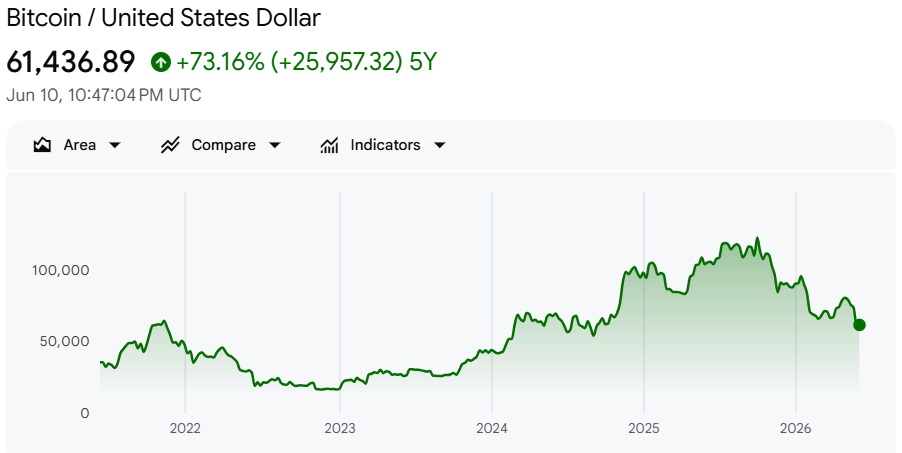
Source: Google Finance
Bitcoin’s all-time high was $126k US in October of 2025. It is currently trading at around $61k. One of the reasons cited for this decline according to Bitwise CIO Matt Hougan is the former speculators in Bitcoin have moved onto AI. Hougan says the attitude is “Who needs crypto when the Nasdaq-100 is up 43% year-over-year?”
None of this suggests that the companies at the heart of the AI narrative will not make great long-term investments. But many investors may not be focused on the long-term. There is likely going to be a good deal of volatility along the way if guidance doesn’t keep going up in a straight line.
Final thoughts
Volatility is both a risk and an opportunity. The more volatile an investment the higher the behavioural risk of investors doing something stupid to hurt their returns.
But with those big price swings comes opportunity for investors who can focus on the underlying business and ignore the share price. Broadcom just might be an example as the Morningstar analyst covering the company thinks the $100 billion of guidance is conservative and expects $200 billion in AI revenue in 2027.
A little mental preparation for volatility and a focus on the long-term pays off in every market environment. I have a feeling the current environment won’t be an exception.
Mark Lamonica
Also in this week's edition...
Meg Heffron walks through whether CGT changes shift Division 296 tax decisions.
The budget has introduced a great deal of uncertainty surrounding testamentary trusts. Dr Sylvia Villios examines the implications for estate planning.
Five tax cuts have been handed down in the Federal budget. Tony Dillion looks at how the cuts stack up against bracket creep.
Quality strategies shine globally, but Australia's concentrated market tells a different story. VanEck shares the limits of a quality investing approach in Australia.
Fresh questions are being raised as private markets expand. The Neuberger Private Markets team explores balancing opportunity and complexity.
As EOFY approaches, Chris Cuffe discusses why strong returns matter as much as generosity.
Simonelle Mody talks about why asset allocation is the most important investment decision you'll ever make.
This week's white paper from Yarra's Tim Toohey, explains why the RBA is unlikely to raise rates further during the current cycle.
Curated by Simonelle Mody and Leisa Bell
***
Weekend market update
From Shane Oliver, AMP
The past week saw another round of gyrations regarding whether there will be a US/Iran deal to end the war or not driving volatility in investment markets along with mixed US inflation data and the SpaceX intial public offering raising $US75bn, which is the biggest ever IPO. Around mid week shares were under pressure as missile exchanges with Iran ramped up to their highest since the ceasefire started as Trump said he will hit Iran “very hard”, driving oil prices up again. But on Thursday shares spiked as Trump (yet again) said a deal may be signed “in coming days” with tech stocks also buoyed by the successful SpaceX IPO.
For the week this has left global share markets mixed – up slightly in the US but down in the Eurozone, Japan and China. Australian shares rose a solid 2% or so for the week having proven more resilient in the face of US weakness mid-week and possibly getting a boost from talk that the RBA may be at or close to the top on interest rates. Gains on the ASX were led by consumer, property, health and industrial shares. Despite the bounce in the last week, Australian shares remain relative underperformers so far this year as RBA rate hikes, worries about the impact of the Iran war and Budget tax changes have impacted.
We continue to see shares overall providing positive returns this year but expect more volatility. The combination of sticky inflation – not helped by the oil supply shock and AI boom related demand, an upwards drift in central bank interest rates, flagging consumer demand, worries about an AI bubble, huge US IPOs (with $US200bn from SpaceX, Anthropic and OpenAI alone as against only $US77bn raised in the US for the whole of last year), and political uncertainty around the US mid-terms are likely to continue to result in a volatile ride.
Surging capital raising via IPOs are a mixed blessing for shares. On the one hand they add to hype around the market with many wanting to get on board. On the other they suck cash out of the market which can be a drag for future gains. I wouldn’t rely on them as a timing indicator though.
A 10% or so plunge in Korean shares earlier in the week caught a lot of attention. This just looks like a correction after a doubling year to date on the back of booming AI semiconductor demand. Such falls are not unusual after big run ups, but with Korean share valuations still cheap – with a forward PE of 7-8 times – and super strong earnings growth it may have further to go yet assuming the AI boom itself has further to run. The rise could be volatile though.
Bond yields were flat to down helped by news of another Iran deal. Gold and iron ore prices fell but metal prices rose and Bitcoin rose too continuing to bounce around its February low. The $US fell but the $A was little changed around $US0.704.
Trump’s latest claim that a deal is imminent could yet again come to nothing. Iran has proven far more resilient to US pressure than Trump seemed to expect, and it could yet string things out further given sticking points around its desire to toll ships through the Strait, it’s enriched uranium, it’s frozen assets, sanctions & Lebanon. That said Trump remains under intense political pressure with the mid-term elections approaching to find a way to dress up a deal sooner rather than later and both sides in the recent re-escalation of fighting appeared to be holding their punches with the aim of leaving room for negotiations. So, our base case remains that a deal will be reached leading to a reopening of the Strait.
The past week also saw a continued drift towards higher interest rates by central banks. While the Bank of Canada left rates on hold, the European Central Bank hiked rates by 0.25% taking them to 2.25% with its commentary reinforcing expectations for more rate hikes ahead and the Bank of Indonesia raised rates for a second month in a row.
US inflation likely keeps the Fed on hold for now but a hike later this year remains a high risk. CPI inflation rose further to 4.2% in May on the back of higher energy prices, and core CPI inflation also rose further to 2.9% yoy. The rise in core inflation was fractionally less than expected helped by softer readings in goods prices and likely leaves the Fed on hold in the week ahead. But elevated services inflation, the rising trend in core inflation with the AI boom stacking on top of the tariffs and the oil shock in adding to costs and core PCE inflation looking likely to come in around 3.4% yoy for May after hot components in the producer price index leaves the risk of a Fed rate hike later this year high.
So Australia is seeming to be less of an outlier now on inflation and rates. Headline CPI inflation in the US at 4.2% yoy is now the same as in Australia.
Consumers also moved a bit more cautious with their savings with an increased preference for bank deposits and paying down debt and less interest in shares and property with more interest in super. This likely partly reflects the tax changes in the Budget which make property and to a less extent shares relatively less attractive compared to super.
The May NAB business survey showed unchanged business conditions at below average levels, with a rebound in confidence but to still weak levels. Capacity utilisation fell suggesting a softening in demand though relative to supply which is something the RBA wants to see.
Latest updates
PDF version of Firstlinks Newsletter
Monthly Gold ETF Flows from World Gold Council
Monthly Bond and Hybrid updates from ASX
Listed Investment Company (LIC) Indicative NTA Report from Bell Potter
ASX Listed Bond and Hybrid rate sheet from NAB/nabtrade
Plus updates and announcements on the Sponsor Noticeboard on our website