My first lesson in risk didn’t come from a finance class.
It came the day I told my parents I was abandoning a law degree in pursuit of one in English literature.
I wasn’t naive about the employment prospects. What I wanted (that I couldn’t articulate at the time), was to learn how the minds that came before me had made sense of uncertainty, ambition, fear, desire. All the things that added meaning to the otherwise mundane. Years later, when I found myself studying a postgraduate degree in finance, I realised the two disciplines weren’t as far apart as they seemed.
During those literature years, I was a William Blake devotee. Perhaps most famous for his poem "The Tyger", an analysis on the creation and coexistence of good and evil.
In a brutally oversimplified description, Blake rejected Enlightenment rationalism and argued that without duality, there was no progress. I think, better than anyone, he understood that the human condition was permanently at war with itself. Now, it’s unlikely Blake was an investor, but he certainly understood the role of excess and appetite.
The unravelling
I recently had a stretch of time off.
Somewhere over the Pacific Ocean, after suffering from altitude-induced introspection, I called time on my thoughts and logged onto the airline Wi-Fi. I stumbled across a clip of Warren Buffett’s latest interview with CNBC. With as much gusto as a person can muster at 95, he lamented about the difficulty of finding value when “everybody is preferring gambling.”
It reminded me of something he said earlier this year, when he described the modern market as “a church with a casino attached.” A rather vivid image.
There’s a common observation in theology that a church is not defined by its walls, but by what people believe happens inside it. A sacred space becomes profane when the rituals lose their meaning and the congregation forgets why they gathered in the first place. What Buffett seems to be describing is the desecration of discipline, replaced by spectacle. And he might have a point.
Retail participation in markets is as high as ever. In many ways, the entry to the casino has never been more brightly lit, inviting anyone with a smartphone and an impulse for financial gain. The most recent spectacle has been South Korea.
A painful lesson
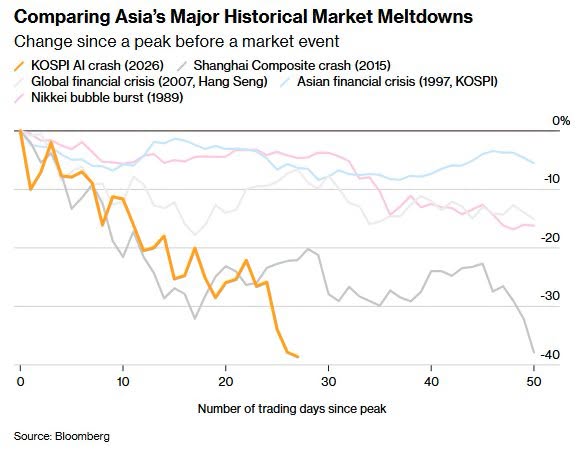
The South Korean market has just lived through one of the most violent episodes in modern financial history. Last week, the Korea Composite Stock Price Index (KOSPI) fell 44% from its June high, to then rebound 18%, marking its largest ever one-day gain.
What appeared like a booming renaissance in early 2026, unravelled into a fragile, self-reinforcing ecosystem built almost entirely on leverage, AI hype and the fervour of retail traders who believed they’d found a one-way bet.
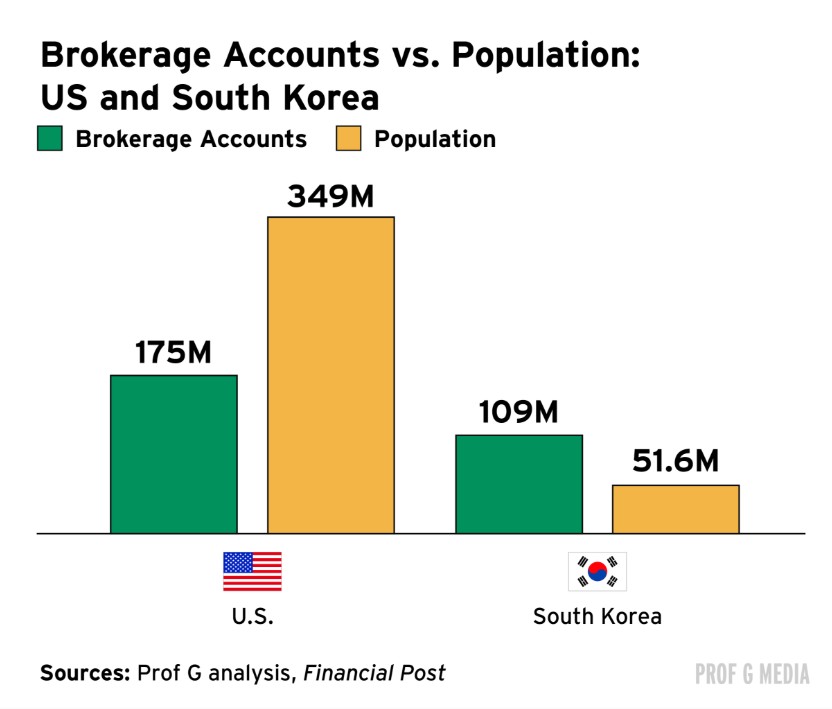
For months, the Korean equity market had been rising on a tide of optimism centred almost entirely around semiconductor players Samsung and SK Hynix, the twin pillars of the KOSPI. Their fortunes had become synonymous with the global AI boom and traders poured into these stocks with enthusiasm. At the same time, the number of retail trading accounts in South Korea also exploded.
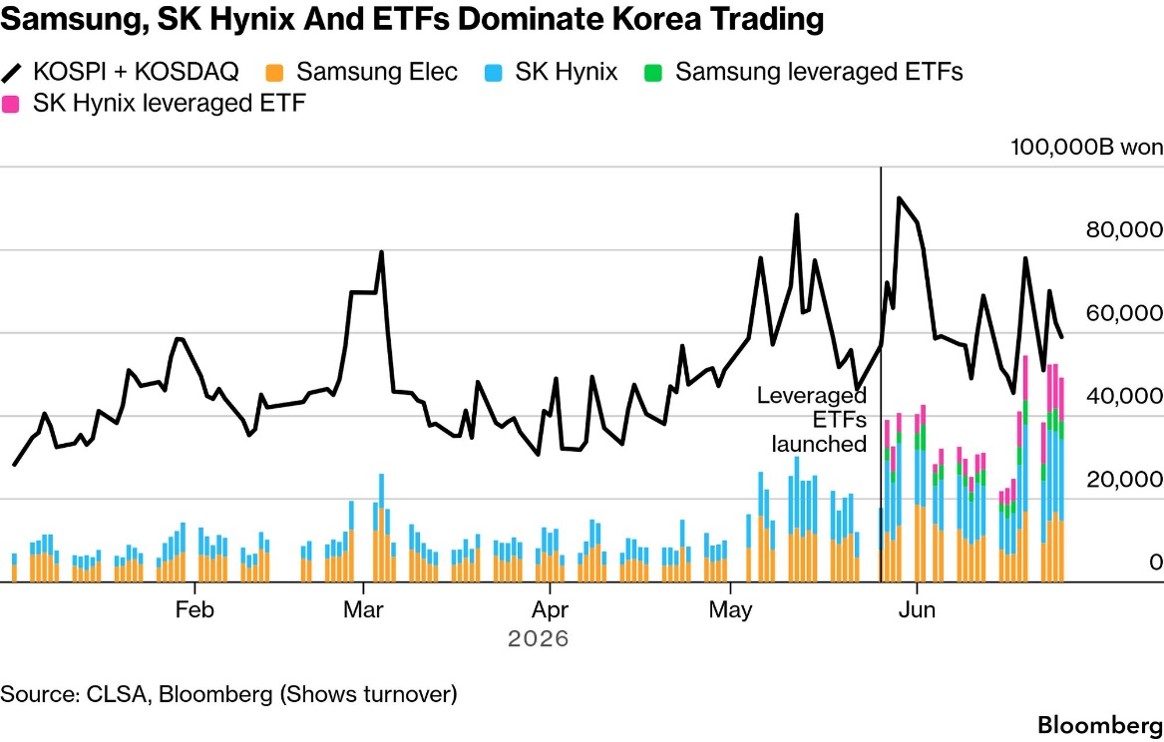
The real spark came in May when Korea launched single-stock 2x leveraged ETFs on Samsung and SK Hynix. Soon enough, leveraged ETFs for Samsung and SK Hynix made up 70% of stock trading value. The products sat on top of an already leveraged ecosystem, all concentrated in the same two semiconductor names.
The road of excess leads to the palace of wisdom
When sentiment finally faltered, there was an immediate and brutal unwind. The leveraged ETFs collapsed, with the SK Hynix 2x product losing ~70% of its value from its peak and nearly half from its launch. Goldman Sachs has estimated over 1.2 million leveraged retail trading accounts in South Korea triggered margin calls with around 30% being wiped out entirely.
The violence of this crash wasn’t simply the result of falling semiconductor prices. It was the consequence of a market structure that had become overly dependent on retail leverage.
There are a number of incredibly sobering stories behind the collapse. These are not abstract losses on institutional balance sheets and I take no pleasure in the demise of the optimistic. But as the saying goes, there is no crying in the casino. Such rules are written in advance, even if no one reads them.
The government’s response was swift and unusually apologetic. Regulators admitted they had not fully considered the risks of single-stock leveraged ETFs and apologised publicly. New rules have been proposed to limit how much retail investors can allocate to such products, as well as the introduction of higher trading costs for speculative instruments. Another inquiry has been launched into the ease with which margin loans were granted through mobile apps. Much too little, too late.
And in a strange way, this brings me back to Buffett and Blake. In the Proverbs of Hell, Blake writes “The road of excess leads to the palace of wisdom”. This was never meant to be read as an endorsement of indulgence. Blake saw wisdom as something earned only after going too far, yet Buffett proves that with experience, some learn to spot the excess long before the rest of us reach the palace.
Simonelle Mody
***
Weekend Market Update
From My Bui, AMP
Global shares had another ripper week with major share markets reaching new all-time highs, before retracing slightly on Thursday as the Iran “deal” seems further away than previously thought. US shares rose 3.7% over the week, with broad-based gains across cyclical sectors including consumer discretionary, communications, IT and industrials. The Euro Stoxx gained 2.5%, Japanese shares rose 1.2% and Chinese shares were up 2.2%. Even the ASX 200, which has lagged this year, reached record highs and is now up 3.3%, helped by a positive start to earnings season and gains across most sectors except energy and utilities.
Bond yields ended the week marginally lower, with the US 10-year yield easing to 4.67% from 4.73% last week with markets in a risk-on mood. But the trend remains up since March this year partially driven by inflation concerns. The US Treasury curve has also seen higher term premium lately, reflecting concerns about US economic policy. These include Kevin Warsh’s preference for less forward guidance, reports that Warsh and Trump have maintained regular direct communication (unlike previous Fed Chairs), and Scott Bessent’s help to support the yen intervention (the first in almost 30 years); alongside longer-term worries about fiscal sustainability and structurally higher inflation from trade policy and geopolitical risks.
Even with rising interest rates, equity risk premium (earnings yield above bond yields) remained in the same range they have been in in the last two years. Both actual and forecast earnings are still trending up especially in the US, supported by still resilient economic data, which have propelled shares to new highs despite the unending cycle of news around the US-Iran war.
Markets were on another Middle East war rollercoaster this week, with weekend escalation from the US tempered by Treasury Secretary Scott Bessent’s Tuesday comment that a deal could come “today or tomorrow”. Positive sentiment has helped gold prices break out of a technical resistance level this week to above $4,250/oz (from just around $4,000 last week). But the leaked details of the expected “deal” between Iran and Oman looked unrealistic, with Iran reportedly demanding a ban on US and Israeli ships through the Strait of Hormuz, while the US maintained its regional blockade and pushed for traffic to resume. It is a classic game theory stalemate: neither side wants to back down because escalation serves their own interests! Now four days later, the Houthis have escalated attacks, Saudi Arabia seems to get pulled deeper into the conflict, Hormuz remains closed, and oil prices have bounced back above $80/bbl. It remained rangebound between $80 and $90/bbl in the last week and is unlikely to drop to below $70 anytime soon with all the back and forth – not too different from previous historical conflicts.
That being said, it’s probably best to follow Dr Shane Oliver’s 40-advice to “turn down the noise”; in other words, we can’t be too bearish given that Trump will likely TACO again at some point. In fact in the past week Trump’s approval ratings have fallen again to new lows for this term, with polls showing Americans are much more focused on gasoline prices and inflation than foreign affairs. So for now, it remains business as usual, with shares still supported by solid fundamentals, strong economic growth and rising productivity.
The RBA will likely revise down their inflation forecast next week and hold rates unchanged, but don’t expect this to be the end of the hiking cycle. With headline inflation for the second quarter coming in significantly lower than previously expected (4.0%yoy versus 4.8% forecast by the RBA in May) while the labour market looks weaker (unemployment rate averaging 4.4% vs RBA’s 4.2% forecast), the Reserve Bank certainly has space to hold rates constant for now to further assess the impact of the three rate hikes so far (they impact the economy with a lag!).
However, the RBA will retain a hawkish bias, and we see a high chance of one more hike in November especially if the quarterly trimmed mean for 3Q comes out to be 0.8%qoq or higher. Specifically, trimmed mean momentum hasn’t trend down at all in the past two months (and 3.6% annual reading is too far from the 2.5% target), consumer spending is still very solid (see the Australian data section below), wage pressures remained high, and now that the fuel excise is fully reinstated, we think there is more room for businesses to pass through their costs to consumers with “fuel surcharges”! In fact, our pipeline pressure indicator remains elevated around the same levels as early 2023 (when the RBA was in the middle of hiking rates), despite having rolled over from oil price peak in May.
73% of the US S&P 500 companies have reported with 78% of them beating expectations, while earnings growth projection remained very solid at 31.8%yoy. Unsurprisingly tech earnings projection is a whopping 49.1% annual growth so far, but energy is the real outperformer at 135%yoy given elevated commodity prices.
The Australian 1H earnings season has started with only 15 companies in the ASX 200 reporting this week so far – usually companies with good results report earlier so take the results this week with a grain of salt. Consensus expectations are for profits to be the strongest in four years at 12% annual growth rate, but profits are likely concentrated in mining (from higher commodity prices and booming AI capex) and financial services (from higher deal activities and favourable operating conditions in the past year). But looking forward, rate hikes will bite with slower consumer spending and declining housing momentum in the second half, so profits growth will slow from here especially for banks, consumer discretionary, and real estate.
67% of companies have increased their dividends this earnings season, the highest since 2021, which is a good sign as it shows that companies have confidence in their cash flows to do so! But it’s lower than the percentage of reported companies which have seen historical earnings rise at 80%.
Australia’s home price downturn deepened in July, with prices now around 2% below their peak while Sydney and Melbourne have seen larger falls around 5–6%. National prices fell 0.7% in this month, and we expect further weakness given the double whammy of rate hikes and investor tax changes. Home sales volumes have unsurprisingly trended lower, similar to levels seen during the 2022-23 downturn. By next year, national prices are expected to fall around 7% before rebounding as monetary policy eases in the second half of 2027 and the structural supply shortage remains.
Also in this week's edition...
The recent pickup in inflation has reignited debate on the falling living standards in Australia. Shane Oliver from AMP discusses why this has happened and how we go about fixing it.
Australia’s golden age of dividends may be ending. Mark LaMonica explores four options for an income investor's next dollar.
Recent CGT reforms tax real gains to inflation, however, they fail to index losses. Jason Nassios and James Giesecke argue this leads to inefficiencies in the tax system.
Phil Strano from Yarra Capital Management prepares investors for the increasing influence of AI funding demands on Australian bond markets.
Jason Teh from Vertium explains why active managers confronting today's markets need to bring a gun to the gun fight.
Kaye Fallick interviews a leading pension fund innovator and poses the question - What can Australian super funds learn from the UK?
Chris Cuffe shares what ten fund managers believe the market may be missing.
Curated by Simonelle Mody and Leisa Bell
Latest updates
PDF version of Firstlinks Newsletter
Monthly Investment Podcast by UniSuper
Listed Investment Company (LIC) Indicative NTA Report from Bell Potter
ASX Listed Bond and Hybrid rate sheet from NAB/nabtrade
Plus updates and announcements on the Sponsor Noticeboard on our website