If there’s one industry that attracts an unusual number of snake oil salesmen, it’s probably this one.
Spending some time around markets eventually reveals the economist who knows what’s coming next, the fundie who has discovered a secret that somehow remains hidden from every other investor on the planet.
In most professions, expertise can be observed directly. We assume the surgeon knows more about surgery than we do and the pilot knows more about flying. Investing is different. It may be one of the few areas where a healthy dose of scepticism is necessary to succeed.
However, I do believe there are a handful of exceptions to this.
For me, Warren Buffett is one of them. But it’s not just due to his extraordinary track record.
It’s that he occupies a peculiar position in this industry. As one of the most successful practitioners of the game, he has spent decades telling people not to play it the same way he does.
Most financial figures are sellers of some description, whether it’s a newsletter, a new fund or at the very least, a world view. And before throwing stones from a glass house, I should acknowledge the irony here. My career exists within this very realm.
The point isn’t that selling ideas is inherently bad. It’s that authority is often derived from the ability to persuade people that you know something most don’t.
Buffett's authority stems from almost the opposite impulse.
How many Michelin-starred chefs would tell people they could make the same dish at home, for a fraction of the cost? There's an almost self-negating quality to Buffett's credibility.
Below are some of my favourite takes from him.
"By periodically investing in an index fund, for example, the know-nothing investor can actually outperform most investment professionals."
Coming from one of history's most successful active investors, the statement borders on paradox.
In 2008 Buffett famously made a $1 million bet that an S&P 500 index fund would outperform most investment professional’s picks over a 10-year period. And indeed, he was right. Ted Seides, co-founder of Protégé Partners, accepted the challenge and handpicked five hedge funds he believed would outperform the S&P 500 over this period. The performance gap was certainly something.
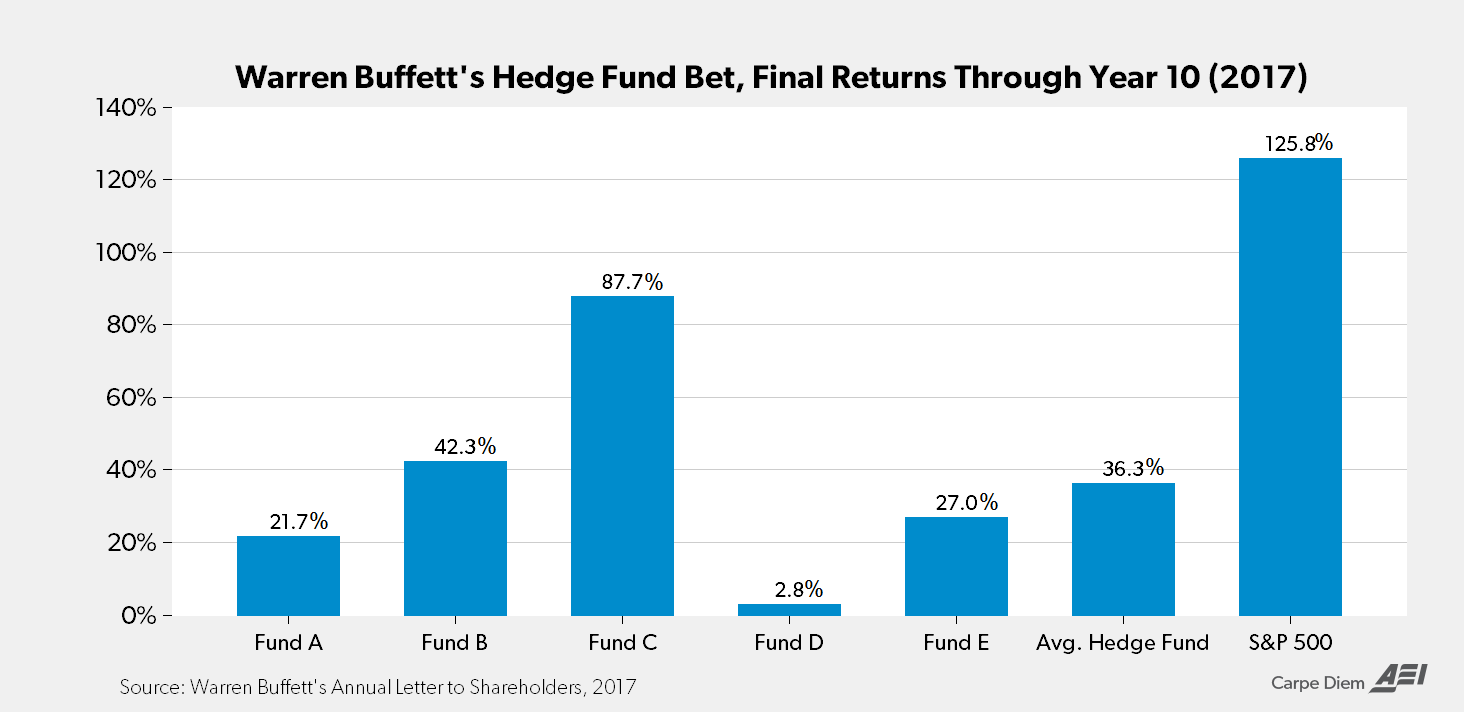
This exercise wasn't intended to be an obituary for active management. Rather, it was an exercise in humility for an industry that has long projected an image of delivering superior returns through complex strategies, demanding higher fees.
“The goal of the non-professional should not be to pick winners – neither he nor his ‘helpers’ can do that – but should rather be to own a cross-section of businesses that in aggregate are bound to do well. A low-cost S&P 500 index fund will achieve this goal.”
I believe the ‘helpers’ he refers to here are “those who profit from giving advice or effecting transactions”. I imagine many readers have successfully invested in individual companies for decades and have the results to show for it.
But no matter your persuasion, the ability to consistently identify winning stocks over decades is extremely difficult, even with professional help. The argument is ultimately about probability rather than possibility.
“The most important quality for an investor is temperament, not intellect.”
Buffett's point challenges the common perception that investing is primarily an intellectual exercise. It also echoes Peter Lynch's observation that the most important organ in investing is the stomach, not the brain.
Lacking a 'superior' intellect is not the barrier many make it out to be. Long-term success is often determined more by the ability to remain disciplined and stick to a sensible process through periods of uncertainty.
Every generation produces its own collection of gurus, visionaries and occasionally outright charlatans. However, the promise of exceptionalism always gives way to the decidedly unglamorous virtue of common sense.
Simonelle Mody
***
Weekend Update
From Shane Oliver, AMP
After record highs in US and European shares a week ago, global shares pulled back in the last week reflecting concerns about rising bond yields, not helped by a further rise in oil prices and some continuing concerns about chip makers. The weak global lead along with mixed earnings reports also weighed on the Australian share market which is down around 0.6% for the week with falls led by retailers, banks, property and IT shares more than offsetting gains in health and resources shares.
Bond yields mostly rose, not helped by higher oil prices and despite US Treasury efforts to lower them.
Bitcoin broke decisively above its 200-day moving average, a move which confirmed the end of the last four crypto winters (which saw circa 80% falls) this time only after a fall of 53%. Technically Bitcoin looks like it’s on the way up again. If we have seen the bottom after a much milder winter than in the past it’s a positive sign that Bitcoin is maturing.
Similarly, gold also looks to be breaking higher after a 27% fall, although its currently right on its 200-day moving average. Both are benefitting from having had long positions and excessive optimism washed out and signs of renewed $US weakness. The latter is also seeing the $A hold above $US0.71. Meanwhile, iron ore prices also rose but metal prices fell.
Oil prices rose again with no resolution to the Strait of Hormuz. The past week saw mixed reports on how much shipping was moving through the Strait, the June interim peace deal expired, Trump indicated there are no talks with Iran, the UK reported a ship in the Strait had been hit and then Trump announced that the US will now use “Economic Warfare and Isolation on an unprecedented scale” against Iran with “TREMENDOUS Economic Consequences” for “ANY country” that supports it. The latter looks like a return to sanctions but its hard to see why these will work now when they haven’t for years or that the US will seriously ramp up pressure on China given the risk of blow back to the US economy.
So the conflict looks as messy as ever with only bad options – return to war (which Trump knows will go down very badly back in the US) or agree a bad deal (giving Iran what it wants). Our base case remains that oil prices will stay in a $US70-100 range with Iran preventing it going lower and the US moving to try and calm things down whenever it gets above $US100….but the risk is high that with no resolution the world will have to face much higher oil prices (like $US150) as reserves run down.
In Australia, despite mixed economic data we continue to expect another rate hike from the RBA around November. RBA Deputy Governor Hauser reiterated the RBA’s concerns about inflation, that consumer spending and employment growth would need to slow further to get it down and that if upside risks materialise then the RBA will hike. Economic data in the last week provided a mixed bag regarding this with a bounce in consumer confidence, wages growth in the June quarter which was benign but likely to pick up this quarter and jobs data was softish in July but still consistent with a labour market that is a “bit tight”. All, up we continue to expect another RBA hike, probably in November as inflation is unlikely to slow to back to target quickly enough.
Seasonal weakness. After strong gains year to date left US shares overbought a pullback through the seasonally weak months of August and September is a high risk which would likely drag Australian shares down. Rising bond yields, a possible Fed rate hike, rising oil prices, worries about an AI bubble and political uncertainty ahead of the mid terms are potential triggers. But with earnings growth remaining strong we would see any pullback as a correction rather than the start of a new bear market.
The Australian June half earnings reporting season is now around 60% complete, and while profits are up nicely its narrowly based with results on the soft side. Profits are seeing a rebound after three financial years of falls, but it remains subdued compared to the AI enhanced profit boom being seen in the US, where profits are up more than 30%, and elsewhere. The consensus expectation for 2025-26 earnings growth of 12% has already been revised down to 11.7% with 2026-27 earnings growth expectations also revised down slightly to 10.5%. Strength is narrowly based on a rebound in mining sector profits which was confirmed by good results at BHP and solid growth for financials with profits in the rest of the market only likely to see growth of 2.5%. So far banks have been under pressure on concerns about slowing housing finance, and stocks exposed to the consumer (eg JB HiFi) and housing (eg Temple and Webster) have had difficult results.
Also in this week's edition...
Rachael Rofe is back to discuss a win for testamentary trusts and deceased estates, as questions on death and divorce rollovers remain unresolved.
Average super balances are often a misleading benchmark. Shani Jayamanne examines her own retirement goal and why comparing averages may lull Aussies into a false sense of security.
Most people spend decades planning how to retire but fewer plan for what comes next. The Retirement Researcher proposes some aspects you might not have considered.
Russel Chesler from VanEck explains why the primary risk in small cap investing is hidden in plain sight.
SMSF investors remain concentrated in shares, cash and property. Nick Kelly argues there may be a missing piece.
Conventional investing wisdom tends to focus more on rules for accumulation. But what about the other side of the equation? Trevor Schmid shows why the buy-and-hold method has no landing gear.
Why have active managers struggled as passive investing has surged? Larry Swedroe examines the broader implications for investors.
Curated by Simonelle Mody and Leisa Bell
Latest updates
PDF version of Firstlinks Newsletter
Listed Investment Company (LIC) Indicative NTA Report from Bell Potter
ASX Listed Bond and Hybrid rate sheet from NAB/nabtrade
Plus updates and announcements on the Sponsor Noticeboard on our website