Register For Our Mailing List

Register to receive our free weekly newsletter including editorials.

Home / 678

Why spending more in early retirement can improve lifetime income

The Retirement Income Covenant requires superannuation trustees to help retirees maximise income, manage risks and maintain flexible access to capital.

Among the most significant challenges are longevity, investment and inflation risks, which can all affect the sustainability and stability of retirement income.

While much of the debate focuses on investment returns and longevity risk, one important component of Australia's retirement income system is often overlooked: the Age Pension.

One example is the role that the Age Pension can play in reducing longevity, investment and inflation risks for many retirees. It provides a government-backed lifetime income that is indexed and not directly exposed to market fluctuations. While future policy settings can never be guaranteed, the Age Pension remains stable and sustainable, with Australia expected to have the lowest cost for public pensions of any OECD economy by 2030[1].

Of course, the Age Pension is means-tested with both income and asset tests. This means that retirees who preserve a large portion of their superannuation, may not qualify for a part or full Age Pension later in their retirement. This raises an important question for retirees who are likely to receive at least a part of the Age Pension later in life.

Could a modestly faster drawdown of superannuation improve both the stability and lifetime of income?

A popular approach

As an example, let’s take a 67-year-old single homeowner retiree who has a remaining superannuation balance between $250,000 and $1 million, after paying off any debts and incurring some immediate expenditure following their retirement. Let’s also assume that this retiree invests this benefit into an account-based pension (ABP) which earns a tax-exempt return of 6.7% pa[2].

Figure 1 shows the total income in today’s dollars[3] received by the retiree from their ABP and the Age Pension (where applicable) for 30 years of retirement for four different superannuation balances, assuming the minimum drawdown rates apply.
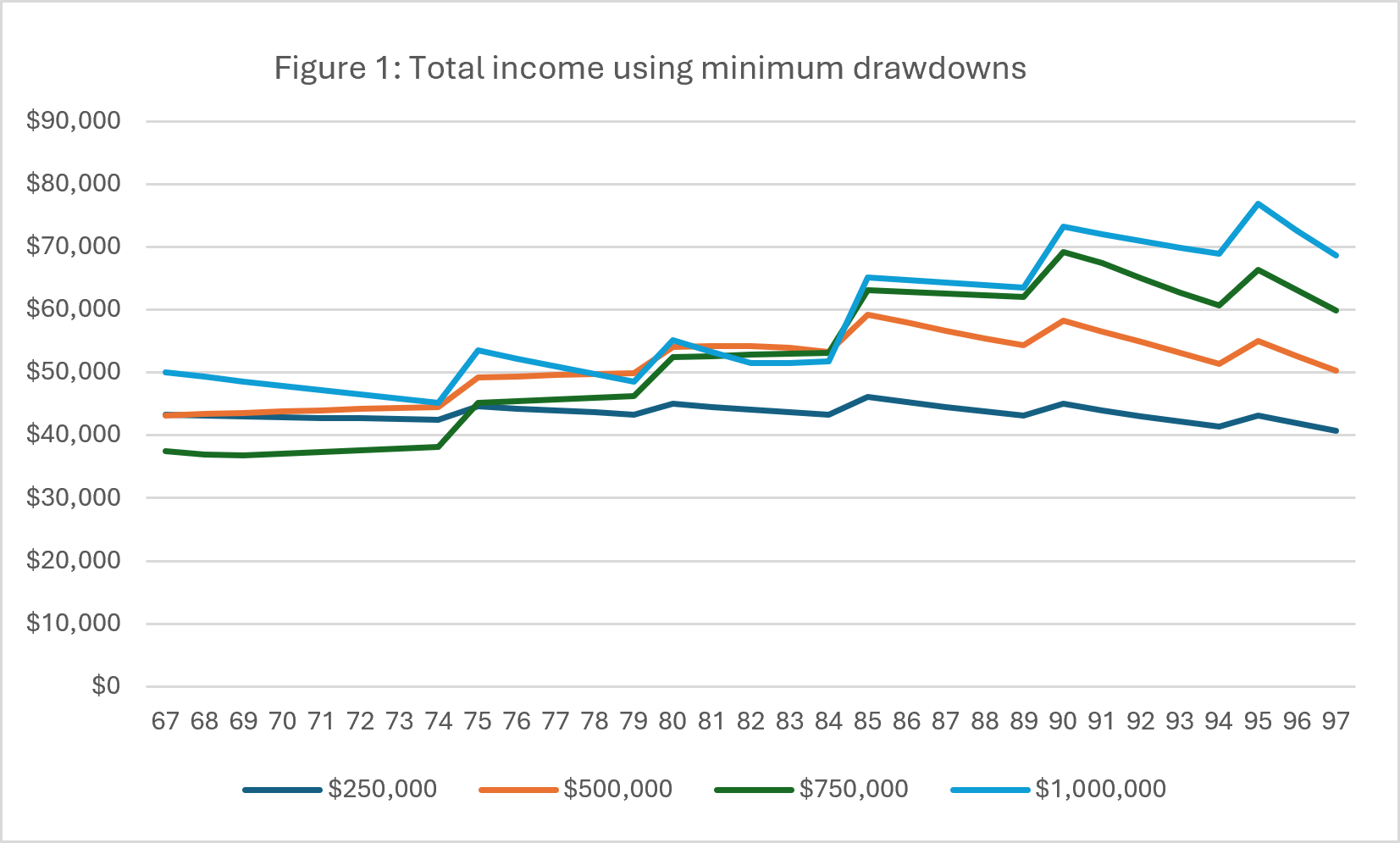
Several interesting features are evident, including:

  • For most retirees, the annual income jumps every five years due to the increase in the minimum drawdown rates. The exception is for the retiree with $250,000 where most of the income is from the Age Pension, which is assumed to be indexed to inflation.
  • For retirees with the higher balances, the total income is not stable throughout their retirement. In fact, there is a general increase in the level of real income, which may be a less desirable outcome, as spending needs are often higher in the earlier years.
  • Because of the means tests on the Age Pension, the retiree with $750,000 begins with a lower income than those with a superannuation balance of $250,000 or $500,000. However, it then increases in real terms as the importance of the Age Pension rises.

The conclusion from these examples is that for many retirees the use of the minimum drawdown rates does not provide them with stable income throughout retirement, contrary to one of the objectives of the Retirement Income Covenant. Of course, minimum drawdown rates were designed as regulatory minimums rather than as optimal spending strategies. Accordingly, there is also no reason to expect them to generate the most stable pattern of income, even though they are often used.

An alternative approach

Instead of using the minimum drawdown rates, let’s commence with the minimum 5% drawdown from the ABP in the first year but then index the drawdowns to inflation each year and only apply the minimum rates, when needed. Figure 2 shows the total income for the four superannuation balances.
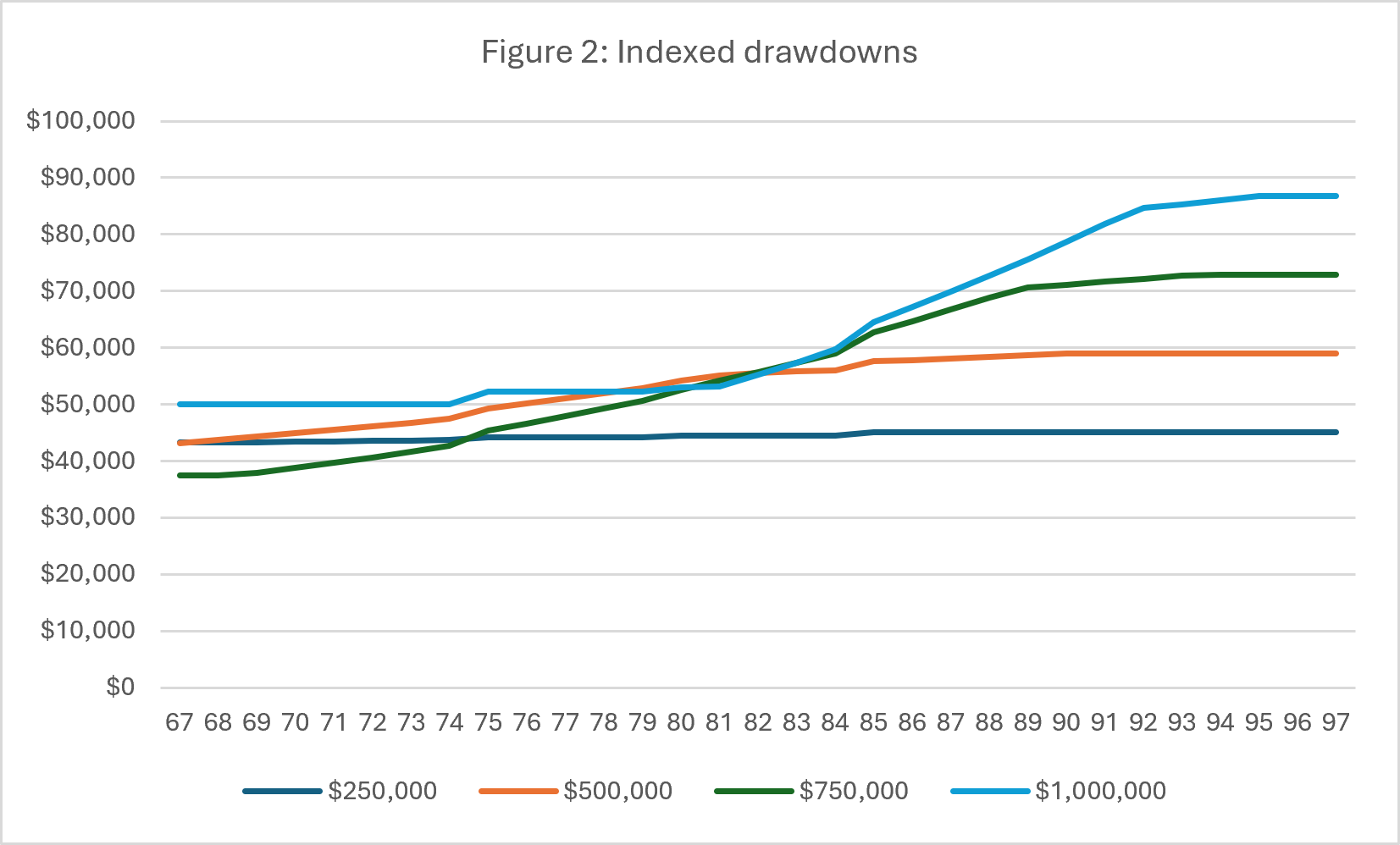
While there are some similarities with Figure 1, there are some important differences. These include:

  • There are very few spikes in income due to the annual indexation of the drawdowns from the ABP.
  • The impact of indexing the drawdown every year, means that the total income has increased from Figure 1. The increase in the average retirement income varies from 2.0% for the lowest balance to 9.0% for the highest balance.

These increases in the level of total income arise from two causes:

  1. a higher level of drawdowns from the ABP; and
  2. increased Age Pension payments for those with the higher balances.

Of course, the higher drawdowns from the ABP means that the value of the ABP at age 97 has decreased from 25.3% to 12.5% of its original balance, when expressed in real terms. There is no ‘correct’ answer for the balance between the level of drawdowns during retirement and the need to maintain access to some capital. Whether this remaining balance is appropriate will depend on individual circumstances. Some retirees will prioritise higher spending during retirement, while others may place greater value on maintaining reserves for aged care, unexpected expenses or gifting. Nevertheless, a remaining balance equal to one-eighth of the original capital after 30 years is consistent with the objective of superannuation.

A composite approach

Although the previous approach removed the spikes, the increase in real income continues through retirement, particularly for those with higher superannuation balances. One possible response is to increase drawdowns in the earlier years of retirement. This provides additional income when spending needs are often highest, while gradually increasing eligibility for Age Pension payments as the retiree’s ABP balance reduces.

There is no single answer to deliver the ‘best’ outcome for every retiree, but to illustrate a composite approach, let us assume that the ABP drawdown in the first year is 6.5% of the balance and is then indexed to inflation for five years. Thereafter, it remains fixed in nominal terms as the relative importance of the Age Pension increases. Figure 3 shows the result for retirees with balances between $500,000, $750,000 and $1,000,000. This composite approach is not applied to the $250,000 balance as the income for this retiree is predominantly from the Age Pension and is therefore relatively level in real terms.
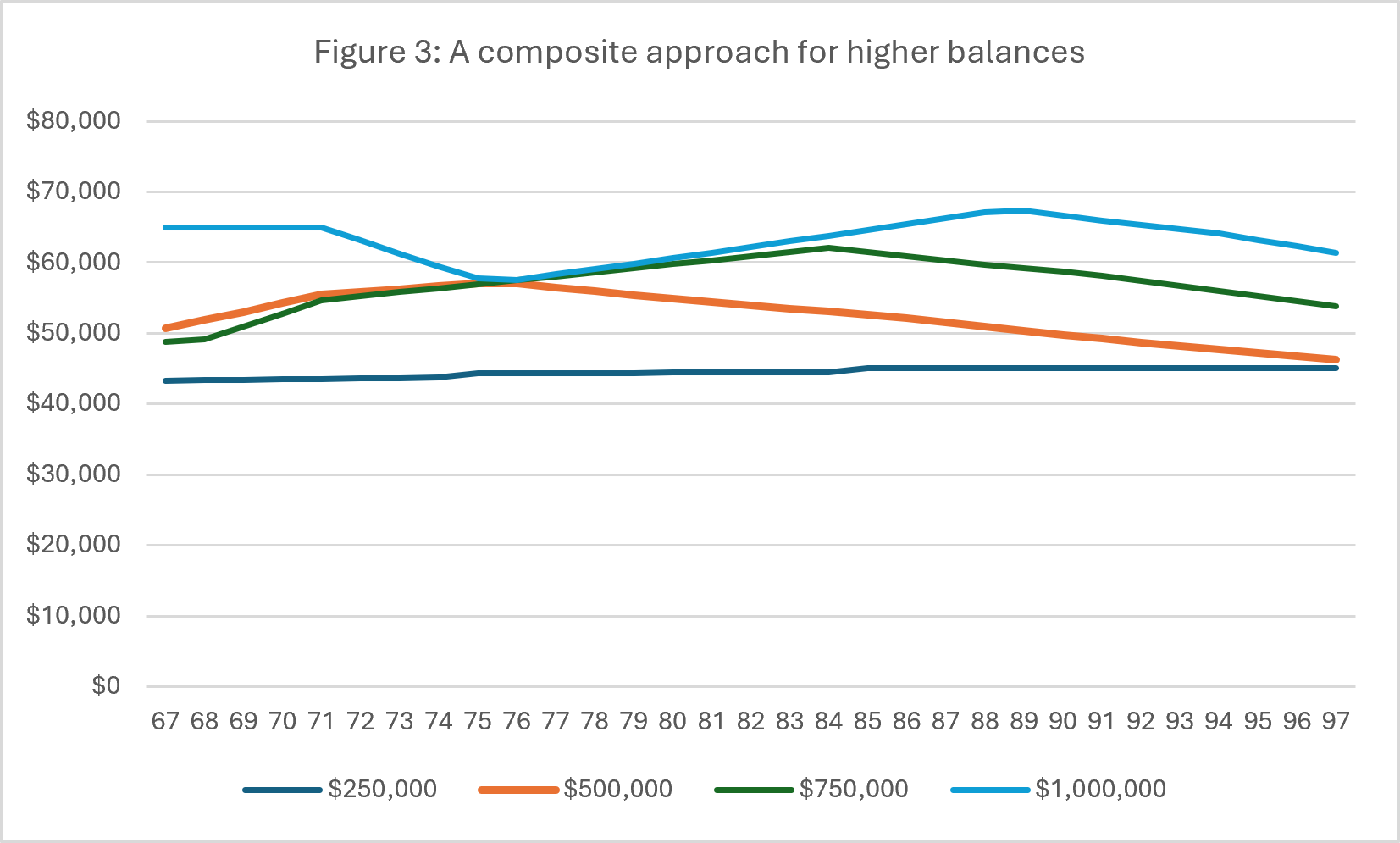
The findings from this composite approach are:

  • The variation in annual income is reduced, particularly for those with higher balances.
  • Income in the earlier years is higher, which is often when retirees are more active and spend more.
  • The average income for the two higher balances has increased due to the greater role of the Age Pension arising from the higher drawdowns in the earlier years.
  • The value of the ABP balance at age 97 is 14.9% of the original balance in real terms, which is slightly higher than in Figure 2.

Conclusion

The Age Pension can play a very significant role in providing stable income for many Australian retirees. For some retirees, particularly those who are likely to qualify for a part Age Pension later in life, spending superannuation a little faster in the early years of retirement may increase average lifetime income while also producing a smoother income profile.

This finding runs counter to much advice from overseas pension experts. The reason is simple. Australia has one of the highest levels of ‘targeted’ pensions, expressed as a percentage of the average wage, amongst OECD economies[4]. Our system is different with no basic or universal pension.

The Age Pension and superannuation are two fundamental sources of retirement income for most Australians. The ‘best’ balance between the two will depend on personal circumstances such as home ownership and the presence of a partner, as well as changing circumstances during retirement.

The purpose of superannuation is to support consumption during retirement, not simply to maintain account balances during retirement. While many retirees understandably wish to preserve capital for flexibility, some may be sacrificing current living standards unnecessarily. The challenge is finding the right balance between spending today and preserving financial security for tomorrow. In that sense, the Age Pension represents an integral component of a sustainable retirement income strategy for many Australians.


David Knox is a global pension expert, actuary, and advisor to a range of leading superannuation funds. He co-authored, with Nick Callil, 'It's time: here's how to turn superannuation into a retirement income system' published by the Actuaries Institute April 2026.


[1] OECD, Pensions at a Glance 2025, Table 8.4. Projections of public expenditure on pensions, 2023-60, percentage of GDP
[2] This represents the assumed earning rate for the pension phase in ASIC’s Moneysmart Superannuation Calculator.
[3] A long-term inflation rate of 3% pa has been assumed.
[4] OECD, Pensions at a Glance 2025, Table 3.2, Current level and recipients of first-tier benefits.


  •   2 September 2026
  • 21
  •      
  •   
21 Comments
Nadal
September 03, 2026

This was similar to the thoughts I had: nowhere in David's analysis was there a comment that these strategies rely on using more of OPM (other people's money ie taxes). From an integrity / respect for others, I would rather fend for myself than dip into the Age Pension without needing to as a safety net.

9
Dudley
September 03, 2026


Your country will do you for taxes and additionally do and your children for their future taxes by borrowing to spend to lure voters siren like.

As that is not enough, your country tapers the Age Pension so that middle capital retirees must burn their capital to have cashflow equal to the capital-less Age Pensioner. Your country's government is too dull witted to imagine that is strong incentive for retirees to dis-save to financially position themselves to become eligible for the Age Pension. A taxable Age Pension of all removes the taper perverse incentive.

10
Dudley
September 03, 2026

I would rather like a pension and my capital to do with as I like, such as Age Care.

For couple homeowners, no debt; avoiding complicated calculations within the Age Pension Assessable Assets Taper from $499,000 to $1,102,500, using your yield and inflation rates with 0% tax:

Age Pension + $499,000 Assessable Assets:
= (26 * 1810.4) + (499000 * ((1 + (1 - 0%) * 6.7%) / (1 + 3%) - 1))
= $64,996 real / y.

No Age Pension + $1,102,500 Assessable Assets:
= (26 * 0) + (1102500 * ((1 + (1 - 0%) * 6.7%) / (1 + 3%) - 1))
= $39,604 real / y.

No Age Pension + $1,809,339 Assessable Assets to produce same cashflow as Age Pension + $499,000 Assessable Assets:
= (26 * 0) + (1809339 * ((1 + (1 - 0%) * 6.7%) / (1 + 3%) - 1))
= $64,996 real / y.

17
Mike
September 22, 2026

Inflation and complex mathematical equations aside, it's easy to make $1,809,339 beat the pension and any other assets left over:

Single person: $1,237.70 per fortnight (including pension and energy supplements) = $32,180.20 p.a.
Couple (each): $933.00 per fortnight.
Couple (combined): $1,866.00 per fortnight ($48,516 p.a.)

Dividend yields of some popular retiree stocks:
ARG = 4.18%
CBA = 3.32%
BHP = 3.97%
VHY = 5.6%

$499,000 into stocks like CBA would give you between $16,566 to $27,944 on top of your pension = between $65,082 to $76,460 at best. But that's where it ends.

Putting the whole lot of $1,809,339 into VHY (or even higher as commercial real estate) would give you just over 101k a year, plus franking credits and capital growth, and is more likely to grow faster than inflation; your aged pension won't !

Dudley
September 22, 2026


From this article:
"Let’s also assume that this retiree invests this benefit into an account-based pension (ABP) which earns a tax-exempt return of 6.7% pa":

The 6.7% return is not guaranteed.

"Dividend yields of some popular retiree stocks":
Adjust nominal (net) dividends by inflation for net real return:
CBA ;
= ((1 + 3.32%) / (1 + 3%) - 1)
= 0.311% / y
Net real amount:
= 499000 * ((1 + 3.32%) / (1 + 3%) - 1)
= $1,550.29 / y
The CBA share price and dividend return are not guaranteed.

"VHY (or even higher as commercial real estate) would give you just over 101k a year":
Also not guaranteed.

Put $1,809,339 on Red/Black, Odd/Even in Roulette and have $3,618,678 (or $0); guaranteed by the Casino.
No adjustment for inflation required as result is instantaneous.

The Age Pension is adjusted for CPI and 41.76% of Wage Male Total Average Weekly Earnings (MTAWE); guaranteed by the Commonwealth.

Allan Gardyne
September 03, 2026

If you're tempted to spend more money early in retirement, remember that you're taking a big gamble on what your future health will be like. In our experience, some elderly people have very complex health problems and when the usual treatments don't fix the pain and don't fix the problems, they pay for extras such as massages, physio and osteo treatments, and try expensive alternative remedies. The expense can be appalling. I've had a bone marrow transplant. My wife has survived two different types of cancer, brain surgery, immunology that nearly killed her, massive intravenous doses of steroids that nearly killed, etc, etc. An accountant's figures based on averages do not allow for this kind of future.
We're fortunate. After working hard and scrimping and saving, we've been self-funded retirees for 12 years now. How about you? If you spend now, are you risking having a future in which you have to decide between eating and having a pain relieving massage? I'm very glad we took the cautious approach, scrimping and saving.

11
Jon Kalkman
September 03, 2026

The problem with account-based pensions is that they are subject to investment volatility, offer no protection against inflation and are designed to expire, usually within one’s life expectancy. That uncertainty engenders extreme caution. Superannuates often feel the need to self-insure against unforeseen circumstances and thus keep substantial funds in reserve, resulting in large bequests to beneficiaries rather than improving their own retirement lifestyle.

Evidence shows that, where retirees have access to a regular income, they can confidently spend more, because they know it will continue in the future. In that context the age pension’s stable and secure income is attractive. It is a gold-plated annuity. But the pension assets test creates a perverse incentive whereby additional assets generates lower pension income.

Commercial annuities in Australia are not popular, because access to capital is lost and returns have historically been low. But an annuity can provide the same regular predictable income as the age pension, indexed to inflation until death. And a larger annuity actually produces more income.

The age pension is now more integrated with annuities. The assets test rules were changed in 2019 so that an annuity is considered an asset under the assets test, but only 60% is counted. After age 85, only 30% is counted. Consider a couple who own their own home, retire at age 67, are eligible for the age pension and have combined super balances of $900,000. Those super assets will reduce their couples age pension from about $ 48,000 to $15,800 per year plus whatever that super can earn. Their income tops out at about $70,000.

If they purchase a lifetime indexed annuity for $400,000, from their super proceeds they then have $740,000 in assessable assets, which is $240,000 from the annuity plus the $500,000 remaining in account-based pensions. As their assessable assets are reduced, their age pension increases to $28,000 per year. Their annuity can be expected to pay about 5.5% or $22,000 per year plus whatever the half million dollars in super can earn. Their income is now over $80,000 per year, of which $50,000 is predictable income from the age pension and the annuity plus another $30,000 of variable income that comes from the account-based pension.

A couple can thus create their own generous pension with guaranteed income indexed to inflation, regardless of market conditions or their life expectancy. It would also reinstate the incentive for people to save more through super to earn higher income and to spend more of their super in their retirement.

Clearly, the government could make annuities much more attractive by reducing the assessable portion of an annuity in the assets test. What if part of the annuity was exempt from the assets test, just like the family home?

8
Graham W
September 04, 2026

Very good points Jon. As an advisor, I regularly used annuities, mainly for the reasons that you outlined. In all cases , a major benefit for most folk is that they are pretty much set and forget, decreasing ongoing management decisions, especially as one ages. I have also used them for clients who had difficult controlling their spending. At least such persons could count on their annuity payments and the Age Penson.
Back around 20 - 30 years ago annuities were 100% asset test exempt, and need to be again.
Due to the Deductible Rules, annuities are very Income Test and Income Tax friendly as the assessed income is reduced by amortising the purchase price by a life expectancy factor.

1
Dudley
September 05, 2026


"Consider a couple who own their own home, retire at age 67, are eligible for the age pension and have combined super balances of $900,000. Those super assets will reduce their couples age pension from about $48,000 to $15,800 per year plus whatever that super can earn. Their income tops out at about $70,000.":

Loss of income due to Age Pension Assets Test, Assets $900,000:
= (26 * (1810.4 - 607.4))
= $31,278.00 real / y.

Real Income from Age Pension, Assets $900,000:
= (26 * 607.4) + (900000 * ((1 + (1 - 0%) * 6.7%) / (1 + 3%) - 1))
= $48,122.50 real / y.

Nominal Income from Age Pension, Assets $900,000:
= (26 * 607.4) + (900000 * ((1 + (1 - 0%) * 6.7%) / (1 + 0%) - 1))
= $76,092.40 nominal / y.

Loss of capital due to inflation:
= (76092.40 - 48122.50)
= $27,969.90 / y.

Total lost income due to Taper plus capital lost due to Inflation:
= (31278.00 + 27969.90)
= $59,247.90 / y.

Lost due to Income Tax where all income is taxable:
= 37.5% * 2 * (37500 - 32774)
= $3,544.50

Best to become comfortably poor; or wealthy in top 5%.

1
Wildcat
September 06, 2026

John, a couple of coal face issues remain. There has been some product evolution but historically the loss to the estate for an early death and not winning the annuity and life lottery of a long life was deeply unattractive. However the annuity providers are really keen to provide examples such as yours. Redo the math if one of them dies. It totally breaks down and the future income of the survivor is cut quite dramatically. Whether this can be impacted by your "the government could make annuities more attractive" comment will also need to be considered. The most important thing in any plan is planning for change, even if you don't know when that will be.

I would posit that unless we get a sustained drawdown, like in the 30's, the security issue will remain a lower priority in superannuants lives, especially with the current aged pension rules.

Remembering also the other strategy is to retain 100% account based pension, shoot for the upside, and use the aged pension as you super put option if things go badly.

OldbutSane
September 06, 2026

Jon, an account based pension is simply a means of transferring superannuation money from one investment structure (superannuation) to another (usually an individual). To say "they run out" is nonsense (they are not really a pension in the true sense of the word), the money simply ceases to be in the superannuation system. If you apply the 4% (or even more if you don't want to preserve capital) spending rule, then the money is unlikely to ever run out.

As for lifetime annuities, from your comments I assume you have plenty in them! I wouldn't, and don't, as they are expensive, have significant risk ie you might die early and are inflexible. Seems to me the only benefit is to the providers.

1
John De Ravin
September 03, 2026

David I fully support all your key messages. Your Figure 1 illustrates the two deficiencies of using the minimum drawdown rates as the rule to determine drawdowns: (a) it’s spiky (legislators could have gotten around that by adopting a scale by individual year of age rather than five- or ten-year bands) and (b) it’s conservative, leading to increasing real required drawdowns at later ages. I think there are understandable reasons why the minima should be conservative; it’s just unfortunate that the mininma have become the default drawdown rates for many retirees.
Your Figure 2 addresses the spikes but still shows significantly increasing drawdowns at later ages. Arguably Figure 3 is the closest to what would be the ideal pattern: consumption as high as possible and with a flat or very slightly declining consumption rate over time.
Hopefully, increasingly over time, trustees will put in place guidance and retirement income products which will help their members maximise utility over their remaining lifespans. And although one or two of the commenters have (very nobly) declined to take the greatest advantage of the government benefits on offer, I see no reason why retirees should feel obliged to forego the benefits that are rightfully available to them. And it totally makes sense to spend a bit more in retirement years if that will entitle retirees to more age pension. That is why, when some actuary colleagues and I wrote a paper suggesting that a less conservative drawdown rule than the minimum statutory rate would be “take the first digit of your age” (5% in your 50s, 6% in your 60s, 7% in your 70s) we added that if you are in the range of assets which is caught by the Assets Test, then add 2% to your drawdown rate.
Thank you for the article and keep up the good work of trying to persuade trustees to offer more guidance and better retirement products!

4
Mike
September 21, 2026

I can't - for the life of me - understand the fixation that people - mostly boomers - have with "I gotta have the aged pension". Maybe it's because (like the rest of us), they paid tax all their lives...

You really DON'T want it. At $32k for a single person or $48k for a couple, it is subsistence wages and just above the poverty line...it was designed this way for a reason, so that you save for your own retirement. What you would have to give up (or not have) in order to qualify for it is a false economy.

Unless you like having no health insurance, basic clothes, no car, low cost leisure activities, less heating in winter and no budget to fix your house, I don't see the appeal.

2
Jack
September 04, 2026

A super pension is really a cash-out process over an extended period. Before 2007 it was directly related to your life expectancy. If you had 20 years left to live the minimum pension was 5%. At 15 years, the minimum was 6.66% and it changed every year. The mandatory pension bands we have now are a simplification of that progression so that the minimum stays unchanged for at least 5 years.

The mandatory withdrawals ensure that you cash out more and more of your super as you age. You are not required to spend it, but you are required to progressively transfer your capital out of tax-advantaged super so that it is then taxed normally. And if there is any super remaining in your account at death, it is subject to compulsory cashing out. As it is a transfer of capital, it is a misnomer to call a super pension an income stream, and the ATO does not recognise it as income because it is not reported on any tax return.

1
JohnC
September 05, 2026

I may be wrong, but it seems to me that the key here is the 6.5% ? If your returns are 8-10%pa this method may not look so flash? Your pension might actually shrink maybe?

1
Independent
September 06, 2026

There have always been cases of people getting bad breaks or events in their lives that prevented them from accumulating sufficient funds to be retirement self sufficient; however, most people did not even bother to save during their working lives. The Age Pension is welfare. There was a time when welfare; like bankruptcy, had a element of shame attached & people did all they could to avoid it. Like some of the other respondents; as a retired adult, I can take care of myself and prefer to leave the Age Pension to those who do not fully fend for themselves and prefer reliance on the cold hand of government .

1
Dudley
September 07, 2026

"I can take care of myself":

So can others, especially where incentives positively reinforce Self-Care, such as saving while working.

In the range of Age Pension Assessable Assets for homeowner couple $499,000 to $1,102,500 the incentive for the Age Pensioner is to reduce Assessable Assets to get larger Age Pension payments.

Disposing excess Assessable Assets or converting them to Home Improvements is then Self-Care for the Age Pensioner.

Positive for the Age Pensioner, negative for the Commonwealth.

1
Dudley
September 03, 2026


"Figure 1 shows the total income in today’s dollars received by the retiree from their ABP and the Age Pension":
Actually the total cash inflow comprised of capital withdrawn from Super Disbursement Accounts and income from Age Pension.

Dudley
September 21, 2026


"the appeal":
Pays better than having $1,809,339 in Age Pension Assessable assets.

Mike
September 22, 2026

Please explain "how" $32,000 a year would ever beat even a conservative 3-4% of $1,809, 339...living purely off the bank interest ? (better returns in high dividend shares or even bank shares themselves, fully franked).


Leave a Comment:

RELATED ARTICLES

$1 million is never worth less than $500,000

5 charts every retiree must see…

Are lifetime income streams the answer or just the easy way out?

banner

Most viewed in recent weeks

Why spending more in early retirement can improve lifetime income

Conventional wisdom encourages retirees to preserve superannuation. But if those likely to qualify for the Age Pension later in life spend a little more today, it may deliver higher lifetime income and a more stable retirement.

Will you run out of money in retirement?

Fear of running out has become a defining retirement anxiety. Why do some retirees die with substantial wealth while others deplete their nest egg? Evidence suggests the answer is more complicated than we think. 

The investment that sidesteps the new tax traps

Tax rules have changed, but many investors are still using yesterday’s strategies. Insurance bonds may offer advantages for those seeking greater control, tax efficiency and certainty about their wealth.

Testamentary trusts have secured the CGT exemption

Treasury’s latest CGT reform draft delivers a win for testamentary trusts and deceased estates, exempting estate-derived gains from the 30% floor. However, questions on death and divorce rollovers remain unresolved.

Meg on SMSFs: What do we think about reversionary pensions these days?

Reversionary pensions have long been a staple of SMSF estate planning, but are they still the best option? Meg Heffron revisits a once-clear favourite and asks whether changing super rules have shifted the balance.

Is it time to bail on Australian stocks?

For generations, Australian investors have backed banks, miners and dividends. But has that loyalty come at a cost? A look at the numbers raises an uncomfortable question about where future returns will come from.

Latest Updates

Planning

Testamentary trusts survived the trust tax. The drafting battle has just begun.

The fight over testamentary trusts looked settled. Then the draft legislation arrived. Hidden in a technical detail is a question that could force many families to rethink wills they thought were already future-proof.

Investment strategies

The new capital gains tax trap for your portfolio

Investors have long accepted one portfolio rule without much question. A major tax shift could change that calculation entirely, forcing difficult trade-offs between risk, discipline and an overlooked cost lurking beneath.

Economy

Population growth masks Australia’s productivity problem

For years, investors have benefited from a seemingly reliable growth story. But recent national accounts raise uncomfortable questions about what has really been driving Australia’s economy and whether that can continue unchecked.

Investment strategies

Why tomorrow’s winners may not be today’s index leaders

The stocks that built retirement balances over the past decade now dominate many portfolios. The new challenge is whether these companies can continue meeting the increasingly high expectations embedded in today's share prices.

Investing

What earnings surprises reveal about future returns

Sometimes the most important information in an earnings result isn't the number itself. It's the possibility that the market's assumptions have been fundamentally wrong and future earnings may look very different.

SMSF strategies

Individual SMSF Trusteeship directly liable for ATO fines

A rarely discussed detail buried in SMSF structures could dramatically change who wears the cost when something goes wrong. With penalties rising, a decision many dismissed as administrative may deserve a second look.

Investment strategies

The currency bet you didn’t know you made

Buying global shares means making two bets: on the companies and on the Australian dollar. Most investors consciously choose only the first. Last financial year, the second bet cost 8.5% in returns for many investors.

Alliances

  • ASA-Logo-RGB-ActiveGreen-web.png

© 2026 Morningstar, Inc. All rights reserved.

Disclaimer
The data, research and opinions provided here are for information purposes; are not an offer to buy or sell a security; and are not warranted to be correct, complete or accurate. Morningstar, its affiliates, and third-party content providers are not responsible for any investment decisions, damages or losses resulting from, or related to, the data and analyses or their use. To the extent any content is general advice, it has been prepared for clients of Morningstar Australasia Pty Ltd (ABN: 95 090 665 544, AFSL: 240892), without reference to your financial objectives, situation or needs. For more information refer to our Financial Services Guide. You should consider the advice in light of these matters and if applicable, the relevant Product Disclosure Statement before making any decision to invest. Past performance does not necessarily indicate a financial product’s future performance. To obtain advice tailored to your situation, contact a professional financial adviser. Articles are current as at date of publication.
This website contains information and opinions provided by third parties. Inclusion of this information does not necessarily represent Morningstar’s positions, strategies or opinions and should not be considered an endorsement by Morningstar.