Register For Our Mailing List

Register to receive our free weekly newsletter including editorials.

Home / 166

Australia’s other boom exports

Australia has some important and resilient industries which have taken up some of the slack in the wind down of the construction-led commodities boom. Record tourist numbers from China, education for international students, strong food exports and a resurgent wine export industry have been sectors which have not only been performing well but have been creating new records. Australia’s economy grew 3.1% year on year to the first quarter of 2016 on the back of a better than expected services sector.

Increasing arrivals to Australia, especially from Asia

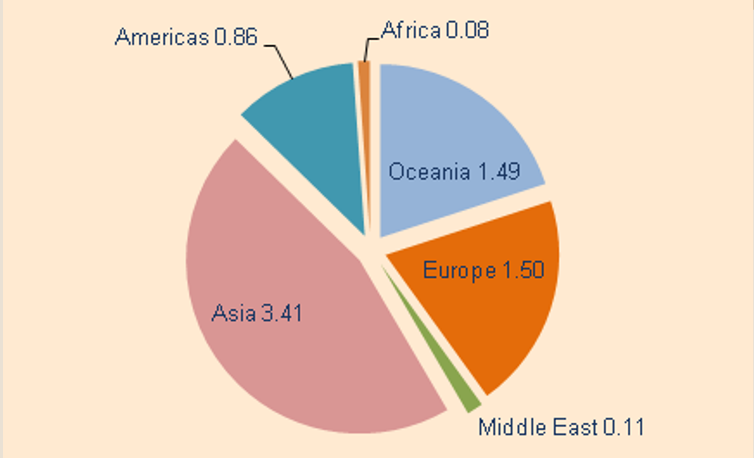
Short-term arrivals from Asia into Australia make up the largest share of any source region. In 2015, as shown in Chart 1, 3.4 million visitors from Asia came to these shores. For the first five months of this year, 3.3 million people have arrived on short-term stays, almost one million more than for the same period five years ago.

Chart 1: Short-term arrivals into Australia in millions, 2015
Source: ABS, Owners Advisory, July 2016

Australia is one of the biggest beneficiaries of the rising consumer in Asia where the region is expected to account for more than two-thirds of the global middle class by 2031. The tourism numbers have boomed from China with 1.4 million short-term arrivals from the mainland and Hong Kong in the past 12 months. This number has now surpassed New Zealand as the country where most short-term arrivals originate.

In addition to tourism, Chinese and Indian students are taking education opportunities in Australia. Education sits behind iron ore and coal as the country’s third largest export. In 2014–15 export income from education was estimated at $18.1 billion. Education is also a pathway to settlement for students who opt to remain in the country as skilled participants.

Food glorious food

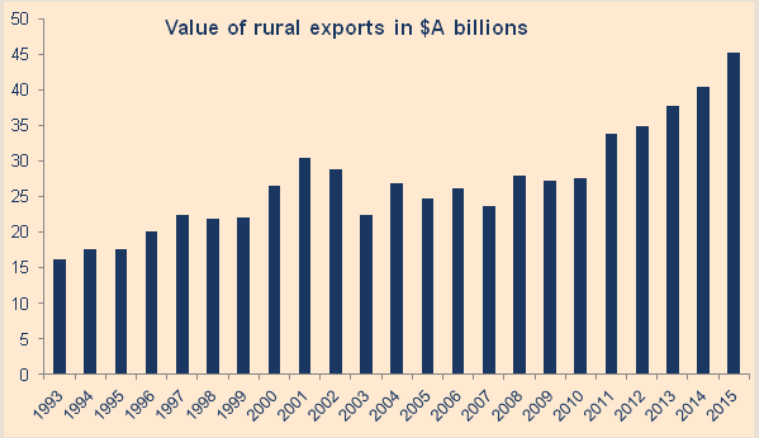
Demand for a bit of ‘Australia’ in the form of food and wine has seen both export classes touch record highs in the past three years. Grain and meat sales have garnered a lot of the attention as Asian consumers change to a more protein-based diet. Agricultural and fisheries exports for the last financial year reached about $46 billion, as shown in Chart 2, or about 25% of Australia’s overall commodity exports of $205 billion.

Chart 2: Australia exported over $45 billion of rural products in 2015
Source: ABS, Owners Advisory, July 2016

Australian wine rises on strong Chinese demand

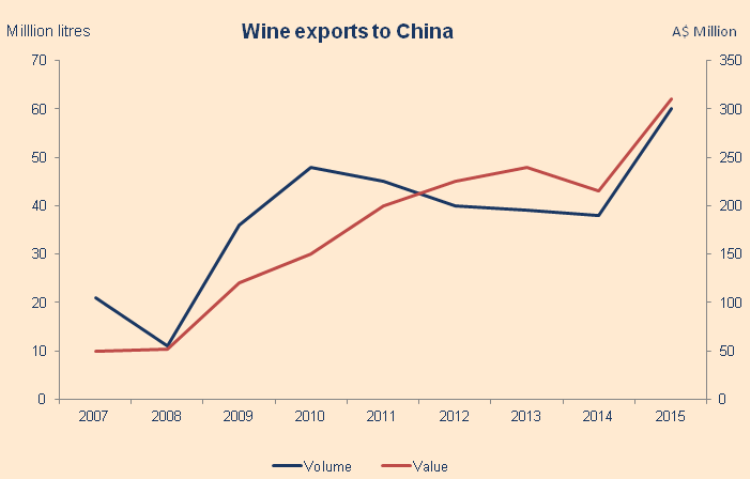
The Australian Bureau of Agricultural Sciences reports that annual wine exports grew over 10% in 2015, and is forecast to generate sales of $2.2 billion in the coming year.

Chart 3: Australian wine to China 
Source: Department of Foreign Affairs and Trade, Owners Advisory, July 2016

Austrade points to the Chinese middle class as the primary driver of interest in Australian wine, which is regarded as a stable, consistent and high-quality product. China is now the second largest export destination for Australian sparkling, red and white wines, taking over from the United Kingdom earlier this year.

Achieving exposure to these export sectors

There are many ways for investors to gain exposure to these sectors. Without going into much detail here, Sydney Airport is one of the main gateways into Australia, and while shares are not cheap, the medium- to long-term returns should persist into the future.

Navitas is a global education provider offering a range of educational services including university programmes, resettlement assistance and language training. Navitas scores well on a number of key metrics of profitability, quality of earning and a management team delivering on its mandate.

Treasury Wines is one of the world’s largest wine companies with brands including Penfolds, Wolfblass and Rosemount, and the outlook for growth of underlying sales and earnings looks strong.


John O’Connell is Chief Investment Officer of Macquarie's Wealth Management group, and Founder of the bank’s roboadvice division, OwnersAdvisory. This article is general information and does not consider the investment needs of any individual.


  •   28 July 2016
  •      
  •   


Leave a Comment:

RELATED ARTICLES

Red wine and our green reputation in China

What export boom?

banner

Most viewed in recent weeks

Australian stocks will crush housing over the next decade, 2025 edition

Two years ago, I wrote an article suggesting that the odds favoured ASX shares easily outperforming residential property over the next decade. Here’s an update on where things stand today.

Australia's retirement system works brilliantly for some - but not all

The superannuation system has succeeded brilliantly at what it was designed to do: accumulate wealth during working lives. The next challenge is meeting members’ diverse needs in retirement. 

Building a lazy ETF portfolio in 2026

What are the best ways to build a simple portfolio from scratch? I’ve addressed this issue before but think it’s worth revisiting given markets and the world have since changed, throwing up new challenges and things to consider.

Get set for a bumpy 2026

At this time last year, I forecast that 2025 would likely be a positive year given strong economic prospects and disinflation. The outlook for this year is less clear cut and here is what investors should do.

Meg on SMSFs: First glimpse of revised Division 296 tax

Treasury has released draft legislation for a new version of the controversial $3 million super tax. It's a significant improvement on the original proposal but there are some stings in the tail.

The 3 biggest residential property myths

I am a professional real estate investor who hears a lot of opinions rather than facts from so-called experts on the topic of property. Here are the largest myths when it comes to Australia’s biggest asset class.

Latest Updates

Investment strategies

Building a lazy ETF portfolio in 2026

What are the best ways to build a simple portfolio from scratch? I’ve addressed this issue before but think it’s worth revisiting given markets and the world have since changed, throwing up new challenges and things to consider.

Investment strategies

21 reasons we’re nearing the end of a secular bull market

Nearly all the indicators an investor would look for suggest that this secular bull market is approaching its end. My models forecast that the US is set for 0% annual returns over the next decade.

Property

13 million spare bedrooms: Rethinking Australia’s housing shortfall

We don’t have a housing shortage; we have housing misallocation. This explores why so many bedrooms go unused, what’s been tried before, and five things to unlock housing capacity – no new building required.

Investment strategies

Market entry – dip your toe or jump in all at once?

Lump sum investing usually wins, but it can hurt if markets fall. Using 50 years of Australian data, we reveal when staging your entry protects you, and when it drags on returns. 

Investment strategies

The US$21 trillion question: is AI an opportunity or excess?

It has been years since the US stock market has been so focused on a single driving theme, and AI is unquestionably that theme. This explores what it means for US and global markets in 2026.

Economy

US energy strategy holds lessons for Australia

The US has elevated energy to a national security priority, tying cheap, reliable power to economic strength, AI leadership, and sovereignty. This analyses the new framework and its implications for Australia.

Strategy

Venezuela’s democratic roots are deeper than Trump knows

Most people know Maduro was a dictator and Venezuela has oil. Few grasp the depth of suffering or the country’s democratic history - essential context as the US ousts Maduro and charts Venezuela’s future. 

Sponsors

Alliances

© 2026 Morningstar, Inc. All rights reserved.

Disclaimer
The data, research and opinions provided here are for information purposes; are not an offer to buy or sell a security; and are not warranted to be correct, complete or accurate. Morningstar, its affiliates, and third-party content providers are not responsible for any investment decisions, damages or losses resulting from, or related to, the data and analyses or their use. To the extent any content is general advice, it has been prepared for clients of Morningstar Australasia Pty Ltd (ABN: 95 090 665 544, AFSL: 240892), without reference to your financial objectives, situation or needs. For more information refer to our Financial Services Guide. You should consider the advice in light of these matters and if applicable, the relevant Product Disclosure Statement before making any decision to invest. Past performance does not necessarily indicate a financial product’s future performance. To obtain advice tailored to your situation, contact a professional financial adviser. Articles are current as at date of publication.
This website contains information and opinions provided by third parties. Inclusion of this information does not necessarily represent Morningstar’s positions, strategies or opinions and should not be considered an endorsement by Morningstar.