Register For Our Mailing List

Register to receive our free weekly newsletter including editorials.

Home / 547

A case study in good business culture versus bad

(Editor's note: as this article went to air, Fletcher Building announced that their CEO and Chair would leave the company this year).

Peter Drucker’s axiom “Culture eats strategy for breakfast” continues to apply, across industries. For investors, if culture is the sophisticated word for execution, market performance has been littered with examples of strong execution dominating market returns.

What Ross McEwan did right

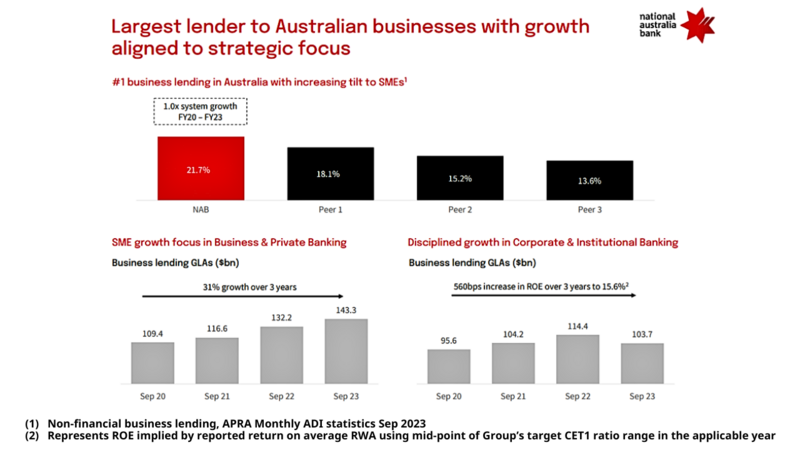
Ross McEwan delivered on culture and strategy for NAB, but if culture is “what we do around here”, McEwan simplified that and made accountability for execution a strong point. Do fewer things but do them well; for example, the number of internal projects being worked on was cut from 467 to 20 when McEwan assumed the role.

As with Boral, and opposed to Fletcher Building, an implicit cultural recognition arose that for any business with the financial resources that arise when profits in the billions are reported, malinvestment is the silent killer. The result was sector leading performance through McEwan’s tenure, with return on equity nudging that of the long-time leader in the sector, CBA. Indeed, whilst NAB’s market performance is about half of CBA’s through the past five years, since McEwan’s arrival and the focus upon simplification the relative performance gap with CBA has converged.

One senior NAB executive recently highlighted to us that much of the base for the work that has been done during recent years was prepared through the past decade with a complete rewiring of the internal transfer pricing mechanisms within NAB, a project led by the then CFO, albeit that data needs to be used judiciously to be turned to commercial advantage, which has been the change in culture seen through the past four years. When asked what the biggest threat was to NAB after his departure, McEwan nominated “losing focus”, trumping AI, government interference, strategic resets and economic cycles.
Boral has turned things around

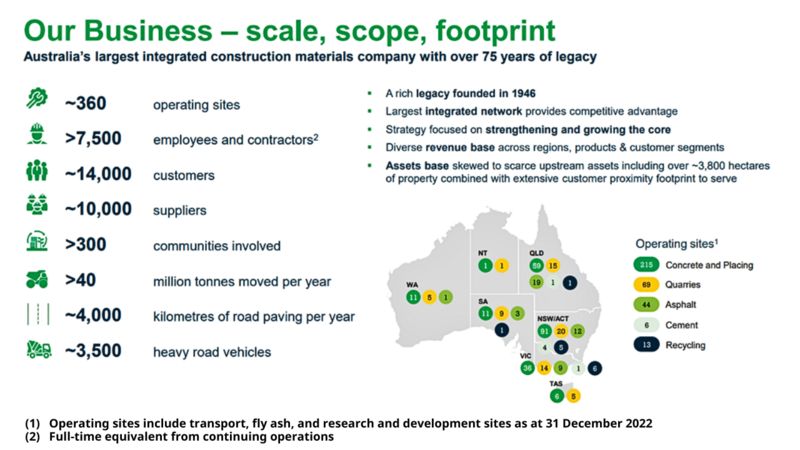
An exemplar of execution through the past year has been Boral. A little more than a year ago, Vik Bansal was appointed as CEO and Managing Director of Boral. In that year, fundamental financial performance changed markedly; revenues up almost 20%, EBITDA up twice that again, and operating cash flow increasing by more than 50%. Repeatedly, internally and externally, 'the Boral Way' is emphasized, speaking to purpose, values, operating model, strategic areas of focus and the pathway to execution. Needless to say, the menu is adopted by many companies, but the focus is often on the former and not the latter elements.

At Boral, since Bansal joined, the focus has been on execution, at a granular level, with the operating model seeing aggressive devolution of authority and responsibility for pricing and volumes, within guardrails, for each of Boral’s 360 operating sites. The CEO spends half of every month in scheduled calls with each of the largest operating sites discussing performance and cashflow performance and requirements. Interestingly, one of the purposes of this is that it is seen as inhibiting malinvestment, especially in grand projects such as ERP systems which are usually expensive, not fit for purpose, do not produce claimed benefits and are soon orphaned vanity projects within the organization which installed them. Mr Bansal claims that managers of operating sites, who will be allocated with the implementation and ongoing costs of such systems, are vocal in opposition to such proposals unless they can see obvious benefit to their asset in terms of the system allowing them to gain market share or charge higher prices.

Indeed, when South32 spun off from BHP, one of the first actions of South32 management was to dismantle the ERP system which had only recently been foisted upon the assets when they were part of BHP, on the basis that the systems were expensive – impeding efficiency – and unduly complicated investment decisions, impeding effectiveness.
Fletcher Building has work to do

In contrast, another materials company we have held is Fletcher Building. Its performance has been as dire as Boral’s has been stellar. It may be a co-incidence that in just about every observable operating model metric, Fletcher Building has been doing the exact opposite to Boral in recent years. A new ERP system is in the process of being installed across a group which straddles construction, home building, distribution, building products (manufacturing plasterboard and insulation) and concrete businesses.

The better New Zealand assets of Fletcher Building in many ways replicate the product and market positions held by Boral and CSR in the Australian market, and yet the operating performance – before we get to write downs – stands in stark contrast. Centralisation has led to a significantly worse outcome than decentralization, a theme we see persistently across industries. Those closest to the customer usually know best where capital should be allocated to meet the needs of those customers. Whilst New Zealand has had some pressures on end market volumes which have affected operating performance, Australia has had the same headwinds and yet Boral and CSR, let alone James Hardie, have used their positions more adroitly to generate value for shareholders. In sum, it’s not just the whiteboard and strategy that matters (they are often very similar across competitors); it’s in the way that you use it that matters for performance and shareholder return.
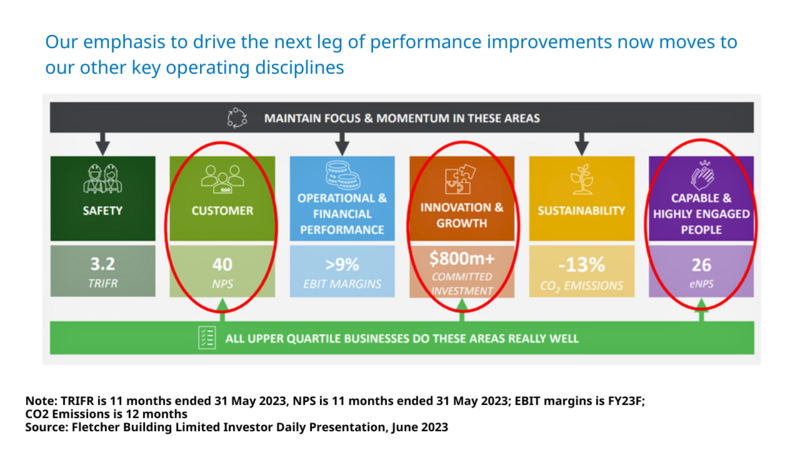
Of course, issues other than just sub peer operating performance have materially impacted upon Fletcher Building in recent years. Unfortunately, most of these wounds are self-inflicted.

In July 2017, Mark Adamson left as CEO of Fletcher Building, after a five-year tenure. Months later, Ralph Norris stood down as Chairman. In each case, the changes reflected losses of circa NZ$660m booked through the prior year. Upon announcing his resignation, Mr. Norris wrote that “… Our shareholders place significant faith in me to act in their best interests and expect accountability from the board for all aspects of the company’s performance”.

After years now of further large write offs, overwhelming those that pre-empted the departure of the prior Chair and CEO, there is now neither accountability at Fletcher Building nor murmurings suggesting the acceptance of accountability. Indeed, just through the past year alone, write offs are at NZ$450m, and significant further risk remains in the book on the company’s own reckoning.

This all comes within two years of Fletcher Building spending NZ$273.5m on a share buyback, completed at an average price per share circa 50% above the current share price. At a current enterprise value less than ten times earnings, the value case for Fletcher Building is clear; albeit a steep discount assuming a continuation of reckless operating and financial performance needs to be maintained so long as the current board and management are in place.

Notwithstanding the current malaise, assuming the current board and management will not endogenously or exogenously change in the face of enduring poor performance is stubborn. And at the time of that change, the Boral and CSR lesson is instructive: privileged assets with long lives, managed well, can readily be afforded a multiple circa two to three times Fletcher Building's. As with many other serial underperformers, it’s time for the company board to lose their religion and try a different choir, even with the same lyrics.


Andrew Fleming is Deputy Head of Australian Equities at Schroders, a sponsor of Firstlinks. This document is issued by Schroder Investment Management Australia Limited (ABN 22 000 443 274, AFSL 226473) (Schroders). This document does not contain and should not be taken as containing any financial product advice or financial product recommendations. It does not take into consideration your objectives, financial situation or needs.

For more articles and papers from Schroders, click here.


  •   14 February 2024
  • 4
  •      
  •   
4 Comments
Steve
February 15, 2024

Gosh so many examples of the issues I saw over my career. ERP was a very expensive one, more than once. Centralisation killed productivity and performance (the world is NOT a cut and paste of the US!). I'm sure I'm not alone. But one has to ask why so many failed leaders repeat the same mistakes? Is it business schools (MBA's?). One of the keys I think is that large organisations become overly bureaucratic so if you allow much more localised control the stifling bureaucracy lessens. The boss of BHP was dictating how many photos you could have on your desk! If the overarching organisation sees its role as there to serve the productive assets and set some broad goals but then gets out of the way, as opposed to having the broader organisation there to serve the head office, things can only get better. The lessons you have shown above are not exactly surprising - less projects, more focus - I ask this every day when I drive and see so many roadworks causing traffic disruption - why not less road projects and finish the ones you are working on faster than 4+ years?? Maybe someone from Main Roads should read this article!

Pete K
February 18, 2024

Steve you must live in the SW of WA! We are at a semi-standstill caused by massive overlapping roadworks. It will be fantastic when they're all finished - probably at about the same time late this year!
I own a small business with 6 staff and frequently deal with very large corporations both as suppliers and customers, and have a saying that: " the larger an organisation gets the harder it is to understand"
Sadly we don't have any dealings with Boral, but this company seems to be an exception to my rule.
I passionately hate ERPs because they seem to me to distance supplier and customer from each other and institutionalise meaningless, unnecessary bureaucracy.
Think I'll stay an SME!
Great article Andrew

Ian
February 19, 2024

Fletcher Building has lagged for the last 40 years - ever since it split from Challenger Group

Vincent Ventura
February 20, 2024

I have never engaged in public comments but the story about “Boral” contrasted with “Fletcher” buildings where a gentleman by the name of Ralph Norris, who I believe was in charge of CBA at the time they acquired Bank West aligned itself with what I have been seeing on people while Ubering around Sydney. So much time has passed. Doing the right thing or otherwise are values. They are culture…perhaps, individual or group or even nation culture that we all acquire as we progress throughout our lives. Thank you for making this article available to me.


Leave a Comment:

RELATED ARTICLES

How to find opportunity in global equities

The next phase of Australian equity leadership

Are franking credits worth pursuing?

banner

Most viewed in recent weeks

Why spending more in early retirement can improve lifetime income

Conventional wisdom encourages retirees to preserve superannuation. But if those likely to qualify for the Age Pension later in life spend a little more today, it may deliver higher lifetime income and a more stable retirement.

It’s time for LICs to die

A high-profile dividend cut and a prominent fund manager’s apology have reignited a long-running debate. If investors can access similar exposures more cheaply and efficiently elsewhere, what exactly is keeping LICs alive?

Testamentary trusts survived the trust tax. The drafting battle has just begun.

The fight over testamentary trusts looked settled. Then the draft legislation arrived. Hidden in a technical detail is a question that could force many families to rethink wills they thought were already future-proof.

Is it time to bail on Australian stocks?

For generations, Australian investors have backed banks, miners and dividends. But has that loyalty come at a cost? A look at the numbers raises an uncomfortable question about where future returns will come from.

The new capital gains tax trap for your portfolio

Investors have long accepted one portfolio rule without much question. A major tax shift could change that calculation entirely, forcing difficult trade-offs between risk, discipline and an overlooked cost lurking beneath.

The investing rule that explains the next market crash

What if investment success depends less on picking the right assets and more on understanding the decisions of other investors? A principle borrowed from game theory offers a different perspective on markets.

Latest Updates

Fixed interest

Higher yields are creating opportunities in global bonds

Bond markets are adjusting to a new reality, but not in the ways investors expect. With markets repricing and capital competing for attention, investors may need to rethink where resilience and opportunity lie. 

Economy

Are we in a recession?

What if the warning signs are already everywhere? From supermarket aisles to company failures, investors are being bombarded with recession signals. But most face a different risk that can be just as dangerous for portfolios. 

SMSF strategies

Meg on SMSFs - Division 296 actuarial certificates

The tax bill might be yours, but the event that caused it may not be. A key Division 296 calculation can sometimes attribute earnings in ways that many SMSF trustees won't instinctively expect or fully appreciate.

Property

The first impact of negative gearing reform is not the tax bill

Negative gearing changes formally begin in 2027, but the first consequences may already be here. A subtle shift is quietly influencing who can borrow, how much they can access and which property strategies still stack up.

Economy

The oil market is running out of easy answers

The biggest threat to markets may not be what investors are watching. The numbers have stopped adding up and supply is harder to measure, with forecasts becoming simple guesses. A more fragile reality is being masked.

Investment strategies

The state of investor knowledge in Australia

Australians are investing more than ever, yet a surprising divide is emerging between those building wealth effectively and those making costly mistakes. Surprisingly, the gap has little to do with income, age or starting capital.

Taxation

Complexity and capital gains

A case study shows that the ‘30% minimum CGT’ is a poorly conceived tax that adds significant complexity to an already over-complex system. A less complicated model would create a much fairer progressive tax scale.

Sponsors

Alliances

  • ASA-Logo-RGB-ActiveGreen-web.png

© 2026 Morningstar, Inc. All rights reserved.

Disclaimer
The data, research and opinions provided here are for information purposes; are not an offer to buy or sell a security; and are not warranted to be correct, complete or accurate. Morningstar, its affiliates, and third-party content providers are not responsible for any investment decisions, damages or losses resulting from, or related to, the data and analyses or their use. To the extent any content is general advice, it has been prepared for clients of Morningstar Australasia Pty Ltd (ABN: 95 090 665 544, AFSL: 240892), without reference to your financial objectives, situation or needs. For more information refer to our Financial Services Guide. You should consider the advice in light of these matters and if applicable, the relevant Product Disclosure Statement before making any decision to invest. Past performance does not necessarily indicate a financial product’s future performance. To obtain advice tailored to your situation, contact a professional financial adviser. Articles are current as at date of publication.
This website contains information and opinions provided by third parties. Inclusion of this information does not necessarily represent Morningstar’s positions, strategies or opinions and should not be considered an endorsement by Morningstar.