Register For Our Mailing List

Register to receive our free weekly newsletter including editorials.

Home / 193

History repeats on housing, but how long will this last?

In 2011, the Reserve Bank of Australia set out to create a policy-induced housing construction boom to fill the hole being left by the collapse of the 2003-2011 mining construction boom. It cut interest rates 12 times between November 2011 and August 2016 to levels never before seen in Australia, to lift house prices and lower borrowing costs to encourage development.

House prices are important for Australian investors for several reasons. The local economy and stock market are heavily reliant on the local banks remaining solvent and lending. Our big banks make up one third of the local stock market value and they pay one half of all dividends.

The vulnerability of banks

The problem with the banks has four main elements:


  1. they are extremely highly leveraged (at around 20:1, for every $1 of debt there is 5 cents of equity capital)


  1. they are highly exposed to the local housing and housing construction industries


  1. they are heavily reliant for funding on fickle foreign markets, as Australia’s conduits for foreign debt, and


  1. mortgage interest rates are extraordinarily low and rising rates will put pressure on highly geared borrowers.


The pattern of mining booms switching to housing construction and lending booms that collapse in bank bad debt crashes and economic recessions is not new. The 1870s-80s mining boom (which gave birth to BHP, Rio and many others) turned into the 1880s housing construction and lending boom which collapsed in the bank bad debt crash in the early 1890s, triggering a deep economic depression. The 1960s mining boom turned into the early 1970s housing construction and lending boom which collapsed in the property finance crash in 1973-1974, triggering the deep 1974-1976 recession. The early 1980s ‘mini-resources boom’ expanded into the mid-1980s ‘entrepreneurial boom’ which after the 1987 crash turned into the late 1980s construction and lending boom which collapsed in the bank bad debt crisis in the ’recession we had to have’ in 1990-1991.

Problems looming in apartments but not houses

In each of these cycles, Melbourne saw the worst of the excesses in construction and lending and suffered worst in the crashes, in terms of price falls, vacancies, bad debts, business failures and unemployment. In the current cycle Melbourne is once again leading the charge (along with Brisbane), while the excesses are less severe in Sydney and other cities.

The main problem is not in the broader suburban housing market but in high-rise construction. As in all previous cycles, the current over-construction will result in high vacancy rates, boarded up building sites, properties lying empty for years, falling rents, falling prices, bankrupt developers and bankrupt over-extended buyers. As in past cycles the problem for the banks will mainly be property developers, not just the highly-leveraged buyers.

This has happened several times before and it will happen again. The risk for investors is that the collapse in the high-rise market will probably also infect the broader economy and the broader housing market as well.

Our broad housing market has not suffered big crashes as it has in most other countries. Our high rates of immigration and population growth and extreme concentration of population in a few large diversified cities ensure broad house prices have tended to rise rapidly for a few years every decade or so, and then go sideways in real terms for several years.
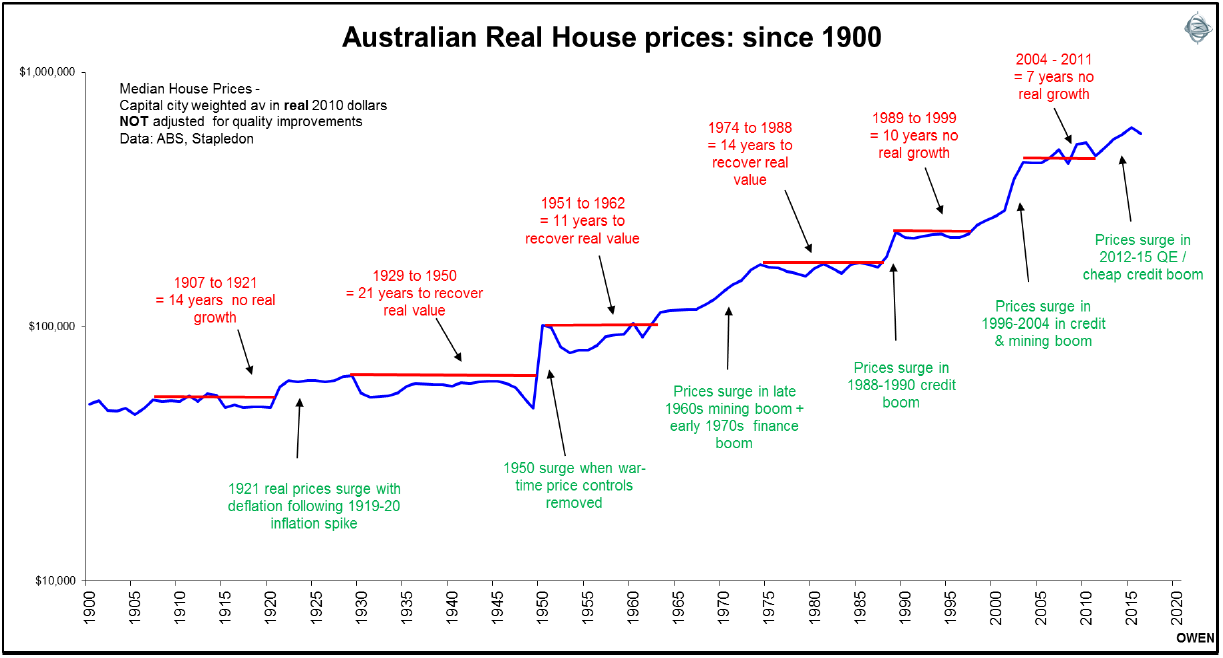
There are regular price falls of 10% to 15% or so but no major broad-based collapses like in the US and many other countries. We easily forget that as recently as the seven years from 2004 to 2011, there was no real growth in house prices following a surge from 1996 to 2004. We have had five periods since 1900 when real house prices have not risen for a decade or more.

While the Melbourne and Brisbane high-rise markets are probably heading for another sizable collapse similar to past boom-bust cycles, the most likely outlook for the broad housing market is for modest price falls in housing and then many years of no real growth, rather than a sudden major crash.


Ashley Owen is Chief Investment Officer at independent advisory firm Stanford Brown and The Lunar Group. He is also a Director of Third Link Investment Managers, a fund that supports Australian charities. This article is general information that does not consider the circumstances of any individual.

  •   9 March 2017
  • 8
  •      
  •   
8 Comments
Andrew
March 09, 2017

Would love to see this chart with a non log axis - suspect this will show the dramatic increase since the 1990s

Warren Bird
March 09, 2017

But the whole point of using log axes is to show that something recent that seems dramatic actually isn't. It shows every episode in percentage change terms, which is the valid comparison.

Any cumulative time series will look as if the most recent period was the most 'dramatic' if you don't use a log scale.

I'm totally with Ashley on his use of log charts.

Fergus Hardingham
March 09, 2017

RE: "While the Melbourne and Brisbane high-rise markets are probably heading for another sizable collapse similar to past boom-bust cycles, the most likely outlook for the broad housing market is for modest price falls in housing and then many years of no real growth, rather than a sudden major crash."

PRE- GFC home owners in the US (and other countries) did not also believe that their property markets would decline as they did.

How can anyone be so sure that Australia (which is building everywhere - including in regional centres houses and apartments at the bottom of the rate cycle) will not suffer the same fate.

Suggest that caution is warranted.

Billy
March 09, 2017

The situation we are in with historically high debts puts us closer to 1929-1930 instead of any other time.

ashley
March 09, 2017

Just confirming my story was mainly about free standing housing ie where most of the value is in land. I would never, and have never bought air ie units. That is where the main problem is, and where most of the losses will be in this cycle. Its all a question of supply and demand. The supply of air space far exceeds demand so prices will fall when stupid bankers wake up and stop lending.
cheers
ashley

Sam
March 10, 2017

Thanks for the chart guys. I've posted this on my twitter feed, Oz we'll have one hell of a bust when this is over and will present amazing buying opportunities! @niremas, twitter.

Sam
March 10, 2017

It's not necessarily about supply and demand, a lot of demand is driven by property spruikers, property investment businesses such as mezzanine debt structures (investment schemes) and of course banking credit via mortgages. And alot of SMSF funds are investing in these!

Irish were spruiking population growth as well and their housing values are still down about 40% from the peak. Its mostly credit driven. @niremas, twitter.

Anyways, amazing article and historical perspective, thanks for this info.

mc
March 11, 2017

Units are best not thought of as "air", but as a tiny parcels of land. If a 100 sqm area of land has one dwelling on it, then that dwelling has 100 sqm of land. If it has ten dwellings stacked on top of each other on it, then each dwelling has 10 sqm of land. When land in a location has a very high value, it is justified to put lots of dwellings on it.

This said, any exceptionally valuable location has the danger of becoming less exceptional. Ordinary locations rarely become exceptionally devalued. Unit prices collapse relatively often compared to non-units because the land under them tends to have been ascribed a much higher value than than surrounding areas.


Leave a Comment:

RELATED ARTICLES

Clime time: What's left unsaid in Australia's housing bubble

Financial pathways to buying a home require planning

Valuations still stretched in Australia’s housing market

banner

Most viewed in recent weeks

Testamentary trusts post-budget: Estate planning, tax reform and the ‘death tax’ debate

Proposed Budget changes to taxation are casting new uncertainty over testamentary trusts, prompting closer scrutiny of estate planning structures and the real implications of reforms still taking shape.

High quality businesses are on sale

Beneath the dominance of the ASX's largest stocks, much of the market has been left behind. High-quality companies are now trading at levels rarely seen, offering opportunities for investors willing to look deeper.

Meg on SMSFs: The CGT changes don’t impact super but what about Div 296 tax decisions?

New CGT rules could tip the scales in the super vs non-super debate. For those facing the Division 296 tax, the case for withdrawing has gotten more complex. A "comparison rate" tool may help assess decisions.

The strange effect of the 30% minimum capital gains tax

The 30% minimum tax on capital gains sits at the heart of the budget's proposed reforms. Yet the mechanics reveal anomalies that introduce unexpected distortions that raise questions about its design.

Welcome to Firstlinks Edition 667 with weekend update

The downfall of the giant and three lessons for investors.

  • 18 June 2026

Ranking three common retirement strategies

The defining challenge of retirement isn't just about building wealth, it's about converting your lifetime savings into sustainable income. A holistic understanding of different strategies can improve long-term outcomes.

Latest Updates

Planning

Does your will qualify for the discretionary testamentary trust exemption?

Treasury has confirmed the exemption many families were hoping for. But buried in the fine print are two conditions that could leave some wills on the wrong side of the exemption, despite years of careful planning.

Lithium's latest drop and what it means for ASX investors

Lithium's latest sell-off has punished ASX miners as prices remain hostage to shifting expectations. The key challenge is navigating a market prone to extreme volatility despite a strong case for the long-term demand outlook.

Investment strategies

CGT reform and fund turnover: who really feels the impact?

The implications of CGT reform are far and wide. As the 50% discount gives way to inflation indexation, turnover and return profiles may become critical drivers of after-tax performance. Some strategies face a far greater hit.

Superannuation

Super was built for a very different Australia

Our retirement system was built around assumptions that no longer hold. Lower homeownership, longer lifespans and changing expectations are exposing cracks that policymakers and super funds need to address.

Retirement

Retirement in reality - 4 months in

Many people spend years planning financially for retirement but little time preparing for what comes next. Four months in, here are the surprising lessons I've learnt on finding purpose, social connection and healthy habits.

Investment strategies

After the Budget, Australia needs its own definition of quality

As tax reforms reshape investment incentives, investors should rethink what quality investing means in the uniquely concentrated Australian market, where traditional frameworks may not translate as effectively.

Datacenters are the new shale oil

Why are tech giants pouring billions into datacentres when the economics look questionable? The most dangerous words in investing may be: "everyone else is doing it". Today's AI boom has striking parallels with the shale bust.

Sponsors

Alliances

© 2026 Morningstar, Inc. All rights reserved.

Disclaimer
The data, research and opinions provided here are for information purposes; are not an offer to buy or sell a security; and are not warranted to be correct, complete or accurate. Morningstar, its affiliates, and third-party content providers are not responsible for any investment decisions, damages or losses resulting from, or related to, the data and analyses or their use. To the extent any content is general advice, it has been prepared for clients of Morningstar Australasia Pty Ltd (ABN: 95 090 665 544, AFSL: 240892), without reference to your financial objectives, situation or needs. For more information refer to our Financial Services Guide. You should consider the advice in light of these matters and if applicable, the relevant Product Disclosure Statement before making any decision to invest. Past performance does not necessarily indicate a financial product’s future performance. To obtain advice tailored to your situation, contact a professional financial adviser. Articles are current as at date of publication.
This website contains information and opinions provided by third parties. Inclusion of this information does not necessarily represent Morningstar’s positions, strategies or opinions and should not be considered an endorsement by Morningstar.