Register For Our Mailing List

Register to receive our free weekly newsletter including editorials.

Home / 76

Confusion with financial planner brands

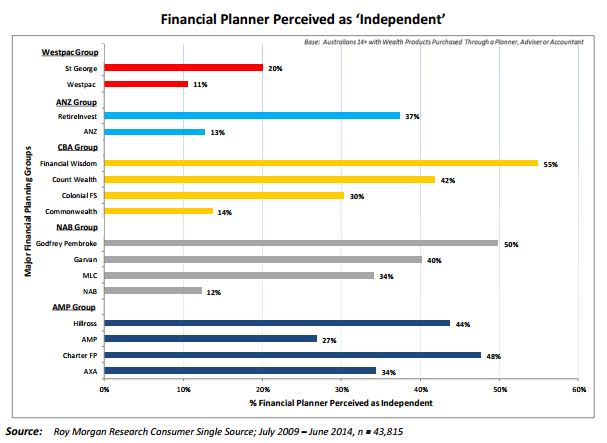
The branding of financial planners is causing confusion among consumers, according to a recent report released by Roy Morgan Research.

The depth of consumers’ confusion is highlighted by the sobering statistic that 14% of consumers visiting a Commonwealth Bank branded financial planner believe they are getting independent advice. Consumers’ confusion increases when they visit a financial planner operating under a different brand compared to that of the umbrella financial institution; 55% of consumers visiting the Commonwealth Bank owned Financial Wisdom perceived it to be independent.
However the problem of independence is not just one of flawed consumer perceptions. Customers of both independent and vertically integrated financial planners have suffered avoidable financial losses after taking poor conflicted advice.

Sean Graham, Principal of Assured Support and previously Head of Advice and Advocacy at Millennium3, said, “The tendency of vertical integration means that advisors have a list of 100 products or more on their approved product list, but when you drill down they maybe only really recommending eight aligned products.”

But there are many examples of business models where conflicts of interest are successfully managed, including newspapers and auditors. And as part of the financial advice giving process, consumers are given a financial services guide which explains where the advisor and the licensee sit as part of the group.

So should consumers be mollycoddled?

In reality, the marketing material in financial planning practices, which the consumer is far more likely to actually read, seldom highlights any ownership relationship or the implications of that relationship. And the ownership relationship can create a fundamental conflict of interest regardless of what remuneration practices are adopted.

Mr Graham said, “Even if you strip out conflicted remuneration by financial institution-owned financial planners, they are still going to be more likely to recommend their own products, because they want to keep their job. If you went into a Toyota showroom, what is the chance they are going to recommend a Ford?”


Les Goldmann has over 20 years experience as a Chartered Accountant. His other roles have included journalism, working as the policy and research manager for the Australian Shareholders Association and senior positions in the commercial and non profit sectors.


  •   18 August 2014
  •      
  •   


Leave a Comment:

banner

Most viewed in recent weeks

Building a lazy ETF portfolio in 2026

What are the best ways to build a simple portfolio from scratch? I’ve addressed this issue before but think it’s worth revisiting given markets and the world have since changed, throwing up new challenges and things to consider.

Ray Dalio on 2025’s real story, Trump, and what’s next

The renowned investor says 2025’s real story wasn’t AI or US stocks but the shift away from American assets and a collapse in the value of money. And he outlines how to best position portfolios for what’s ahead.

13 million spare bedrooms: Rethinking Australia’s housing shortfall

We don’t have a housing shortage; we have housing misallocation. This explores why so many bedrooms go unused, what’s been tried before, and five things to unlock housing capacity – no new building required.

21 reasons we’re nearing the end of a secular bull market

Nearly all the indicators an investor would look for suggest that this secular bull market is approaching its end. My models forecast that the US is set for 0% annual returns over the next decade.

Making sense of record high markets as the world catches fire

The post-World War Two economic system is unravelling, leading to huge shifts in currency, bond and commodity markets, yet stocks seem oblivious to the chaos. This looks to history as a guide for what’s next.

3 ways to fix Australia’s affordability crisis

Our cost-of-living pressures go beyond the RBA: surging house prices, excessive migration, and expanding government programs, including the NDIS, are fuelling inflation, demanding bold, structural solutions.

Latest Updates

Property

How cutting the CGT discount could help rebalance housing market

A more rational taxation system that supports home ownership but discourages asset speculation could provide greater financial support to first home buyers.

Investment strategies

The Ozempic moment for SaaS

Every investing cycle has its Ozempic moment, a narrative shock so compelling that the market briefly forgets that incumbents can and do adapt to transformative technology like AI.

Superannuation

Meg on SMSFs: Last word on Div 296 for a while

The best way to deal with the incoming Division 296 tax on superannuation is likely doing nothing. Earnings will be taxed regardless of where the money sits, so here are some important considerations.

Investment strategies

If people talk about a bubble, it’s unlikely to crash soon

It is almost impossible to identify a bubble in real time, and history shows they last far longer than we think, giving investors (perhaps misplaced) hope and short-sellers seemingly endless pain before the share price collapses.

Investment strategies

Seismic shifts that could drive private markets

Dealmaking appears to be on the mend, but investors could be well served to look through near-term trends toward six major themes that we think may drive private markets for years to come.

Latest from Morningstar

Corporations are winning the stock market. Here’s a new plan for everyone else

Retail investors have the worst trading record, according to a study of trading performance. Institutional investors weren't at the top either. Here are 6 ways to improve your odds.

Infrastructure

The bull case for Melbourne

A counterpoint to today’s prevailing narrative that Melbourne is the capital of a failing state defined by its strained public finances, COVID hangover and an opposition obsessed with undermining its own credibility.

Sponsors

Alliances

© 2026 Morningstar, Inc. All rights reserved.

Disclaimer
The data, research and opinions provided here are for information purposes; are not an offer to buy or sell a security; and are not warranted to be correct, complete or accurate. Morningstar, its affiliates, and third-party content providers are not responsible for any investment decisions, damages or losses resulting from, or related to, the data and analyses or their use. To the extent any content is general advice, it has been prepared for clients of Morningstar Australasia Pty Ltd (ABN: 95 090 665 544, AFSL: 240892), without reference to your financial objectives, situation or needs. For more information refer to our Financial Services Guide. You should consider the advice in light of these matters and if applicable, the relevant Product Disclosure Statement before making any decision to invest. Past performance does not necessarily indicate a financial product’s future performance. To obtain advice tailored to your situation, contact a professional financial adviser. Articles are current as at date of publication.
This website contains information and opinions provided by third parties. Inclusion of this information does not necessarily represent Morningstar’s positions, strategies or opinions and should not be considered an endorsement by Morningstar.