Register For Our Mailing List

Register to receive our free weekly newsletter including editorials.

Home / 432

Is your SMSF ready for SuperStream?

From 1 October 2021 rollovers to and from SMSFs can only be processed via SuperStream.

Overview

SuperStream is the electronic system used to transfer money and data to super funds and is used to process employer contributions to APRA-regulated funds and for rollovers between super funds. It can also be used for certain ATO release authorities.

The move to include SMSFs in SuperStream rollovers has been welcomed by many SMSF fund members who have experienced delays in receiving rollovers to SMSFs. The SuperStream protocols require paying funds to process the rollover of a member’s benefit electronically and within three days of receiving a valid request.

Many SMSFs have mature members who are not anticipating receiving any further rollovers so they have paid little attention to the SuperStream requirements. However, if members decide to wind up their SMSF and rollover to a retail fund, they will generally need to register for SuperStream before the SMSF can process the rollover. SuperStream, however, can be activated at any time and can be expected to be established within days.

In-specie rollovers are not covered by SuperStream and may continue to experience delays. Members may also initiate a rollover via their MyGov account or by requesting the rollover from the paying fund.

ASIC’s requirement for an SMSF’s investment strategy to consider an exit strategy may require SMSF trustees to consider SuperStream as part of their next regular investment strategy review.

What is required for an SMSF to be SuperStream ready?

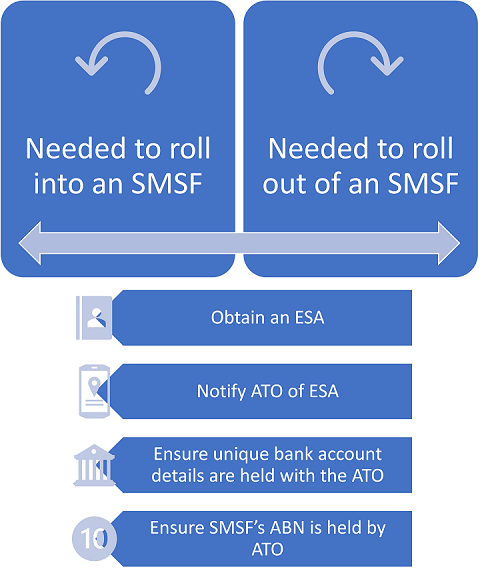
Most professional administrators are SuperStream ready, and many have been using SuperStream to process rollovers for some time. Where an SMSF doesn’t use professional administration services they will need the following:

  • An electronic service address (ESA) which is provided by most SMSF software platforms, administrators, tax agents and some third-party suppliers. The ATO provide a list of ESA suppliers on their website - ATO ESA providers
  • A unique bank account recorded with the ATO
  • A Unique Superannuation Identifier (USI) which is the fund’s Australian Business Number (ABN)

Verifying member details

The fund that is paying a rollover is also required to use the ATO’s electronic services to verify the SMSF and member details. Details include that:

  • the SMSF status is complying or regulated
  • the TFN of the member requesting the rollover is associated with the SMSF
  • the SMSF bank details are held by the ATO
  • the SMSF’s ESA is held by the ATO

The process should reduce delays in verifying the bone fides of the receiving SMSF - if the ATO is happy, the paying fund should be happy!

The ATO has been active in identifying SMSFs where the fund is not recorded as holding a unique bank account. If an SMSF changes bank account details, the fund will need to advise the ATO of the updated account details.

Processing a rollover

The paying fund has three days from receiving an actionable rollover request to process the payment. If the rollover request has incomplete information, the trustee of the paying fund must request the required information within three days. Additional time may be allowed if the paying fund needs to sell down assets.

Whilst the prompt receipt of rollovers into SMSFs is welcomed, there may be many practical reasons why an SMSF is not able to action a request to rollover to another fund within the three-day timeframe. In the absence of professional administration, it is not always possible to accurately calculate a member’s entitlement within three days. In addition, the sale of assets to make the cash payment may take longer than the time allowed.

Where one member is leaving because of a dispute with another member, further difficulties in meeting the required timeframes may occur.

Another requirement of the SuperStream system is that the trustee of the receiving fund must allocate the rollover to the member’s account within three days of receipt of the funds. For SMSFs without professional administration, a minute regarding the allocation may be required.

Conclusion

SMSFs expecting to receive member benefits rolled over from another fund will need to ensure they are registered for SuperStream prior to the member requesting the rollover. Likewise, registration will be required before an SMSF trustee can rollover a member benefit to another fund.


Julie Steed is Senior Technical Services Manager a Australian Executor Trustees. This article is in the nature of general information and does not consider the circumstances of any individual.


  •   3 November 2021
  •      
  •   


Leave a Comment:

RELATED ARTICLES

Meg on SMSFs: Where are the risks in our major super sectors?

A guide to valuing SMSF assets correctly

Does a declaration of trust satisfy SMSF separation of asset regulations?

banner

Most viewed in recent weeks

Building a lazy ETF portfolio in 2026

What are the best ways to build a simple portfolio from scratch? I’ve addressed this issue before but think it’s worth revisiting given markets and the world have since changed, throwing up new challenges and things to consider.

Get set for a bumpy 2026

At this time last year, I forecast that 2025 would likely be a positive year given strong economic prospects and disinflation. The outlook for this year is less clear cut and here is what investors should do.

Meg on SMSFs: First glimpse of revised Division 296 tax

Treasury has released draft legislation for a new version of the controversial $3 million super tax. It's a significant improvement on the original proposal but there are some stings in the tail.

Ray Dalio on 2025’s real story, Trump, and what’s next

The renowned investor says 2025’s real story wasn’t AI or US stocks but the shift away from American assets and a collapse in the value of money. And he outlines how to best position portfolios for what’s ahead.

10 fearless forecasts for 2026

The predictions include dividends will outstrip growth as a source of Australian equity returns, US market performance will be underwhelming, while US government bonds will beat gold.

13 million spare bedrooms: Rethinking Australia’s housing shortfall

We don’t have a housing shortage; we have housing misallocation. This explores why so many bedrooms go unused, what’s been tried before, and five things to unlock housing capacity – no new building required.

Latest Updates

Economy

Making sense of record high markets as the world catches fire

The post-World War Two economic system is unravelling, leading to huge shifts in currency, bond and commodity markets, yet stocks seem oblivious to the chaos. This looks to history as a guide for what’s next.

Australia’s generous housing subsidies face mounting political risk

Canada’s leader Mark Carney has spoken of a rupture in the rules based system that has governed the world since 1945. That rupture means nations like Australia will need to boost defence spending and find savings elsewhere.

Shares

Finding yield on the ASX

With ASX dividend yields now below government bond yields, investors face an upside-down market where income is scarce, growth is muted, and careful selection of bond-like stocks has never mattered more.

Investment strategies

Digging for value among ASX miners

ASX miners are back in favour after playing second fiddle to banks for years. Is it too late to get in? Here are some thoughts on the large caps such as BHP and Rio, and the hot gold mining sector.

Gold

Gold: Is it time to be greedy or fearful?

Most commentary on gold's recent record highs focus on it being the product of fear or speculative momentum. That's ignoring the deeper structural drivers at play. 

Investment strategies

Asia in 2026: Riding AI, reform and a shifting global order

Tariff turmoil tested Asia, but AI leadership, policy easing and reform momentum are restoring investor confidence and strengthening the region’s outlook for 2026. 

Investment strategies

Investors beware: Bull markets don’t last forever

New research explains why high valuations, low dividends and bullish sentiment rarely coexist with strong long-term returns after extended bull markets. 

Sponsors

Alliances

© 2026 Morningstar, Inc. All rights reserved.

Disclaimer
The data, research and opinions provided here are for information purposes; are not an offer to buy or sell a security; and are not warranted to be correct, complete or accurate. Morningstar, its affiliates, and third-party content providers are not responsible for any investment decisions, damages or losses resulting from, or related to, the data and analyses or their use. To the extent any content is general advice, it has been prepared for clients of Morningstar Australasia Pty Ltd (ABN: 95 090 665 544, AFSL: 240892), without reference to your financial objectives, situation or needs. For more information refer to our Financial Services Guide. You should consider the advice in light of these matters and if applicable, the relevant Product Disclosure Statement before making any decision to invest. Past performance does not necessarily indicate a financial product’s future performance. To obtain advice tailored to your situation, contact a professional financial adviser. Articles are current as at date of publication.
This website contains information and opinions provided by third parties. Inclusion of this information does not necessarily represent Morningstar’s positions, strategies or opinions and should not be considered an endorsement by Morningstar.