Register For Our Mailing List

Register to receive our free weekly newsletter including editorials.

Home / 644

Meg on SMSFs: First glimpse of revised Division 296 tax

Shortly before Christmas, Treasury released draft legislation for a new version of the controversial Division 296 tax – the additional tax for those with more than $3 million in super. The new version does represent a significant improvement on the original proposal in that it no longer includes taxing unrealised capital gains. But there are definitely some stings in the tail.

Key points

If implemented exactly as outlined in the draft legislation, the new tax:

  • is due to start from 1 July 2026 (ie, the first financial year would be 2026/27) rather than 1 July 2025,
  • would be a brand-new tax levied on individuals (although it can be paid from super) – in addition to all normal super taxes which will remain exactly the same,
  • will be charged as an extra 15% tax on the proportion of super ‘earnings’ (more on this later) that relates to an individual’s super balance over $3 million. However (the first sting in the tail), there would be a further extra tax of 10% on the proportion of super earnings relating to the proportion over $10 million. This means some people will pay an extra 25% (15% + 10%) tax on some of their super earnings. The Government talks about ‘headline rates’ of tax on those with large super balances being up to 30% and 40% respectively – this is simply adding the normal super fund tax rate of up to 15% to the new tax rates above,
  • unlike the old proposal (which involved taxing unrealised capital gains), uses normal tax principles to calculate ‘earnings’ for Division 296 tax purposes. It even incorporates some special protections to allow SMSFs with capital gains built up before 30 June 2026 to avoid paying Division 296 tax on these gains when the assets are eventually sold, and
  • calculation will have some similarities to the previous draft bill in that it will be:
    A percentage x earnings x a tax rate
    but (a second sting in the tail), the percentage will be worked out differently and the new method is designed specifically to stop people avoiding the tax by taking a lot of money out of super during the year.

A simple example

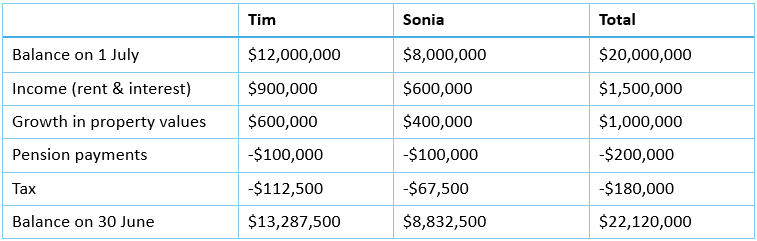
Tim and Sonia have an SMSF worth $20 million at the start of the year (1 July). Tim has $12 million and Sonia has $8 million. During the financial year, their super fund received income (rent on various properties and interest) of $1.5 million, and the properties grew in value by $1 million (but no properties were sold – no capital gains were realised during that financial year). Let’s say they drew pensions of $100,000 each ($200,000 in total). Their super fund would pay income tax in the usual way – let’s say that was around $180,000. For now, we’ll just ignore any expenses the fund might have paid to keep the calculations simple.

During the year, their super fund would have grown by $2.12 million (ie, $1.5 million in rent and interest plus $1 million in growth less pension payments and taxes of $380,000 combined).

Let’s say Tim and Sonia’s balances are $13,287,500 and $8,832,500 respectively at the end of the year as shown below:
We then work out their Division 296 tax in 4 steps:

Step 1: Add up the whole super fund’s ‘Div 296 earnings’.

This is $1.5 million (rent and interest). Notice how the “growth” amount is completely ignored? (Under the old version of Division 296 tax, it would have been included in each member’s earnings and the total amount would have been reduced by their share of the fund’s tax bill of $180,000).

Step 2: Divide the fund’s ‘Div 296 earnings’ between the two of them.

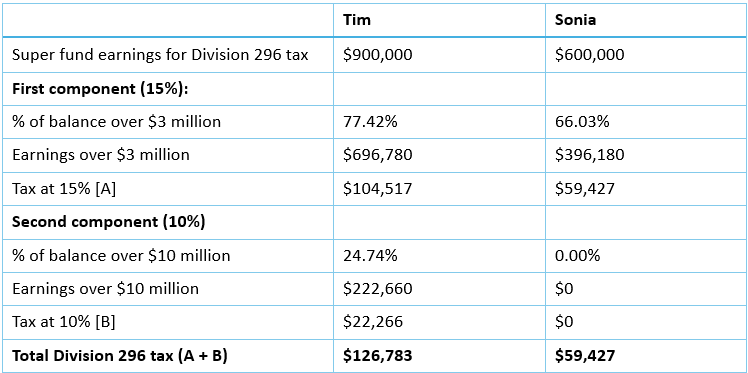
The details of how this will be done are yet to come – we need to see some more regulations. But based on what we do know, it’s likely the split would be 60% to Tim (on the basis that he has around 60% of the fund) and 40% to Sonia. This means the $1.5 million divided between them would be $0.9 million and $0.6 million respectively.

Step 3: Work out the % of their super balances over $3 million and $10 million.

Under the old version of Division 296 tax, this would have been worked out using their end of year balances only. The new version will be based on the higher of their balances at the start and end of the year (with a special concession in the first year – 2026/27 – more on this below).

In other words, for Tim we’d work out this % based on the higher of $12,000,000 and $13,287,500. Like many people, Tim’s super balance has grown during the year so the right number for him will be $13,287,500.

Of this, 77.42% is over $3 million (ie, his balance is over $3 million by $10,287,500 and this represents 77.42% of his total balance). In addition, 24.74% of his balance is over $10 million. The equivalent figures for Sonia are shown below.

Step 4: Apply the two tax rates to these proportions of the earnings amount.
There are some interesting features of this tax that will change some of the planning strategies we might have adopted under the old method.

A different approach for the percentage

As mentioned above, when working out the proportion of super over a threshold ($3 million or $10 million), the new draft bases this on the higher of the member’s super balance at the start and end of the year. Previously it only depended on the balance at the end of the year.

This is a big issue for those hoping to realise gains in a particular year and then withdraw a lot of their super before the end of the year to avoid Division 296 tax. The Government was presumably on to this one!

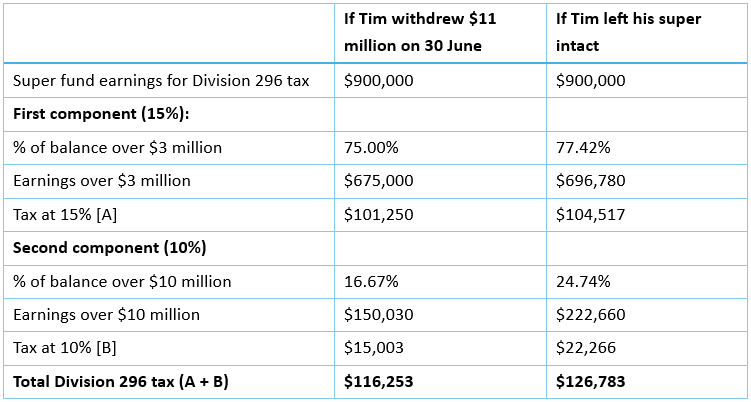
For example, what if Tim had withdrawn $11 million of his super right at the end of the year (bringing his balance down to $2,287,500)? Under the original proposal, this would have been enough to avoid Division 296 tax altogether. His super ‘earnings’ might still be very high but the percentage subject to the tax would have been 0%.

Under the new method, the super balance used to work out how much of Tim’s super fund earnings is over $3 million and $10 million would be based on the higher of two balances: his balance at the start of the year ($12 million) and end of the year ($2,287,500).

The big withdrawal would change his Division 296 tax a little bit but not much:
There is a special transitional rule in 2026-27 – the percentage will be based on the member’s super balance on 30 June 2027 only.

That means people seriously intending to extract a lot of superannuation because they have no intention of ever paying this tax realistically have until 30 June 2027 to do so. If Tim’s big withdrawal (above) had occurred in 2026/27, for example, he would have been able to avoid Division 296 tax entirely.

Capital gains

So far we’ve ignored the possibility that Tim and Sonia’s SMSF might sell one of its properties during the year.

If it did so, the fund would realise some capital gains. Normally these would be taxed and now that we’re going back to ‘normal tax principles’ for Division 296 tax, they’ll be caught in the tax net too.

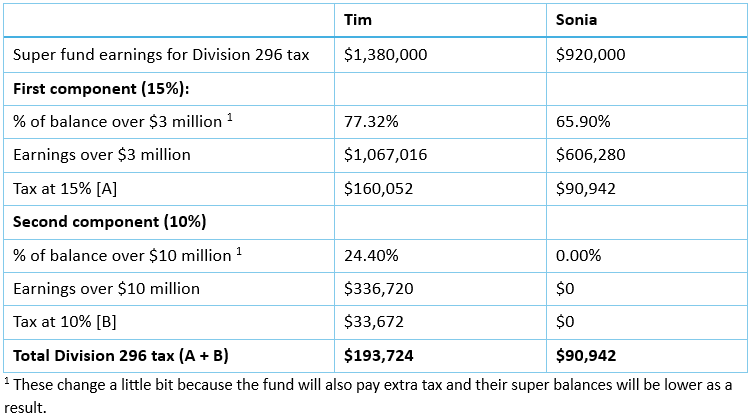
For example, let’s imagine everything is exactly as before but this time, Tim and Sonia’s SMSF sold a property. The property was purchased for $1.8 million in 2027 and sold for $3 million in 2030, making a capital gain of $1.2 million. This would trigger an extra tax bill in the super fund (so their end of year balances would be a little lower) but it would also mean the ‘earnings’ used to work out their Division 296 tax would include some of this capital gain.

Super funds only pay tax on two-thirds of their capital gains if they’ve owned the asset for more than 12 months but even so, the ‘earnings’ for Division 296 tax would increase from $1.5 million to $2.3 million ($1.5 million plus $0.8 million i.e. two-thirds of $1.2 million).

This changes the figures a lot:

Note – if Tim and Sonia’s SMSF had capital losses carried forward from previous asset sales, these can be used to reduce the normal tax paid by the fund. The same applies to Division 296 tax. For example, the ‘earnings’ amount shown above was $2.3 million between them because it included $0.8 million (two-thirds of the $1.2 million capital gain). If the super fund had $0.3 million in losses carried forward from previous asset sales, only $0.6 million would be included in earnings (two-thirds of $0.9 million).

There is a special concession that allows Tim and Sonia to shield existing growth from this tax.

Importantly, if Tim and Sonia’s SMSF already owns the property on 30 June 2026, any growth built up before that date can be protected.

For example, if they bought it in 2020 rather than 2027 and on 30 June 2026 it was already worth $2.5 million there would be an extra step.

While the fund would still pay the normal amounts of capital gains tax (i.e., based on the whole capital gain of $1.2 million), the earnings used for Division 296 tax would be less. The capital gain taken into account for Division 296 tax would only be $333,333 (ie, two-thirds of the gain that built up after 30 June 2026, being $500,000).

A critical point here – that special treatment isn’t automatic. Funds wanting to take advantage of it will need to opt in using an ‘approved form’.

The requirement to opt in is an important one because it comes with a deadline: the due date of the SMSF’s 2026/27 annual return. Funds that – for example – lodge their return late will miss out. Similarly, funds that just lodge their return without specifically opting in will miss out (we don’t know exactly what the opt in process will look like yet).

Note that any SMSF can opt in – even one with no members who have more than $3 million in super at 30 June 2026. It might still be attractive to do so if any of the members expect to be over $3 million in the future and the fund has already accrued large gains.

The ‘opt in’ happens at a fund level rather than a member or asset level. In other words, funds are either ‘in or out’ of the relief, they don’t get to choose to opt in for some assets but not others (eg assets that are currently in a loss position). It also – curiously – means members who join that same fund in the future will benefit from the opt in if pre-July 2026 assets are eventually sold while they are a member.

A new challenge for the future

The special protection for capital gains built up before 30 June 2026 will be useful in the near term but eventually most SMSFs will be selling assets they bought after this tax started.

The way in which the percentage is calculated (taking into account both the start and end of year super balances) creates all sorts of headaches in different circumstances.

Example: Jane and Kris both had $15 million in super at the start of the year (1 July 2030). They were fortunate in that one of their SMSF’s investments exploded in value during 2030/31, significantly increasing their super (it’s May 2031 and looking more like $25 million each). They would like to de-risk and sell the asset but they can see Division 296 tax will be a major issue for them. They need to make some decisions quickly.

They could hang on to the investment for now and accept that when they eventually sell it in a few years, their ‘Div 296 earnings’ will include a very large capital gain AND the percentage of this amount which is subject to tax will be based on a really high balance (likely to be $25 million at least). Even if they make a large withdrawal from super in the same year they sell the asset, this might not lower their tax percentage very much since we’ll now look back at their start of year balance as well.

Or they could sell it ‘now’ (May 2031) and immediately withdraw the money from super. That way at least the Division 296 tax percentages would be based on $15 million (ie, their super before it increased dramatically).

Or they could hope that in the future they will have other assets they can sell first (at much lower gains) to get their overall super lower at a time when their ‘earnings’ are still low. This will require careful management!

Different CGT relief for large funds

Large funds will adjust the fund’s actual realised capital gains for the first four years only (2026/27 – 2029/30) – presumably on the basis that mostly assets are turned over during this timeframe (whereas many SMSFs tend to be ‘buy and hold’ investors). We’ll need the regulations to see exactly how this will work.

Splitting the fund’s Division 296 earnings between members

Once the fund has calculated its ‘earnings’ overall, it will need to split that global amount between members since Division 296 tax is a personal tax calculated at the individual level.

For an SMSF, the precise method will be set out in Regulations (yet to be released) but additional guidance issued by Treasury indicates the regulations will involve relying on a special actuarial certificate. This makes sense in that the style of calculation required is similar to the calculations used for actuarial certificates already in place for many pension funds.

Of course, not all SMSFs with members impacted by Division 296 tax are in pension phase – so some accumulation funds will find they need an actuarial certificate for this purpose for the first time. Hopefully this will be administered in a practical way so that it is not necessary for every single fund to obtain an actuarial certificate ‘just in case’.

Interestingly, Treasury has specifically highlighted that SMSFs holding specific asset pools for specific members will be required to use the same method as all other funds – effectively ignoring any specific asset allocations.

Large funds (ie other than SMSFs, small APRA funds) will again use a different approach. They will be required to allocate the Division 296 earnings amount in a “fair and reasonable” way between members.

What if ‘earnings’ are negative?

Unfortunately, there’s no refund for Division 296 tax under these circumstances – there’s just none payable for the current year.

This might happen if, for example, the fund has expenses that are much higher than its assessable income. While these could be carried forward and used to reduce both fund taxes and Division 296 tax in the future, there’s no immediate refund to the member.

What’s next?

The consultation period for this Bill is short – it ends on 16 January 2026. The Government is obviously keen to get the legislation tabled and passed quickly. They have included some improvements to the Low-Income Superannuation Tax Offset (LISTO) in the same Bill – presumably in the hope this will encourage other parties to support it.

It’s difficult to see where significant changes might be made – so I think we can expect to see this introduced as law if the Government can navigate the politics.


Meg Heffron is the Managing Director of Heffron SMSF Solutions, a sponsor of Firstlinks. This is general information only and it does not constitute any recommendation or advice. It does not consider any personal circumstances and is based on an understanding of relevant rules and legislation at the time of writing.

For more articles and papers from Heffron, please click here.


  •   7 January 2026
  • 29
  •      
  •   
29 Comments
Mal
January 08, 2026

Agreed that it is a tax on wealth, that is, wealth that is being disguised as superannuation. The funds with huge balances don't meet the original intention for superannuation. The difficult issue is to determine what is an unreasonable superannuation balance?

6
Rob
January 08, 2026

Meg - you have been all over this since Day 1 where most others are only just catching up so thank you. I would make three points:

1. This is not a "Tax on Super" it is a "Wealth Tax" that "uses" TSB to see if you are caught ie deemed Wealthy!
2. You say "...no longer includes taxing unrealised capital gains...." but it still does, at least partially. TSB includes unrealized gains - as TSB grows, so does the "proportion" over $3m or $10m and therefore the tax impost.
3. The key variable now is Income which, in a SMSF, you at least have some control as to when Gains are realised or deferred. A portfolio focussed on Capital Growth worth a thought

At the end of the day, it is a question of paying tax due under 296 or pulling out "excess" funds and paying tax elsewhere, or upgrading principal place of residence, or kids, or grandkids etc

7
Meg Heffron
January 08, 2026

Thanks Rob - and your point (2) is particularly valid, I'd not really thought of that. I can definitely see some unintended (or maybe intended) consequences here. For example, imagine someone normally had a super balance of around $3m but a crazy set of circumstances meant one asset jumped enormously (taking their balance up to $5m) and then dropped again. If 30 June 2028 happened in the middle, their brief moment at $5m would penalise them in both 2027/28 and 2028/29. At least - IMO - this is better than the previous draft!

Rob
January 08, 2026

Meg - personal view, it is "intended" and intentionally blurred from view! Headlines - "296 no longer taxes unrealised gains, we have listened..." Everyone breathes a sigh of relief...But!

As long as TSB controls the formula, unrealised gains are captured in the calculation. The impact is certainly less than "296 Version 1" but it is not Zero. If for example income including realised gains was $250k in year 1 and exactly the same in Years 2 and 3, But TSB grew by 20% in each year due to unrealised gains, the "proportion >$3m" pops as does the tax.

The task for anyone impacted and I am, is to model a range of scenarios, compare them with other tax structures and, if necessary, take action prior to 30/6/27.

Kerrod
January 08, 2026

Meg this is excellent analysis and as Rob has stated, you have been on top of all of this since the start - thank you.

In relation to Capital Gains, if the fund sold an asset during the year and realised a gain, am I correct in interpreting this to mean that the fund will still be assessed for CGT under the current CGT laws applying to a fund PLUS the tax assessed under Div 296 and that both amounts are payable?

4
James
January 08, 2026

Thanks Meg - an excellent article.
One question if I may. Above you say: super earnings relating to the proportion over $10 million. This means some people will pay an extra 25% (15% + 10%) tax on some of their super earnings.
In your example above the income relating to the proportion over $10M is $222,660 which you have taxed at 10% = $22,266 tax to pay. Shouldn't the $222,660 be taxed at 25% - therefore tax payable would be $55,665 (an extra $33,399 in tax payable) ? Unless I have misunderstood your calculations ? Thank you.

Maurie
January 08, 2026

"A portfolio focussed on Capital Growth worth a thought"

That can become a bit problematic when you are in pension mode and required to discharge the minimum pension requirement every year.

Steve
January 08, 2026

James, I think you will find that the $222,660 has already been included in the first component (i.e. amounts > $3m) and accordingly taxed at the rate applicable to that threshold (15%)

Meg Heffron
January 08, 2026

Hi James - that tricked me at first too! But actually if you think about it, that $222,660 is ALSO included in the $696,780 (the amount over $3m). So it's already been caught at 15% in part [A] above, we only need to add on 10% for part [B] to get to the total of 25%. Does that make sense?

Meg Heffron
January 08, 2026

Kerrod - thanks for your kind words, although I have to admit ... I do get paid to nerd out on this tax and it's ilk.
In terms of your question on capital gains : yes tax will be paid twice on that gain. Once by the fund (15% on the discounted amount) and another time by Division 296 tax to the extent that the members of the fund are impacted by that tax. So if only one member was impacted and they had 70% of the fund, the likely outcome would be their Division 296 tax would be based on only 70% of that discounted gain. As to exactly how much Division 296 tax they'd pay, it would depend on the size of their balance. If the relevant balance was $4m it would be:
15% (the tax rate) x 25% (the proportion over $3m) x earnings
If we're looking at just this particular capital gain, earnings = 70% (their share) x the discounted capital gain.
The reason I'm laying out all the numbers is that as you can see if the gain is $150,000 (or $100,000 after discounting), the super fund might pay 15% on the full $100,000 but the Div 296 tax will be much less.

Jon Kalkman
January 08, 2026

To date, super funds pay all the tax on fund earnings at the fund level, because the super fund owns the assets that earns the taxable income. Each member’s share of that tax is never calculated, This new tax is a personal tax based on an individual’s share of the super fund’s earnings where their personal balance is over $3 million. In an industry fund where there are thousands of members, joining and leaving on a daily basis, with multiple investment options in the fund that members can also change on a daily basis, it is impossible to calculate a person’s share of the fund’s income and capital gains.

That’s why the first iteration of this tax was based on unrealised gains - to appease industry funds. The only way an industry fund could work out a member’s tax obligation was to simply look at the increase in the member’s super balance over time based on the growth in unit prices (which automatically includes unrealised gains). But for SMSFs, including unrealised gains meant a tax on income that hadn’t yet arrived and relied on a professional opinion about the market value of an asset that hadn’t yet been sold. It was a tax based on “an opinion”.

In response to the political flak, the new tax will now only include realised gains and that makes life much simpler for SMSFs to work out each member’s share of the fund’s tax obligation. This new tax doesn’t apply until the asset is actually sold and that maybe never. But for industry funds, the problem of calculating each member’s share of the fund’s income and realised gains, remains. The draft legislation says that these funds will do that calculation in a “fair and reasonable manner”, but offers no clue as how that will work. Clearly, this new tax will be a tax on “a best guess”.

Div 296 is not a tax on super funds - it’s an individual tax liability - but it’s a tax based on the growth in assets that I do not own! I do not own the assets in my super fund held in a trust on my behalf. So how can the member be held responsible for the tax on these assets. This absurd situation only arises because the government is determined to make one taxpayer, the member, responsible for the tax obligations of another taxpayer, the super fund.

4
HandyAndy
January 08, 2026

Thanks for this update. It all seems ridiculously complicated, as it has from when it was first announced.

3
Peter
January 08, 2026

If they are both in pension phase, why would the fund pay tax of $180,000 in "the usual way"? Shouldn't that be no tax at all?

2
Old super hand
January 08, 2026

In regard to both the question from Harry and the question from Peter, due to the Transfer Balance Cap not all of the assets of the (hypothetical) fund are in tax free pension phase. It is also the reason the fund is paying normal superannuation tax on part of the investment income.

Peter
January 08, 2026

Oh, thanks for that clarification. Maybe it should have been postscripted to the tabulation.

1
Rob
January 08, 2026

That is where people get confused and why u should consider this as a " wealth tax", not a Super Tax. Your tax liability in Pens Mode or Acc mode, simply does not change. 296 has nothing to do with Super per se other than using your Super balance to determine whether you are in or out.

The "problem" is that all the commentary seems to assume you are in Accum Mode and the start point is already 15%. There will be people in Pens Mode where the start point is Zero and the 296 liability will be much less..

Pradeep Agrawal
January 08, 2026

There is no excepted income for calculating Div 296 earnings. Hence 296 liabilities will be same whether the members are in Acc or Pens mode in any combination.

Ian
January 08, 2026

Meg, thank you for the detailed update.
Are you able to comment on the planned treatment of defined benefit pensions. How will they be assessed as a contribution to an individual's total super assets?

2
Meg Heffron
January 08, 2026

That would be a whole other article Ian and there are some important regulations I wouldn't mind seeing first.

David
January 08, 2026

Meg. Are you also able to please comment on the mechanism for indexation of the thresholds as this does not seem to be covered but was one of the highlighted issues with the original proposals.
Overall, this is an overly complicated mess that wastes more resources on accounting and super fund fees. I thought Jim Chalmers had a goal to fix productivity and overly onerous legislation in Australia!

1
Meg Heffron
January 08, 2026

Yes David - both the $3m and $10m thresholds are indexed in line with inflation and in fixed increments ($150,000 for the $3m threshold and $500,000 for the $10m threshold). That means once we've had enough inflation to take $3m just above $3,150,000 it will be indexed to that amount.

Harry
January 08, 2026

Is it just to simplify the calculation or is there something about pensions I don’t understand, but a $200k pension on a $20m fund is just 1%, I thought the pension phase limits would require a minimum of 4%?

Peter
January 08, 2026

I have been wondering the same but ignored it as my main concern was about the tax of $180,000 shown as payable in the table (before the Div 296 tax calculation) when there should be none as both members are in pension phase. Or do the $180,000 tax paid relate to the previous year when, possibly, the members were not yet in pension? If so, that should have been explained to avoid confusion.

3
Peter
January 08, 2026

Harry, perhaps there are pro-rata pensions if the members entered into pension phase part-way through the year only. If that is so, it ought to have been explained as it is totally confusing ( as is the $180,000 tax calculation) and undermines the veracity of the whole article.

TaniaL
January 08, 2026

The compulsory 4% (or more) applies only to the Pension account which was set at 1.6 million (under PM Turnbull). The rest of Tim’s super fund is in an “accumulation “ account.
Tim must withdraw 4% of 1.6 million = $64,000 as a pension.
Anything extra is taken as lump sums from his accumulation account(s) if he wants to.
The pension account cap has grown a little over the last seven years (income earned) but that is the part that is tax free and that is the account where the compulsory pension must come from

1
Meg Heffron
January 08, 2026

Sorry Harry I should have clarified : in both cases, the member have way more in super than they would be allowed to have in a pension (in most cases). So I assumed that each member had $2m in pension phase and drew the minimum for someone aged 65-75 (5%) - ie, $100,000 each. The rest of their super would be in accumulation phase and hence the fund would still be paying tax. Of course, if its income was coming in the form of franked dividends rather than interest, it would still be receiving a refund in the fund (thanks to those franking credits) but not a full refund of ALL the franking credits as their accumulation balances give rise to taxable income.

Jim Bonham
January 08, 2026

Meg, thanks for an excellent article.

The wording of Section 1.35 of the Explanatory Memorandum (justifying the use of the greater of the TSB values at the end or just before the start of the year) strikes me as rather odd: "This approach acts as an integrity measure to ensure the liability for Division 296 tax cannot be avoided by reducing the TSB prior to the end of the income year".

For a start, it doesn't "ensure" that the tax liability can't be avoided, it just means the tax can't be less than whatever is calculated using the TSB just before the start of the year.

More worrying though: since when does withdrawing money from super lack integrity?

James
January 08, 2026

With all due respect, I must say the example the author uses ( balance of 12m and 8m ) is unrealistic and far from reality. Because the assumes people of such high super balances are still not having their super in pension phase, my understanding is that only less than 2 percent of the population have super balance over $3m, it is very odd and silly to not to commute your SMSF into a pension if your earning income out of your fund is more than $200k, you simply pay $60k extra tax for no reason in this instance.


Leave a Comment:

RELATED ARTICLES

Meg on SMSFs: Indexation of Division 296 tax isn't enough

Meg on SMSFs: negative earnings and the $3 million tax

The case for the $3 million super tax

banner

Most viewed in recent weeks

Australia's retirement system works brilliantly for some - but not all

The superannuation system has succeeded brilliantly at what it was designed to do: accumulate wealth during working lives. The next challenge is meeting members’ diverse needs in retirement. 

Australian stocks will crush housing over the next decade, 2025 edition

Two years ago, I wrote an article suggesting that the odds favoured ASX shares easily outperforming residential property over the next decade. Here’s an update on where things stand today.

Get set for a bumpy 2026

At this time last year, I forecast that 2025 would likely be a positive year given strong economic prospects and disinflation. The outlook for this year is less clear cut and here is what investors should do.

The 3 biggest residential property myths

I am a professional real estate investor who hears a lot of opinions rather than facts from so-called experts on the topic of property. Here are the largest myths when it comes to Australia’s biggest asset class.

AFIC on the speculative ASX boom, opportunities, and LIC discounts

In an interview with Firstlinks, CEO Mark Freeman discusses how speculative ASX stocks have crushed blue chips this year, companies he likes now, and why he’s confident AFIC’s NTA discount will close.

Property versus shares - a practical guide for investors

I’ve been comparing property and shares for decades and while both have their place, the differences are stark. When tax, costs, and liquidity are weighed, property looks less compelling than its reputation suggests.

Latest Updates

Superannuation

Meg on SMSFs: First glimpse of revised Division 296 tax

Treasury has released draft legislation for a new version of the controversial $3 million super tax. It's a significant improvement on the original proposal but there are some stings in the tail.

Investment strategies

10 fearless forecasts for 2026

The predictions include dividends will outstrip growth as a source of Australian equity returns, US market performance will be underwhelming, while US government bonds will beat gold.

Infrastructure

How many hospitals will an extra 1 million people need?

We're about to add another million people to cities like Brisbane, Sydney, and Melbourne. How many hospitals and other essential infrastructure are needed to cater to a million more people? This breaks down the numbers.

Risk management

Is the world's safest currency actually the riskiest?

The US dollar’s long-standing role as a ‘shock absorber’ during times of market stress is showing cracks. The ‘Liberation Day’ sell-off was a timely reminder of this, and here's what investors should do about it.

10 things I learned about dementia and care homes from close range

My mother developed dementia before eventually dying in June last year. She was in three aged care homes before finding the right one. Here is what I learned along the way.

Economics

China's EV and solar backlog and future trade wars

China has flooded the world with electric cars and solar panels to offset the economic drag from a weak domestic property market. How long can this go on, and what are the implications for commodities and Australia?

Investment strategies

Why Elon Musk's pay packet is justified

Tesla copped criticism after its shareholders approved a package allowing Musk to earn up to $1 trillion in stock options. If only Australian businesses were more like Tesla.

Sponsors

Alliances

© 2026 Morningstar, Inc. All rights reserved.

Disclaimer
The data, research and opinions provided here are for information purposes; are not an offer to buy or sell a security; and are not warranted to be correct, complete or accurate. Morningstar, its affiliates, and third-party content providers are not responsible for any investment decisions, damages or losses resulting from, or related to, the data and analyses or their use. To the extent any content is general advice, it has been prepared for clients of Morningstar Australasia Pty Ltd (ABN: 95 090 665 544, AFSL: 240892), without reference to your financial objectives, situation or needs. For more information refer to our Financial Services Guide. You should consider the advice in light of these matters and if applicable, the relevant Product Disclosure Statement before making any decision to invest. Past performance does not necessarily indicate a financial product’s future performance. To obtain advice tailored to your situation, contact a professional financial adviser. Articles are current as at date of publication.
This website contains information and opinions provided by third parties. Inclusion of this information does not necessarily represent Morningstar’s positions, strategies or opinions and should not be considered an endorsement by Morningstar.