Register For Our Mailing List

Register to receive our free weekly newsletter including editorials.

Home / 668

The GST cannot stop inflation

The ABC recently ran a series asking what, if anything, governments can do about high inflation beyond simply relying on the Reserve Bank to raise interest rates (a policy tool that every knows is cruel and unusual).

One idea that gets floated is using the GST as an active stabilisation tool, automatically increasing the GST when inflation rises, and cutting it when inflation falls.

At first glance, this sounds sensible. If inflation is too high, why not temporarily raise consumption taxes to dampen spending?

But when you actually model the idea formally, the results are surprisingly bad. Terrible in fact!

The charts below show the welfare loss and inflation volatility in an economy as a function of a single parameter: how aggressively the GST responds to inflation. At zero the GST rate never changes (the economy today). As the parameter becomes positive the GST rises automatically whenever inflation rises with greater degrees of responsiveness.
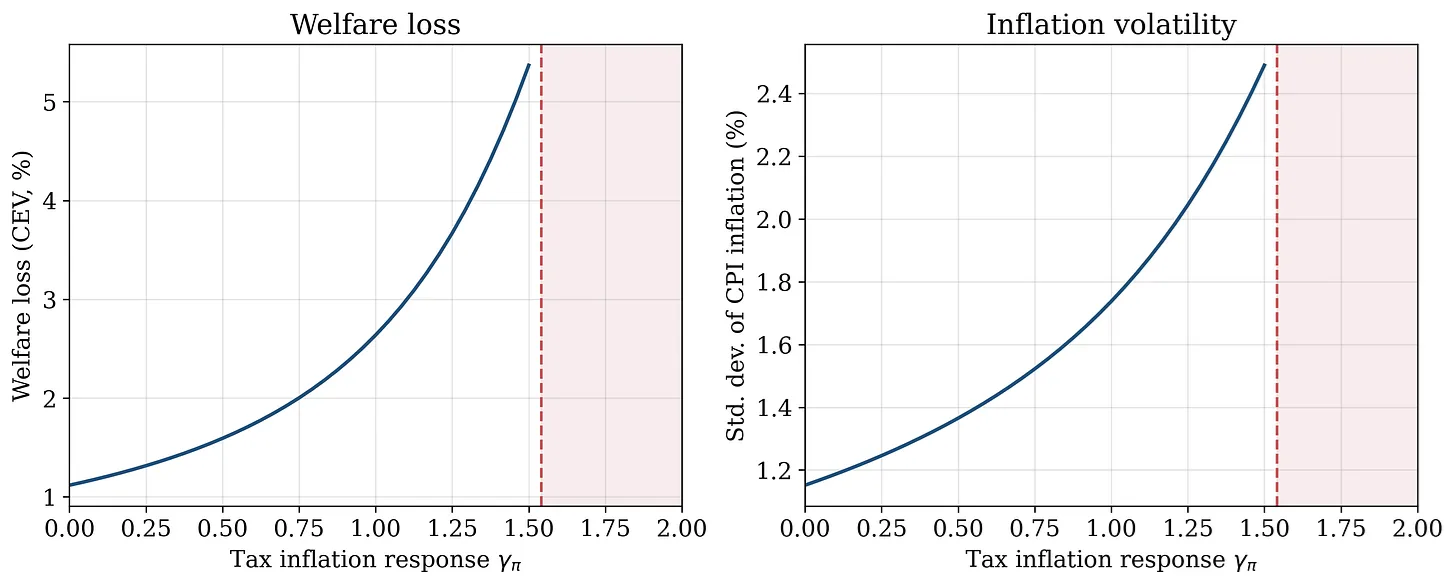
Perhaps surprisingly, welfare falls sharply (ie welfare losses increase) the more aggressively the GST responds to inflation. Inflation itself also becomes substantially more volatile. What explains this counter intuitive result!?

Downward dog inflation

Imagine we lived in a world where the GST automatically increased whenever inflation rose. If inflation jumped by 3 percentage points the GST would mechanically rise from 10% to 15%.

Now consider the sort of shock Australia has recently experienced: turmoil in the Middle East pushing up global oil prices.

To keep things simple imagine you run a yoga studio. Your business barely uses petrol directly, so the oil shock itself is not especially important for your costs.

But the GST is.

In Australia, firms typically advertise and set prices inclusive of GST. And because many firms only adjust prices infrequently — perhaps once or twice a year — they have to think carefully about where taxes and costs are likely to be over the coming year when they decide on prices today.

So what happens when news breaks of a major geopolitical conflict likely to push inflation higher?

In a world with a varying GST policy, the answer is obvious: businesses immediately expect the GST rate to rise in the near future. War today, means high oil prices in the coming weeks, which means higher inflation prints in the coming months and thus a higher rate of GST for the next year or so.

As a yoga studio owner, this matters enormously. If the GST rises from 10% to 15% while your advertised prices stay fixed, your after-tax revenue falls and your profit margins get squeezed.

So what is the rational response?

You raise prices today.

Even though the oil shock barely affects your own business directly, the expectation of higher future GST causes you to increase prices immediately in anticipation.

And once every firm in the economy starts thinking this way, the policy becomes self-reinforcing.

The initial inflation shock causes firms to expect higher GST rates in future. Firms then raise prices more aggressively today to pay for those future taxes. That additional price-setting behaviour pushes inflation even higher, which in turn triggers even larger GST increases.

Rather than stabilising inflation, the policy amplifies it increasing volatility. In fact if the GST-responsiveness-to-inflation parameter gets too high (about 1.5 in the plots above) the economy becomes “indeterminate” which is economist speak for double plus bad.

Under a constant GST regime, many firms — like the yoga studio — might barely respond to an oil shock at all. But once GST becomes an active “counter-cyclical” tool, even firms with little direct exposure to the original shock have an incentive to raise prices preemptively.

The result is higher inflation volatility, more distorted price-setting behaviour, and ultimately lower welfare across the economy.

The irony is that while counter-cyclical GST policy sounds stabilising in theory, once you account for forward-looking firms and sticky prices, it can end up making inflation dynamics substantially worse.


Dr Isaac (Zac) Gross is a lecturer in economics at Monash University. This article was first published via Zac’s blog, Gross National Product, and is reproduced with permission.


  •   24 June 2026
  • 8
  •      
  •   
8 Comments
Francis H
June 25, 2026

Zac, my understanding is that taxes like the GST are counted when the ABS calculates inflation. Excises impact inflation as seen with the monthly inflation print this week. The monthly fall in the headline CPI was clearly impacted by the reduction in the fuel excise. If I am correct, then an adjustment higher for inflation will result in a higher inflation result when the CPI is calculated subsequently. With the increases in prices referred to in your article there is a double whammy effect.

On another matter, as a former Federal employee my pension is indexed to the CPI. Every time Governments give rebates ( electricity ) and reduce fuel excises the CPI falls resulting in a fall in the value of the pension. This also has the effect that the so called benefit to me and many others is an illusion. The reduction in the value of my pension caused by electricity rebates alone completely wiped out the benefit of the rebates. It might be argued that the CPI will be higher when the excise is reimposed but that could be 2 years down the track. Also will the subsequent increase equal the decrease now ? I have not seen any articles in the media about this. It needs to be written about. With State Governments desperate to cling to power we are seeing all sorts of freebies which impact the CPI. It also impacts all pensions and wages if the CPI is artificially low because Governments want to buy popularity . This is all without going into the practice of using the CPI as a cost of living index. Which it is not , for example the discounting of technology improvements in upwards CPI calculations, the practice of substitution, the failure to properly reflect housing costs etc etc. Some articles on these matters would be good to see.

OldbutSane
June 25, 2026

Please prove your assertion that electricity and fuel rebates have been worth less than the small reductions in the increase to your indexed Government pension due to electricity rebates or fuel tax reductions. It doesn't make sense as fuel and electricity are very small components of CPI, less than 5% each (according to the information I can find).

Francis H
June 25, 2026

OldbutSane, the ABS stated in one of its releases that the effect of the electricity rebates was 0.7 % lower CPI in one quarter alone. What might seem like small components can have a significant effect on the CPI in one quarter. Everyone remembers the impact of bananas on the CPI some years ago when a cyclone wrecked the banana crop in North Queensland.

Francis H
June 25, 2026

OldbutSane, futher to my earlier reply which might not have gone through, I suggest a google search of Electricity rebate effects on CPI Australia. It is very illuminating and supports my point.

OlsbutSane
June 28, 2026

Actually it doesn't. Yes the rebates have reduced CPI marginally, but your assertion that the effect on your indexed pension is greater than the actual rebates has not been shown at all. You have not shown any calculations proving your statement, just generalised assertions, which prove nothing.

BTW when banana prices increase and affect the CPI I consider that a bonus as I won't buy bananas when they are that expensive!

1
Francis H
June 29, 2026

OldbutSane, the evidence is there if you read the Quarterly releases starting with the September 2024 Quarter until the rebates were wound back a year later. The cumulative effect is evident. As for the bananas example , it is not the choice of the consumer which is the issue but the application of the CPI to all pensions and wages

OldbutSane
July 01, 2026

Francis H

That was not your point and the CPI is not used to index the age and DSP pensions and carer payment and it is not generally applied to wages (but may be a guide).

If you are not happy with the CPI indexing of your Comsuper pension, maybe you should have cashed it out before retiring and tried to get a better return elsewhere (but bet you wouldn't have because it is such a good deal).


Leave a Comment:

RELATED ARTICLES

Is 'The Great Australian Dream' a sham?

7 questions, 70 opinions on major policies facing Australia

Readers back mining tax and gas reserve but not Stage 3

banner

Most viewed in recent weeks

Division 296: the initial moves to make before the windows close

What if the best superannuation strategy isn't about earning more, but acting before your options disappear? Several overlooked planning windows are narrowing, with consequences that can last for decades.

The retirement scorecard: how many of these questions can you answer?

From the maths of retirement, estimating spending and picking the right asset allocation to survive a poor decade, here are the questions every retiree – current or future – should be able to answer for themselves.

Testamentary trusts: Treasury has picked the wrong reading

A decades-old estate planning tool has survived one tax crackdown only to be caught by another. The surprise isn't who the reform is targeting, but who could end up paying the price for drafting choices made years ago.

Superannuation’s structural failings

Politicians are fighting over access to super, but they may be arguing about the wrong thing. The system’s three fundamental flaws have been hiding in plain sight for decades, costing Australians far more than they realise.

Avoid unnecessary CGT with this estate planning clause

A simple estate plan can create a ticking time bomb. One overlooked clause can pit spouses against children, delay inheritances, and potentially leave a family facing an unexpected tax bill worth hundreds of thousands of dollars.

Does an American retirement rule work for Australians?

The 4% rule has survived decades of scrutiny, but Australia's retirement system changes the equation in ways most overlook. Before accepting or rejecting this rule of thumb, it pays to understand what really drives retirement outcomes.

Latest Updates

Superannuation

Bill Kelty: Super can't solve everyone's problems

One of the key figures behind Australia’s superannuation system reflects on how it began, what has changed, and why some of today’s biggest debates may be asking too much of a retirement savings system.

Investment strategies

Rising yields have put bonds back in business

For the past decade, investors were forced to chase income wherever they could find it. With yields now offering competition to dividends, the new challenge is deciding whether they're still being adequately rewarded for risk.

Strategy

Do you want a bucket with that?

Retirees, advisers and super funds all talk about the bucket strategy as if it's one thing. It's not. The differences can be significant, and some may matter far more than investors realise when markets become volatile.

Investment strategies

What The Odyssey can teach us about valuation discipline

Investment temptations are hard to resist in the moment, but successful investing is not about ignoring compelling opportunities or ideas. For value investors, the smart move is to prepare before momentum clouds judgement.

Shares

Does market concentration really mean more risk for investors?

One of the most closely watched trends in global markets has become a growing source of investor concern in recent years. Whether that concern is justified, however, turns out to be a far more complicated question.

Retirement

Retirement in reality - 8 months in

Health goals, new friendships and lingering questions about identity have dominated this month. The experience has challenged widely held beliefs about purpose, belonging and what it really means to leave work behind.

Shares

Stagnation might be OK at this point

Australia's economic problems are hardly a secret. The more interesting question for investors is whether the stock market is as exposed to those problems as commonly assumed, or whether the picture is more nuanced.

Sponsors

Alliances

  • ASA-Logo-RGB-ActiveGreen-web.png

© 2026 Morningstar, Inc. All rights reserved.

Disclaimer
The data, research and opinions provided here are for information purposes; are not an offer to buy or sell a security; and are not warranted to be correct, complete or accurate. Morningstar, its affiliates, and third-party content providers are not responsible for any investment decisions, damages or losses resulting from, or related to, the data and analyses or their use. To the extent any content is general advice, it has been prepared for clients of Morningstar Australasia Pty Ltd (ABN: 95 090 665 544, AFSL: 240892), without reference to your financial objectives, situation or needs. For more information refer to our Financial Services Guide. You should consider the advice in light of these matters and if applicable, the relevant Product Disclosure Statement before making any decision to invest. Past performance does not necessarily indicate a financial product’s future performance. To obtain advice tailored to your situation, contact a professional financial adviser. Articles are current as at date of publication.
This website contains information and opinions provided by third parties. Inclusion of this information does not necessarily represent Morningstar’s positions, strategies or opinions and should not be considered an endorsement by Morningstar.