Register For Our Mailing List

Register to receive our free weekly newsletter including editorials.

Home / 354

Welcome to Firstlinks Edition 354

  •   22 April 2020
  • 4
  •      
  •   

The impact of central bank activity on stock and bond markets is so pervasive that 'don't fight the Fed' has become a cliché. In fact, clichés are thriving in the coronavirus pandemic. We hear 'the cure is worse than the disease', events are 'unprecedented' and 'black swans', hotels and ships are 'Petri dishes', while 'we're all in this together' but it's 'the worst since the Great Depression' before we 'come out on the other side'. And yes, yes, yes, we know 'when the tide goes out, we can see who's been swimming naked', although 'it's the end of the beginning'.

'Don't fight the Fed' is advice to invest in alignment with the actions of the US Federal Reserve, which is doing 'whatever it takes'. It's a risky strategy. It's apparently safe to invest in equities when the Fed is lowering rates and pumping money into the economy. Confidence has even returned to high-yield (which we used to call junk) bond markets because the Fed is buying, despite the fact that many companies will not survive the downturn. Poorly-run companies which have leveraged their balance sheets by borrowing for share buybacks (and thereby enhancing executive bonuses) instead of building reserves should be allowed to fail. Risk should have a price. 

For many years, since it ran out of monetary policy ammunition, the Bank of Japan has been buying trillions of yen of equities a year to stablilise the market, and the Fed is not far behind.

But while the Fed can print an apparently unlimited amount of money, 26 million Americans who have lost their jobs in the last five weeks will not spend it. Millions of companies facing lockdown will not invest it in new equipment. Most people are home-bound, hunkering down and protecting cash. And as restrictions are lifted, will people resume their pre-coronavirus lives? Incomes are falling, rents are not paid, and for a long time, we will be wary at sporting events, in restaurants, at shopping centres. Then what happens when governments shut off the life supports?

In Australia, 800,000 jobs have gone in three weeks. The Grattan Institute estimates that up to 26% of Australian workers could be out of work as a direct result of the shutdown, with "an enduring impact on jobs and the economy for years to come."

Nassim Taleb (he of 'black swan' fame) in his book Antifragile: Things That Gain from Disorder, says:

"Indeed, our bodies discover probabilities in a very sophisticated manner and assess risks much better than our intellects do. To take one example, risk management professionals look in the past for information on the so-called worst-case scenario and use it to estimate future risks - this method is called 'stress testing'. They take the worst historical recession, the worst war, the worst historical move in interest rates, or the worst point in unemployment as an exact estimate for the worst future outcome. But they never notice the following inconsistency: this so-called worst-case event, when it happened, exceeded the worst case at the time."

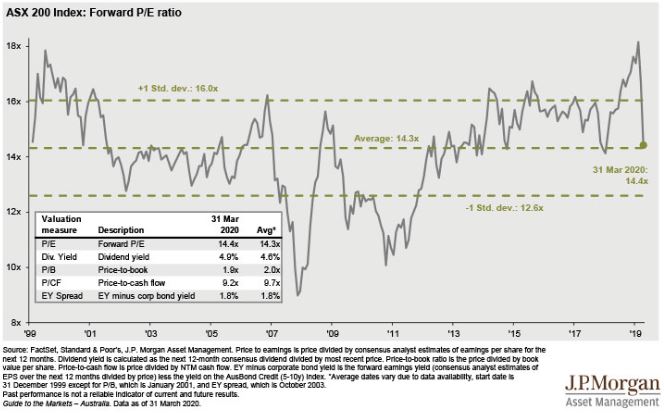
If the crisis is indeed 'unprecedented', we are not overly worried when, since the heavy falls to 23 March, stock markets have rallied strongly. That's 'don't fight the Fed'. We are now back above the average price/earnings ratio for the S&P/ASX200 since 1999 despite the prospect of massive corporate earnings collapses. The chart below is to 31 March 2020 and the market is up since then. Look what happened in 2008 during the GFC.
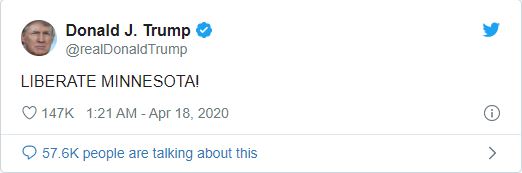
And while Australia can take comfort from its impressive control of coronavirus, in the 'Land of the Free', armed protesters are taking to the streets to campaign against the lockdowns, actively encouraged by their President.
We lead with a comprehensive review by three authors from consulting and actuarial firm Rice Warner, contrasting decisions taken by different countries. They plot an exit strategy, comparing the 'go too early' versus 'stay out longer'.

Duncan Lamont checks 11 bear markets since 1871 for investing lessons, notably warning that hiding in cash and not reinvesting misses the inevitable market recoveries. Paul Taylor identifies a rule-of-thumb the market is using, and looks at business activities which will survive the downturn.

Chris Manuell warns of further falls as economic conditions deteriorate, and the oil price crash shows widespread problems caused by lack of demand.

While it's accepted that there is little potential for inflation while output is so weak, we complete the third part in our series asking experts to opine on the consequences of massive borrowing programmes. A trillion here, a trillion there, and soon we're talking serious money. Chris Brightman worries that governments have lost all semblance of fiscal restraint when money printing seems so easy. 

Raewyn Williams sees an opportunity due to the market fall not only to seek stock bargains, but to do a portfolio makeover without a capital gains tax bill, while Aidan Geysen says loss of dividends can be managed by taking a 'total return' approach to spending needs. 

In this week's White Paper, Shane Oliver lists the good news and the bad news to see if there is a light at the end of the tunnel. 

David Knox addresses whether superannuation taxes unfairly benefit wealthy people, and Morningstar's Adam Fleck runs his ruler over Magellan and Platinum as investment opportunities.

Plus articles by Nick Griffin on avoiding FOMO's market spell and Randall Jenneke on managing a portfolio in these extraordinary circumstances.


Graham Hand, Managing Editor

A full PDF version of this week’s newsletter articles will be loaded into this editorial by midday.

Latest updates

PDF version of Firstlinks Newsletter

Australian ETF Review for March 2020 from Bell Potter

ASX Listed Bond and Hybrid rate sheet from NAB/nabtrade

Indicative Listed Investment Company (LIC) NTA Report from Bell Potter

Plus updates and announcements on the Sponsor Noticeboard on our website


  •   22 April 2020
  • 4
  •      
  •   
4 Comments
Michael2
April 24, 2020

Very easy to read article, thank you

I am wondering if we need to invest in shares considering our superannuation inevitably holds a good percentage of shares

Why rush in and expose our cash to management fees and growth assets?

I think blokes are action people, we have to do something. Sometimes (quite often) it is better do do nothing

Martin
April 25, 2020

Re - "will people resume their pre-coronavirus lives" and "we will be wary at sporting events, shopping centres, restaurants...." I disagree. I seem to be out on a limb here, but my prediction is that things will snap back fast. People are ITCHING to get back to doing the things they love. In fact today (a gorgeous sunny Sunday in late April), there are complaints in the media about beaches being too crowded and people not taking social distancing seriously enough. I think as soon as restrictions are lifted, we're going to see a boom in spending, which will encourage businesses to re-hire staff, and things will bounce back.

We also know that the hardest hit industries are retail and hospitality, and shopping therapy and being able to socialise again will be the first things that people spend their money on.

And P.S. With interests rates at an all-time low, those who are strapped for cash will find it easier than ever to borrow to satisfy their urges!

Graham Hand
April 26, 2020

Hi Martin, well how's this from the HuffPost about the consequences of ending social distancing. This virus is not suddenly going away:

"This is the importance of social distancing, said Michael LeVasseur, a visiting assistant professor of epidemiology and biostatistics at Drexel University’s Dornsife School of Public Health. Since individuals are likely capable of transmitting the virus when they are asymptomatic, limiting the number of contacts any individual has to the household, for example, will limit the spread of the virus.

So, what happens if we loosen up social distancing measures? It depends on the point in the so-called “curve” that each state or municipality decides to lift its guidelines.

If we have the public health infrastructure that individuals can report to a testing clinic to receive a test and then self-isolate while awaiting results, maybe it would work, LeVasseur said. If we don’t, then they’ll likely continue infecting people and we will see a surge of cases.

I don’t believe that we go back to normal at all, LeVasseur said. Not until there’s an effective treatment or vaccine, anyway. We can regain some semblance of normalcy, but we will need to remain vigilant as citizens and scale up our public health efforts in order to prevent future surges.

Source: Huffpost

Rob
April 25, 2020

Graham,

I just read your Editors Note (354) and I enjoy hearing your thoughts on matters big and small. It reminded me how similarly we think on some things. I, no doubt wrongly, cashed out of all equities using my lizard brain and the word “unprecedented” as my guides.

I cannot understand how this goes from “once in a lifetime” to V shape market recovery in weeks. Many people I know are now unemployed. Anyway, I have a good secure job and no financial stress until we reach, to use another cliché’, “The next normal”.


Leave a Comment:

banner

Most viewed in recent weeks

Why have Australian living standards 'fallen' and how do we fix it?

For the last few years there has been much talk of a 'cost-of-living' crisis in Australia and of 'falling living standards'. Lately this has flared up again with the pickup in inflation resulting in a renewed fall in real wages.

Will you run out of money in retirement?

Fear of running out has become a defining retirement anxiety. Why do some retirees die with substantial wealth while others deplete their nest egg? Evidence suggests the answer is more complicated than we think. 

Four options for an income investor’s next dollar

What if Australia’s golden age of dividends is ending? Rather than overhaul your portfolio, it may be worth considering where new capital can work harder. I discuss four income strategies and the trade-offs behind each.

The investment that sidesteps the new tax traps

Tax rules have changed, but many investors are still using yesterday’s strategies. Insurance bonds may offer advantages for those seeking greater control, tax efficiency and certainty about their wealth.

Why spending more in early retirement can improve lifetime income

Conventional wisdom encourages retirees to preserve superannuation. But if those likely to qualify for the Age Pension later in life spend a little more today, it may deliver higher lifetime income and a more stable retirement.

Testamentary trusts have secured the CGT exemption

Treasury’s latest CGT reform draft delivers a win for testamentary trusts and deceased estates, exempting estate-derived gains from the 30% floor. However, questions on death and divorce rollovers remain unresolved.

Latest Updates

Retirement

Why spending more in early retirement can improve lifetime income

Conventional wisdom encourages retirees to preserve superannuation. But if those likely to qualify for the Age Pension later in life spend a little more today, it may deliver higher lifetime income and a more stable retirement.

SMSF strategies

Who really loses from the SMSF borrowing ban?

The ban on borrowing to buy residential property inside a self-managed super fund was framed as closing a loophole for the wealthy. Yet ATO data suggests its effects may be felt more heavily on members with moderate balances.

Investment strategies

The investing rule that explains the next market crash

What if investment success depends less on picking the right assets and more on understanding the decisions of other investors? A principle borrowed from game theory offers a different perspective on markets.

Investment strategies

Gold: should you own the metal or the miners?

Gold is back in the headlines but investors may be asking the wrong question. Before deciding where prices are headed next, it's worth considering whether the investment you choose will deliver the outcome you're actually seeking.

Fixed interest

Global bonds markets are hiccupping

For decades, investors looked the other way as government debt ballooned. But a reckoning may be beginning. Bond markets are stirring and the consequences could reach far beyond markets into everyday life.

Property

Why investors are looking beyond traditional property sectors

A little-known corner of the property market may be quietly benefiting from powerful demographic and healthcare trends. Could this specialised sector offer investors something increasingly difficult to find: enduring demand?

Retirement

Retirement in reality - 6 months in

Is retirement really an identity crisis, or is something else at play? New insights challenge conventional thinking and reveal why some retirees struggle to fully embrace life after work.

Sponsors

Alliances

  • ASA-Logo-RGB-ActiveGreen-web.png

© 2026 Morningstar, Inc. All rights reserved.

Disclaimer
The data, research and opinions provided here are for information purposes; are not an offer to buy or sell a security; and are not warranted to be correct, complete or accurate. Morningstar, its affiliates, and third-party content providers are not responsible for any investment decisions, damages or losses resulting from, or related to, the data and analyses or their use. To the extent any content is general advice, it has been prepared for clients of Morningstar Australasia Pty Ltd (ABN: 95 090 665 544, AFSL: 240892), without reference to your financial objectives, situation or needs. For more information refer to our Financial Services Guide. You should consider the advice in light of these matters and if applicable, the relevant Product Disclosure Statement before making any decision to invest. Past performance does not necessarily indicate a financial product’s future performance. To obtain advice tailored to your situation, contact a professional financial adviser. Articles are current as at date of publication.
This website contains information and opinions provided by third parties. Inclusion of this information does not necessarily represent Morningstar’s positions, strategies or opinions and should not be considered an endorsement by Morningstar.