Register For Our Mailing List

Register to receive our free weekly newsletter including editorials.

Gold Demand Trends: Q1 2026

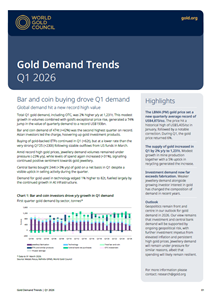
Bar and coin buying drove Q1 demand 

Global demand hit a new record high value 

Total Q1 gold demand, including OTC, was 2% higher y/y at 1,231t. This modest growth in volumes combined with gold’s exceptional price rise, generated a 74% jump in the value of quarterly demand to a record US$193bn. 

Bar and coin demand of 474t (+42%) was the second highest quarter on record. Asian investors led the charge, hoovering up gold investment products. 

Buying of gold-backed ETFs continued in Q1 (+62t), but at a lower rate than the very strong Q1’25 (+230t) following sizable outflows from US funds in March.

Amid record high gold prices, jewellery demand volumes remained under pressure (-23% y/y), while levels of spend again increased (+31%), signalling continued positive sentiment towards gold jewellery. 

Central banks bought 244t (+3% y/y) of gold on a net basis in Q1 despite a visible uptick in selling activity during the quarter.  

Demand for gold used in technology edged 1% higher to 82t, fuelled largely by the continued growth in AI infrastructure.

Highlights

  • The LBMA (PM) gold price set a new quarterly average record of US$4,873/oz. The price hit a historical high of US$5,405/oz in January, followed by a notable correction. During Q1, the gold price returned 6%.
  • The supply of gold increased in Q1 by 2% y/y to 1,231t. Modest growth in mine production together with a 5% uptick in recycling generated the increase.
  • Investment demand now far exceeds fabrication. Weaker jewellery demand alongside growing investor interest in gold has changed the composition of demand in recent years.

Outlook

Geopolitics remain front and centre in our outlook for gold demand in 2026. Our view remains that investment and central bank demand will be supported by ongoing geopolitical risk, with further investment impetus from elevated inflation and persistent high gold prices. Jewellery demand will remain under pressure for similar reasons, albeit that spending will likely remain resilient.


Download the full paper
(login or registration required to read the full text, view charts and download files.
Registration is free, and gives you access to all downloads on WGC's website.)
 

  •   10 May 2026
  •      
  •   


Leave a Comment:

banner

Most viewed in recent weeks

It’s time for LICs to die

A high-profile dividend cut and a prominent fund manager’s apology have reignited a long-running debate. If investors can access similar exposures more cheaply and efficiently elsewhere, what exactly is keeping LICs alive?

Testamentary trusts survived the trust tax. The drafting battle has just begun.

The fight over testamentary trusts looked settled. Then the draft legislation arrived. Hidden in a technical detail is a question that could force many families to rethink wills they thought were already future-proof.

Is it time to bail on Australian stocks?

For generations, Australian investors have backed banks, miners and dividends. But has that loyalty come at a cost? A look at the numbers raises an uncomfortable question about where future returns will come from.

The new capital gains tax trap for your portfolio

Investors have long accepted one portfolio rule without much question. A major tax shift could change that calculation entirely, forcing difficult trade-offs between risk, discipline and an overlooked cost lurking beneath.

How the typical Australian Family could save $844,350 in taxes

The value of a testamentary trust is not determined by wealth alone. Depending on circumstances, it can reduce the tax burden on inherited income, create efficiencies and help build intergenerational wealth.

The housing slide could become a crash

House prices are sliding across Australia, yet the most dangerous ingredient for a housing crash is still missing. If job losses surge amid growing economic risks, today's correction could become a historic property downturn.

Latest Updates

Retirement

The retirement scorecard: how many of these questions can you answer?

From the maths of retirement, estimating spending and picking the right asset allocation to survive a poor decade, here are the questions every retiree – current or future – should be able to answer for themselves.

2026 is not 1999

The US market looks eerily similar to the dot-com era with soaring AI spending and tech giants dominating returns. But one difference separates today’s boom from the dot-com bubble and it could determine what happens next.

Planning

Taxing time for trusts

Trusts are facing a shake-up, but an overhaul may not be necessary. Families can explore restructuring strategies that preserve succession and the asset protection benefits that have made these structures valuable.

Economy

Why the US economy is stronger than you might think

War, inflation and higher rates were expected to derail America. But has the market got it wrong? Three forces are driving the economy beyond expectations, revealing implications for stock prices and portfolio positioning.

Gold

How much trust is in your portfolio?

Everyone talks about diversifying assets. Far fewer think about diversifying trust. As inflation, debt and market assumptions collide, the question is whether portfolios need greater protection from unexpected outcomes.

Retirement

Retirement in reality - 7 months in

Seven months into retirement, I'm still uncovering surprises. This month was spent reflecting on the slow pace of health change, the myth of neatly scheduled part-time work and the unexpected persistence of retirement guilt.

The new geography of technology leadership

The next chapter of technology may not belong to the companies or business models many expect. As the landscape shifts, some opportunities are emerging in places that remain surprisingly overlooked by global markets.

Sponsors

Alliances

  • ASA-Logo-RGB-ActiveGreen-web.png

© 2026 Morningstar, Inc. All rights reserved.

Disclaimer
The data, research and opinions provided here are for information purposes; are not an offer to buy or sell a security; and are not warranted to be correct, complete or accurate. Morningstar, its affiliates, and third-party content providers are not responsible for any investment decisions, damages or losses resulting from, or related to, the data and analyses or their use. To the extent any content is general advice, it has been prepared for clients of Morningstar Australasia Pty Ltd (ABN: 95 090 665 544, AFSL: 240892), without reference to your financial objectives, situation or needs. For more information refer to our Financial Services Guide. You should consider the advice in light of these matters and if applicable, the relevant Product Disclosure Statement before making any decision to invest. Past performance does not necessarily indicate a financial product’s future performance. To obtain advice tailored to your situation, contact a professional financial adviser. Articles are current as at date of publication.
This website contains information and opinions provided by third parties. Inclusion of this information does not necessarily represent Morningstar’s positions, strategies or opinions and should not be considered an endorsement by Morningstar.