Register For Our Mailing List

Register to receive our free weekly newsletter including editorials.

Home / 662

$42 billion too late

Stock volatility is at unprecedented levels. Whether it is Cochlear’s April trading update, the 2026 Hormuz crisis, Liberation Day in 2025, or a company reporting season, the swings are sharper and less anchored to fundamentals than at any previous point in market history. The market structure has permanently changed in how equity prices are set, and the consequences are being felt unevenly across the active management industry. The wide dispersion of returns away from fair value has produced an equally wide dispersion of outcomes for active managers.

Whether a manager runs a value, growth, or quality investment style, the propensity for extreme outperformance and underperformance has risen sharply. The rotations between investment styles have become faster and more extreme than at any previous point in market history. Growth managers were devastated in 2022, only to recover strongly in 2023. Value managers underperformed through 2024 before conditions finally turned in their favour in 2025. Now growth is under pressure again and this time quality managers have not been spared.

Australia's electricity mix has changed dramatically over the past decade. The chart below tells the story of coal in steady retreat and rooftop solar surging from a rounding error before 2015 to 14 percent of National Electricity Market (NEM) generation by 2025.
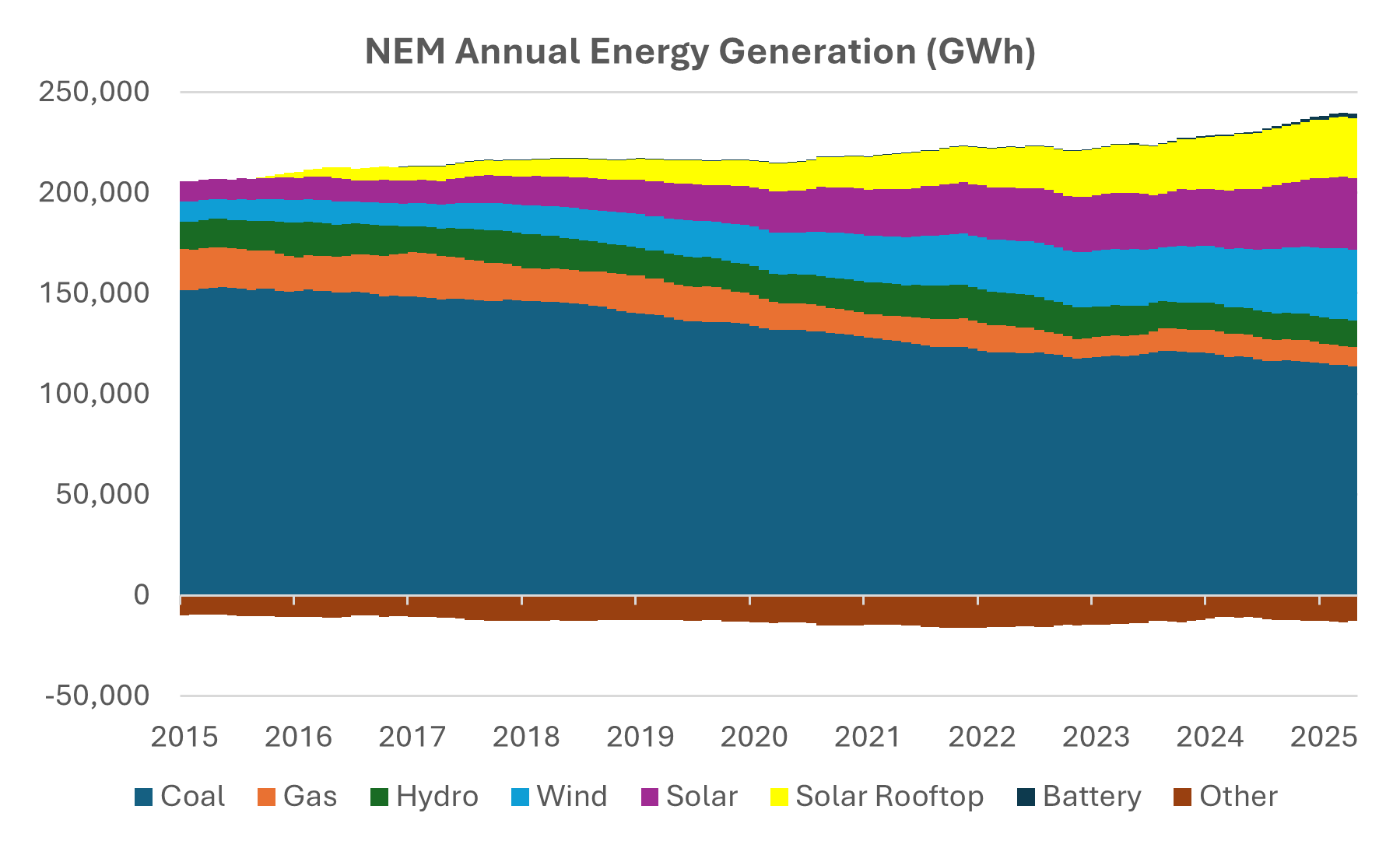

Source: OpenElectricity

That transformation created a new problem. A grid that generates enormous solar surpluses during the day and loses that generation as the sun sets develops a structural imbalance in the evening. The 6pm to 9pm window is the grid's critical stress point: supply falls, demand peaks, and prices spike. Two energy storage projects now define Australia's attempt to solve it. Both exceeded their original budgets, but for entirely different reasons, and one is at risk of looking like a white elephant.

Snowy Hydro 2.0: The nation-building bet

In March 2017, Prime Minister Malcolm Turnbull announced Snowy Hydro 2.0 as a nation-building response to Australia's energy crisis. South Australia had suffered a state-wide blackout in September 2016. Electricity prices were surging as domestic gas prices rose sharply after new LNG export facilities linked the east coast gas market to international prices for the first time. Hazelwood, one of the NEM's largest and cheapest coal-fired generators, was weeks from closing. The political pressure to act was intense.

The project proposed linking two existing reservoirs — Tantangara at the top and Talbingo at the bottom — via a 27-kilometre tunnel through the Snowy Mountains. The scheme uses cheap electricity during the day to pump water uphill into Tantangara, then releases it back down through turbines to generate power when electricity is expensive in the evening. At full capacity, the project would add 2.2 GW of dispatchable generation to the NEM.

The original $2 billion cost estimate was produced without a detailed feasibility study. A subsequent study revised that to $3.8 to $4.5 billion, and the project was formally sanctioned by the Morrison Government in February 2019. Construction began in 2021, and the cost estimate has since risen to at least $12 billion. Independent analysts at the Victoria Energy Policy Centre now estimate the all-in cost at $42 billion.

The Cheaper Home Batteries Program: A cost-of-living bet

The Cheaper Home Batteries Program launched in July 2025 as rising electricity bills put household energy costs at the centre of the 2025 federal election campaign. The scheme addressed a clear market failure: despite solar sitting on one in three rooftops, only one in 40 households had a battery. The high upfront cost was the barrier. Batteries offered households a direct way to reduce their exposure to retail tariffs and relieve cost-of-living pressure.

The scheme offered households a 30 percent discount at the point of installation, targeting 1 million installations by 2030 with an original budget of $2.3 billion. Within five months, 155,000 new batteries had been installed, roughly matching half the entire fleet accumulated over the prior decade. The budget was on track to run out by 2026, and in December 2025 the government responded by tripling the budget to $7.2 billion, doubling the installation target to 2 million and quadrupling the storage target to 40 GWh.

The financial case was compelling from day one. Most household batteries operate in self-consumption mode, charging from rooftop solar during the day and discharging at night instead of buying grid power at around 38 cents per kWh. Without a battery, that solar would be exported to the grid at around 5 cents. Based on typical evening consumption of around 10 kWh, the arbitrage is worth about $1,200 per year in bill savings

Some households go further by enrolling their battery in a Virtual Power Plant (VPP), a network where an operator coordinates discharge in response to grid conditions. In exchange, households earn a fee from the operator ranging from $300 to $600 annually, or on more sophisticated plans, a share of returns from capturing price spikes with the potential to exceed $1,000 annually. In NSW, the state government adds up to $1,500 upfront for connecting to a VPP on top of the federal rebate, making enrolment a compelling financial proposition.
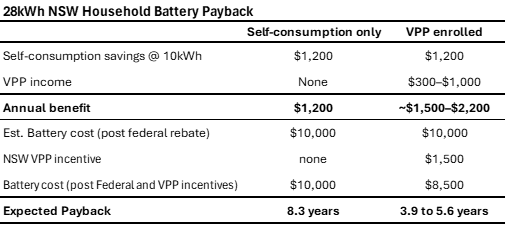

Source: Vertium

Scaled to 2 million households, those individual decisions become a grid-scale resource. At 2030 target scale, 2 million households drawing from batteries rather than the grid removes the equivalent of 50 percent of NEM summer peak demand from the wholesale market entirely. That is without any coordination. With coordination, the impact is even greater. Given state government incentives, VPP enrolments could reach 30 percent of batteries installed by 2030. Six hundred thousand batteries discharging at an average rate of 7.5 kW gives a peak dispatch capacity of 4.5 GW, covering a further 15 percent of NEM summer peak demand and about double Snowy Hydro 2.0's discharge capacity. Any price spikes that remain will be targeted by those VPP batteries, leaving little commercial headroom for Snowy 2.0.
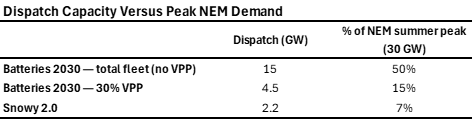

Source: Vertium

The commercial implications extend beyond Snowy. Gas-fired peakers earn the bulk of their revenue running precisely when evening prices spike. AGL and Origin are building their own grid-scale batteries to capture the elevated prices in the evening ramp, even as distributed household batteries work to eliminate them. Origin has argued that more gas-fired peaking capacity is needed as coal retires, a position that has genuine merit for multi-day winter periods when solar is weak and batteries cannot recharge in time. That argument is harder to sustain on the daily evening ramp, where batteries are already proving their case. In Q1 2026, the peak summer quarter, AEMO reported that batteries delivered an average of 1.1 GW into the evening peak, directly reducing reliance on gas. Gas-fired generation averaged just 712 MW for the quarter, its lowest level since 1999. For AGL and Origin, the structural question is not whether household batteries affect their peaking revenue. It is how quickly that effect is felt.

Snowy faces the same commercial pressure on the evening ramp, but its position is more nuanced. Unlike gas peakers, it can store energy and dispatch it without burning fuel. But like gas peakers, it can sustain output for far longer than a home battery. A home battery is exhausted within five to six hours at full discharge. Snowy can sustain 2.2 GW continuously for approximately 18 hours to four days depending on reservoir levels, becoming genuinely irreplaceable during the prolonged overcast periods that Origin describes. That is a legitimate grid service for those rare instances, but it could easily be met by existing gas-fired peakers without costing taxpayers a cent.

Conclusion

Both schemes exceeded their original budgets, but that is where the similarity ends. Snowy Hydro 2.0 was a single concentrated bet — costed without engineering rigour, committed without market validation, and now carrying an estimated price tag of $42 billion. The home battery scheme was messy in its first iteration, but it mobilised private capital at a scale that forced the government to expand the subsidy to $7.2 billion to keep pace with demand. One budget blew out because demand exceeded expectations. The other blew out before it produced anything.

Snowy is 70 percent bored, has missed six consecutive completion deadlines, and is realistically not expected to operate until the early 2030s. By then, the battery scheme will have run its full course — 2 million homes, 40 GWh of distributed storage, and years of evening peak prices already compressed. Snowy will arrive, at extraordinary cost, to find the market it was designed to serve already transformed. That transformation has a price.

The price of that transformation: $7.2 billion. The price of Snowy 2.0 could be $42 billion too late.


Jason Teh is the founder and Chief Investment Officer of Vertium Asset Management. This article is general in nature and does not constitute or convey personal financial advice. It has been prepared without consideration of anyone’s financial situation, needs, or financial objectives. Before acting on the areas discussed and contained herein, you should consider whether it is appropriate for you and whether you need to seek professional advice.


  •   13 May 2026
  • 10
  •      
  •   
10 Comments
Kent Fitch
May 14, 2026

It remains to be seen whether $42B is a fair estimate. After all, it includes transmission line construction which will have uses for moving around more solar/wind generation. But lets assume a conservative all-up cost of $30B, an asset lifetime of forever, zero maintenance costs and zero chance of damage due to seismic activity etc. The 10 yr bond rate of about 5% implies the financing cost of $30B is $1500M/yr, that is, about $4.1M per day. Assuming optimal use of the Snowy2 generating asset in pumped mode can output 2.2GW for 7 hours/day, it could sustainably generate 15GWh/day, which works out at about 27 cents/kWh. It will need to buy solar/wind, competing with batteries: lets assume it can buy power for 6 cents/kWh. But the long tunnels of Snowy2 means it will struggle to return more than 66% of the power it uses to pump water to the top reservoir, so the input power costs will be about 9 cents/kWh. Ignoring transmission losses (and it is likely to be further from both generation and consumption than the utility batteries), Snowy2 will probably lose money on each kWh under 36 cents/kWh. And that's with optimal operating conditions, zero maintenance costs, infinite lifetime.

Grid scale batteries lifetime "levelised cost of storage" and supply, including buying power for 6 cents/kWh is now falling steadily through 15 cents/kWh. Who knows where it will be when Snowy2 is finished, but 12 cents/kWh by 2030 would not be out of the question. Snowy2's role will revert to very occasional use when solar/wind drop for extended periods, and then, will be very expensive per kWh. But during such periods, household batteries, and eventually (2030?) high storage capacity V2G car batteries, will have a huge incentive to discharge to the grid, undercutting Snowy2 even then.

4
ACB
May 15, 2026

Couple of points worth mentioning:
1. When I toured the Snowy system last year, the sun was shining, the wind was blowing and the wholesale electricity price was negative. The existing Snowy system was being paid to pump water uphill. Snowy2 will make money, the amount will depend upon battery rollout speed.
2. I did the numbers for a home battery and came to the conclusion that it would probably wear out before it paid for itself. However, my solar panels are 7 years old and are still going strong well after the payback. Maybe a battery one day when the numbers stack up.

Kent Fitch
May 16, 2026

Both good points, ACB. Negative wholesale prices during the middle of the day have occurred because there was no demand for the (mostly) solar being generated. But the government's stipulation that all households with a smart meter must be offered a plan giving 3 hours per day of free power will reduce that cheap surplus available to either Snowy2 or utility batteries. Both Snowy2 and utility batteries will be competing for the remaining surplus power. The differences are:
1. utility batteries levelised cost of storage is dropping fast (currently falling thru about 9c/kWh), whereas Snowy2's is very likely be at least 27c/kWh (assuming zero maintenance, zero outages)
2. utility batteries wont be able to (as economically) store days worth of power to cover an extended period of low sun and wind, but Snowy2 will be. But a set of smaller, cheaper and more efficient pumped hydro installations could too, and much more robustly (no single point of failure).

Alan
May 14, 2026

Our current electricity prices are so high we have lost most of our manufacturing industries. The cost of achieving net zero in Australia will be $9 trillion and will reduce global temperatures by 0.0001C. Now that’s insanity personified! The climate models are not worth the paper they are written on. If you really want to go down the net zero route then the only long term solution to give reliable base power is nuclear power. With the move to AI we will need huge power plants to run the data centres. We increasing costs of living we risk becoming a third world nation.

4
Kent Fitch
May 14, 2026

Agree cheap power is very important. Would lifetime costs of nuclear be lower though, Alan? If wind and solar are economic at an unsubsidised 6 cents/kWh, and grid-scale battery is already economic (for when the sun doesnt shine and the wind doesnt blow) at 15 cents/kWh (and falling), and small-scale pumped hydro or gas can fill in the rare gaps, wont we have plenty of cheap power, and wont costs end up being dominated by transmission lines, which are mostly common across any system? (And perhaps transmission with decentralised gen and consumption is cheaper anyway). What's the lifetime cost of new-build nuclear?

5
Peter Single
May 16, 2026

No country can achieve reduction of global temperatures alone - it requires international cooperation, and adding of all the gains. So this "insanity personified" argument is logically flawed, especially for a small country. We have to be part of an effort in which all players contribute. Tidy our own back yard and expect others to do the same.

Meanwhile China is getting close to 25% of long-haul trucks now electric, and 50% of cars. They are being good citizens. The US is a bigger worry, though even there the story is mixed with California (an economically large state) with its nukes doing well.

Dudley
May 16, 2026


"They are being good citizens."
China emits 30 times more CO2 than Australia from about the same land area.

Whether Australia doddles or dashes to 'Net 0' will have no measurable effect on when the world arrives there.

If Australia does not innovate it would be better off doddling and picking up better technology later.

2
Errol
May 14, 2026

Interesting article Jason. Really highlights the dangers of governments committing huge sums to projects like Snowy 2 without due diligence and the required financial rigour that such a decision deserves. Even worse, no accountability when it goes pear shape.
The Home Batteries Program appears to be a better strategy notwithstanding that government subsidies are arguably going to those that are not in the lower socioeconomic demographic and thus are paying higher prices for their electricity.

2
Peter Sullivan
May 14, 2026

Great article Jason. Still won't silence the LNP.

OldbutSane
May 14, 2026

One wonders when any Government will create a scheme that is actually optimal. Snowy II is a classic infrastructure stuff-uo and the Government has rightly pulled the inland rail project which was similarly fanciful.

The home battery scheme is yet another that was poorly designed and ill-targetted. Who really needs a 20 or 50kw battery (except to make money feeding back into the grid), subsidy was not means tested and so mainly the better off could afford it. They also just encourage more electricity consumption (as it is costing "nothing"). For those who use little electricity and already have solar panels it still didn't make economic sense - I did the sums for us and the payback period was over 10 years!

Still don't think the home battery system is the best way to go as house without solar are left out. A community battery system is probably a better way to go (eg like on Norfolk Island which has a big community battery).


Leave a Comment:

RELATED ARTICLES

Double down on renewables?

Energy policy must prioritise the economy

An investing theme you can bet on for the next 30 years

banner

Most viewed in recent weeks

Little‑known government scheme can help retirees tap into $3 trillion of housing wealth

The Home Equity Access Scheme in Australia allows older homeowners to tap into their home equity for retirement income, yet remains underused due to lack of awareness and its perceived complexity.

Origins of the mislabeled capital gains tax ‘discount’

Debate over the CGT discount is intensifying amid concerns about intergenerational equity and housing affordability. This analysis shows that the 'discount' does not necessarily favor property investors.

2 billion reasons to fix retirement income

A proposal to address Australia's 'stranded balances' in retirement by requiring super funds to transition members to pension phase at 65, boosting retirement income and reframing super as a source of income.

The ultimate superannuation EOFY checklist 2026

Here is a checklist of 28 important issues you should address before June 30 to ensure your SMSF or other super fund is in order and that you are making the most of the strategies available.

Div 296 may mean your estate pays tax on assets your beneficiaries never receive

The new super tax, applying from 1 July, introduces more than just a higher rate on large balances. It brings into focus a misalignment between where wealth sits and where the tax on that wealth ultimately falls.

Do super funds need a massive wake up call?

UK retirement expert, Guy Opperman, believes super funds are failing at supporting members in deaccumulation. Here is what Australia should do about it. 

Latest Updates

Retirement

How inflation is quietly moving the goalposts on retirement

Inflation doesn’t just raise today’s bills - it quietly increases the amount needed to retire, while simultaneously making it harder to save. Three steps to take before June 30th to improve retirement outcomes.

Investment strategies

Three strategies for investing amid AI whiplash

AI fears have shifted from bubble talk to disruption anxiety, driving investors toward asset-heavy, 'AI-resistant' businesses while punishing many software and service firms. This environment may be ripe for stock pickers.

Investment strategies

Are private market assets the answer in an unstable world?

Private markets can offer diversification and return potential, but their opacity, scale and wide dispersion of outcomes make manager selection and due diligence critical for non‑institutional investors.

Property

Mispriced in plain sight: The case for Global REITs

Global REITs have fallen out of favour, trading at deep discounts after years of underperformance, despite resilient earnings and improving fundamentals.

Investment strategies

Survival is the only success

True financial success isn’t about how much you make, but whether you can sustain it — survival is the only win that matters.

Investment strategies

$42 billion too late

Why Australia's biggest energy bet may already be redundant while a less celebrated government program is exceeding expectations. 

Investment strategies

Do investors accept lower returns from assets that make them feel good?

Assets that deliver emotional satisfaction tend to offer lower financial returns, as investors accept an “emotional yield” in place of performance which shapes how investors approach ESG and unpopular assets.

Sponsors

Alliances

© 2026 Morningstar, Inc. All rights reserved.

Disclaimer
The data, research and opinions provided here are for information purposes; are not an offer to buy or sell a security; and are not warranted to be correct, complete or accurate. Morningstar, its affiliates, and third-party content providers are not responsible for any investment decisions, damages or losses resulting from, or related to, the data and analyses or their use. To the extent any content is general advice, it has been prepared for clients of Morningstar Australasia Pty Ltd (ABN: 95 090 665 544, AFSL: 240892), without reference to your financial objectives, situation or needs. For more information refer to our Financial Services Guide. You should consider the advice in light of these matters and if applicable, the relevant Product Disclosure Statement before making any decision to invest. Past performance does not necessarily indicate a financial product’s future performance. To obtain advice tailored to your situation, contact a professional financial adviser. Articles are current as at date of publication.
This website contains information and opinions provided by third parties. Inclusion of this information does not necessarily represent Morningstar’s positions, strategies or opinions and should not be considered an endorsement by Morningstar.