Register For Our Mailing List

Register to receive our free weekly newsletter including editorials.

Home / 670

Div 296's million-dollar reset worth $25,000

Since the $3 million super tax became law in March, one word has carried the industry's entire message: 'protect'. Make the cost base reset election and you 'protect' the gains your fund built before July. Miss it and decades of growth are 'exposed'. The word worked. Adviser notes spent June urging trustees to commission valuations before the deadline, and pointing out that the only way to keep an asset out of the election was to sell it first. But the arithmetic under the slogan says something quieter: for a typical affected member, 'protecting' $1 million of gains is worth about $25,000. Real money. Also two and a half cents in the dollar, arriving years from now, and only if you are still over the threshold when you finally sell.

The panic also got the calendar wrong. The date that mattered on 30 June was the valuation, not the decision. The election itself is made on an approved form any time up to the due date of the fund's 2026-27 annual return, so trustees have the better part of a year to choose, working from a number that is now fixed. The photograph has been taken. Whether to hand it to the tax office is still an open question, and this article is the arithmetic for answering it.

What Division 296 actually taxes

Division 296 took effect on 1 July. It adds 15% tax on the share of a member's super earnings attributable to the portion of their total super balance above $3 million, with a further 10% above $10 million. Three design details do all the work in what follows.

First, it taxes realised earnings only: dividends, interest, rent, and capital gains when assets are actually sold. Paper movements no longer count, which is the concession that made the final law palatable. Second, capital gains keep the one-third discount for assets held longer than 12 months, so at most two-thirds of any gain enters the calculation. Third, and least understood, only the proportion of earnings matching the proportion of the balance above the threshold is taxed. A member with $4 million has a quarter of their balance over the line, so a quarter of their earnings wear the extra 15%. Pension phase does not help; earnings that are exempt from ordinary fund tax are counted back in.

Multiply the three together and the most a dollar of capital gain can cost in Division 296 tax is 10 cents, rising to 16.7 cents only for the slice of a balance beyond $10 million; a ceiling approached only by very large balances. On the way down, the proportion shrinks it quickly.

The reset, in cents per dollar

The transitional election lets an SMSF (and other small funds) treat the market value of every asset it held directly on 30 June 2026 as a fresh cost base, for Division 296 purposes only. Ordinary capital gains tax is untouched. Gains accrued before this month then never enter Division 296 earnings; only growth from here does. The election is made at fund level, covers every asset or none, and once made cannot be unwound. So, what is a quarantined dollar of gain actually worth? The saving is 15% of two-thirds of the proportion over the threshold. In cents:
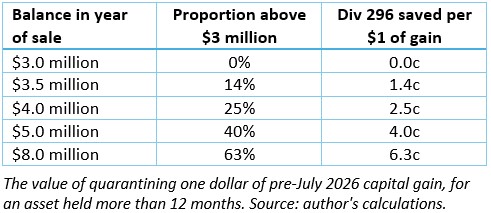
Now a worked example. A single-member fund with a $4 million balance holds a share portfolio bought for $600,000 and worth $1.6 million on 30 June: an accrued gain of $1 million. It also holds an unlisted investment bought for $500,000 and now worth $400,000. Elect, and the share gain is quarantined; at a 25% proportion that saves $25,000 of Division 296 tax in the eventual year of sale. But every asset means every asset. The loss position resets too, its cost base falling to $400,000, so if it merely climbs back to what was paid for it, $100,000 of recovery is counted as new gain, costing up to $2,500. Net benefit: about $22,500. And if the sale is a decade away, nearer $12,600 in today's dollars at a 6% discount rate.
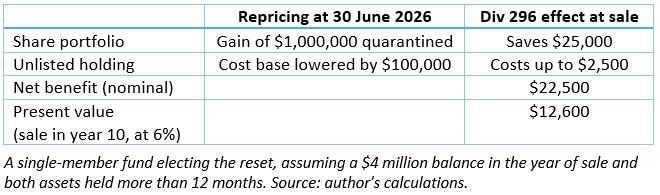
Notice where the $1 million sits in that table: the middle column, never the last. The reset does not protect gains. It removes a slice of a tax on a discounted fraction of them.

The honest case for electing anyway

For most funds sitting on net gains, consider electing. The election costs a form, the 30 June valuation was needed for the fund's accounts regardless, and the option runs one way: fail to opt in by the return's due date and that door closes for good. A free option with an irreversible expiry should usually be taken. That asymmetry, not fee-hunting, is why the adviser notes pushed so hard: recommending against a free irrevocable option is the kind of call nobody wants to defend later. And for the funds the tax was aimed at, the cents add up. A $2 million property gain in an $8 million balance is roughly $125,000 of Division 296 tax, which pays for a great deal of paperwork. The cents-in-the-dollar framing sizes the decision. It does not dismiss it.

What it does dismiss is the gymnastics. Selling assets purely to reshape the fund before the photograph, round-trip disposals to crystallise gains (wash sales by another name, and the ATO has a long-standing dislike of those), restructures priced in the thousands to defend tax measured in the hundreds. At a $3.2 million balance, quarantining $100,000 of gain is worth $625. June offered plenty of ways to spend more than that achieving it.

Who actually needs the arithmetic

Members over $3 million should model the netting, gains against loss positions, and elect calmly inside the year they have. Members under it are being told to elect 'just in case', and the free-option logic supports that, but the trajectory deserves arithmetic rather than fear. The threshold is indexed in $150,000 steps, and a pension balance drawing 5% while earning 6% grows about 1% a year while the threshold compounds with inflation. The gap widens. Many drawdown funds will never cross the line, and their reset will simply never matter. The genuine 'just in case' cases are younger accumulators with large balances and years of contributions ahead. Members of large APRA-regulated funds have no election to make; their funds receive separate transitional treatment, and there is nothing to do. One caveat throughout: the supporting regulations were still in draft at the time of writing, so administrative details, including exactly how balances are valued, may yet move.

The election is worth making for most funds and worth panicking over for almost none. The photograph was taken on 30 June. Your fund has until its next tax return to decide whether it belongs in the frame.


Trevor Schmid has more than 20 years’ experience across superannuation, financial advice and member education. This article is general information only and does not consider any individual’s objectives, financial situation or needs.


  •   8 July 2026
  • 11
  •      
  •   
11 Comments
Mark B
July 10, 2026

Very nice analysis. Personally I've taken the view to not allow unrealised gains to build up to the point where there will be an issue in the future. Our Super balances are close to the $3M point but in pension mode so the ATO can hardly complain about wash sales if gains are being realised and some time in the future those shares are purchased again hopefully at lower prices than sold. After all, gains are gains and it's not the Fund's fault if they are ignored due to being in pension phase so no tax is being dodged.
Keeping on top of cost bases minimises the net capital gains to be calculated when some future PM breaks a promise and again messes with Super and maybe taxes those gains. Luckily brokerage rates are exceptionally low nowadays for shares but obviously not really possible for property assets.

4
Stephen
July 12, 2026

Spouses in pension phase with balances between $1.5m to $3m need to consider what happens if the pensions are reversionary and one of them dies. Suddenly the election matters.

1
Old super hand
July 09, 2026

The supporting regulations are now final and published. Mostly about defined benefit matters, but there are some provisions relevant to SMSFs in particular. However, nothing really which changes the analysis above.

DIO
July 09, 2026

Your statement about members in large APRA funds doing nothing is true for people in the premixed options. There are added complications for people who manage their funds using a Direct investing Option like Member Direct offered by AustralianSuper. The members can clearly see their unrealized capital gains position in the reports generated and they are taxed within super based on this information. I think that people who use the Direct investing Option in an APRA fund will be better off if they had sold their shares and paid their 10% capital gains tax before 30/6/2026 so past capital gains are not captured in the new tax. With many members wanting to restructure their super in 26/27 they will need to sell their shares to do this in a APRA fund.

Graeme
July 09, 2026

And are the platforms (Netwealth, Hub etc) going to be treated the same way?

DIO
July 11, 2026

I do not know about other platforms but this is what is happening with Member Direct. I have copied the information provided by AustralianSuper below. So I think this is what will be happening with all the APRA platforms. Therefore, anyone who has old unrealised capital gains invested on the APRA platforms must realise these gains in 2026-27 to ensure Division 296 tax is only paid on 20% of the old gains. If they realise the old gains after 30/6/2030 they will pay Division 296 tax on all of the gains prior to 30/6/2026.

The draft regulations propose a temporary discount on realised capital gains for APRA regulated super funds, like AustralianSuper, being:
80% in 2026-27
60% in 2027-28
40% in 2028-29
20% in 2029-30
0% from 2030-31 onwards.

Sam
July 11, 2026

As a single person, Thankfully, I will not reach the $3 million. $1.4m in super is enough in retirement and i won't worry about it. The people who will eventually inherit my estate estate will have to pay the 17% so called death tax

helly
July 14, 2026

Sam - and isn't it absolutely **disgusting** that if you are able to choose to marry and you divorce, your EX spouse, who is not financially dependent on you, can inherit your Taxable Component Super...at 0% tax. But if a single person leaves their entire super to charity - the ATO takes 17% of the TCS before the funds are moved to your estate then gifted to charity. Absolute discrimination.

D Ramsay
July 12, 2026

Related to all of this is the new indexation method used to calculate CGT in the new era of ChAlbo economics.

Has any truly knowledgeable person looked at the formula (see below) the ChAlbo cartel arrived at for the calculation to see if its valid ? Or even meaningful as opposed to gobbledy gook?

I ask as it seems to be a lot of hand waving, smoke and mirrors and voila - the Govt gets more tax income so it can go on wasting money on its unapproved (by the voting public) agenda.
Why is "indexation is frozen as of 30 September 1999" (see quote from AI on new method below) ...it all smacks of spreadsheet fiddling until you get the answer you want. Shades of "Net Present Value (NPV)" spreadsheet calculations used in boardrooms where the rate of return number is step wise refined to get the answer you want (i.e. buy or don't buy)

Indexation method (Quote from AI)
Under the Australian Taxation Office (ATO) historical CGT rules, indexation is frozen as of 30 September 1999. If you purchased an investment in 1991, the indexation factor is typically the September 1999 CPI (68.7) divided by the CPI of the quarter you bought it.

ELEANOR MARTIN
July 13, 2026

Well the whole thing is confusing. I sold down some of my super but being single can have less in retirement. Then they say being in your own name is worse tax wise. So now I am $4m smsf and only $1m in own name. where is the best place as the discretionary trust seems to be double taxed.
What is the best scenario?


Leave a Comment:

RELATED ARTICLES

Negative gearing: quarantined, not killed

The when and why of four million Australian retirees

Who needs the Caymans? 10 ways to avoid paying tax

banner

Most viewed in recent weeks

The strange effect of the 30% minimum capital gains tax

The 30% minimum tax on capital gains sits at the heart of the budget's proposed reforms. Yet the mechanics reveal anomalies that introduce unexpected distortions that raise questions about its design.

High quality businesses are on sale

Beneath the dominance of the ASX's largest stocks, much of the market has been left behind. High-quality companies are now trading at levels rarely seen, offering opportunities for investors willing to look deeper.

Does your will qualify for the discretionary testamentary trust exemption?

Treasury has confirmed the exemption many families were hoping for. But buried in the fine print are two conditions that could leave some wills on the wrong side of the exemption, despite years of careful planning.

Ranking three common retirement strategies

The defining challenge of retirement isn't just about building wealth, it's about converting your lifetime savings into sustainable income. A holistic understanding of different strategies can improve long-term outcomes.

Welcome to Firstlinks Edition 667 with weekend update

The downfall of the giant and three lessons for investors.

  • 18 June 2026

Are you making these SMSF mistakes?

After four decades advising investors, there are a few common mistakes I've seen SMSF investors make. From holding too much cash and chasing yield to overtrading and trusting tips. Are these errors costing you?

Latest Updates

Superannuation

Are you making these SMSF mistakes?

After four decades advising investors, there are a few common mistakes I've seen SMSF investors make. From holding too much cash and chasing yield to overtrading and trusting tips. Are these errors costing you?

Retirement

Retirement spending is not one-size-fits-all

New data challenges the idea that Australians are underspending their super. The bigger issue may be helping retirees navigate complexity, make confident decisions and use their savings to support security, wellbeing and choice.

Taxation

The missing link in the CGT debate

A little-noticed consequence of Labor’s tax changes could have implications well beyond investors’ tax bills. The issue raises bigger questions about incentives, capital allocation and the drivers of long-term economic growth.

Investment strategies

The surprising beneficiaries of the AI boom

While markets obsess over AI winners, a larger, more predictable growth engine is forming. A surge in electricity demand and infrastructure build‑out reveals the quiet, durable assets evolving beneath the AI story.

Superannuation

When losses in super become irreplaceable

The notion of 'you can afford more risk' assumes that losses can be replaced. Above a $2.1 million super balance the law says otherwise, and a worked example shows the refill takes decades, or never happens.

Retirement

Why I object to ‘hitting a number’ for retirement

Many investors dream of “hitting their number” and walking into retirement. But what if reaching that milestone is the moment they should be asking the tough questions? After all, there's a lot more to life than a high portfolio value. 

Planning

Does your will qualify for the discretionary testamentary trust exemption?

Treasury has confirmed the exemption many families were hoping for. But buried in the fine print are two conditions that could leave some wills on the wrong side of the exemption, despite years of careful planning.

Sponsors

Alliances

© 2026 Morningstar, Inc. All rights reserved.

Disclaimer
The data, research and opinions provided here are for information purposes; are not an offer to buy or sell a security; and are not warranted to be correct, complete or accurate. Morningstar, its affiliates, and third-party content providers are not responsible for any investment decisions, damages or losses resulting from, or related to, the data and analyses or their use. To the extent any content is general advice, it has been prepared for clients of Morningstar Australasia Pty Ltd (ABN: 95 090 665 544, AFSL: 240892), without reference to your financial objectives, situation or needs. For more information refer to our Financial Services Guide. You should consider the advice in light of these matters and if applicable, the relevant Product Disclosure Statement before making any decision to invest. Past performance does not necessarily indicate a financial product’s future performance. To obtain advice tailored to your situation, contact a professional financial adviser. Articles are current as at date of publication.
This website contains information and opinions provided by third parties. Inclusion of this information does not necessarily represent Morningstar’s positions, strategies or opinions and should not be considered an endorsement by Morningstar.