The Australian Bureau of Statistics has released the average weekly ordinary time earnings (AWOTE) and consumer price index (CPI) figures which are used to determine key superannuation rates and thresholds that will apply from 1 July 2026. This article outlines the rates and thresholds that are changing and those that aren’t. It also explains key considerations and opportunities in the lead up to 30 June 2026 and beyond.
Transfer balance cap
The transfer balance cap limits the amount of superannuation that can be used to start a pension, where the investment returns are generally tax free. The transfer balance cap was introduced from 1 July 2017 at $1.6 million and is indexed periodically to the CPI in $100,000 increments.
From 1 July 2026 the transfer balance cap will increase from $2 million to $2.1 million.
Contributions
All key indexed thresholds that impact contribution planning will increase from 1 July 2026.
Total super balance
The value of the general transfer balance cap is used to determine the total super balance threshold which impacts eligibility for making non-concessional contributions and spouse contributions, as well as receiving Government co-contributions. This will increase to $2.1 million from 1 July 2026.
When determining eligibility for contributions, the total super balance is measured at the previous 30 June, not at the time a contribution is made.
Concessional contributions
The concessional contributions cap is indexed to AWOTE in $2,500 increments. The concessional contributions cap will increase to $32,500 from 1 July 2026.
This also impacts the concessional contributions that can be made under the five-year catch-up concessional contribution rules by individuals who have a total super balance at the previous 30 June of less than $500,000. The five-year catch-up total super balance threshold is not indexed.
Individuals who have a total super balance on 30 June 2026 below $500,000 could have a potential a concessional contribution cap of up to $175,000 in 2026/27. This includes the 2026/27 cap of $32,500 and the maximum of $27,500 for 2021/22, 2022/23, 2023/24, $30,000 for 2024/25 and 2025/26. Remember that the current year’s concessional contribution cap is always used before applying any catch-up contributions.
From 1 July 2026, any unused concessional contributions from 2020/21 or earlier will no longer be available to use. This means that 2025/26 is the last year that individuals can use any unused concessional contribution cap from 2020/21.
Non-concessional contributions
The non-concessional contributions cap is calculated as four times the concessional contributions cap. From 1 July 2026 the non-concessional contributions cap will increase to $130,000.
The two- and three-year bring forward limit also increase to $260,000 and $390,000 respectively from 1 July 2026.
The total super balance thresholds for determining eligibility to make non-concessional contributions will change, as outlined in the table below:
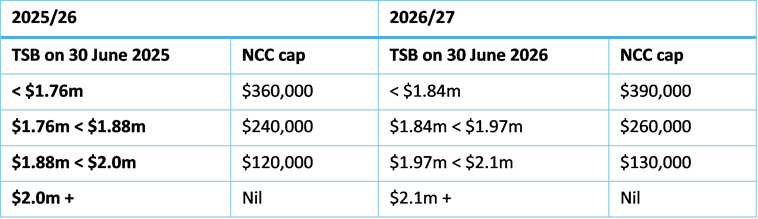
Importantly, the two- or three-year bring forward maximum contribution is based on the non-concessional contributions cap at the time the two- or three-year bring forward is triggered. There is no benefit from indexation in 2026/27 for individuals who triggered a bring forward in 2024/25 or 2025/26.
Example
Oscar triggered the three-year bring forward in 2024/25 by making a $150,000 non-concessional contribution. In 2024/25 the maximum three-year bring forward was $360,000. Oscar can contribute a further $210,000 prior to 30 June 2027 (subject to their total super balance). Oscar doesn’t benefit from indexation of the non-concessional contributions cap during this time.
Thresholds not indexed
The $500,000 threshold for accessing the five-year concessional catch-up contributions is not indexed. In addition, the $300,000 total super balance threshold for determining eligibility for the work test exemption is not indexed.
Historic rates and thresholds
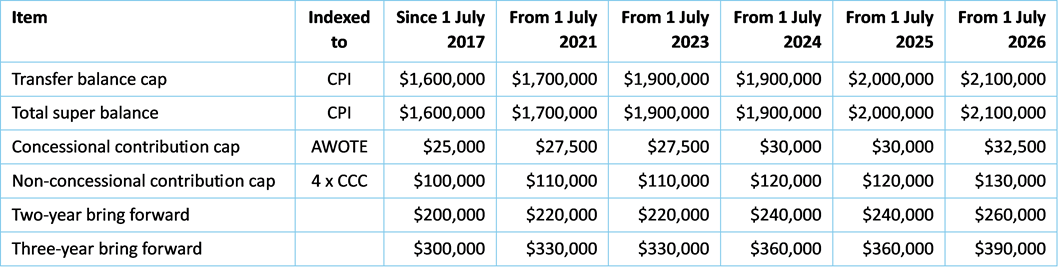
The table below summarises the history of the rates and thresholds:
Summary
The superannuation rules changed dramatically in 2017 and introduced a variety of thresholds that determine eligibility for certain tax concessions and the ability to make contributions. The indexation of the thresholds adds an additional layer of complexity from 1 July 2026. Understanding the additional complexities will assist individuals to maximise the opportunities available within super in both 2025/26 and 2026/27.
Julie Steed is a Senior Technical Services Manager at MLC TechConnect. This article provides general information only and does not consider the circumstances of any individual.