Register For Our Mailing List

Register to receive our free weekly newsletter including editorials.

Home / 648

Inflation is the biggest destroyer of wealth

Following two decades of ‘low-inflation’ in the 2000s and 2010s, inflation spiked up suddenly in 2021 after the Covid lockdowns unleashed a fiscal and monetary flood of cheap money. The ‘return’ of inflation in 2021 awakened a sudden resurgence in interest in the implications of inflation for investors.

Over the past couple of years, I have heard and read dozens of comments along the lines of: “Gee, we haven’t had to worry about inflation for so long, but now it’s back, we’d better take a look at inflation protection”.

The problem is that most advisers and portfolios managers have only ever experienced the wonderful disinflation boom since the early 1990s – a period when declining inflation and interest rates boosted nominal and real returns from every asset class.

Great returns made every asset manager look good – even, and especially bond fund managers - but it was mostly just lucky timing.

That wonderful low-inflation era is now gone, and so are the great returns from every asset class that came with it.

Before 2021, there was a widely held belief (even by central bankers) that inflation had magically been ‘solved’, so we no longer needed to worry about it anymore.

If inflation does return to the target levels (2-3% range in Australia, 2% in the US) – that does NOT mean the problem has gone away.

Even ‘low’ inflation destroys wealth

In reality, the wealth-destroying impacts of inflation never went away. Inflation has always been a silent, government-sponsored destroyer of the purchasing power of money, and therefore it critically important for investors, even in so-called ‘low inflation’ years.

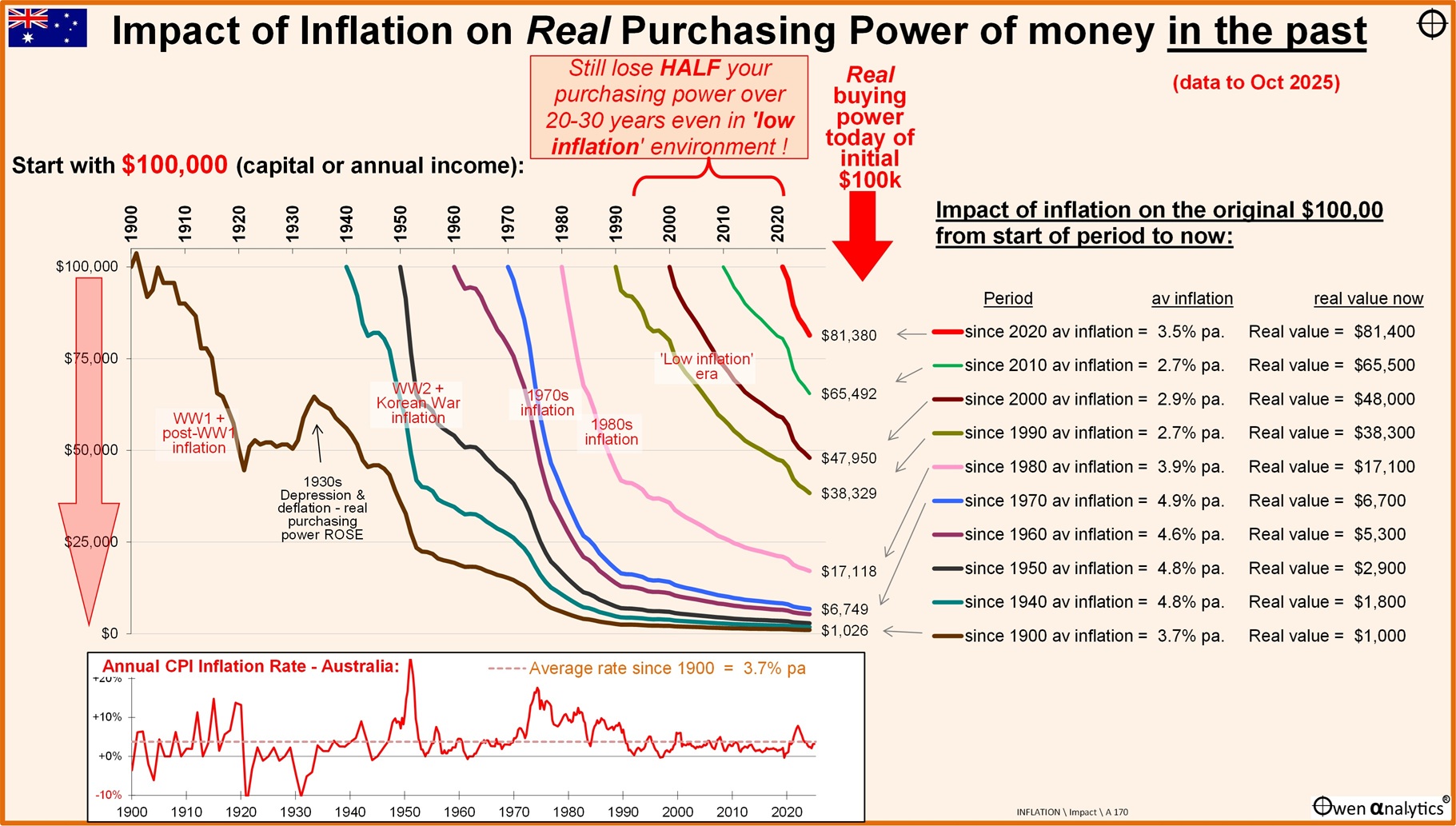
This chart shows the impact of inflation in Australia on $100,000 in assets or income, from different starting points.

Click to enlarge.

For example, take 1980 as a starting point (the pink curve near the middle of the chart). $100,000 of assets or income in 1980 was a lot of money at that time. Believe it or not, the median Sydney house price was just $69,000 in 1980! But $100,000 in 1980 dollars would have been whittled down to $17,000 in today’s dollars due to the compounding effects of inflation.

Another way of looking at it is this: if you had $100,000 in paper dollars in 1980 and locked it in a safe, if you opened the safe today you still have that same $100,000 in paper money, but it would only buy $17,000 worth of today’s goods and services. (Or, if you invested in bank term deposits in 1980 and you lived off the interest).

Inflation over the years since 1980 has eaten away 83% of its purchasing power.

With the 1980 ‘real’ (ie after inflation) value line (pink line starting from 1980), we can see that the real purchasing power of $100,000 in 1980 decayed very quickly during the high inflation 1980s, but then the rate of value decay eased off (a less steep downward value decay curve) in recent decades.

The section at the bottom of the chart shows the annual CPI inflation rate in Australia since 1900. In the past 50 years, inflation was very high in the 1970s, then declined in the 1980s, and was relatively ‘low’ in the 2000s and 2010s decades.

Destructive impact during ‘low inflation’ years

The problem is that, even in the so-called ‘low inflation’ years, inflation still had a very serious destructive impact on wealth and incomes.

For me, the most remarkable feature of this chart is the fact that the value destruction curves are still steeply negative even during the so-called ‘low inflation’ years. Look at how steeply negative the lines are for money starting in 1990 (grey), 2000 (brown), and 2010 (green).

For example, $100,000 starting in 1990 has been eaten away to a purchasing power of just $38,000 today.

$100,000 starting in 2000 has been eaten away to a purchasing power of just $48,000 today.

Even in the ultra-low inflation post-GFC years, $100,000 starting in 2010 has been eaten away to a purchasing power of just $65,000 today. That’s a big destruction of wealth and purchasing power in a relatively short period of time.

That’s one third of our wealth and living standards gone – permanently destroyed – in the so-called ‘low inflation era’.

2020s

In the current decade so far (up until October 2025), $100,000 at the start of 2020 has already lost 19% of its purchasing power, to just $81,000 today. We can see this in the short but very steep red value destruction curve to the right of the chart.

The downward slope of the 2020s wealth destruction curve is as steeply negative as the 1950s and 1980s wealth destruction curves on the chart.

The wealth-destroying effects of inflation never went away. Remember how central bankers dreamed about reviving inflation in the post-GFC years and in the Covid crisis - with their ‘positive inflation targeting’, zero interest rates, and their mad ‘QE’ (Quantitative Easing) money printing sprees. Likewise, governments with their free money hand-outs to anything that moved.

Well, they certainly succeeded in bringing back inflation (be careful what you wish for), and we are all paying for it now.

Unfortunately, even after more than half a decade after the Covid lockdown crisis, governments are still addicted to inflationary deficit-spending sprees.

And, for decades to come, our kids and grandkids will be paying for the debt that was borrowed by governments to fund the inflationary handouts. That’s a double-whammy of wealth destruction governments and their central banks have handed our kids – thanks for the debt, and thanks for the inflation!

Compounding in reverse

We all know about the benefits of compounding on investments. Albert Einstein is attributed as saying: “Compound interest is the eighth wonder of the world. He who understands it, earns it ... he who doesn't ... pays it”.

The destructive negative effect of inflation is compounding in reverse – Einstein’s “he who doesn’t [understand it] … pays it.”

Long-term investors, especially those who are (or will in the future be) relying on their savings to fund their living expenses, are heavily exposed to inflation, even so-called ‘low’ inflation.


Ashley Owen, CFA is Founder and Principal of OwenAnalytics. Ashley is a well-known Australian market commentator with over 40 years’ experience. This article is for general information purposes only and does not consider the circumstances of any individual. You can subscribe to OwenAnalytics Newsletter here.


  •   4 February 2026
  • 16
  •      
  •   
16 Comments
GeorgeB
February 05, 2026

Inflation is not only a destroyer of wealth it is also a destroyer of debt because it a transfers wealth by stealth, hence it suits socialist governments who can't live within their means although they will never admit it.

9
David
February 05, 2026

The most important thing to remember is that inflation is not an act of God, that inflation is not a catastrophe of the elements or a disease that comes like the plague. Inflation is a policy.
Ludwig von Mises

8
L F
February 05, 2026

Thanks Ashley for telling us what the problem is.
Can you now tell us what has been the best way over the last 50 years to defend against this problem?

3
Kevin
February 05, 2026

Well L F I've been working on a plan on how to beat inflation for close to 45 years. I'm reasonably confident I 've cracked it. The maths is extremely difficult but I think I'm close enough to getting it roughly right so the numbers can go on the back of an envelope that is in a ballpark.
Ashley has got it right and spectacularly wrong. The bit that is right is compounding in reverse 10 out of 10 for that one. The spectacularly wrong bit is 'we all understand the benefits of compounding'.
The maths, you need to be able to multiply a number by 2,the world's most difficult equation .Ashley said a house in 1980 cost $69K. Apparently houses have been compounding @ 7% for a very long time. Is that more than inflation? That means you double your money in ~ 10 years. Wait 'til you hear this one, it is out of this world. Get it roughly right so start the 69 @ 70. Perhaps I could've explained that a different way. Then 5x10 = 50,it's a miracle, it will double 5 times ,so that would be 7 , 14 , 28. Now I'm lost,like I said a very difficult equation, see if you can complete it yourself, you'll need to work out which way to move the decimal point.
My super has been returning ~ 9% for 40 years.That means you double your money every 8 years..
People like Shane Oliver say that the Australian index has been 'compounding' I think the word is @ ~ 11% for 125 years, but perhaps that was Noel Whittaker, or Paul Clitheroe. So many people it is difficult to remember their names, and they've been repeating that since shall we say 1980s. Michael Pascoe is another one. Then we have Romano Sala Tela (sorry if I've got the spelling wrong) He says 13%, work out for yourself how many years it takes to double your money there.
The biggest fool of them all, somebody called Buffett I think his name is. Doing something called compounding (? ) @ ~ 20% for 60 years. Now who would believe that?
I've done quite well myself for a long time. So I'm fairly confident I've worked out how to beat inflation. We'll have to wait and see what CBA are worth after after 50 years. I'm really beginning to think my plan is working.
I'm confident that if somebody in the future can work out how to beat inflation they'll probably get rich.
Are you Dudley in disguise? :-)

David
February 06, 2026

In Australia, there is no defense. We are all expected to wear the effects of inflation, because it is essentially a tax, and the tax laws are very careful not to include indexation to compensate. For those who try to avoid it by buying "appreciating" assets, the capital gains taxes are there to catch you in the end.

7
David
February 06, 2026

I neglected to say that the 50% concession on capital gains tax is now under threat, it being one of the last items in the tax law to give some partial concession to inflation. There is talk (Jim Chalmers) that this will be in the next budget, without an election to justify it. If it succeeds, will it be retrospective, or start for new assets purchased after the date of the law? Will be the new rate be 0%? Where is the opposition in all of this. Fighting among themselves?

6
steven
February 12, 2026

Being a part owner of companies that are growing their earnings at a higher rate than inflation and hive a high chance of continuing to do so. And ideally pay out some of those earnings to you every year in dividends. Be a patient part owner, over the long term, not worrying about short term share price moves driven by sentiment. (Hint - Banks and Miners mostly don't, most of the time.) Very good examples in Australia over many years are CSL, TNE, RMD, COH, JBH, NCK, PME, MAD, JIN etc.

Barry
February 09, 2026

In Australia, inflation is the creator of wealth not the destroyer of wealth if you invest in real estate.
Load up on as many houses as possible and load up on as much debt as possible.
Inflation will destroy the value of the debt, leaving you with fully paid off houses that you only put down a 10% or 20% deposit on. These houses pay you inflation adjusted rents that go up with inflation every year. As workers get their pay rises to keep up with inflation each year, they will be able to afford to pay you more nominal rent every year, as the money that their employers pay them loses value every year.

3
Dudley
February 09, 2026


In simple nominal terms.

Loan $1,000,000, interest only, interest rate 5.59% / y, 1 payment per year, 30 years.
= 1 * 30 * PMT(5.59% / 1, 1 * 30, -1000000, 0)
= $2,084,722.36 total nominal payment.

Principal place of Residence $1,000,000, price growth rate adjusted for costs and taxes 5.59%.
= 1000000 * (1 + 5.59%) ^ 30
= $5,113,093.05 value after 30 years.

The loan interest rate is too small; resulting in prices increasing faster than inflation and faster than wages.

2
Dudley
February 11, 2026


"simple nominal terms":

Can go a little further without much more complexity.

Value of Principal place of Residence $1,000,000, price growth rate adjusted for costs and taxes 5.59%.
= 1000000 * (1 + 5.59%) ^ 30
= $5,113,093.05 value after 30 years (regardless of paid cash or borrowed).

Total interest paid on loan:
= CUMIPMT(5.59%, 30, 1000000, 1, 30, 0)
= -1,084,722.36

Net value with loan:
= HomeValue - InterestPaid
= 5113093.05 - 1084722.36
= $4,028,370.69

Dudley
February 11, 2026


"a little further":

Simple real (inflation adjusted) terms.

Real price 30 y:
= 1000000 * ((1 + 5.59%) / (1 + 2.5%)) ^ 30
= $2,437,629.71

Real interest 30 y:
= CUMIPMT((1 + 5.59%) / (1 + 2.5%) - 1, 30, 1000000, 1, 30, 0)
= -$533,474.52

Real price - real interest:
= 2437629.71 - 533474.52
= $1,904,155.19

"The loan interest rate is too small; resulting in prices increasing faster than inflation and faster than wages."

Graham W
February 07, 2026

There was little inflation when the world was on the gold standard. Since the seventies a dollar has lost 97 % of it's purchasing power due to inflation. Gold maintains it's value over time.

1
OldbutSane
February 05, 2026

There is also a thing called "the time value of money" is a $1 today is worth more than a dollar in a years time (even with no inflation) as you can invest the money today to generate a return.

Also, when inflation is higher then it is often the case that asset prices increase commensurately.

Vee
February 11, 2026

The difficulty is getting a return high enough to combat the cost of inflation AND the tax take, otherwise you still go backwards.

Dudley
February 11, 2026


The difficulty is getting a return high enough to combat the cost of inflation AND the tax take, otherwise you still go backwards.

AND required risk premium. Likely cost of losses over the term of investment.

2
 

Leave a Comment:

RELATED ARTICLES

Investing across deflation, inflation and stagflation

A one-page introduction to investing

How inflation impacts different types of investments

banner

Most viewed in recent weeks

Building a lazy ETF portfolio in 2026

What are the best ways to build a simple portfolio from scratch? I’ve addressed this issue before but think it’s worth revisiting given markets and the world have since changed, throwing up new challenges and things to consider.

Ray Dalio on 2025’s real story, Trump, and what’s next

The renowned investor says 2025’s real story wasn’t AI or US stocks but the shift away from American assets and a collapse in the value of money. And he outlines how to best position portfolios for what’s ahead.

13 million spare bedrooms: Rethinking Australia’s housing shortfall

We don’t have a housing shortage; we have housing misallocation. This explores why so many bedrooms go unused, what’s been tried before, and five things to unlock housing capacity – no new building required.

21 reasons we’re nearing the end of a secular bull market

Nearly all the indicators an investor would look for suggest that this secular bull market is approaching its end. My models forecast that the US is set for 0% annual returns over the next decade.

Making sense of record high markets as the world catches fire

The post-World War Two economic system is unravelling, leading to huge shifts in currency, bond and commodity markets, yet stocks seem oblivious to the chaos. This looks to history as a guide for what’s next.

3 ways to fix Australia’s affordability crisis

Our cost-of-living pressures go beyond the RBA: surging house prices, excessive migration, and expanding government programs, including the NDIS, are fuelling inflation, demanding bold, structural solutions.

Latest Updates

Property

How cutting the CGT discount could help rebalance housing market

A more rational taxation system that supports home ownership but discourages asset speculation could provide greater financial support to first home buyers.

Investment strategies

The Ozempic moment for SaaS

Every investing cycle has its Ozempic moment, a narrative shock so compelling that the market briefly forgets that incumbents can and do adapt to transformative technology like AI.

Superannuation

Meg on SMSFs: Last word on Div 296 for a while

The best way to deal with the incoming Division 296 tax on superannuation is likely doing nothing. Earnings will be taxed regardless of where the money sits, so here are some important considerations.

Investment strategies

If people talk about a bubble, it’s unlikely to crash soon

It is almost impossible to identify a bubble in real time, and history shows they last far longer than we think, giving investors (perhaps misplaced) hope and short-sellers seemingly endless pain before the share price collapses.

Investment strategies

Seismic shifts that could drive private markets

Dealmaking appears to be on the mend, but investors could be well served to look through near-term trends toward six major themes that we think may drive private markets for years to come.

Latest from Morningstar

Corporations are winning the stock market. Here’s a new plan for everyone else

Retail investors have the worst trading record, according to a study of trading performance. Institutional investors weren't at the top either. Here are 6 ways to improve your odds.

Infrastructure

The bull case for Melbourne

A counterpoint to today’s prevailing narrative that Melbourne is the capital of a failing state defined by its strained public finances, COVID hangover and an opposition obsessed with undermining its own credibility.

Sponsors

Alliances

© 2026 Morningstar, Inc. All rights reserved.

Disclaimer
The data, research and opinions provided here are for information purposes; are not an offer to buy or sell a security; and are not warranted to be correct, complete or accurate. Morningstar, its affiliates, and third-party content providers are not responsible for any investment decisions, damages or losses resulting from, or related to, the data and analyses or their use. To the extent any content is general advice, it has been prepared for clients of Morningstar Australasia Pty Ltd (ABN: 95 090 665 544, AFSL: 240892), without reference to your financial objectives, situation or needs. For more information refer to our Financial Services Guide. You should consider the advice in light of these matters and if applicable, the relevant Product Disclosure Statement before making any decision to invest. Past performance does not necessarily indicate a financial product’s future performance. To obtain advice tailored to your situation, contact a professional financial adviser. Articles are current as at date of publication.
This website contains information and opinions provided by third parties. Inclusion of this information does not necessarily represent Morningstar’s positions, strategies or opinions and should not be considered an endorsement by Morningstar.