Register For Our Mailing List

Register to receive our free weekly newsletter including editorials.

Home / 679

Is it time to bail on Australian stocks?

Many Australian investors continue to maintain portfolios heavily concentrated in domestic blue-chip stocks. Historically, that approach has come at a significant cost.

Over the 12 months, the Australian market has returned less than 1% whilst the US market has returned ~20%. And over the last 20 years, the Australian market has produced a compound return of 7.2% whilst the US market has returned 11.8% (Vanguard). 

Is it time to bail on the Australian market?

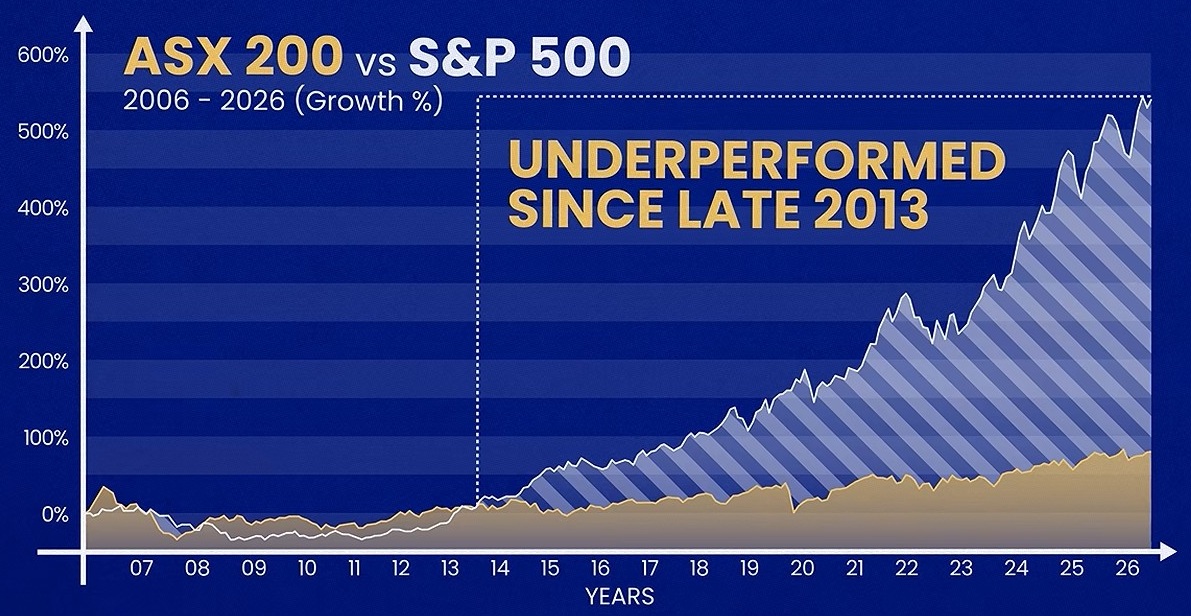
Below is a chart of the ASX 200 index against the S&P 500 index over the last 20-plus years. The chart highlights the extent to which the Australian market has relentlessly underperformed the US market. In fact, the only sustained period of Australian outperformance came during the resources boom between 2000 and 2007.

Source: Marcus Today

Following the growth 

US investors generally view the stock market as a growth investment, rather than for income generation. They look to the bond market for that. Australia's market is dominated by financial institutions that have traditionally offered attractive dividend yields. As a result, many investors view domestic equities primarily as an income source.

Growth stocks in Australia are hard to come by. Outside of resources, the market is dominated by the banks, which are mature, low-growth stocks, and a collection of industrials.  

Over the last 20 years, the S&P 500 is up 502%. The ASX 200 is up 76%. That's without dividends. We'd only be a little bit more competitive if you included them. Over the last 10 years, the S&P 500 is up 253%, the ASX 200 is up 66%. Over the last five years, the S&P 500 is up 75%, the ASX 200 is up 19%, and over the last year the ASX 200 is up less than 1% whilst the US market is up 22%. And that's just looking at the S&P 500 not the NASDAQ.

So why has Australia lagged so badly, and under what circumstances can it outperform?

The Australian challenge 

This is a chart of the performance of the Australian market (All Ordinaries index) relative to the US market (S&P 500 index) since 1980 to 2024.
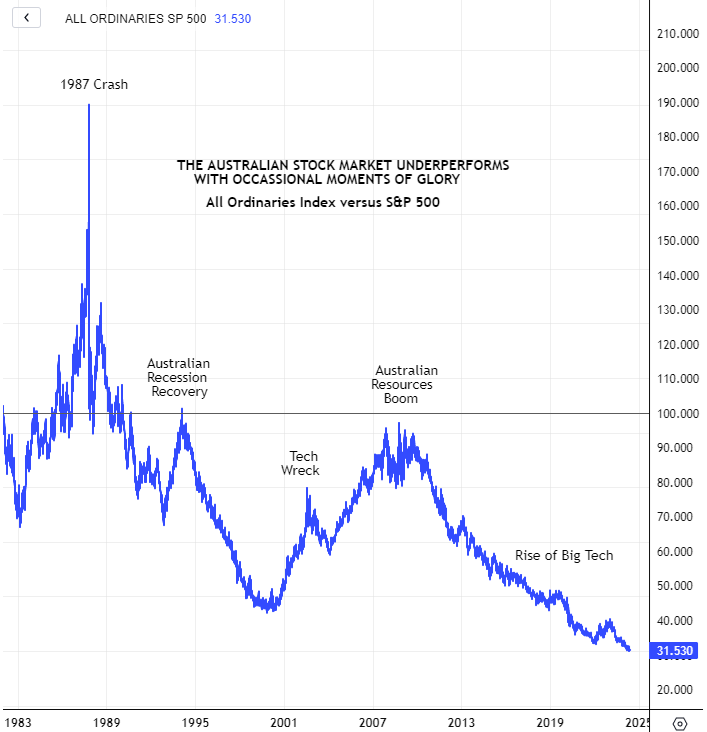
It highlights a few things:

  • Australia outperforms when the US falls. The Australian market is generally more defensive than the US. That said, nobody buys Australia simply because it might fall less during a sell-off. So when the US stumbles, the answer isn't necessarily to buy Australia. Often, the better option is to reduce equity exposure altogether.
  • Australia outperforms if there is a resources boom. It remains Australia's only competitive advantage in global equity markets. When the world becomes focused on resources (2000-2008), Australia and Canada suddenly become globally significant stock markets. Australia was all the rage in asset allocation meetings in every skyscraper from New York to Beijing in 2000-2008, as China's rapid development drove exceptional demand. Resource booms are fantastic for international investors because not only are they buying BHP and RIO and FMG, and not only are the share prices are going up, but when resources go up, because commodity prices are going up, the Aussie dollar also goes up. That delivers international investors the ‘Double Bubble’. They gain on the stocks and they gain on the currency. In 2005 every Wall St broker knew who Andrew Forrest was. I spoke to my Wall St broker mate in 2012 (after the resources boom) and asked if he was still interested in FMG and Forrest. He said - "Who? Oh yeah. No. That's all so 2000s". They'd moved on. About the only time Australia becomes interesting to the world is when commodity prices are rising sharply. 
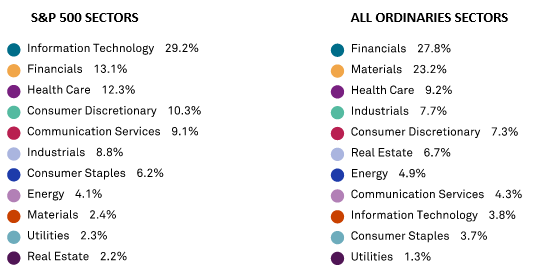
  • Australia underperforms and outperforms depending on the US Tech sector. The US Technology sector now accounts for 29.2% of the S&P 500 with Communication Services (also Tech) accounting for another 9.1%. The US is very tech-heavy. Our market has a tiny Technology sector (3.8% of the All Ords). The relative performance of Australia is related to the US Technology sector which is why one of the few times Australia outperformed the US was during the Tech Wreck. If Big Tech falls over, then Australia will outperform again (but again, relative defensiveness alone is rarely a compelling long-term investment thesis).
Australia's competitive advantage 

One factor that could quickly restore international interest in Australian equities is another resources boom. Australia remains a commodity-driven economy, and the Australian dollar has historically been closely linked to commodity prices and resource sector strength.

During the last major resources boom, the Australian dollar surged to more than US$1.10. That currency appreciation created a powerful incentive for overseas investors to allocate capital to Australia.

The attraction was what investors often call a "double bubble". Not only were resource stocks such as BHP and Rio Tinto generating strong share price gains as commodity demand surged, but foreign investors were also benefiting from a rising Australian dollar.

Given that the resources sector accounts for roughly 25% of the Australian sharemarket, global investors seeking exposure to commodities had little choice but to look at Australia. As they bought Australian resource companies, they gained exposure to both rising commodity prices and a strengthening currency.

For a US investor, for example, returns were driven by two separate sources: capital growth from Australian mining stocks and the currency gain from holding assets denominated in Australian dollars. The combination proved highly lucrative and led to significant international capital inflows into the Australian market. During this time, the share price of many stocks were becoming overinflated. 

The ETF revolution and international investing

Fortunately, investing internationally has become significantly more accessible over the past two decades thanks to the exchange-traded fund (ETF) market. The ASX now hosts over 400 ETFs, meaning investors can access overseas markets as easily as you would click and buy CBA. 

International investing also offers another potential benefit that many investors overlook: currency exposure. If US stocks go up and the Australian dollar goes down, investors benefit from something referred to as a "double bubble", benefitting from both equity returns and favourable currency movements. 

Australian investors with unhedged exposure to international equities can benefit when overseas markets rise and the Australian dollar weakens. As the Chinese economy stagnates, the Aussie dollar is facing relentless pressure against several major currencies and may not recover until there is another commodity boom. Investors heavily concentrated in Australian assets risk missing opportunities that take advantage of international currency strength and international stock markets.

For many Australian investors, this may not be a concern. The banks have historically provided attractive dividend income and remain a core holding for many portfolios. But there is opportunity to take advantage of growth stories that don't exist in Australia. The most obvious example is the technology sector, which has been a major contributor to the US market's outperformance of the Australian market.

Investors focused primarily on domestic blue-chip stocks may have benefited from dividends and stability, but at the cost of access to many of the global growth opportunities available through international markets. Today, ETFs provide a simple way to broaden that exposure beyond Australia.

Outside periods of resource-led outperformance, Australia's market has struggled to match the returns available in larger and more diversified global markets. Unless investors expect another sustained commodity boom, the case to broaden your investment universe beyond Australia remains compelling.

The bottom line is that Australia probably needs either a resources boom or a US Big Tech collapse to outperform again. For now, the trend is set - Big Tech, helped by AI prospects, is seeing tremendous earnings growth relative to any other section of the economy and relative to any Australian sector.


This is an adapted version of a transcript from the Marcus Today YouTube channel. The full video can be found here

Marcus Padley is the author of the daily stock market newsletter Marcus Today, see marcustoday.com.au. This content is general information only and does not consider your personal circumstances. It is not personal financial advice. Please consider whether it is appropriate for you or seek professional advice before making investment decisions.

  •   9 September 2026
  • 17
  •      
  •   
17 Comments
Steve
September 13, 2026

I think simplistic is a good choice of words. You may be content with BHPs performance but I expect we could find 20-50 companies in the US with a superior 20 year return and that is the point. The author didn't say the Aussie market was a dud, just a middling performer with limited prospects. Just like most of our corporate directors. Any concerns about iron ore from Simandou by the way?

BeenThereB4
September 10, 2026

Marcus, Australian comparisons with US would improve (? look less bad) if you include value of franking credits. As you know these are particularly valuable for Superannuation funds in Pension mode.

Also some may be wary of concentration of Wall Street in the Mag Seven !

9
Rob
September 10, 2026

Answered your own question Marcus. Australia's only industry with a global "competitive advantage" are resources so a broad mkt analysis is useless. Go sector by sector, include dividends plus franking and u add circa 6% per annum - picture becomes much clearer. Talking my own book of course but it is doing ok!

6
Mart
September 10, 2026

Impossible to argue with Marcus other than to point out the impact of franking credits, the annual capital gains hit of ETFs, etc but the base premise is indisputable. Guess it somewhat depends if you're looking for income or growth. I'd be fascinated to see Peter Thornhill make the case for Australian shares in response mind!

5
Jon Kalkman
September 10, 2026

No mention here of the different tax treatments of company profits between the two countries. In the US, company profits are taxed twice, once at the company level and again in the hands of the shareholder. The effect is that companies pay less in dividends and retain more of the profit. Warren Buffett doesn’t pay any dividends. The retained profits allows directors to grow the business, buy back their own shares or offer share splits and this is reflected in rising share prices. That arguably also makes the share market more volatile and volatility makes life difficult for retirees who look for regular income. Many shareholders, with other sources of income, also prefer their share of company profits to be returned to them as capital gains rather than income because they only pay that tax when they sell.

Australia’s system of franking credits means that company profits are only taxed once - in the hands of the shareholder who pays tax on those profits at their marginal rate. Arguably it encourages companies to actually pay tax as that pre-paid tax is a direct benefit to every Australian shareholder in that it represents additional taxable income. Super funds, with their low tax rates, love franking credits. The impact of franking credits is subject to great debate but it clearly leads to more of the company profits being paid out as income than capital gains. That arguably means less retained profits for business growth but it does not restrain companies from seeking more capital from shareholders by issuing new shares. It probably does restrain company boards from some of the expensive overseas frolics we’ve seen in the past.

Is Marcus suggesting we return to double taxation?

3
James#
September 10, 2026

"Is Marcus suggesting we return to double taxation?"

No, I think more making the point that double taxation is why US companies, in part, pay out less dividends. Investors in the US prefer growth from shares, income from bonds.

CGT changes in Australia punish investors and our CGT will soon be one of the highest in the world.

Marcus is perhaps softly selling his Strategy Fund which market times the USA market, using index and thematic ETF's. He cashes out completely, often! Not for everyone!

4
Trevor
September 11, 2026

Returning to double taxation or at least abolishing franking credit refunds is most probably on the government’s to do list for its next term.

4
Steve
September 13, 2026

Capital gains in the US are not taxed at marginal rates, if held more than 1 year. Rates are 0, 15 or 20% depending on filing status, so this is another reason shareholders prefer their investments to provide capital growth rather than dividends. No surprise companies know this and act accordingly.

2
AlanB
September 12, 2026

Instead of International ETFs that don't pay franking credits and have AMIT capital gains tax consequences, there are still some international LICs that have rising share prices, growing dividends, 100% franking credits and are not AMITs. PGF, MFF, WQG.

1
B.Cooper
September 10, 2026

Might want to correct the spelling on your graph - Occasional not Occassional

John
September 11, 2026

Might want to rewrite the article to include impact of dividends including franking credits.

2
Steven Jackson
September 11, 2026

No mention nor allowance for any devaluation of the USD to help repay the 40trillion and rising debt which could be analysed as unrepayable or for the need to inflate away the debt. Also what evidence of growing earnings for US tech companies besides circular investing among the club members to give the impression of earnings and possible growth thereof.
All round a risky investing environment for the next extended period without taking into consideration the self generated geopolitical risk a la war and imagined revanchism everywhere.

Rob
September 12, 2026

I have already commented on this article as i think it is simplistic, but I will drop another rock in the pond.

30 years ago a very smart Actuary drilled into me the necessity to match "future liabilities" with "investment assets", a concept totally foreign to Global politicians. If all or most of your future liabilities are in A's, then the second you buy offshore Assets, you have, in the jargon, a "mismatch". If I go back to 2013/14 the Aussie $ was at parity, 1:1 with the US$, cracking time to buy US$ denominated assets. With the USA being run like a Casino, could it happen again and if so, how would your investments look? In a word ugly! Balance is important.

It is of course true that if you own BHP, you already have US$ and Global currency exposure, even dividends are in US$'s - enough for most people? Probably! In a long term portfolio, you simply cannot ignore "forex risk" when considering investment options.

Steve
September 13, 2026

There are hedged alternatives which reduces currency risk but retains exposure to the rest of the world if that's an issue holding you back.

Roger Ng
September 13, 2026

Typically the US investment landscape is spoilt for liquidity. Take startups for example. In Australia, startups have to go cap-in-hand to sophisticated investors. No institution will invest on a pre-money basis. In the US that is flipped. There are funds galore for early stage companies. That extraordinary liquidity flows all the way through to massive IPOs. As I see it, the problem with the US is that every decade or so they ignore a key component of investment - Risk. You could be forgiven for thinking that there was a complete absence of risk when Mr Musk IPOd SpaceX recently - it was oversubscribed. The other key component which usually brings risk into focus is the absence of the ratings agencies in this discussion. Once they intervene by possibly downgrading US debt again, the bond market will respond. Usually the equity market follows.

Kym
September 14, 2026

AEQ is popular due to the tax credit. So let's see the numbers re returns based on AFTER-TAX RETURNS. Headline rates aren't much use in understanding how an accumulator is going


Leave a Comment:

RELATED ARTICLES

Four options for an income investor’s next dollar

Why Australian shares are falling behind the world

The limits of a quality investing approach in Australia

banner

Most viewed in recent weeks

Why have Australian living standards 'fallen' and how do we fix it?

For the last few years there has been much talk of a 'cost-of-living' crisis in Australia and of 'falling living standards'. Lately this has flared up again with the pickup in inflation resulting in a renewed fall in real wages.

Will you run out of money in retirement?

Fear of running out has become a defining retirement anxiety. Why do some retirees die with substantial wealth while others deplete their nest egg? Evidence suggests the answer is more complicated than we think. 

Four options for an income investor’s next dollar

What if Australia’s golden age of dividends is ending? Rather than overhaul your portfolio, it may be worth considering where new capital can work harder. I discuss four income strategies and the trade-offs behind each.

Why spending more in early retirement can improve lifetime income

Conventional wisdom encourages retirees to preserve superannuation. But if those likely to qualify for the Age Pension later in life spend a little more today, it may deliver higher lifetime income and a more stable retirement.

The investment that sidesteps the new tax traps

Tax rules have changed, but many investors are still using yesterday’s strategies. Insurance bonds may offer advantages for those seeking greater control, tax efficiency and certainty about their wealth.

Testamentary trusts have secured the CGT exemption

Treasury’s latest CGT reform draft delivers a win for testamentary trusts and deceased estates, exempting estate-derived gains from the 30% floor. However, questions on death and divorce rollovers remain unresolved.

Latest Updates

SMSF strategies

Red flags to watch out for when considering an SMSF

Thinking about an SMSF? Before you sign anything, learn how to spot the difference between genuine advice and a sales pitch, understand the real costs, and avoid the compliance mistakes that attract ATO attention.

Shares

Is it time to bail on Australian stocks?

For generations, Australian investors have backed banks, miners and dividends. But has that loyalty come at a cost? A look at the numbers raises an uncomfortable question about where future returns will come from.

Investment strategies

Making a case for the 40 year mortgage

The housing debate tends to focus on prices, interest rates and deposits. Yet an overlooked feature of the mortgage itself could help buyers enter the market sooner without abandoning prudent lending standards.

Investment strategies

The market paid for change, not comfort

Reporting season has delivered a clear message: the market is no longer paying simply for quality, resilience or an earnings beat. It is paying for change in earnings expectations and the outlook ahead.

Investment strategies

Not all income is created equal

Market conditions are shifting as familiar yield sources quietly lose momentum. Australian public credit may be the most compelling source of income in today's market but many investors haven't noticed the shift. 

Investment strategies

Will AI destroy investor capital?

Some of history's most important innovations changed the world while leaving investors much poorer. As trillions pour into AI, a familiar pattern may be emerging, one that rewards society far more generously than capital.

ASX reporting season: Signals, surprises, stock stories

August reporting season delivered strong earnings and bigger-than-expected dividends, but beneath this, a more nuanced story emerged. First Sentier Investors’ David Wilson and Christian Guerra unpack the key trends.

Sponsors

Alliances

  • ASA-Logo-RGB-ActiveGreen-web.png

© 2026 Morningstar, Inc. All rights reserved.

Disclaimer
The data, research and opinions provided here are for information purposes; are not an offer to buy or sell a security; and are not warranted to be correct, complete or accurate. Morningstar, its affiliates, and third-party content providers are not responsible for any investment decisions, damages or losses resulting from, or related to, the data and analyses or their use. To the extent any content is general advice, it has been prepared for clients of Morningstar Australasia Pty Ltd (ABN: 95 090 665 544, AFSL: 240892), without reference to your financial objectives, situation or needs. For more information refer to our Financial Services Guide. You should consider the advice in light of these matters and if applicable, the relevant Product Disclosure Statement before making any decision to invest. Past performance does not necessarily indicate a financial product’s future performance. To obtain advice tailored to your situation, contact a professional financial adviser. Articles are current as at date of publication.
This website contains information and opinions provided by third parties. Inclusion of this information does not necessarily represent Morningstar’s positions, strategies or opinions and should not be considered an endorsement by Morningstar.