Register For Our Mailing List

Register to receive our free weekly newsletter including editorials.

Home / 577

Last call on bank hybrids

On Tuesday 10 September 2024, APRA announced its long awaited proposed changes on a more effective capital framework for a financial crisis. It is a gutsy document that tears up the playbook on bank regulatory capital funding. APRA wants to simplify the capital framework for banks. It wants to remove Additional Tier 1 (AT1) bonds and replace it with mainly Tier 2 and some Common Equity Tier 1 (CET1) capital.

In short, the AT1 hybrid market for Australian banks will cease to exist. For insurers, it looks like it will remain unchanged, for now. APRA does not expect to see banks increase AT1 from current levels or extend call dates beyond 2032.

The transition will be orderly – or so APRA says. From Jan-2027, outstanding AT1 bank hybrids would be eligible for Tier 2 capital treatment until their first scheduled call date. What happens after that is not clear. It is also not clear what happens to bank-related NOHC structures like MQG and AMP.

There are obvious funding implications. More Tier 2 supply = wider spreads. Less AT1 supply = tighter spreads. There is a perceived assumption that AT1 investors will just pack-up and roll into Tier 2. Whilst this may be true for the institutional investor, for those that love hybrids for tax efficient franking credits, it seems just as likely they will stay in the hybrid market for up to the next eight years. The point here is that we do not think AT1 investors that have the ability to purchase OTC securities will just like-for-like transfer the demand into Tier 2.

Importantly, APRA’s document has started what appears to be the unofficial transition for bank AT1 capital. It is unclear as to if any more AT1 bank hybrids will be issued. Strictly speaking, APRA does not expect AT1 levels to increase, so a refinance could be on the cards, so long as the call period is before Mar-2032 (NABPH’s first call date). You can make the argument that until Dec-26, ASX-listed bank AT1 transactions could still occur (noting the term is still greater than five years to first call meeting reg-cap eligibility requirements). Assuming otherwise, i.e. no more bank hybrids, then the next ASX AT1 may be issued by CGF, which has CGFPC’s first call in May-2026, closely followed by SUNPH in Jun-26. That is 1 ¾ years away!

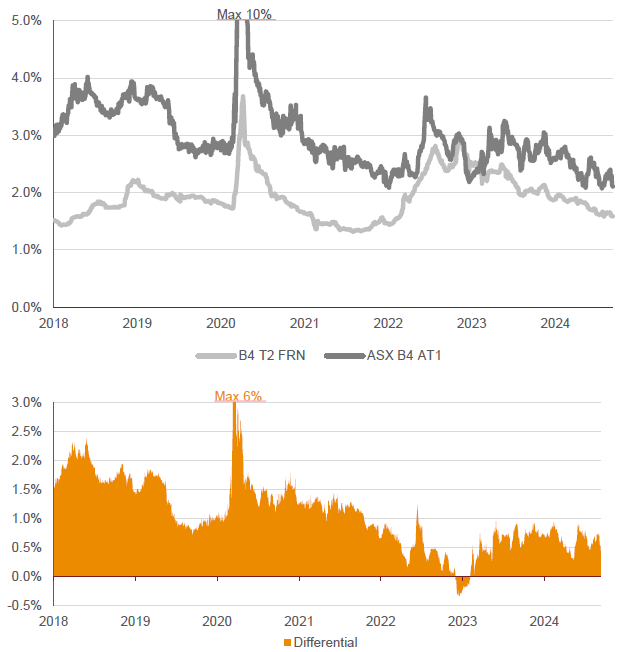
Higher spreads in Tier 2 markets increases the risk of uneconomic non-call events. This is not being priced in, particularly for the non-major banks, where we expect the funding impact to be worst at the Tier 2 level – which is contrary to APRA’s opinion. The risk of non-call is not present in the AT1 market.

These are proposed changes. There is still additional consultation being sought. But the Rubicon has been crossed, and it is highly likely that from Jan-2027 the new requirements will be effective, and the official transition will have started.

This will be a gold rush. There is some c.$43 billion in AT1 hybrids locally, the Big Five (including MQG and MBL) make up c.$38 billion of that. Investors will need other forms of income, ideally franked, to replace the AT1 redemptions that occur. There will be a raft of new product issuance to meet this. Winners include LITs, ETFs, MCIs, corporate hybrids, and structured products. We do not think the ASX Tier 2 market will return based on APRA’s strong commentary surrounding the litigation risk of mis-selling, and the contagion risk it would “reintroduce” to the system.

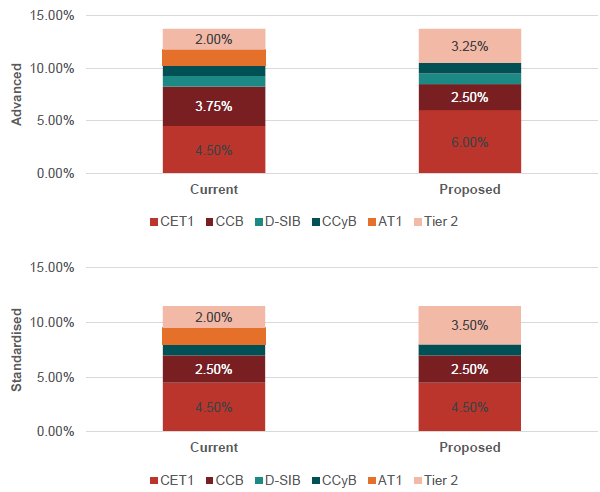
The specific changes to the capital framework are as follows:

  • Advanced banks (ANZ, CBA, NAB, WBC, MBL, ING)

- Replace existing 1.5% AT1 with at least 0.25% CET1 and 1.25% Tier 2.
- Increase the minimum CET1 from 4.5% to 6.0%.
- Remove the Advanced portion of the capital conservation buffer of 1.25%.
- Increase the minimum Total Capital ration to 9.25% via additional Tier 2.
- This means the total capital plus CET1 buffer level of 13.75% remains unchanged.

  • Standardised banks (all others)

- Fully replace AT1 with Tier 2 capital.
- Remove the minimum Tier 1 Capital ratio.

Figure 1. Current vs Proposed Frameworks – Advanced vs Standardised Banks
Source: BondAdviser, APRA.

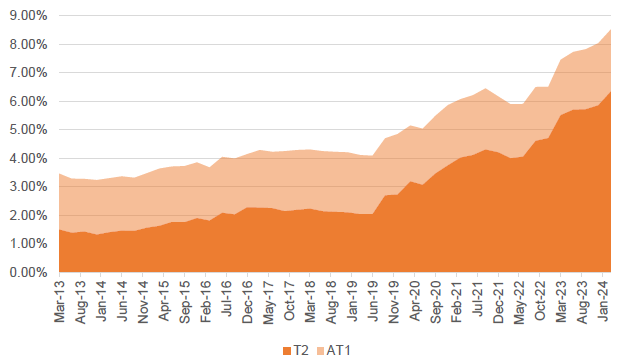
Figure 2. Major Bank Basel III Tier 2 and AT1 capital as a % of RWA
Source: BondAdviser, APRA.

Winners

Insurance: Biggest winners. There are no proposed changes to the insurance capital requirements. They will be able to issue ASX hybrids at much cheaper rates given the outsized demand. For reference, these three issuers (SUN, IAG, CGF) only have seven securities on the ASX worth a total of just c.$2.7 billion.

Mutuals: Whilst this has impacts to the cost of AT1 and Tier 2 (if outstanding), it likely makes the cost of Mutual Capital Instruments (MCIs) much cheaper. MCIs were not referenced in the report, and we think they will not be impacted. Like the insurers, mutuals will benefit from being able to issue ASX MCIs at tighter spreads via bigger bookbuilds.

Corporate Hybrids / Listed Bonds: Could we see the return of the ASX corporate hybrid market off the back of this change to the market? It is possible, and the insatiable demand for franking credits and steady income means some attractive funding rates could be found for crafty corporate boards.

Income LITs: Listed investment trusts have been shunned by new issuers since the removal of stamping fees. We expect investors to pile into existing private debt products (MXT, MOT), but also for new issuers and products to emerge to fill the gap.

Losers

Tier 2 bonds: Tier 2 bonds are at risk of three problems. (1) Higher supply, (2) credit ratings downgrade, (3) extension risk.

(1) The passive roll-over from listed-AT1 into unlisted-Tier 2 is not as simple as it sounds. Retail investors cannot access OTC markets and remaining suitors will likely progressively demand a higher premium to swallow up to $40 billion of fresh Tier 2 supply. We question whether $A Tier 2 and legacy AT1 valuations could converge as a result. While APRA has stated it will only require Tier 2 capital equivalent to 1.25% of RWAs to replace the 1.50% minimum requirement for AT1 capital, banks will likely continue to hold healthy buffers as they done historically (the Majors hold AT1 capital over 2% of RWAs for context) and as a preference over issuing more equity.

(2) Tier 2 instruments are currently notched-down up to 3 notches from senior unsecured ratings of Australian banks (A- versus AA- in the case of the Majors) and will become the secondary layer of loss absorption behind CET1 capital under APRA’s proposals. While there is a lack of global precedent to go off, we question whether Tier 2 capital could be notched down further to account for the additional implied subordination. We note AT1 hybrids are typically 2 notches lower than Tier 2 instruments (or BBB for the Majors). This requires a deeper examination, which we will be doing over the coming days for our clients.

(3) If Tier 2 spreads trend wider over the coming the years, the outstanding vintage of Tier 2 bonds, issued at tight spreads, may not be called on first date given the uneconomic nature to the issuer of an early refinancing at a higher rate. APRA have been strong on this in the past, and if a 100bps differential opens up the risk is real. We note for this to occur, point (1) and (2) probably have to be correct.

Regional and smaller banks: These banks struggle to attract big orderbooks for Tier 2 as it is. They will have to pay away even more to get the local market to pay attention. Amplifying this is that they do not have great access to international debt capital markets. APRA is assuming that from an all in funding cost the Regionals and smaller banks will actually be better off. We are not convinced this will be the case and expect these bank Treasurers to be rueing the day given the loss of deep funding diversity.

Imputation credit investors: This change means there are less ways for investors to get access to a steady stream of franking credits outside volatile common equity ownership.

Figure 3. Major Bank Tier 2 vs AT1 5-year trading margin
Source: BondAdviser.


Charlie Callan, CFA and Jack Pobjoy are Directors at BondAdviser. This article is general information and does not consider the circumstances of any investor.


  •   11 September 2024
  • 10
  •      
  •   
10 Comments
Neil
September 13, 2024

I know that it’s really a side issue to your important and informative article, but I’m not sure why you keep referring to franking credits as a positive feature of hybrids. In my experience they make up part of the coupon rate - they are not additional to it. I would rather receive an unfranked interest payment of $100 up front than get $70 and then have to wait till tax time to receive my remaining $30. Why would any investor chase a stream of franking credits in preference to full cash payments of the same total amount?

Dudley
September 13, 2024

"Why would any investor chase a stream of franking credits in preference to full cash payments of the same total amount?":

They would not.

Government demands dividend payers pay 25% - 30% withholding ['company'] tax on profits because they don't want to chase dividend recipients for tax payable - especially those in foreign places.

Nick
September 13, 2024

Hi Neil,
Self Managed Super Funds chase the franking credits as these funds pay a 15% tax rate while receiving a 30% franking credit. There are approximately $1 trillion in SMSF assets and they commonly utilise the hybrid market. In this case, the rebate they receive for the franking credit is additional to the return on their investment.

Dudley
September 14, 2024

"the rebate they receive for the franking credit is additional to the return on their investment":

Not additional to.

Return on investment is gross profit [like gross wage].
Dividends are after tax, net, profit [like net wage].
Tax withheld from gross profit paid as dividends is credited to the dividend recipient as franking credit [like wage income tax].
Dividend recipient's income is calculated on dividends received plus franking credit [= gross profit paid as dividends] [like wage income tax calculation].
Dividend recipient pays / receives the difference between tax paid and franking credit.

Dudley
September 14, 2024

"tax paid and franking credit": tax payable and franking credit [tax paid].

soo
September 15, 2024

I like dividends refund

Michael
September 15, 2024

It would be useful for APRA to demonstrate why this change is necessary. It is not clear what problem is being fixed and why it warrants major change? This article sets out some consequences. Many skilled private sector finance specialists that would know more about the intricacies of market operations than APRA have also expressed concerns.

I hate to be cynical but the current Government does not like the "cost" of franking credits and needs more revenue. I presume Dr Jim very happily signed this one off.

Bruce
September 15, 2024

The article demonstrates that its authors clearly understand the impact of what is proposed. For those of us with a lower level of comprehension is it possible that they could produce a follow-up version for financial dummies such as myself ?

ChairmanGG
September 15, 2024

Well we can all have an opinion, but I’d think the government concern has been the proportion of retail / unsophisticated interest in hybrids, who may have been mis sold these on the understanding it was equivalent to a term deposits but with juiced ( and franked) income.

Perhaps my former mates at APRA ( but don’t email ME with your complaints) also think that the proportion of CPR which is actually debt and not real equity is too high…. Hybrids were only supposed to make up a smallish proportion of total equity and its Akron 15 years to redress.

As for why it changes for one part of regulated entities (ADIs) and not for other issuers…. Don’t know. Maybe if we still had bancassurance you could fund through the insurer and on lend internally!!

Brian
September 16, 2024

The first call on NABPH is Dec 29, NABPK is Mar 32


Leave a Comment:

RELATED ARTICLES

How 'ridiculous' are hybrids for retail investors?

Replacing bank hybrids with something similar

The useful role that subordinated debt can play in your portfolio

banner

Most viewed in recent weeks

Are you making these SMSF mistakes?

After four decades advising investors, there are a few common mistakes I've seen SMSF investors make. From holding too much cash and chasing yield to overtrading and trusting tips. Are these errors costing you?

Why have Australian living standards 'fallen' and how do we fix it?

For the last few years there has been much talk of a 'cost-of-living' crisis in Australia and of 'falling living standards'. Lately this has flared up again with the pickup in inflation resulting in a renewed fall in real wages.

Will you run out of money in retirement?

Fear of running out has become a defining retirement anxiety. Why do some retirees die with substantial wealth while others deplete their nest egg? Evidence suggests the answer is more complicated than we think. 

Retirement spending is not one-size-fits-all

New data challenges the idea that Australians are underspending their super. The bigger issue may be helping retirees navigate complexity, make confident decisions and use their savings to support security, wellbeing and choice.

Four options for an income investor’s next dollar

What if Australia’s golden age of dividends is ending? Rather than overhaul your portfolio, it may be worth considering where new capital can work harder. I discuss four income strategies and the trade-offs behind each.

The missing link in the CGT debate

A little-noticed consequence of Labor’s tax changes could have implications well beyond investors’ tax bills. The issue raises bigger questions about incentives, capital allocation and the drivers of long-term economic growth.

Latest Updates

SMSF strategies

Meg on SMSFs: What do we think about reversionary pensions these days?

Reversionary pensions have long been a staple of SMSF estate planning, but are they still the best option? Meg Heffron revisits a once-clear favourite and asks whether changing super rules have shifted the balance.

The ageing ‘crisis’ has not and will not happen

Rising age dependency is frequently treated as a warning sign for economies. But when actual workforce participation is examined, a strikingly different picture emerges about ageing, productivity and economic sustainability.

Retirement

How does the 4% rule stack up?

The 4% rule has long been retirement's gold standard. But after a difficult period for investors, fresh analysis suggests a more conservative approach may significantly improve the chances of making savings last.

Shares

Four charts that expose market concentration risk

Investors have recently been rewarded for backing market leaders, but history suggests this eventually comes at a cost. Now may be the time to review whether your portfolio is carrying unintended risks beneath the surface.

Investment strategies

The case for gearing beyond property

Most Australians gear into property but ignore shares. That may be a mistake. Used carefully, geared equity strategies can enhance long-term returns, reduce cash tied up in growth assets and support retirement income goals.

Economy

Australia's $1 trillion debt pile

The headlines exclaiming that Australian government debt has hit A$1 trillion and US government debt has hit $40 trillion has turned heads, but how serious are they really? Will Australia's mix of debt create challenges?

Economy

Has 100 years of growth made us any happier?

For decades, GDP has been the benchmark for economic success, but has it made us materially happier? If happiness does not rise in lockstep with prosperity, are we overlooking what constitutes a successful society?

Sponsors

Alliances

  • ASA-Logo-RGB-ActiveGreen-web.png

© 2026 Morningstar, Inc. All rights reserved.

Disclaimer
The data, research and opinions provided here are for information purposes; are not an offer to buy or sell a security; and are not warranted to be correct, complete or accurate. Morningstar, its affiliates, and third-party content providers are not responsible for any investment decisions, damages or losses resulting from, or related to, the data and analyses or their use. To the extent any content is general advice, it has been prepared for clients of Morningstar Australasia Pty Ltd (ABN: 95 090 665 544, AFSL: 240892), without reference to your financial objectives, situation or needs. For more information refer to our Financial Services Guide. You should consider the advice in light of these matters and if applicable, the relevant Product Disclosure Statement before making any decision to invest. Past performance does not necessarily indicate a financial product’s future performance. To obtain advice tailored to your situation, contact a professional financial adviser. Articles are current as at date of publication.
This website contains information and opinions provided by third parties. Inclusion of this information does not necessarily represent Morningstar’s positions, strategies or opinions and should not be considered an endorsement by Morningstar.