Register For Our Mailing List

Register to receive our free weekly newsletter including editorials.

Home / 640

Regulators warn super funds to lift retirement focus

97% of super fund trustees say that they’ve improved their understanding of member retirement needs in the last three years, yet only 15% rate that understanding as being better than “good”. Only around 1 in 6 trustees can robustly track how members are faring toward (or in) retirement.

Incomplete member insights and patchy outcomes measurement are just some of the findings of the recent third annual review into the implementation of the retirement income covenant (RIC), released jointly by the Australian Prudential Regulation Authority (APRA) and the Australian Securities & Investments Commission (ASIC).

As the ASIC media release to this 2025 RIC ‘Pulse Check’ bluntly stated:

“The report highlights that despite RIC obligations being introduced over three years ago on 1 July 2022, the gap is widening between trustees actively promoting better retirement outcomes for their members and those that are not.”

Concerning words, given the forecast 2.5 million Australians who will commence their journeys toward retirement in the coming decade, joining over 4 million retirees already there.

Retirement income covenant – a refresher

The retirement income covenant joins a host of other legislative ‘promises’ that super funds must uphold to members (whether explicitly written into their governing rules or not), with effect from 1 July 2022. It does not apply to SMSFs.

In essence, the RIC requires APRA-regulated funds to formulate, regularly review and give effect to a retirement income strategy to help members achieve and balance three retirement objectives:

  • maximising their expected retirement income;
  • managing expected risks to the sustainability and stability of this retirement income;
  • having flexible access to expected funds during retirement.

Strategies may differ for different types (cohorts) of members (e.g. by age, balance, income needs or other factors).

Every super fund must make a summary of its retirement income strategy publicly available on its website to help individuals decide if the suite of retirement measures on offer is suitable/sufficient for their needs.

As to why the RIC was introduced, population dynamics are forcing the hand of governments and regulators, as I recently wrote about in ‘Super crosses the retirement Rubicon’.

The 2025 Pulse Check findings

This newest review follows similar reviews at the first and second anniversary marks of the RIC commencement.

The July 2023 ‘thematic review’ expressed concerns with trustees properly understanding member needs, designing fit-for-purpose assistance and overseeing retirement income strategy implementation.

This was despite clear written expectations by APRA prior to July 2022 on the key areas that trustees should consider in formulating and executing their RIC programmes, outlined below.
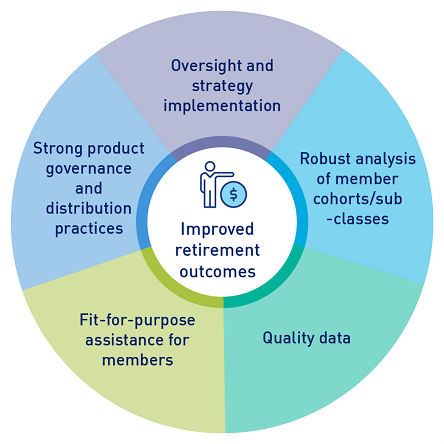

Source: APRA, ‘Implementation of the retirement income covenant,’ letter to RSEs, published 7 March 2022

The July 2024 RIC ‘Pulse Check’ noted that while trustees with larger memberships and more members approaching retirement had made better progress, it still found “considerable variability in the implementation approach taken by RSE [registrable superannuation entities] licensees, and a lack of urgency in embracing the intent of the covenant.”

As for this latest, more detailed, RIC ‘Pulse Check’, it involved responses from 39 RSE licensees, representing some 95% of the ~$550 billion in retirement phase assets under APRA regulation.

The high-level findings are best captured in the following passage:

“Some RSE licensees have shown leadership by investing significant effort into meeting the needs of members transitioning to and in retirement, with a smaller number innovating and pushing forward best practice.

Still, far too many have been content with making incremental improvements. In many cases, we have not observed the level of investment in robust governance, innovative retirement income solutions and tailored support for members that regulators and, more importantly, members should expect.”

This is broadly consistent with recent regulatory commentary that RIC implementation is bifurcating into a market environment of ‘leaders and laggards’.

As to why so many trustees are still struggling three years into the RIC becoming law, the below table outlines the challenges some are finding difficult to overcome.

Key challenges RSEs cite in implementing the RIC (adapted from Table 3 – 2025 Pulse Check)
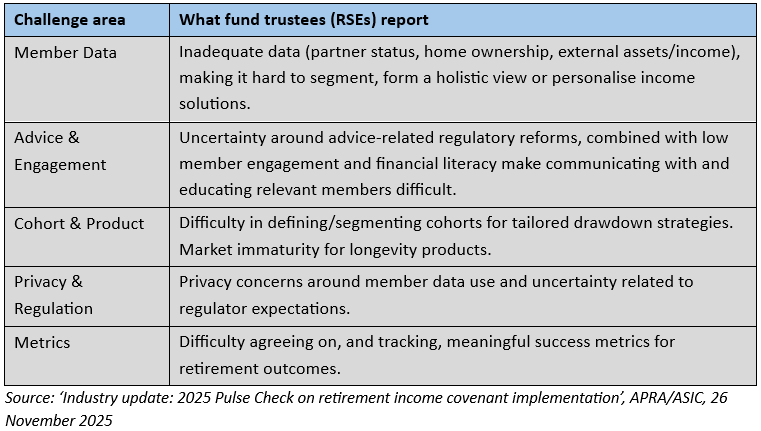
Source: ‘Industry update: 2025 Pulse Check on retirement income covenant implementation’, APRA/ASIC, 26 November 2025

In terms of member data, that this most recent review finds trustees still struggling with developing a holistic representation of member circumstances is highly concerning, as the 2023 review had suggested better practice as:

“… seeking to better understand the financial profile of their membership in different sub-classes beyond superannuation balance, including key information such as home ownership, partner/marriage status, and material assets and income outside of the RSE or the superannuation system.”

Having outlined why understanding the member’s household balance sheet (in particular home ownership and any related debt) is so important to formulating a view of retirement readiness, including here, here and most recently, here, the lack of progress since 2023 is unfortunate indeed.

Tension between the ‘cohort of one’ and ‘just one cohort’

Another area of concern is the lack of progress on cohorts; segmenting members such that there can be differentiated member experiences for information, communications, behavioural nudges, education, guidance, retirement income product solutions and suggested drawdown strategies.

Over half of the trustees surveyed (54%) have reviewed and updated their cohort approach since the 2024 Pulse Check. Around 75% of respondents who used cohorts self-assess their approach as ‘good’ or ‘very good’.

However, on closer inspection the report found that only 28% of trustee respondents currently measure the success of their retirement initiatives against specific cohorts.

And therein lies the tension, with fund trustees caught in a bind between knowing and not knowing their members, due to the legislative complexities of their operating environment.

The regulatory expectations of the retirement income covenant plus improved member outcomes (SPS 515) pulling in one direction, versus the sole purpose test plus best financial interests duty often pulling in the opposite direction, are by no means trivial to navigate.

That said, three years on from becoming law, super fund trustees should now be on notice that the RIC is no longer negotiable, especially when some 20,000 members will start their homeward run to retirement each month on average for the next decade.

Regulatory patience wearing thin

The regulatory tone of this triennial Pulse Check has become noticeably more strident compared to the previous two years, with the media release stating that:

“APRA Deputy Chair Margaret Cole noted ‘ASIC and APRA are committed to holding superannuation trustees to account for improving the experience of members approaching and in retirement, in line with the objective of the RIC.”

Fund trustees would do well to consider the 2021 introduction of the Design and Distribution Obligations regime (DDO), which saw a similar period of implementation reviews and industry engagement, before engagement turned to enforcement for the laggards.

Trustees who move early can treat the retirement income covenant not as a compliance hurdle, but as a design aid - to build richer member insights, interactive tools and journeys that help members make better decisions, before and throughout retirement.

The opportunity is to act now while the regulators are in ‘engage and support’ mode, rather than waiting for the enforcement phase to define the agenda. The future belongs to funds willing to embrace the RIC’s intent, and which design end-to-end solutions driven by quality insights into member retirement needs, circumstances and preferences.


Harry Chemay is a co-founder of Lumisara, a consultancy that assists a range of clients across wealth management, FinTech and the APRA-regulated superannuation sector, with a particular focus on the late accumulation to early decumulation phase of the retirement journey.


  •   3 December 2025
  • 18
  •      
  •   
18 Comments
Maurie
December 04, 2025

Agree. People have been transiting from accumulation to pension phase for ages. Why is this suddenly a concern for the regulators. Surely trustees have had enough runway to understand that the overall needs and motivation of this 'cohort'. At the end of the day, trustees need to focus on maintaining solid returns at low cost and members are in the best position to manage their own personal circumstances.

5
john
December 05, 2025

Hear Hear. I would only add they need to improve when a member dies and survivor or beneficiary needs to claim.

Tony
December 07, 2025

Do APRA or ASIC have any idea what they’re looking for? It’s obvious they don’t, as they expect trustees to somehow plan retirement for millions of members without knowing anything of their personal circumstances!
These organisations are run by bureaucrats who have never been trustees or serious superannuation professionals.

Neil
December 04, 2025

I share my fellow readers concerns here. The RIC feels like total overreach by APRA. I do not want my super fund trustees asking about my financial affairs in order to place me in a “cohort”.
Good governance (including timely payment of death benefits), solid investment returns and easy access to simple advice around the rules of superannuation should be pretty much all that is required of them.
Is APRA expecting all funds to offer annuities, or to somehow judge that a member is - taking too much/not taking enough - risk?

5
Harry Chemay
December 06, 2025

As the author, I’d take this opportunity to clarify some apparent reader confusion over the intent and operation of the Retirement Income Covenant (RIC).

First, some historical context. The RIC was introduced into the ‘covenant’ section of superannuation law in 2022 after a long period of policy development including the Cooper Review of 2009-10 and the David Murray-led Financial System Inquiry of 2013-2014.

It was contained in an omnibus Bill introduced into the 46th Parliament in late 2021 by the Morrison-led Coalition Government, passed in February 2022 and came into effect on 1 July 2022.

The intent of the RIC is to ensure that APRA-regulated funds help members who might otherwise struggle in managing the key risks associated with retirement.

So if you are in a SMSF, you can ignore the RIC and this article.

If you are in an APRA-regulated fund and a regular reader of Firstlinks, you are clearly more engaged in financial and retirement matters than the average Australian.

That said, if you are one of the less than 20% of Australians who use a financial adviser on a comprehensive and continuous basis, the RIC probably does not apply to you, because your adviser should be helping you manage your specific set of risks, financial resources, retirement goals and objectives.

If you do not retain a financial adviser, preferring instead to do your own research and make your own financial decisions, the RIC probably doesn’t apply to you either. You have made a conscious decision to manage the myriad of risks to retirement security including longevity, inflation, investment, sequencing, agency, budgetary, health and later-life aged care costs. Once again you under no compulsion to take any notice of anything your APRA-regulated super fund might say about retirement readiness and risk management.

As to regulatory ‘overreach’ and paternalism, I would make the point that APRA’s job is to regulate the funds in its jurisdiction and ensure that they operate in accordance with superannuation law. And as it stands, the Retirement Income Covenant is part of superannuation law, so both APRA and ASIC are duty-bound to ensure compliance with it.

Finally I would note that for every avid Firstlinks reader using this excellent resource to optimise their financial affairs, there are tens of thousands of Australians who aren’t as engaged and may benefit from assistance by their super fund to improve their retirement outcomes. The RIC exists for their benefit, because navigating a retirement of two or perhaps three decades in a system as complex Australia’s is hard enough for people who remain highly engaged (as you clearly are), let alone those for whom the here-and-now of children, mortgages, work pressures, carer responsibilities and the cost-of-living squeeze take precedence over retirement planning.

5
Dudley
December 06, 2025


"tens of thousands of Australians who aren’t as engaged and may benefit from assistance by their super fund to improve their retirement outcomes"
...
"The RIC exists for their benefit, because navigating a retirement of two or perhaps three decades in a system as complex Australia’s is hard enough for people who remain highly engaged (as you clearly are), let alone those for whom the here-and-now of children, mortgages, work pressures, carer responsibilities and the cost-of-living squeeze take precedence over retirement planning.":

Most frequent, and lowest cost, point of contact: super calculators.

The current crop of look-alike super calculators are only suitable for those who will never have much personal capital and will quickly exhaust their super, soon after retiring relying on Age Pension and 'other' inheritances.

The 'next gen' industry-wide look alike super calculators need only a tiny tweek from current crop super calculators: data persistence and, to match reality more closely, simulation of retiree spending from their personal capital. Be more useful to more than the 'negligible super - straight on the Age Pension' group.

Several times I have shown super funds 'the error of their calculator' I have been ignored by those I judge are ignorant; 'It's just a rough guide.'. Made rough by inadequacy that is unnecessary and readily fixed.

1
Morgan
December 07, 2025

Thank you for this lucid explanation Harry, much appreciated.

Errol
December 04, 2025

One of the problems with RIC evidenced by the slow take up of annuity style products (even with favourable pension treatment) is that it is a one way street. Many retirees are still struggling with determining if they have enough funds to see them through retirement let alone knowing if they should convert a chunk of that to an annuity that can’t be reversed.

While well intended, it adds a further level of complexity and uncertainty and the need for expensive financial advice.

The cynic in me harbours the thought that at some point the government will make it mandatory to adopt annuity style products perhaps aimed at preventing wealth transfer?

2
Allan Cross
December 04, 2025

Errol, I think you are right on the money there. I am absolutely certain that is what the Government will do one day. I have a feeling they tried that on with private pensions in the U.K. but had to back peddle fast when it was a disaster. Of course they'll never learn from others mistakes. Hopefully if it does happen it will be after I have "departed".

Steven Jackson
December 07, 2025

G'day Errol, why does an annuity stop wealth transfer? If the annual payment is above the supperanuats needs it can be dribbled in small amounts to the recipient of the wealth transfer hence receiving at the time of greater need for the child etc rather than when the child has retired or already doing OK.
I personally don't like the fees and poor return on the amount placed in annuities but it does stop the lump sum from being frittered away at the racetrack etc by those who are irresponsible could I say.
Horses for courses and one reading this journal is not an average or mean retiree.

1
retired accountant
December 07, 2025

Nothing is going to change until members have the right to vote and nominate for a position of Trustee in industry super funds.

Who would prefer to run your fund? A self funded retiree (retired accountant with 2 under grad and 1 post grad degrees in accounting and finance) who has more than doubled the funds balance since both members have retired or a ex politician or Trade Union who have trouble understanding the “sole purpose” test?

2
Dudley
December 04, 2025


"understanding the member’s household balance sheet":

Without members providing the pieces that are otherwise unknowable by trustees then trustees can not do much advising beyond spruiking their funds wares.

My suggestion is that APRA stop beating up trustees and provide a calculator which can be used by members of all super funds including SMSFs.

The data within the calculator should be persistent and updatable by members.

The trustees merely provide members a persistent link to the calculator, and possibly updating their fund account balance, - their duty then done.

If members don't care to update their data, why should anyone else care.

The Age Pension 'safety net' catches members who mess up.

Drawdown calculator for simplest retired member balance sheet:
= PMT((1 + (1 - 0%) * 4.3%) / (1 + 2.5%) - 1, (97 - 67), -2000000, 1074000)
= $58,832.65

Add more assets and liabilities, and chaotic outcomes more likely.


1
Dudley
December 04, 2025


Harry Chemay:
'As a consultant, Harry designed an award-winning retirement-income product for Equip Super.'

You might like to advise EquipSuper that their calculator:
https://www.equipsuper.com.au/tools-and-resources/calculators/retirement-drawdown-calculator
has an industry wide pernicious flaw.

The calculator presumptuously assumes that mandatory withdrawals are instantly 'vaporised' - not instantly added to non-super capital and from there more or less slowly invested or spent.


3
Harry Chemay
December 05, 2025

Thanks for your feedback 'Dudley'.

I suggest that before you disparage all APRA-regulated super funds for this "pernicious flaw" in their online retirement calculators, you take the time to understand the requirements of ASIC's RG 276 'Superannuation forecasts: Calculators and retirement estimates'.

Super fund calculators look broadly the same not because of flaws in thinking or methodological rigour, but due to regulatory requirements in meeting RG 276.

Someone in financial advice may find this hard to accept (and feel free to take the matter up with ASIC) but that is the reality of this "pernicious flaw", as you phrase it.

Best, Harry

4
Dudley
December 05, 2025


"Super fund calculators look broadly the same not because of flaws in thinking or methodological rigour, but due to regulatory requirements in meeting RG 276.":

'RG 276.194
Providers must make reasonable assumptions about the growth (or indexation)
of various factors over time. We think that it is reasonable to assume that
some factors increase at the rate of wage inflation, and others at the rate of
consumer price inflation. We also think it is reasonable to use the inflation
rates specified in ASIC Instrument 2022/603 for these growth rates. For
example, we think it is reasonable to assume by default that superannuation
contributions will grow at a 3.7% p.a. rate of wage inflation: see RG 276.183.
We also think it is reasonable to assume by default that the age pension means
test thresholds will increase in line with 2.5% p.a. consumer price inflation
and the payment rates will increase in line with 3.7% p.a. wage inflation
(throughout both the accumulation and retirement phase): see RG 276.165.'

"must make reasonable assumptions":

Where does it say calculators MUST simulate withdrawals INSTANTLY DISAPPEARING? Answer: Does not.

Whare does it say calculators MUST NOT record initial personal capital and simulate changes to that capital? Answer: Does not.

The reality is that amounts withdrawn from super instantly become part of the retiree's personal capital.

The calculators already request input of initial personal capital but FAIL to add withdrawals to that and FAIL to simulate retirees investing and spending their personal capital - greatly misrepresenting their financial circumstances.

Result is that retirees are assumed to be super spendthrifts who somehow manage to spend super withdrawals instantly.

7
Wildcat
December 07, 2025

When you see people with large balances in accumulation phase and over the age of 65 you know something’s wrong.

The problem is unless you get comprehensive advice, advice just on your super sometimes just isn’t enough and in fact can be counterproductive.

But when you have a regulatory overreach created by the legislation and regulation in financial advice it becomes expensive.

We had the Royal commission that banned fee for no service which was fine but we replace it with collective charging for financial advice for a few members.

How is this not fee for no service for most members? Hypocrisy rules ok?

The regulatory framework is so poorly put together with years of layered complexities we need to scrap the whole system and start again.

Then maybe comprehensive advice can be delivered at reasonable prices.

Dudley
December 07, 2025


"When you see people with large balances in accumulation phase and over the age of 65 you know something’s wrong.":

Super accumulation tax rate, 15%, might be their lowest marginal tax rate.

SAPTO income tax free threshold $31,887 / y; $31,888 marginal tax rate 26%.
Company tax 25%.

1
 

Leave a Comment:

RELATED ARTICLES

There’s a lot more to retirement incomes than super

banner

Most viewed in recent weeks

Warren Buffett's final lesson

I’ve long seen Buffett as a flawed genius: a great investor though a man with shortcomings. With his final letter to Berkshire shareholders, I reflect on how my views of Buffett have changed and the legacy he leaves.

13 ways to save money on your tax - legally

Thoughtful tax planning is a cornerstone of successful investing. This highlights 13 legal ways that you can reduce tax, preserve capital, and enhance long-term wealth across super, property, and shares.

The housing market is heading into choppy waters

With rates on hold and housing demand strong, lenders are pushing boundaries. As risky products return, borrowers should be cautious and not let clever marketing cloud their judgment.

Why it’s time to ditch the retirement journey

Retirement isn’t a clean financial arc. Income shocks, health costs and family pressures hit at random, exposing the limits of age-based planning and the myth of a predictable “retirement journey".

Taking from the young, giving to the old

Despite soaring retiree wealth, public spending on older Australians continues to rise. The result: retirees now out-earn the young, exposing structural flaws in the tax system and challenges for fiscal sustainability.

Welcome to Firstlinks Edition 637 with weekend update

What should you do if you think this market is grossly overvalued? While it’s impossible to predict the future, it is possible to prepare, and here are three tips on how to best construct your portfolio for what’s ahead.

  • 13 November 2025

Latest Updates

Investment strategies

Howard Marks: AI is "terrifying" for jobs, and maybe markets too

The renowned investor says there’s no shortage of speculative investors chasing AI riches and there could be a lot of money lost in the process. His biggest warning goes to workers and the jobs which will be replaced by AI.

Property

The 3 biggest residential property myths

I am a professional real estate investor who hears a lot of opinions rather than facts from so-called experts on the topic of property. Here are the largest myths when it comes to Australia’s biggest asset class.

Retirement

Australia's retirement system works brilliantly for some - but not all

The superannuation system has succeeded brilliantly at what it was designed to do: accumulate wealth during working lives. The next challenge is meeting members’ diverse needs in retirement. 

Retirement

Retirement affordability myths

Inflated retirement targets have driven people away from planning. This explores the gap between industry ideals and real savings, and why honest, achievable benchmarks matter. 

Retirement

Can you manage sequencing risk in retirement?

Sequencing risk can derail retirement, but you’re not powerless. Flexible withdrawals, investment choices and bucketing strategies can help retirees navigate unlucky markets and balance trade-offs.    

Retirement

Don’t rush to sell your home to fund aged care

Aged care rules have shifted. Selling the family home may no longer be the smartest option. This explains the capped means test, pension exemptions and new RAD exit fees reshaping the decision.

Shares

US market boom-bust cycles - where are we now?

This gives comprehensive data on more than 100 years of boom and bust cycles on the US stock market - how the market performed during these cycles, where the current AI uptick sits, and what the future may hold.

Property

A retail property niche offers a lot more upside

Retail real estate is outperforming as a cyclical upswing, robust demand and constrained supply drive renewed investor interest. This looks at the outlook and the continued rise of convenience assets. 

Sponsors

Alliances

© 2025 Morningstar, Inc. All rights reserved.

Disclaimer
The data, research and opinions provided here are for information purposes; are not an offer to buy or sell a security; and are not warranted to be correct, complete or accurate. Morningstar, its affiliates, and third-party content providers are not responsible for any investment decisions, damages or losses resulting from, or related to, the data and analyses or their use. To the extent any content is general advice, it has been prepared for clients of Morningstar Australasia Pty Ltd (ABN: 95 090 665 544, AFSL: 240892), without reference to your financial objectives, situation or needs. For more information refer to our Financial Services Guide. You should consider the advice in light of these matters and if applicable, the relevant Product Disclosure Statement before making any decision to invest. Past performance does not necessarily indicate a financial product’s future performance. To obtain advice tailored to your situation, contact a professional financial adviser. Articles are current as at date of publication.
This website contains information and opinions provided by third parties. Inclusion of this information does not necessarily represent Morningstar’s positions, strategies or opinions and should not be considered an endorsement by Morningstar.