Register For Our Mailing List

Register to receive our free weekly newsletter including editorials.

Home / 374

Reporting season winners and losers in listed property trusts

The August 2020 results were the first real chance investors have had to properly look under the bonnet and dissect the performance of listed A-REITs (property trusts) since the onset of COVID-19. Not surprisingly, there were wide variances reported, given the impact that forced lockdowns have had on the various property sectors. However, the output was better than initially feared back in March 2020 when COVID-19 first hit.

Valuations across the A-REIT sector now look compelling especially relative to bond yields. The A-REIT sector is priced on an FY21 dividend yield of 4.8%, a 390 basis point spread over 10-year bonds, and well above its long-term average of 200 basis points.

We believe market dislocations create good buying opportunities for active managers. We continue to focus on select A-REITs with high quality portfolios (assets, lease covenants and longer lease tenures) and strong balance sheets (low gearing, diversified funding sources, longer duration debt) which trade on cheap multiples (low P/E and large discount to NTA).

Fund manager A-REITs outperform retail mall A-REITs

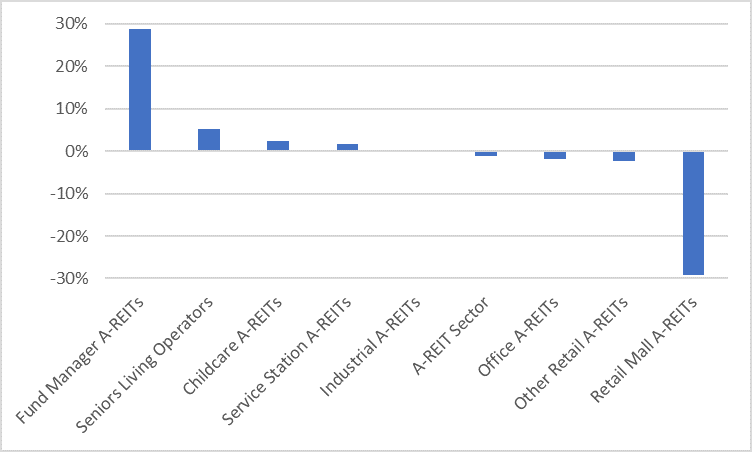
On average, A-REITs delivered annual EPS (earnings per share) growth of approximately -1.1% for the year ending June 2020. Yet this headline hides the significant dispersion across the different sectors.

Strong performances were recorded by the fund manager A-REITs (including Goodman Group ASX:GMG and Charter Hall ASX:CHC) and seniors living operators (including Ingenia Communities ASX:INA), which delivered EPS growth of +28.8% and +5.2% respectively, while not surprisingly, retail mall A-REITs (including Scentre ASX:SCG and Vicinity ASX:VCX) were the weakest with average EPS growth of -29.3%.

Figure 1: A-REIT Sector Earnings Growth - FY20
But it’s all about the cashflow

While EPS numbers provide a useful measure of performance the focus this reporting season was on cashflow. Leading into this reporting season, we knew things would be different given the difficult trading operating environment.

A-REITs have had to contend not only with enforced closures (e.g. pubs) but also the federal government’s Code of Conduct legislation for landlords and tenants which mandated that landlords would be required to waive or defer rent to small and medium enterprises tenants who had annual turnover less than $50 million and had a greater than 30% loss in revenue.

The extent of the impacts on individual A-REITs were influenced by a mixture of sector focus, tenant covenant, and management skills. Clearly those A-REITs whose portfolios were more leveraged to the consumer and small to median enterprises fared worse (Figure 2).

Figure 2: Proportion of Rent Collected – March 2020 to June 2020
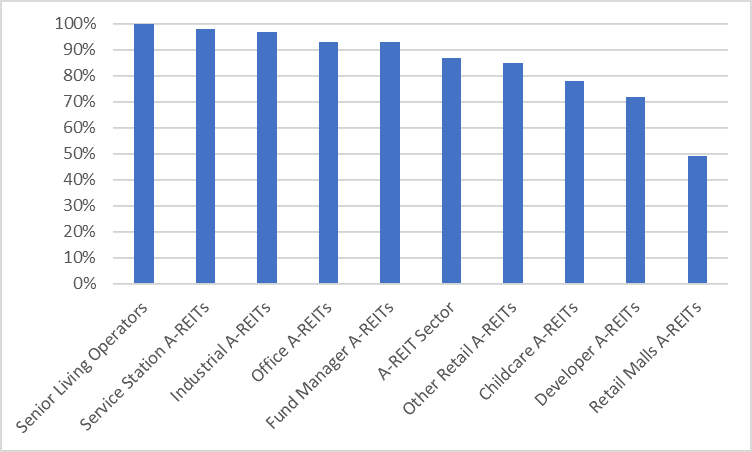
A-REITs took different approaches to account for these shortfalls in rent which made assessing individual earnings performance less reliable than usual. Hence the assessment of cashflow became key.

Given the cash shortfalls across several REITs, dividends were cut by an average of -9.6% for the past financial year, although excluding retail mall A-REITs the result was only -4.8%.

A quick take on each sector

Turning to the A-REIT sub-sectors, both industrial and office delivered stable results, and despite all the noise about ‘working from home’, cash collected from rents remained high.

In contrast, the performance of retail A-REITs was weaker, particularly those with larger malls that are more exposed to discretionary focused retail. In particular, Scentre Group (ASX:SCG) and Vicinity Centres (ASX:VCX) reported very weak results with large falls in foot traffic, tenant sales, reported earnings, and asset values. Their performance reflects both the cyclical elements associated with a slowing economy and the acceleration of the structural changes from the growth in online shopping.

The momentum in online shopping was well under way before COVID-19 but as a number of industry players have noted, the COVID-19 lockdowns forced consumers to go online in greater number and frequency, accelerating the shift away from physical stores to digital shopping by at least five years.

Residential developers, Stockland (ASX:SGP) and Mirvac (ASX:MGR), delivered flat growth in settlement volumes on stable margins, but promisingly net deposits were up about 20% which indicates a stronger outlook. Both groups referred to the positive affect on sales activity from recent increases in government stimulus programs for housing.

Property fund managers continued their recent trend of strong growth in FUM and earnings, given the supportive backdrop of low interest rates and demand for yield-orientated investments. Standout performers in this category were Charter Hall (ASX:CHC) and Goodman Group (ASX:GMG).

Select alternative sectors, such as rural and service stations, were largely unaffected by the effects of COVID-19 and delivered solid results. In this context we highlight good results from Rural Funds (ASX:RFF), Waypoint REIT (ASX:WPR) and APN Convenience REIT (ASX:AQR).

Seniors living operators such as Ingenia Communities (ASX:INA) continue to benefit from Australia’s ageing population and low levels of supply of quality seniors living. These groups were generally able to drive strong EPS growth from their development of new stock and high occupancy from existing villages.

Balance sheets were under the microscope

The emergence of COVID-19 has acted as a trigger for some asset softening across the commercial property sector. But as with EPS results, the damage was largely contained to large retail malls, with mall values falling on average by 11% with some further dilution to net tangible assets (NTA) coming from the cash shortfalls of rent collected.

Figure 3: NTA Growth – 6 Months to June 2020
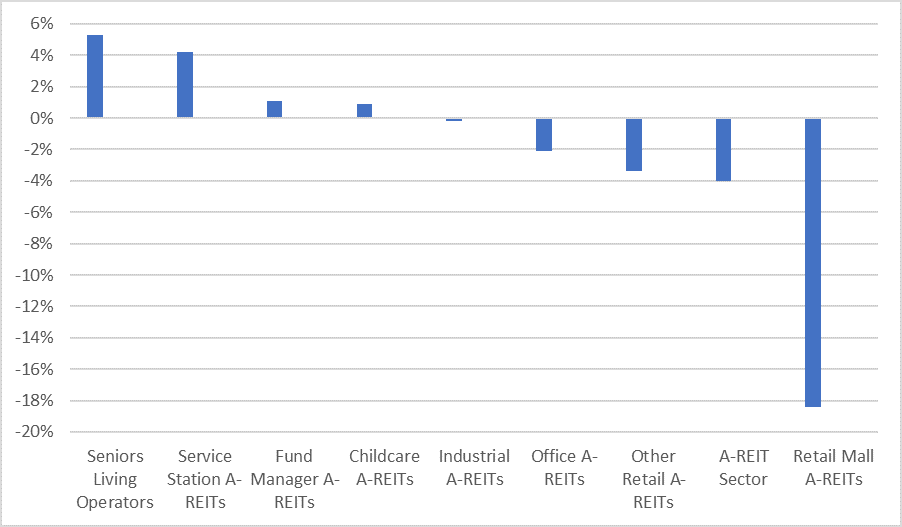
Balance sheets overall came out in reasonable shape. Some A-REITs went to market and raised capital through April to June to strengthen their balance sheets. The sector appears to have learnt the lessons of the GFC, coming into the COVID-19 crisis with more diversified funding sources, lower gearing – at 30 June the average gearing level was circa 26% - and longer debt tenor (average tenor is circa 5 years).

No guidance but clear upside

Earnings guidance was hard to come by this reporting season, with only a handful of A-REITs willing to stick their neck out given Melbourne is still in lockdown and the timing of a vaccine remains unclear.

However, there are enough signs to be optimistic on the outlook. Operating performance for retail focused A-REITs have started to improve (excluding Melbourne assets), rent collections are up across most sectors in July and August and as noted earlier, most balance sheets are in good shape.

While the potential of further COVID-19 waves cannot be ignored, the most likely outcome is for COVID-19 domestic cases to subside or the emergence of vaccine which would be positive for both the economy and A-REITs. We believe given the significant variance across the underlying A-REIT sub sectors and individual A-REITs that this will continue to be a market for active managers to make selective investments.


Jonathan Kriska is Portfolio Manager, Listed Securities at Charter Hall Maxim Property Securities. Charter Hall is a sponsor of Firstlinks. This article is for general information purposes only and does not consider the circumstances of any person, and investors should take professional investment advice before acting.


  •   9 September 2020
  • 5
  •      
  •   
5 Comments
PB
September 09, 2020

Great thought leadership

George
September 09, 2020

Here's hoping there's no second wave in NSW or Queensland.

Graeme
September 10, 2020

If Retail REITs have retail businesses as tenants and Industrial REITs have industrial companies as tenants, do Fund Manager REITs only have fund managers as tenants?
I've invested in Property Trusts / REITs for 30 years and have never come across that classification before.

Charter Hall
September 13, 2020

Fund Manager A-REITs like Charter Hall and Goodman have funds management platforms as part of their investment structure. In the case of Goodman they have $16.1bn of assets on their balance sheet at 30 June 2020 comprising incoming producing industrial assets leased to a range of tenants ($1.8bn), developments either held as inventory or under way ($3.1bn), co-investments ($7.8bn) in partnerships and funds they manage on behalf of other investors and $3.4bn in cash and other investments. They have circa $46bn in external funds under management across industrial property and business parks in Australia and many other countries that they manage on behalf of institutional investors. So they generate earnings from rent, development profits and fees from managing the external funds and partnerships. In the case of Charter Hall, they have $2.4bn of assets on their balance sheet. The majority of which, $1.8bn, is co-invested in the $41.8 bn in funds and partnerships they manage across office, convenience retail, industrial & logistics and social infrastructure assets. In FY20, they generated $110.8m in EBITDA from their investments in these funds and partnerships and $156.6m in EBITDA from the management fees, transaction and performance fees, development fees and leasing fees that they charge the funds and partnerships in which they manage.

Percy Allan
September 29, 2020

Good roundup. Thanks.


Leave a Comment:

RELATED ARTICLES

Focus on quality yield, not near-term income

Listed property headlines disguise full story

The big lessons from the A-REIT reporting season

banner

Most viewed in recent weeks

Why spending more in early retirement can improve lifetime income

Conventional wisdom encourages retirees to preserve superannuation. But if those likely to qualify for the Age Pension later in life spend a little more today, it may deliver higher lifetime income and a more stable retirement.

Testamentary trusts have secured the CGT exemption

Treasury’s latest CGT reform draft delivers a win for testamentary trusts and deceased estates, exempting estate-derived gains from the 30% floor. However, questions on death and divorce rollovers remain unresolved.

Meg on SMSFs: What do we think about reversionary pensions these days?

Reversionary pensions have long been a staple of SMSF estate planning, but are they still the best option? Meg Heffron revisits a once-clear favourite and asks whether changing super rules have shifted the balance.

Is it time to bail on Australian stocks?

For generations, Australian investors have backed banks, miners and dividends. But has that loyalty come at a cost? A look at the numbers raises an uncomfortable question about where future returns will come from.

Testamentary trusts survived the trust tax. The drafting battle has just begun.

The fight over testamentary trusts looked settled. Then the draft legislation arrived. Hidden in a technical detail is a question that could force many families to rethink wills they thought were already future-proof.

How does the 4% rule stack up?

The 4% rule has long been retirement's gold standard. But after a difficult period for investors, fresh analysis suggests a more conservative approach may significantly improve the chances of making savings last.

Latest Updates

Planning

How the typical Australian Family could save $844,350 in taxes

The value of a testamentary trust is not determined by wealth alone. Depending on circumstances, it can reduce the tax burden on inherited income, create efficiencies and help build intergenerational wealth.

Superannuation

There's a reason why your super is locked up until your 60s

For decades, it seemed settled. Then one controversial idea reignited a debate that could reshape the financial future of millions. The real question isn’t who’s right or wrong, but whether a long-held assumption deserves another look.

Property

The housing slide could become a crash

House prices are sliding across Australia, yet the most dangerous ingredient for a housing crash is still missing. If job losses surge amid growing economic risks, today's correction could become a historic property downturn.

Retirement

Under-retiring: The greatest retirement risk in a generation

Two retirees. Similar savings. Completely different lives. New research from Challenger reveals why some Australians confidently spend in retirement while others hold back and the overlooked factor shaping retirement decisions.

Five risks to watch in markets

Things you may often hear are: a recession is around the corner, markets are overpriced, the AI sector is about to flop at any moment. It’s like the never-ending laundry pile that sits in my house, it never really disappears.

Investment strategies

Do you qualify as ‘rich’?

What does it mean to be 'rich'? For something so universally desired, it is surprisingly difficult to define. That ambiguity creates a challenge for investors and raises a bigger question about what financial success really looks like.

Investment strategies

If you’re worried about your bond portfolio, you’re missing the point

Most investors think they know what bonds are for. But when markets turn volatile, a surprising misunderstanding can lead to costly decisions. Here’s the overlooked lesson that could change how you view your portfolio.

Alliances

  • ASA-Logo-RGB-ActiveGreen-web.png

© 2026 Morningstar, Inc. All rights reserved.

Disclaimer
The data, research and opinions provided here are for information purposes; are not an offer to buy or sell a security; and are not warranted to be correct, complete or accurate. Morningstar, its affiliates, and third-party content providers are not responsible for any investment decisions, damages or losses resulting from, or related to, the data and analyses or their use. To the extent any content is general advice, it has been prepared for clients of Morningstar Australasia Pty Ltd (ABN: 95 090 665 544, AFSL: 240892), without reference to your financial objectives, situation or needs. For more information refer to our Financial Services Guide. You should consider the advice in light of these matters and if applicable, the relevant Product Disclosure Statement before making any decision to invest. Past performance does not necessarily indicate a financial product’s future performance. To obtain advice tailored to your situation, contact a professional financial adviser. Articles are current as at date of publication.
This website contains information and opinions provided by third parties. Inclusion of this information does not necessarily represent Morningstar’s positions, strategies or opinions and should not be considered an endorsement by Morningstar.