This is an edited transcript of an interview that Australian Ethical's Head of Asset Allocation, John Woods, did with colleague, Maria Loyez.
Maria Loyez: Tell us a little bit about the market and the economic backdrop.
John Woods: Look, 2022 has been a volatile market. I'd describe the world at the moment as fragile. Markets are beginning to be positioned more constructively after the shocks we experienced in the first half. If you look at the market pricing of key indicators like inflation, it implies that it will become more under control, that central bank policy will be effective in bringing it down to within expected ranges. And that's echoed when we look more broadly as well in areas like agriculture prices and commodity prices. So, if you take wheat futures or something like that, it will also show a downward sloping price for the future as well.
Loyez: Inflation has been one of the biggest talking points of 2022. Do you want to talk about what your view is on that and what the implications are for investors?
Woods: Inflation should be a central theme in investment through time. It's the most important variable in retirees achieving the standard of living that they're anticipating. And 2022 has really seen the regime that we were in pre-pandemic change. That regime that we were in was catalyzed by a period of QE, of disinflation coming from China, and the market was always worried that after a period of such unorthodox monetary policy that inflation could emerge. And as we saw the supply shock to energy prices and broader commodities at the start of the year, inflation accelerated rapidly. And now, we're in a period of high, volatile inflation. But if we look at indicators from the market that try and look forward from today, such as the TIPS and agriculture prices, both are sloping downwards and suggest that the action that central banks have been taking over the last six months to raise rates rapidly almost at an unprecedented level are beginning to have an impact.
Loyez: Potentially some good news for the future.
Woods: The market is positioned constructively for 2023. There are a number of risks to that. If we look back at history, the Fed - only one time in the last 11 have they been successful in engineering a soft landing. But [Jerome] Powell has all the lessons of his predecessors in the past to look back on. So, he will be cognizant of the mistakes they made.
Loyez: That sounds like good news generally. Is that changing your long-term view of assets and how they might perform over time?
Woods: It is. I mean, inflation is the single most important variable in understanding your retirement outcome. Our multi-asset funds are designed to exceed inflation. And the tools that we can use to deliver inflation-plus returns in moderate inflation environments, like some of the defensive assets - bonds, infrastructure - they're becoming more important part of our allocation from here.
Loyez: You talked about multi-asset funds. Along with asset allocation you look after multi-asset funds as well, because they go hand-in-hand.
Woods: That's right.
Loyez: Can you talk to us a bit about the performance of the multi-asset funds this year?
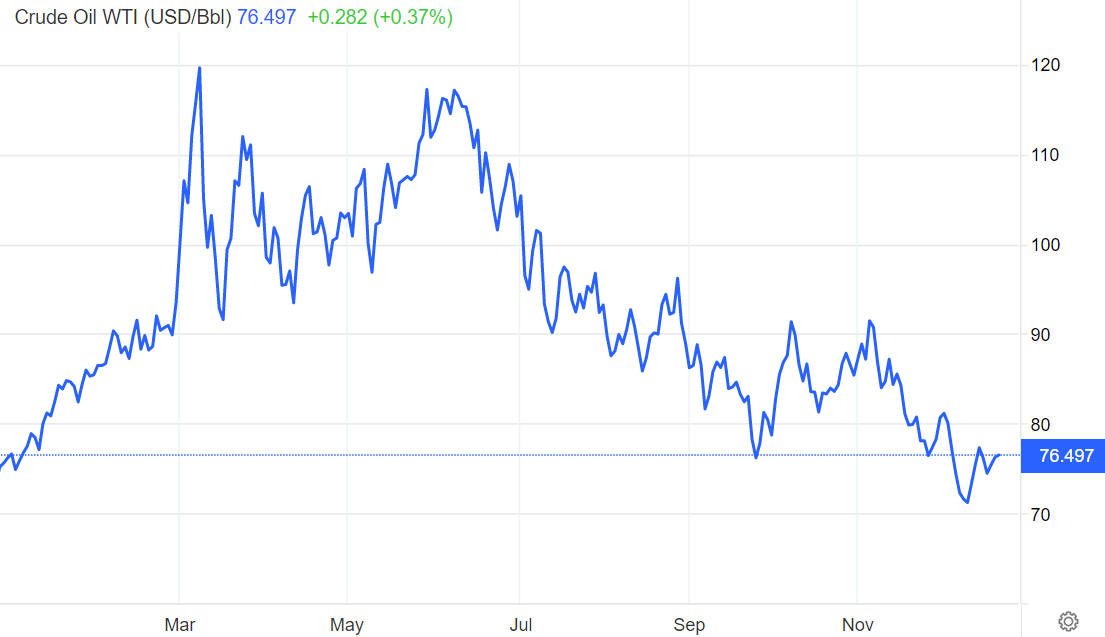
Woods: The managed funds we have on offer – the Balanced Fund, the High Growth Fund – the first half of the year was really impacted by the energy crisis, the panicked moments we had as parts of Europe and the rest of the world focused really on prioritizing energy security over energy transition. We saw oil up over $100, nearly $120, through that period. And we don't invest in fossil fuel companies. So, that was a significant headwind to our performance.
Source: Trading Economics
In the second half of the year, we start to see longer-term trends emerge. So, there's still headwinds from rising rates, but that commodity shock has abated, and our performance has started to catch up a little bit and start to exceed benchmarks again through the second half of the year.
We have a very long-term focus but it's pleasing to see that some of the trends we were invested in prior are coming back to the fore through the later part of the year.
Loyez: Well, that sounds promising. So, those funds also include unlisted assets.
Woods: Yeah.
Loyez: They're probably some of the most interesting stories. Do you have any favorites that you're looking at?
Woods: Unlisted assets have a really important role in multi-asset portfolios, particularly for an ethical investor. That's how we get a lot of our diversification is focusing on assets that we can't obtain in public markets because we can go deeper into the broader range of private assets.
Favorites at the moment – look, we're invested in a fund that's affiliated with the CSIRO. They've been doing some really good work with early-stage capital, so venture capital. And I'm excited by a number of their projects. One that comes to mind is the investments they've been making in plastic recycling - breaking plastics down back to their original polymers so we can recycle them as much as possible.
And that's exciting for a number of reasons. One, the returns have been fantastic. And two, if you think about the impact that has - plastics are hard to abate use of fossil fuels because to-date they haven't been infinitely recyclable. But this is changing that narrative, so I'm really excited for what that could bring.
Loyez: Does that mean I'll no longer be stockpiling my soft plastics in the cupboard?
Woods: Hopefully.
Loyez: Are there any other unlisted assets that you are interested in?
Woods: This year we saw one of our first investments in way to abate carbon through natural capital. I think that was an exciting milestone for us, and there's a significant future in those assets, particularly as we begin to discern different types of ways to abate carbon.
Loyez: Just thinking about John Woods, your personal portfolio, how are you thinking about that at the moment and with the knowledge that you've got of the markets?
Woods: I think with a personal portfolio, it's important to identify a core strategy and stay committed to that, particularly for the bulk of your retirement savings.
I have a long-term investment horizon. One year doesn't change my view. I've identified my risk appetite through the volatility we've had over the last 10, 15 years. And I'm confident that the asset allocation I have in place will serve me well into the future. In an environment like this, it's tempting to respond to the news, but it's important to stay committed to your long-term strategy.
Loyez: And what are you most optimistic about for 2023 and beyond?
Woods: Beyond 2023, I am very optimistic about this energy transition. If I look back at some of the long-term metrics, looking at something like barrel of oil per GDP – it's been on a continual decline. The cost of energy for the world's population has been on a continual decline. And if I look at some of the trends in renewable energy in particular, it's possible that we could actually see an acceleration in that decline of energy costs. And what we can do with that is really exciting.
Maria Loyez is Chief Customer Officer and John Woods is Head of Asset Allocation at Australian Ethical, a sponsor of Firstlinks. This information is of a general nature and is not intended to provide you with financial advice or take into account your personal objectives, financial situation or needs.
This is an edited transcript of Maria and John's interview published 19 December 2022. View the original interview here.
For more articles and papers from Australian Ethical, please click here.