Register For Our Mailing List

Register to receive our free weekly newsletter including editorials.

Home / 684

The retirement scorecard: how many of these questions can you answer?

Planning is bringing the future into the present so that you can do something about it.
- Alan Lakein

The 2026 Epic Retirement Tick rated industry and retail super funds against a set of twenty criteria designed to measure how well they supported their members in retirement.

I’m supportive of any effort that helps Australians improve their retirement outcomes. But I also have a different worldview. Advice and support play a key role in outcomes. But ultimately my retirement comes down to me.

A super fund – like any investment – is a tool. My retirement outcome depends on the person wielding the tool. No organisation is going to hand me the life I want.

The agency you have over your outcome is both the promise and challenge of investing. For anyone who wants a great retirement I’ve come up with my own tick test. I’ve immodestly named it the 2026 Legendary Self-directed Investor Scorecard.

2026 Legendary Self-directed Investor Scorecard

A legendary retirement doesn’t happen by chance. You need a framework to guide your decision making and help you follow the pathway to achieving your goals. Use this scorecard to self-assess where you stand.

Do you understand the maths of retirement?

Financial literacy is the foundation for a great retirement. You don’t need advanced maths or to dedicate your life to financial planning. Understanding the high-level mechanics of retirement will do – that starts with the 4% rule.

There are several legitimate criticisms of the 4% rule. I’m an advocate for everyone to create a personalised retirement roadmap. But to do that means understanding the different factors that impact the sustainability of a withdrawal rate.

The baseline goal for every retiree is the same…don’t run out of money. How quickly you run out of money depends on the interplay between several factors including your withdrawal rate, inflation and the order and magnitude of returns.

For instance, in a recent article I ran a Monte Carlo simulation to figure out the probability of not running out of money in retirement. I put in assumptions for withdrawal rates, inflation, returns and asset allocation.

The simulation gave a 78.37% chance of not running out of money in thirty years. But the simulation also showed that starting out with $1m you have a 10% probability of ending up with more than $8.5 million in thirty years. The middle 50% of scenarios between the 25th percentile and the 75th percentile shows outcomes between $248k and $4.53m. These are meaningfully different outcomes and to have a great retirement you need to understand why.

Gaining this foundational knowledge allows you to incorporate your individual circumstances into a personalised plan. Your plan will help you spend confidently by knowing you’re not spending too much or too little.

If you can answer the following questions it is a good sign you understand the maths of retirement:

  • What is the most challenging market environment to navigate as a retiree?
  • What are the assumptions around spending embedded in the 4% rule?
  • What are the assumptions about taxes embedded in the 4% rule?
  • How long is the 4% rule designed to last?
  • Why can two retirees with the same average return experience very different outcomes?

Give yourself a score between 1 to 5. 5 indicates you can easily answer the questions while 1 means you have some work to do. Scored low? Start with understanding the assumptions behind the 4% rule.

Do you have an estimate of how much you will spend each year?

Everybody will have a different vision of retirement. But in every case it won’t be free so you need to estimate how much you will spend each year.

The precision of your estimate is largely dependent on how long you have until retirement. I still have my estimate from my twenties in a spreadsheet. Looking at it now makes me want to go back in time and shake young, naïve Mark… don’t you know how much nice hotels and flights cost?

My ambitions and perspective have changed but that doesn’t mean it wasn’t worth going through the exercise.

An evolving goal is better than no goal at all.

Start with a goal and then develop a plan. Adjust accordingly. There are several factors to consider when making an informed estimate.

Typically, retirees spend a lot early in retirement when they are active and less once they’ve grown older. Spending can also spike at the end of life as medical and care costs come into play.

If you put these typical spending patterns on a chart it looks like a smile – hence, it is known as the smile effect. A study by a former Morningstar researcher found that spending typically drops in real terms by approximately 1% a year for retirees between the ages of 60 and 90.

This may not seem meaningful but it compounds over time. A retiree with $100,000 in spending at age 60 would hit a spending trough around age 84 when spending is $74,146 or 26% lower. Not accounting for this tendency may mean underspending early in retirement.
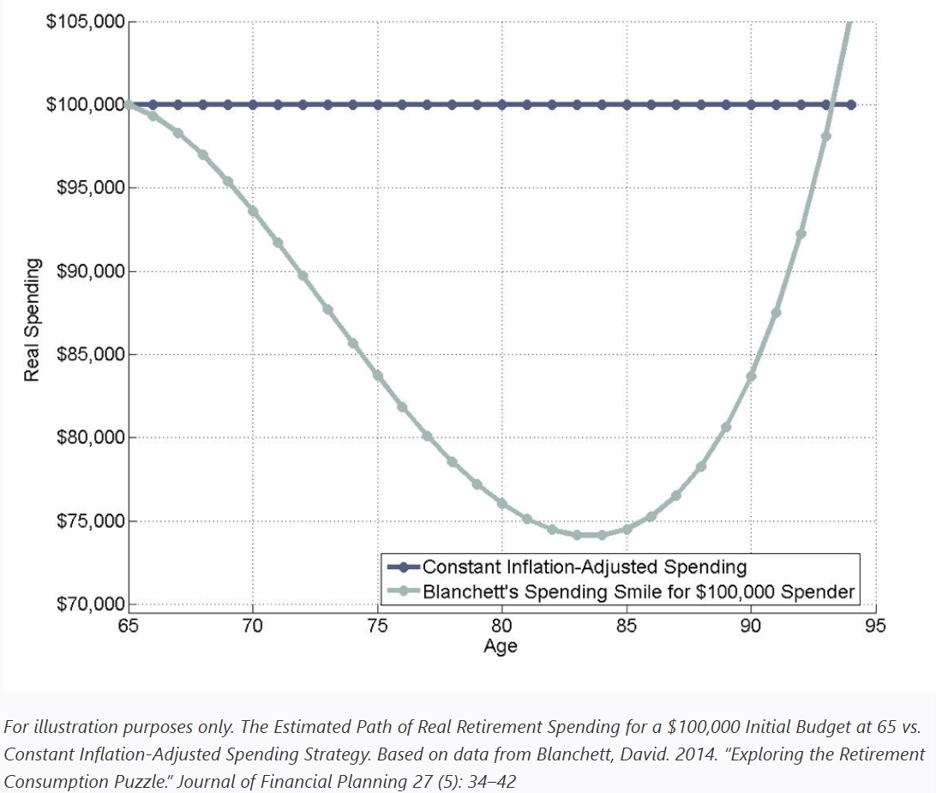

Source: What is the retirement spending smile?

When coming up with your estimate concentrate your efforts on the big categories of spending. Housing and day-to-day expenses are universal factors. Other categories will be dependent on your individual goals.

When estimating your retirement spending there are several questions to ask:

  • Will your expenses change significantly in retirement? Examples include paying off your mortgage, relocating to a cheaper location or a desire for more recreation and travel.
  • How vulnerable are your expected expense categories to inflation?
  • Given your planned retirement age and / or health how long do you believe you will be active?

Give yourself a score between 1 to 5. 5 indicates you can easily answer the questions while 1 means you have some work to do. Scored low? My four-step process for estimating retirement spending should help.

Do you know how much money you need to retire?

I’m not a big believer in rules of thumb. You aren’t going to be successful without interrogating the conventional wisdom of retirement. Examples include the 4% rule / rule of 25 and the ASFA retirement standard.

A rule of thumb is a rough estimate that broadly applies to most people without precisely applying to any individual.

You are unique – your goals, financial circumstances and philosophy about money are all distinct. Estimating your annual retirement spending is only half the battle. Your withdrawal rate needs to be personalised as well.

The withdrawal rate is the next step in your retirement roadmap as it mathematically transforms your annual spending into the lump sum you need to retire. Small changes make a big difference. Increasing your withdrawal rate from 4% to 4.50% increases annual spending by 12.50%.

One reason hard and fast rules don’t work is because everyone’s circumstances are different. One example is the flexibility of retirement spending.

If most of your projected spending is on ‘needs’ there may be little flexibility and a requirement to increase spending by inflation.

If most of your spending is on ‘wants’ you may be able to adjust your spending based on market conditions and inflation.

Spending flexibility is just one example. Others include the length of your retirement, the return environment, your asset allocation, your investment flexibility. All these factors should influence your personalised withdrawal rate.

Once you’ve got an estimated withdrawal rate you can calculate the lump sum you need to retire. Just divide your annual spending needs by the withdrawal rate.

Now you have your target for a legendary retirement based on your personal circumstances rather than somebody else’s assumptions.

To estimate your personalised withdrawal rate consider the following:

  • Do you have flexibility around your spending so you can adjust it based on market conditions?
  • What percentage of your total expected spending is ‘needs’?
  • Do you plan to retire prior to your preservation age and have you factored it into your plan?  

Give yourself a score between 1 to 5. 5 indicates you can easily answer the questions while 1 means you have some work to do. Scored low? Get tips on creating a personalised retirement plan.

Do you have an asset allocation target?

For all the attention that security selection receives from investors, asset allocation plays the biggest role in investor outcomes.

Asset allocation impacts the long-term returns of portfolios. It impacts the volatility of a portfolio and the drawdowns faced by investors in bear markets.

Asset allocation decisions dictate how a portfolio will respond to the twin risks of retirement – sequencing risk and longevity risk. These are the two risks the 4% rule is designed to mitigate.

Sequencing risk refers to how the order – or sequence – of returns impacts how long a portfolio can support your spending in retirement. If you retire into a bear market and need to sell when prices are low to fund spending, you will run out of money faster.

Outliving your retirement savings is the other key risk faced by retirees. This is longevity risk which becomes more of a challenge as life spans increase.

The order of returns may not seem important. But if you retired in the year 2000 with a $1m portfolio and withdrew $40,000 annually you would be left with approximately $330,000 twenty years later if you invested your entire portfolio in the S&P 500.

If you reversed the order of S&P 500 returns over those twenty years you would end up with approximately $1.564m. The average return is the same but the outcomes are very different.

The simplistic response to sequencing risk is to invest in more defensive assets which will fall less in a bear market. The problem with defensive assets is that they have lower long-term returns.

Those lower returns are a problem because of longevity risk. To avoid outliving your savings means investing in growth assets with higher expected long-term returns.

The seemingly contradictory approaches to addressing these twin risks underpins the dilemma for retirees when choosing the right asset allocation. But this high-level view ignores the nuance involved in crafting a plan for retirement.

Retirees have many tools at their disposal including using cash as part of a bucket approach, holding income generating assets, annuities and positioning within a high-level asset class.

Asset allocation decisions in retirement aren’t about perfection. They are about resilience under a variety of scenarios.

Come up with a plan to address the underlying risks of retirement which addresses the following questions:

  • How will you respond if the market plunges early in retirement?
  • How will you respond if returns are different from your expectations over the course of your retirement?
  • How long can your portfolio last in retirement and what medical and care scenarios can it support?

Give yourself a score between 1 to 5. 5 indicates you can easily answer the questions while 1 means you have some work to do. Scored low? Learn how asset allocation can help you survive the worst year of retirement.

Final thoughts

Are you feeling more confident about retirement? Are there areas you need to focus on? Were you so confused by what I wrote that it might as well have been in Latin?

The good news is this wasn’t a test. The point of the scorecard was to help you identify areas that might need some further attention.

A legendary retirement doesn’t happen by chance. You are in control of your outcomes.

You can develop a baseline of financial literacy.

And you can use your knowledge to make the trade-offs needed to create a plan and adapt as circumstances change.

The future is unknown. That doesn’t mean you can’t take steps today to make it better.

Questions, comments or restaurant recommendations? I can be reached at [email protected]


Mark LaMonica, CFA, is Director of Personal Finance at Morningstar Australia.


  •   14 October 2026
  • 20
  •      
  •   
20 Comments
Mark LaMonica
October 15, 2026

Thanks Michael. I did receive this question from someone else and will be writing about it this coming week. As you said it is all about perspective. It is all about the life that you want and how big of a consequence it is to have the age pension as your only source of income.

4
John Byrne
October 19, 2026

Sorry Michael BUT What if the Govt run out of Tax income from the aspirational savers , and then be unable to borrow more to pay your future living wage pension ? Good luck then finding a hospital to care for your deteriorating health . John B Morisset

Carmen
October 15, 2026

Well done Mark. I’ve been reading your articles for many years. They’re very clear and in layman’s language.
I have never written. I’d love an article on what percentages an 80 year old female should aim for in Australian shares, cash in bank and tax free super.
Many thanks.

7
Dan
October 15, 2026

Good on you Mark, for providing your email to help people (and invite critique!)

4
Mark LaMonica
October 15, 2026

Thank you Dan. I'm always available if you have any questions or feedback.

1
Greg Flavel
October 15, 2026

Hi Mark,
Thanks and I must say that is a very clear explanation of all the variables and trade-off choices. I found your Monte Carlo simulations on all the possible outcomes over 30 years is a little terrifying, as I could end up either broke in 12 years or worth $10m in 30! That's a bugger, but I guess it shows the power of compounding in both directions. Keep up the good work. Greg

2
Mark LaMonica
October 15, 2026

Thank you Greg. Here's hoping for the $10m!

Jeff O
October 15, 2026

Thanks Mark - Another insightful article for workers and then retirees ...some comments

1. If you do not understand the financial maths....given compulsory tax effective savings ...get retirement "income" advice early ....and revisit when the key facts change...esp. salary, retirement age, life expectancy...and there's good income calculators provided by super funds - see eg Mercers - you just have to put your numbers/scenarios in, press calculate and read the (free) reports/advice - very year or when the key drivers change unexpectedly!!!)

2. SAA drives 90% of returns and retirement savings are locked up for 30 to 40 years...and while the world is uncertain (Knightian), actual returns are not volatile over the long run (30 to 40 years) ...so 3-4% rule means retirement income at start maintained over lifetime allowing for low inflation....and part aged pension tops income up and this no spending of likely tax free capital gains of another 2-3%!

3. Personal/health mgt ....remember to take out life and home insurance ...if you got a mortgage and a family...and be a great partner and never divide by 2 (divorce)

4. Market risk (downside protection/scenario) ..not a big fan of Monte Carlo ....if the facts change just do a review of expected retirement income using the 4% rule after allowing for a 30% fall in growth assets...and the potential need to offset loss of income by small asset rundown/withdrawals (1-2% of super assets) for a few years or longer if any rebound takes longer and/or age pension top up, if you meet the asset test..

5. Uncertainty... do every time the unexpected occurs and in good times and bad times...most people in the good times of the past 20 years "under-retire" ...underspend or have worked too long or will leave a significant estate (including the family home)!

2
Steve
October 16, 2026

A simple question is how much do you spend. I was kind of surprised when I set up a little table with all the regular bills (utilities, insurance, telephone/internet, rates, golf club fees, car registration etc etc) how much it came to. Even though you pay these bills regularly they slip a bit under the radar. That's before anything like food even! Insurances is one area you rarely think of but it was around 1/3 of this spend!

2
Bob
October 15, 2026

Please Mark, forget the 4% rule that is an American thought bubble. Reality in Australia Super drawdown is 5% then 6% rule and so on till it gets to 14% (I should be so lucky).
An aticle built around factual drawdown rates would most welcome.

Bob

1
Mark LaMonica
October 16, 2026

Hi Bob -
Thank you for the comment. I actually just published an article based on some questions I received around the 4% rule. You can find it here: https://www.morningstar.com.au/retirement/unconventional-wisdom-does-an-american-retirement-rule-work-australians

But in summary, the 4% rule is intended to represent a sustainable withdrawal rate given a variety of market return and inflation environments over thirty years. Specifically, it is supposed to protect against a bear market and high inflation early in retirement.

The minimum pension drawdown rate is not designed with the sustainability of a portfolio in mind. There are generous tax breaks for account-based pensions. Investors pay no tax on capital gains or income.

The minimum pension drawdown rate is designed to get assets out of this generous tax environment so they can be taxed or spent. This isn’t some conspiracy theory. Politicians from various political parties have repeatedly said the purpose of super is not tax minimisation or estate planning – it is to pay for retirement.

I would encourage everyone to come up with their own withdrawal rate and not rely on a rule of thumb like the 4% rule or some policy that comes from Canberra.

7
June
October 18, 2026

Hi Mark, you always write great articles for us, but like Bob, I agree that the only "certainty" we have to work with is the mandated amount that we have to withdraw as we age. If you aspire to not have to rely on the Age Pension, then your focus is on your annual, five year, ten year, etc, spending needs, your actual and projected returns and your mandated withdrawal rate. I fully understand that everyone is different, has different wants and needs and different resources to enable their lives as they age.

Peter R
October 17, 2026

Just because it must come out of super does not mean you have to spend it, it can stay in your name and maybe you have pay tax on its earnings.

4
Jan H
October 18, 2026

And, Peter R, if you don't want or need the minimum pension payment, it would help sustain your smsf's compounding growth where dividends and interest are reinvested. The rising minimum percentage causes you to withdraw more than you need, if you have no materialistic desires and only spend on the basics.

1
Mark LaMonica
October 15, 2026

Thank you so much Carmen. I really appreciate the kind words and suggestion.

Woodsy
October 18, 2026

The only problem I have with the 4% rule is that you have to take more than 4% out when go into pension phase with a smsf…….and it increases as you age.

Dudley
October 18, 2026


"problem I have with the 4% rule is that you have to take more than 4% out when go into pension phase with a smsf":

... and deposit the capital withdrawn from super into your non-super accounts, the first $30,000 income from which is taxed at 0%.

Capital invested at 5% to yield $30,000:
= 30000 / 5%
= $600,000.


Jack
October 20, 2026

While withdrawing cash from a super account-based pension is mandatory, spending it is not. Once the cash is transferred to the retiree, it can invested outside super where super’s generous tax concessions no longer apply..
 
These pension payments are compulsory transfers of capital out of the tax-advantaged superannuation structure. They are like the tax on super death benefits. The government clear intention is for super’s tax concessions be used to support retirement and not passed on to beneficiaries as concessionally taxed bequests.

Bec Wilson
October 23, 2026

Mark - I love this! Retirement does require you to self-actualise - I couldnt agree more. I'd love to get in touch and have a chat!


Leave a Comment:

RELATED ARTICLES

Do super funds need a massive wake up call?

Financial advice as the pathway to economic security

Retirement income expectations hit new highs

banner

Most viewed in recent weeks

It’s time for LICs to die

A high-profile dividend cut and a prominent fund manager’s apology have reignited a long-running debate. If investors can access similar exposures more cheaply and efficiently elsewhere, what exactly is keeping LICs alive?

The retirement scorecard: how many of these questions can you answer?

From the maths of retirement, estimating spending and picking the right asset allocation to survive a poor decade, here are the questions every retiree – current or future – should be able to answer for themselves.

Division 296: the initial moves to make before the windows close

What if the best superannuation strategy isn't about earning more, but acting before your options disappear? Several overlooked planning windows are narrowing, with consequences that can last for decades.

Testamentary trusts: Treasury has picked the wrong reading

A decades-old estate planning tool has survived one tax crackdown only to be caught by another. The surprise isn't who the reform is targeting, but who could end up paying the price for drafting choices made years ago.

Higher yields are creating opportunities in global bonds

Bond markets are adjusting to a new reality, but not in the ways investors expect. With markets repricing and capital competing for attention, investors may need to rethink where resilience and opportunity lie. 

Will investors be better or worse off under new housing tax changes?

Housing tax reforms have sparked warnings of market turmoil and promises of greater fairness. But after modelling nearly two decades of property data, the results suggest winners and losers may not be who many investors expect.

Latest Updates

Superannuation

Superannuation’s structural failings

Politicians are fighting over access to super, but they may be arguing about the wrong thing. The system’s three fundamental flaws have been hiding in plain sight for decades, costing Australians far more than they realise.

Planning

The great wealth transfer myth

Why do some families preserve wealth for generations while others struggle to? As the great wealth transfer unfolds, the determining factor is often not the structure of the estate, but the preparation of those who will inherit it.

Investment strategies

What comes after bank hybrids?

For years, bank hybrids have been a cornerstone of portfolio income. With tens of billions of dollars now disappearing from the market, investors face a critical question: what comes next, and are the obvious replacements enough?

Investment insights from the US

What happens when knowledge becomes a commodity? The latest themes emerging from the US tech sector suggest AI could reshape company moats, disrupt incumbents and create winners and losers in unexpected places.

Investing

Can Berkshire thrive without Buffett?

Warren Buffett's departure marks the end of an era. But the more important question for investors is whether Berkshire's culture, discipline and capital allocation framework can survive without the man who built them.

Retirement

The Bengen 4% Rule: Lost in translation

For years, retirees have been told to focus on withdrawal rates. But the real question is far simpler: how many dollars can you safely spend? The answer may be very different from what conventional retirement wisdom suggests.

Interest rates

Super low interest rates came with side effects

For more than a decade, investors lived through an era of near-zero interest rates. With bond yields now surging, it's worth asking whether cheap money solved economic problems, or introduced a much larger set of risks.

Sponsors

Alliances

  • ASA-Logo-RGB-ActiveGreen-web.png

© 2026 Morningstar, Inc. All rights reserved.

Disclaimer
The data, research and opinions provided here are for information purposes; are not an offer to buy or sell a security; and are not warranted to be correct, complete or accurate. Morningstar, its affiliates, and third-party content providers are not responsible for any investment decisions, damages or losses resulting from, or related to, the data and analyses or their use. To the extent any content is general advice, it has been prepared for clients of Morningstar Australasia Pty Ltd (ABN: 95 090 665 544, AFSL: 240892), without reference to your financial objectives, situation or needs. For more information refer to our Financial Services Guide. You should consider the advice in light of these matters and if applicable, the relevant Product Disclosure Statement before making any decision to invest. Past performance does not necessarily indicate a financial product’s future performance. To obtain advice tailored to your situation, contact a professional financial adviser. Articles are current as at date of publication.
This website contains information and opinions provided by third parties. Inclusion of this information does not necessarily represent Morningstar’s positions, strategies or opinions and should not be considered an endorsement by Morningstar.