Register For Our Mailing List

Register to receive our free weekly newsletter including editorials.

Home / 658

There will be no permanent underclass

For months now there’s been an online joke that anyone who doesn’t learn about AI will be a part of the “permanent underclass.” The permanent underclass represents the new have-nots of society—all of those who will be left behind in the coming AI wave. While a subset of the population will have all of their work done by LLM-powered agents, the permanent underclass will be left jobless and in perpetual destitution.

It’s a nice theory, but it has no historical precedent. For example, the share of the U.S. workforce employed on farms fell from 90 percent in 1790 to less than 2 percent today. If I came to you in 1790 and told you that 98 percent of all farming jobs would be eliminated in the future, you’d have a difficult time predicting what all of those people would be doing today.

You’d have no clue that they’d be social media managers, real estate agents, data scientists, or the thousands of other roles that literally didn’t exist at the time.

This is why the fear mongering around AI today is misguided. Because this technological shift will create many new roles and increase demand within existing ones. This explains why software development job postings are up over 10% over the last year despite increased reliance on AI for creating software. As Kenton Varda, a technical lead at Cloudflare, explained:

Worries that software developer jobs are going away are backwards. There is SO MUCH software to build right now, that previously wasn’t possible (uses AI directly) or wasn’t cost-effective (too niche). We’re going to have more developers, and orders of magnitude more software.

This phenomenon is known as Jevons’ paradox, where the increased efficiency of a given resource (e.g., software creation) leads to an increase, not decrease, in its consumption. This is going to happen across a host of different jobs and industries as a result of AI. And when it does, humans will be better off in the long run.

Some will argue that “this time is different” because AI is replacing knowledge work, not just physical work. And, if this comes to pass, what will there be left for people to do?

It’s a compelling argument, but people made similar arguments about the automation of physical work. There was literally a group of people in England in the early 1800s called the Luddites who destroyed weaving machines due to their adverse impact on textile workers.

The Luddites couldn’t imagine what would replace their livelihoods and the same is true for us now. There will be future roles that require a different set of human skills that we can’t even imagine today. These skills won’t directly compete with LLMs, but will enhance them.

And while the speed of AI disruption will likely be faster than previous cycles, the recovery will be as well. Since information travels much faster today than in the past, people will be able to reorganize and re-skill at a much faster pace than in prior centuries.

David Oks wrote a great piece on why the impact of AI on the labor market won’t be as harsh as people initially expect:

…the relevant question for labor impacts is not whether AI can do the tasks that humans can do, but rather whether the aggregate output of humans working with AI is inferior to what AI can produce alone.

Fortunately, we are still at the point where AI + human is better than AI alone.

If you’re still worried though, consider how prior technological changes have permeated throughout society. I know of no case in recorded history where a new technology was widely adopted and the percentage of people living in poverty increased over time.

In fact, over the last half century, the opposite seems to have happened. The number of people worldwide living in extreme poverty has declined by roughly 66% since the 1970s, despite many groundbreaking, technological advancements:
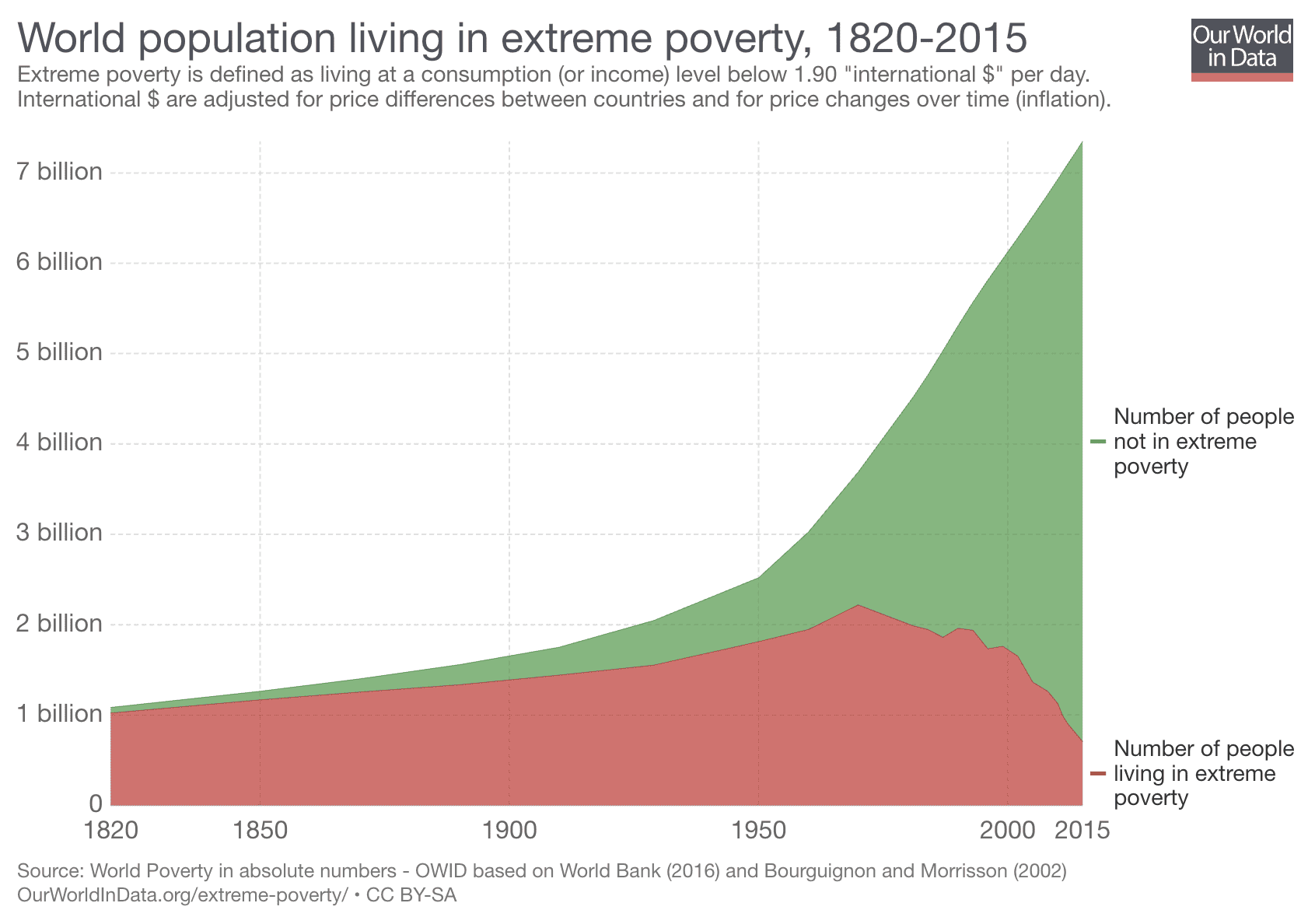
Of course, there have been short periods where a new technology has led to some local displacement/decline. The early years of the Industrial Revolution were a period where life was arguably worse for the typical laborer (e.g., the Luddites). However, such setbacks were short-lived and never resulted in a permanent underclass.

Some of you will see this data and argue that it’s irrelevant because extreme poverty isn’t the right metric. What matters is the relative difference in wealth, not the absolute difference. After all, even if we eliminated all extreme poverty, there still can be an underclass, right?

In some ways, yes. But that’s already true today. We already have a small subset of the global population that flies private, owns a yacht (or two), and doesn’t need to work a 9-5 job. Thankfully, such lofty positions are almost never permanent.

The temporary elite

One of the biggest reasons why I’m not worried about an AI-induced class divide (even if it does come to pass), is that it’s likely not to last very long. If you look over the course of history, you will notice that fortunes tend to rise and fall within families. Some families have wealth and power in one generation, only to lose it in the next. If you are under the impression that rich families stay rich forever, consider this (from Fortune’s Children):

When 120 of Cornelius Vanderbilt’s descendants gathered at Vanderbilt University in 1973 for the first family reunion, there was not a millionaire among them.

Cornelius Vanderbilt was born poor, yet became the richest man on Earth. Nevertheless, even that fortune didn’t last more than a few generations. The dominant industry of Vanderbilt’s time (railroads) gave way to others that overtook it.

This simple example illustrates how even those in the current AI-elite will eventually lose their fortune in one way or another. It reminds me of that Warren Buffett quote:

I try to invest in businesses that are so wonderful that an idiot can run them. Because sooner or later, one will.

Well, guess what? No matter how rich or successful you are today, one of your future descendants will be the “idiot” that loses your fortune, one way or another. Attributes like talent, intelligence, and temperament exhibit mean reversion over time. This is what makes it near impossible for a family to hold onto great wealth for long.

It’s also why I’m skeptical of a future, AI-induced class divide. Because, even if there is, it won’t last.

There will be no permanent underclass because there is no permanent elite.

All such places of privilege and power are temporary. History has demonstrated this time and time again.

So, stop worrying about getting left behind and start focusing on how to be more useful in the first place.


Nick Maggiulli is the creator of personal finance blog Of Dollars And Data and the Chief Operating Officer at Ritholtz Wealth Management. For disclosure information please see here. This article was originally published on the Of Dollars and Data blog and is reproduced with permission. If you liked this article, consider signing up for Nick’s newsletter.


  •   15 April 2026
  • 12
  •      
  •   
12 Comments
Steve
April 19, 2026

I think you miss the point David. The whole premise of AI is that it IS able to make decisions and mimic what a real person might do or "think". This is the threshold between very fast number crunching of existing computing and the new ability of actually making "choices" from the available information. Fortunately if the internet is their learning place, they have alot of rubbish to weed out. Garbage in, garbage out still holds.

CC
April 16, 2026

your optimism is admirable.
but no, just no.
A.I. could well well lead to the downfall of mankind and be the worst thing ever invented.
like mice inventing the mouse trap. except that mice would not be so stupid.
don't be so naive to think that once A.I becomes sufficiently advanced in the future that it won't take over and make decisions for us whether we like it or not and becomes unstoppable.

1
Peter B
April 19, 2026

There were cries of doom in the 1970s when computers were introduced. People thought there would be massive job losses, and a few thought they’d have more leisure time. Commentators were wrong. Economists were wrong.

Humans are addicted to doomsayings. Look what we have done to the natural environment and the economy in the name of climate doom.

Steve
April 19, 2026

And Peter the media just LOVE a scare story. Facts are optional.

Abel
April 16, 2026

Nick, two observations on your optimism:
1. You are right that up to now, whenever a category of jobs were lost, new jobs appeared. But similar to Moore's Law, it worked until it didn't. We don't know yet how it will develop this time (hopefully new job categories will appear, but maybe not)
2. "In the long term" we are all dead. If the transition takes 20 years, you can't dismiss the havoc it will cause to great segments of the working population. You and I may not be impacted, but we would be very selfish not to be concerned.

I don't think the solution is to ban AI (you really can't), but we need to think about how to manage this and not just hope on "she'll be right"

1
Lauchlan Mackinnon
April 17, 2026

Thanks Nick. You make some good points. But re "It’s a nice theory, but it has no historical precedent" - everything is unprecedented until it happens. The fact that it hasn't happened before doesn't mean it can't happen in the future.

In this case, what's different is that if we create agentic AI that can replace human roles in organisations to a reasonable degree of quality and effectiveness, then we don't need the people any more - the AI could be scalable and productive, and replace people.

But that's not all. If agentic AI can replace people in an organisation, ultimately it can replace all the people in an organisation apart, perhaps, from an owner or board of governance that oversees the strategic decisions. AI companies could just start companies in every industry and every market and segment, staffed by Agentic AI at all levels, competing against companies run by and staffed by humans, and directing all the profits directly to the AI companies. In other words, AI could conceivably wipe out 99.9% or so of all jobs, leaving only the role of "owner" and "board member" with the AI companies - and the AI companies being the only employers of human beings in that AI economy. They could turn off access to AI for normal companies, making it hard to compete with them.

That's never happened before, because we never had the technology before to enable it to happen. But it could happen. So the possibility can't be discounted, just because it's never happened before. There's a first time for everything.

In reality, I don't think people will like AI displacing the human economy, so we would see boycotts and legislation that stops or slows this happening. But it's a scenario that needs to be considered.

1
Steve
April 19, 2026

The obvious hole in all the doomsday scenarios is that when swathes of the populace are displaced and lose their incomes, they have much less to spend and governments much less income to tax. The elite still need customers. Customers need a source of income. So this is a largely self-defeating outcome if the population loses the means to enrich the elite? More likely is a continuation of where jobs that require large volumes of people (think old-fashioned typing pools) get replaced by more efficient methods. Just as large secretarial pools disappeared, so will paper pushers in many other areas (paper pusher also referring to keyboard warriors). No-one truly knows the future but best bet it tell your kids to get a trade.

Michael Wise
April 16, 2026

Hi Nick,
In writing this commentary you are very likely to already be talking to the permanent elite, and the document changes in wealth distribution in the US, Australia (not as sharp but still evident) and other economies suggests that there is a permanent underclass. The real question, therefore, is whether AI will make it worse. I would suggest that it will, and certainly in the short term. In my daytime job in IT, AI is being rolled out at a pace, and the best use-case is where it augments the still of the practitioner. I suspect that that will generally be true: AI as force-multiplier for knowledge workers. In other words, to get knowledge you still need knowledge to drive the dialogue. Those unable to access to knowledge in the first place are, and will be, the underclass.

B
April 16, 2026

Nick - today's Vanderbuilts - or descendants of other billionaires - keep and multiply their wealth. With LMMs that they own, and extremely fast systems able to exploit trade discrepancies, that they also own. Human intelligence no longer a risk factor. Read a little Marx perhaps, about owning the means of production, and review the optimism of your article that's based on the history of one wealthy family, and a thin argument of the limited imagination of Luddites. AI is a new paradigm.

Nadal
April 16, 2026

When 120 of Cornelius Vanderbilt’s descendants gathered at Vanderbilt University in 1973 for the first family reunion, there was not a millionaire among them.

Makes a good case for testamentary trusts, managed by professional trustees / financial planners.

James#
April 18, 2026

No, way too optimistic! Alternative (Terminator) Reality: AI will take over the world and build soldier robots etc. Having correctly concluded that humans are overall a destructive, unreliable, greedy, cruel and dangerous species, they will terminate us, for the good of the planet. Didn't they make a film or two about that?


Leave a Comment:

RELATED ARTICLES

AI is more smoke and mirrors than a revolution

There’s more to software than just code

The Ozempic moment for SaaS

banner

Most viewed in recent weeks

Indexation implications – key changes to 2026/27 super thresholds

Stay on top of the latest changes to superannuation rates and thresholds for 2026, including increases to transfer balance cap, concessional contributions cap, and non-concessional contributions cap.

The refinery problem: A different kind of energy crisis in 2026

The Strait of Hormuz closure due to US-Iran conflict severely disrupted global energy supply chains. While various emergency measures mitigated the crude impact, the refined product market faces unprecedented stress.

Has Australia wasted the last 30 years?

The 20 years after Peter Costello left Treasury have been deemed wasted...by Peter Costello. The missed opportunities for Australia began long before.  

3 ways to defuse intergenerational anger

With the upcoming budget increasingly likely to include bold proposals to alter the tax code I’ve outlined three incremental steps with fewer unintended consequences.

Navigating the next stage of life in retirement

Retirement planning is more than just saving enough money. Long-term care needs, housing choices, and social networks are just as critical for a happy and enjoyable life.

The missing 30%: how LIC returns are understated, and why it matters

The perceived underperformance of LICs compared to ETFs is due to existing comparison data excluding crucial information, highlighting the need for proper assessment and transparent reporting.

Latest Updates

Superannuation

Do super funds need a massive wake up call?

UK retirement expert, Guy Opperman, believes super funds are failing at supporting members in deaccumulation. Here is what Australia should do about it. 

Retirement

Sequencing risk resurfaces for retirees

A retirement strategy must consider how both the timing of cash flows and the sequence of returns impact the final dollar outcome from which a retirement is funded.

SMSF strategies

Meg on SMSFs: Payday super – why should SMSF members even care?

Not filing your SMSF annual return on time can mean missed contributions under the new Payday super regulation. 

Strategy

There will be no permanent underclass

Worries about AI causing mass job loss are misguided. Far from creating a permanent underclass, Like other technological innovations AI will improve living standards around the world.

Taxation

Reforming the taxation of wealth and wealth transfers

As the budget approaches debate continues about the need and method for addressing wealth inequality. Could reinstating wealth transfer taxes be the answer?

Investment strategies

The biggest oil shock in history. Why isn't the price higher?

While increases in oil prices are dominating media coverage of the turmoil in the Middle-East it is worth exploring why prices haven't gone up more. 

Financial planning

Structured giving's new moment

A big year for philanthropy has seen multiple tax changes impact the approach donors are taking. For those with the intention to give generously there is a third structure available in the structured giving landscape.

Sponsors

Alliances

© 2026 Morningstar, Inc. All rights reserved.

Disclaimer
The data, research and opinions provided here are for information purposes; are not an offer to buy or sell a security; and are not warranted to be correct, complete or accurate. Morningstar, its affiliates, and third-party content providers are not responsible for any investment decisions, damages or losses resulting from, or related to, the data and analyses or their use. To the extent any content is general advice, it has been prepared for clients of Morningstar Australasia Pty Ltd (ABN: 95 090 665 544, AFSL: 240892), without reference to your financial objectives, situation or needs. For more information refer to our Financial Services Guide. You should consider the advice in light of these matters and if applicable, the relevant Product Disclosure Statement before making any decision to invest. Past performance does not necessarily indicate a financial product’s future performance. To obtain advice tailored to your situation, contact a professional financial adviser. Articles are current as at date of publication.
This website contains information and opinions provided by third parties. Inclusion of this information does not necessarily represent Morningstar’s positions, strategies or opinions and should not be considered an endorsement by Morningstar.