Register For Our Mailing List

Register to receive our free weekly newsletter including editorials.

Home / 367

Welcome to Firstlinks Edition 367

  •   22 July 2020
  • 1
  •      
  •   

Weekend market update: For the first time in a month, Wall Street lost ground last week on fears of technology stocks underperforming earnings estimates and escalations in COVID-19 statistics. The S&P/ASX200 lost 1.1% on Friday while the S&P500 shed 0.6%. Gold rose above US$1,900 for the first time since 2011, and the Australian dollar remained firm at US$0.71.

***

There is a similarity between the current health crisis and economic crises of the past. For COVID-19, record amounts of biotech funding from government agencies and private companies are looking for a vaccine. Likewise, central banks once struggled treating recessions but the 'vaccine' now is record amounts of financial stimulus to ensure liquidity. While the world awaits a COVID treatment, markets are purring along, at least until side effects hit.

In what is now considered a major economic policy mistake, during the Great Depression from 1930 to 1933, the US Fed shrank the supply of cash quickly, leaving less money in circulation and reducing liquidity for people to buy goods, services and assets. A potentially mild recession became severe with a quarter of Americans out of work. Disposable incomes fell by almost 30%.

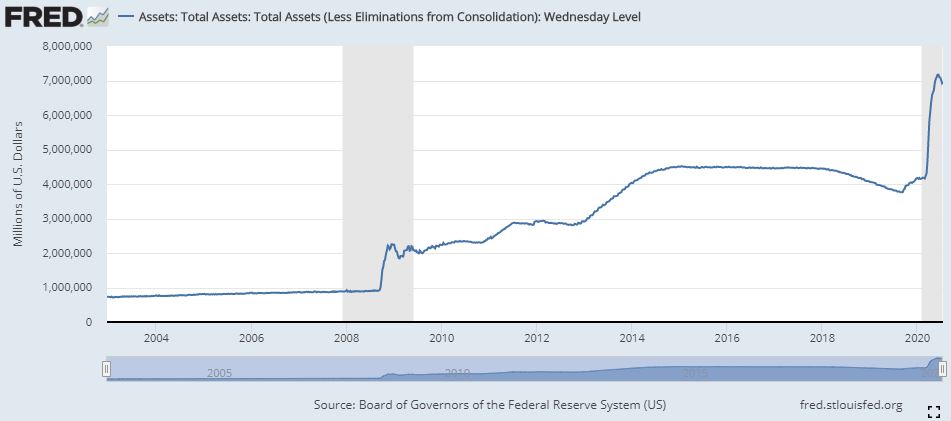
Learning how to treat that disease, central banks now throw unlimited 'whatever it takes' liquidity at the market, the latest iteration being the US Fed buying corporate bonds. The chart below shows the total assets of the US Fed, currently US$7 trillion, with the 2020 expansion making the GFC look like a blip.
In the background, we have Modern Monetary Theory (MMT) saying governments have no practical constraints on their spending, so they can just go hard when there are no inflationary consequences. Next, solve world poverty?

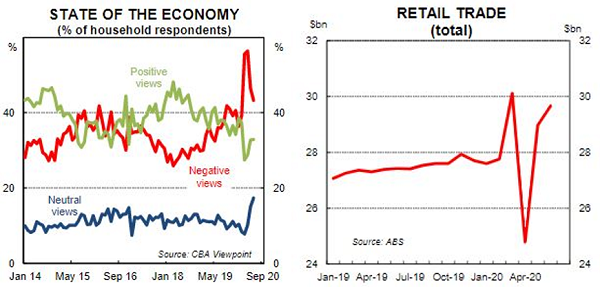
In Australia, gross government debt has reached about $850 billion and where previously a budget surplus in 2019/20 was forecast, a $90 billion deficit is now expected. The spending has a purpose and Reserve Bank Governor, Philip Lowe, is relaxed on the amount. The combination of JobKeeper, JobSeeker, super early release and business loans has helped retail trade, as shown below from ABS data and CBA Economics.

Individuals and the economy are benefitting. The heavy retail fall in April was followed by strength in May and June, such that Q2 2020 was only 2% lower than Q1 2020, an extraordinary result given the job losses and lockups. Negative views on the state of the economy have fallen quickly. So far, that's the economic cure, although we have yet to see the reality of poor corporate earnings in the coming season.
As with a vaccine, it remains to be seen whether there are unacceptable side effects from burgeoning government debt, but after a dozen years of liquidity injections in the US, there are few signs of inflation or limits to the size of the Fed balance sheet.

Where are we on the other cure, the vaccine? The stock market has drawn considerable enthusiasm from potential breakthroughs by US company Moderna and the UK's AstraZeneca working with Oxford University. China's Sinovac, Australia's CSL, big US players such as Johnson & Johnson and Merck, and German firms CureVac and BioNtech are among the leaders.

However, there is a reality check on vaccines which the market is ignoring. Rod Skellet reports on the company with most recent vaccine success, Merck, saying it takes much longer to develop safely than the market recognises. After approval, will governments hang on to supplies for their own people?

Next up, two of Australia's highest-profile fund managers identify stocks they like in the current market. Matt Williams shows the value of clever capital allocation is vital for company success, and Paul Xiradis reveals his favourites.

Then Raewyn Williams describes the conditions under which value stocks can recover lost ground versus the growth momentum, while Christine Benz interviews retirement expert, Wade Pfau, on the 4% 'safe withdrawal' rule, which has long been an industry standard for not running out of money in retirement.

In these uncertain times, Noel Whittaker describes new ways a portfolio can be hedged against stock market falls, and Amit Lodha says his reading has informed his long-term thinking more than ever during the pandemic lockdown.

This week's White Paper from Fidelity International focusses on the rapid growth of waste, and the investment opportunities from avoiding a devastating impact on our lives and the planet.

Graham Hand, Managing Editor

Latest updates

PDF version of Firstlinks Newsletter

Australian ETF Review from Bell Potter (June 2020 update)

ASX Listed Bond and Hybrid rate sheet from NAB/nabtrade

Indicative Listed Investment Company (LIC) NTA Report from Bell Potter

LIC Monthly Report from Morningstar

Plus updates and announcements on the Sponsor Noticeboard on our website


  •   22 July 2020
  • 1
  •      
  •   
banner

Most viewed in recent weeks

Building a lazy ETF portfolio in 2026

What are the best ways to build a simple portfolio from scratch? I’ve addressed this issue before but think it’s worth revisiting given markets and the world have since changed, throwing up new challenges and things to consider.

Get set for a bumpy 2026

At this time last year, I forecast that 2025 would likely be a positive year given strong economic prospects and disinflation. The outlook for this year is less clear cut and here is what investors should do.

Meg on SMSFs: First glimpse of revised Division 296 tax

Treasury has released draft legislation for a new version of the controversial $3 million super tax. It's a significant improvement on the original proposal but there are some stings in the tail.

Ray Dalio on 2025’s real story, Trump, and what’s next

The renowned investor says 2025’s real story wasn’t AI or US stocks but the shift away from American assets and a collapse in the value of money. And he outlines how to best position portfolios for what’s ahead.

10 fearless forecasts for 2026

The predictions include dividends will outstrip growth as a source of Australian equity returns, US market performance will be underwhelming, while US government bonds will beat gold.

13 million spare bedrooms: Rethinking Australia’s housing shortfall

We don’t have a housing shortage; we have housing misallocation. This explores why so many bedrooms go unused, what’s been tried before, and five things to unlock housing capacity – no new building required.

Latest Updates

Economy

Making sense of record high markets as the world catches fire

The post-World War Two economic system is unravelling, leading to huge shifts in currency, bond and commodity markets, yet stocks seem oblivious to the chaos. This looks to history as a guide for what’s next.

Australia’s generous housing subsidies face mounting political risk

Mark Carney has spoken of a rupture in the rules based system that has governed the world since 1945. That rupture means nations like Australia will need to boost defence spending and find savings elsewhere.

Shares

Finding yield on the ASX

With ASX dividend yields now below government bond yields, investors face an upside-down market where income is scarce, growth is muted, and careful selection of bond-like stocks has never mattered more.

Investment strategies

Digging for value among ASX miners

ASX miners are back in favour after playing second fiddle to banks for years. Is it too late to get in? Here are some thoughts on the large caps such as BHP and Rio, and the hot gold mining sector.

Gold

It’s economic reality, not fear-based momentum, driving gold higher

Most commentary on gold's recent record highs focus on it being the product of fear or speculative momentum. That's ignoring the deeper structural drivers at play. 

Investment strategies

Asia in 2026: Riding AI, reform and a shifting global order

Tariff turmoil tested Asia, but AI leadership, policy easing and reform momentum are restoring investor confidence and strengthening the region’s outlook for 2026. 

Investment strategies

Investors beware: Bull markets don’t last forever

New research explains why high valuations, low dividends and bullish sentiment rarely coexist with strong long-term returns after extended bull markets. 

Sponsors

Alliances

© 2026 Morningstar, Inc. All rights reserved.

Disclaimer
The data, research and opinions provided here are for information purposes; are not an offer to buy or sell a security; and are not warranted to be correct, complete or accurate. Morningstar, its affiliates, and third-party content providers are not responsible for any investment decisions, damages or losses resulting from, or related to, the data and analyses or their use. To the extent any content is general advice, it has been prepared for clients of Morningstar Australasia Pty Ltd (ABN: 95 090 665 544, AFSL: 240892), without reference to your financial objectives, situation or needs. For more information refer to our Financial Services Guide. You should consider the advice in light of these matters and if applicable, the relevant Product Disclosure Statement before making any decision to invest. Past performance does not necessarily indicate a financial product’s future performance. To obtain advice tailored to your situation, contact a professional financial adviser. Articles are current as at date of publication.
This website contains information and opinions provided by third parties. Inclusion of this information does not necessarily represent Morningstar’s positions, strategies or opinions and should not be considered an endorsement by Morningstar.