Register For Our Mailing List

Register to receive our free weekly newsletter including editorials.

Home / 391

Welcome to Firstlinks Edition 391

  •   21 January 2021
  • 4
  •      
  •   

Weekend market update: The S&P500 had a small pullback from record levels on Friday, but NASDAQ held its ground. Over the week, stimulus optimism and strong earnings results pushed the US up 1.9%. The All Ords in Australia fell 0.3% on Friday but rose 1.3% for the week with some stellar rises in IT, health and retail.  

***

The 46th President of the United States, Joe Biden, was sworn in on Wednesday, protected by over 20,000 troops in the Capitol, and we all hope it heralds a new era in US politics. Biden delivered a message about unity, including ending “this uncivil war that pits red against blue”. He spoke of the need for truth and highlighted when “facts themselves are manipulated and even manufactured”.

It will not be the end of Presidential tweets, as Biden announced:
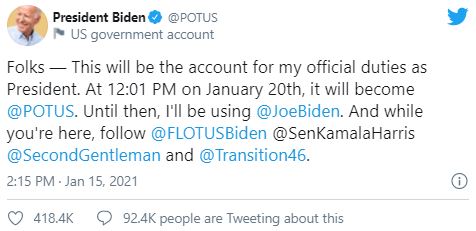
It followed a chaotic couple of months where Donald Trump desperately tried to prevent the transfer of power. In a speech the day before the inauguration, Trump said his political movement was only just beginning. It's unlikely we have seen the last of him. Even US Senate leader Mitch McConnell accused fellow Republican Trump of provoking the 6 January riots. Still, three-quarters of Republicans believe the election result was rigged and 74.2 million Americans voted for the outgoing President, despite 400,000 US citizens dying from COVID-19 and the rise of white supremacy under his watch.

The inauguration overshadowed an event equally important for markets, the appointment of Janet Yellen as Treasury Secretary and her testimony to Congress on Tuesday. She asked legislators to "act big" on virus stimulus, and in her previous role at the US Fed, she was a strong supporter of full employment. It's a further reason the market is having a Biden bounce.

While Joe Biden clearly has his work cut out uniting the nation, the US economy is a remarkable growth engine. Putting aside inequality issues (which should not be ignored), the US system has spawned some of the most influential and in their own way, greatest companies the world has ever seen. Amazon, Apple, Microsoft, Facebook, Google, Netflix ... the list goes on ... have changed the way we live. Not always for the better but most of us enjoy their services even as we complain about their market power.

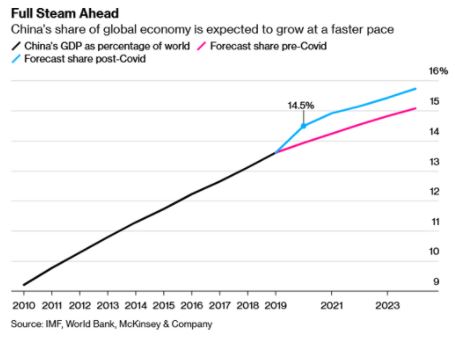
We have lived through a remarkable decade, and at a time when many are questioning the ascendancy of the US, China's share of global GDP is rising, from 9% to 14.5% since 2010. Post-COVID, China is on an accelerated path, as this chart forecasts.
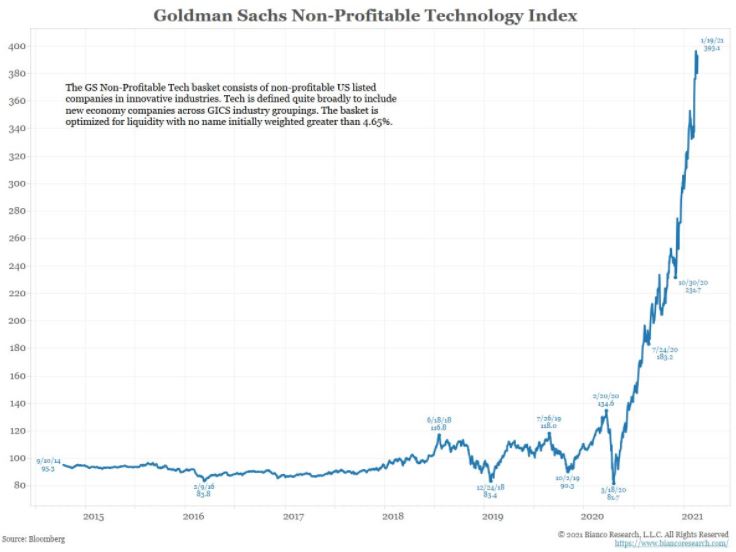
And with Joe Biden comes more stimulus and stockmarket optimism, with US markets reaching new records overnight. Companies do not even need to make a profit now or in the near future to become extremely valuable. In the US, Goldman Sachs produces on index of non-profitable listed companies, mainly using a broad definition of tech, and it's a 5-bagger in less than a year. The index barely moved for the previous five years, showing how 2020 has taken investors into rarefied territory.
One day, but who knows when, there will be a reckoning. Charlie Munger recently told the California Institute of Technology that the tech frenzy as exemplified by Apple was “the most dramatic thing that’s almost ever happened in the entire world history of finance.” Quite a claim from a 97-year-old. "This has been unbelievable. There’s never been anything quite like it.”

The stories of how many stocks are not trading on fundamentals is repeated so often it is almost tiresome. Any number of charts illustrate the point. Elon Musk can tweet about an unknown company (such as Signal Advance, Inc) and the share price can rise 10-fold over a couple of days. There is no analysis of company value and the sheer speculation will only stop when there is a major correction.

The contrast to an investor such as Peter Thornhill could not be greater. He has stuck to the same simple methods for 40 years, and he updates his 'mothership' chart to show the latest results as well as explaining his techniques. It has delivered a handsome retirement income for him.

On the subject of a slow accumulation in wealth, Brendan Ryan updates his list of ways the Government helps retirees, and it pays to check his list, even for those not eligible for the age pension.

Like Warren Bird, I find the word 'millionaire' meaningless as a description of a genuinely wealthy person. Invest a million at say 4% and the resulting $40,000 would barely finance a modest lifestyle (as per the ASFA standards) for a couple in retirement. Warren shows why the word has lost its relevance.

Most investors accept the role of ESG principles in portfolios, but Marian Poirier says actions should be backed up by active ownership to translate meaningfully into added equity returns. Companies are listening to their owners.

Portfolios benefitted from an allocation to gold in 2020, both for returns and diversification, but there was some second-half softness as equities rallied. Jordan Eliseo checks the headwinds and tailwinds for 2021.

Back to the US/China tussle, Michael Collins identifies a major conflict front with winner-take-all trade war potential and ramifications for all other countries. There is no limit to the ways technology will change our lives.

And Carden Calder hosted a forum of superannuation and funds management experts to find out how managers are promoting their funds, and it's worth professionals and their clients learning what's going on.

This week's White Paper is the BetaShares review of the remarkable successes of ETFs over the last year as the $100 billion milestone rapidly approaches. It was not long ago that Australians were criticised for their heavy domestic investing bias, but ETF flows in 2020 show that's an old story. Fixed income and commodities are also well supported.
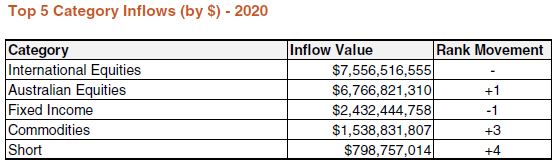
Vanguard Australia also reported its best ever year in 2020 with $5.7 billion of inflows, up 12% on 2019. Its December inflows of $2.1 billion were also a record. So much for a pandemic year worrying investors as equity funds also dominated.


Graham Hand, Managing Editor

A full PDF version of this week’s newsletter articles will be loaded into this editorial on our website by midday.

Latest updates

PDF version of Firstlinks Newsletter

Australian ETF Review from BetaShares

ASX Listed Bond and Hybrid rate sheet from NAB/nabtrade

Indicative Listed Investment Company (LIC) NTA Report from Bell Potter

Plus updates and announcements on the Sponsor Noticeboard on our website


  •   21 January 2021
  • 4
  •      
  •   
4 Comments
Steve
January 20, 2021

The proof in the pudding is whether Biden will prevent China annexing Taiwan or not.

jeff
January 27, 2021

I value the Morningstar material and relationship. I do not value your making it a political podium. While politics shapes and influences events, your bias is blatant and your attempt to shove it down our throat is pathetic.

SMSF Trustee
January 27, 2021

Huh? Jeff, Graham has written nothing that shows political bias or that's inappropriate. He's given a very brief summary of what's happened - Trump disputed the election and did so quite desperately, that's just a statement of fact, not a political comment - and made the important observation that the appointment of Janet Yellen as Treasury Secretary is significant for how policy will be made.
So there's no shoving down throats and it's not pathetic. Would you care to withdraw your comment as it's unfounded and incorrect?

Kevin Buxton
January 27, 2021

The " Biden bounce " may be a short lived phenomenon as the Dow Jones and S&P indices have reversed this trend, falling more than 3% in the past couple of trading sessions ( 26 -27 January ). Another phenomenon linked to the recent U.S. Presidential Election , is a reliable statistic that Trump recorded approximately 10 million more votes when losing in 2020, than in his narrow win in 2016. Accordingly Biden must have recorded an even greater number of votes in 2020, than Hilary Clinton received when defeated in 2016. The one statistic, that to the best of my knowledge has not been divulged, is the total voter turnout for 2020, in comparison to 2016. Is it possible that both Biden and Trump could record substantial increases in total votes, unless there was a substantial increase in voter turnout in 2020 ? Perhaps this actually occurred - however this phenomenon has not come to notice, so who is say that Trump's strident assertions concerning a " rigged election process " are completely without foundation.


Leave a Comment:

banner

Most viewed in recent weeks

Why spending more in early retirement can improve lifetime income

Conventional wisdom encourages retirees to preserve superannuation. But if those likely to qualify for the Age Pension later in life spend a little more today, it may deliver higher lifetime income and a more stable retirement.

Testamentary trusts have secured the CGT exemption

Treasury’s latest CGT reform draft delivers a win for testamentary trusts and deceased estates, exempting estate-derived gains from the 30% floor. However, questions on death and divorce rollovers remain unresolved.

Meg on SMSFs: What do we think about reversionary pensions these days?

Reversionary pensions have long been a staple of SMSF estate planning, but are they still the best option? Meg Heffron revisits a once-clear favourite and asks whether changing super rules have shifted the balance.

Is it time to bail on Australian stocks?

For generations, Australian investors have backed banks, miners and dividends. But has that loyalty come at a cost? A look at the numbers raises an uncomfortable question about where future returns will come from.

Testamentary trusts survived the trust tax. The drafting battle has just begun.

The fight over testamentary trusts looked settled. Then the draft legislation arrived. Hidden in a technical detail is a question that could force many families to rethink wills they thought were already future-proof.

How does the 4% rule stack up?

The 4% rule has long been retirement's gold standard. But after a difficult period for investors, fresh analysis suggests a more conservative approach may significantly improve the chances of making savings last.

Latest Updates

Planning

How the typical Australian Family could save $844,350 in taxes

The value of a testamentary trust is not determined by wealth alone. Depending on circumstances, it can reduce the tax burden on inherited income, create efficiencies and help build intergenerational wealth.

Superannuation

There's a reason why your super is locked up until your 60s

For decades, it seemed settled. Then one controversial idea reignited a debate that could reshape the financial future of millions. The real question isn’t who’s right or wrong, but whether a long-held assumption deserves another look.

Property

The housing slide could become a crash

House prices are sliding across Australia, yet the most dangerous ingredient for a housing crash is still missing. If job losses surge amid growing economic risks, today's correction could become a historic property downturn.

Retirement

Under-retiring: The greatest retirement risk in a generation

Two retirees. Similar savings. Completely different lives. New research from Challenger reveals why some Australians confidently spend in retirement while others hold back and the overlooked factor shaping retirement decisions.

Five risks to watch in markets

Things you may often hear are: a recession is around the corner, markets are overpriced, the AI sector is about to flop at any moment. It’s like the never-ending laundry pile that sits in my house, it never really disappears.

Investment strategies

Do you qualify as ‘rich’?

What does it mean to be 'rich'? For something so universally desired, it is surprisingly difficult to define. That ambiguity creates a challenge for investors and raises a bigger question about what financial success really looks like.

Investment strategies

If you’re worried about your bond portfolio, you’re missing the point

Most investors think they know what bonds are for. But when markets turn volatile, a surprising misunderstanding can lead to costly decisions. Here’s the overlooked lesson that could change how you view your portfolio.

Alliances

  • ASA-Logo-RGB-ActiveGreen-web.png

© 2026 Morningstar, Inc. All rights reserved.

Disclaimer
The data, research and opinions provided here are for information purposes; are not an offer to buy or sell a security; and are not warranted to be correct, complete or accurate. Morningstar, its affiliates, and third-party content providers are not responsible for any investment decisions, damages or losses resulting from, or related to, the data and analyses or their use. To the extent any content is general advice, it has been prepared for clients of Morningstar Australasia Pty Ltd (ABN: 95 090 665 544, AFSL: 240892), without reference to your financial objectives, situation or needs. For more information refer to our Financial Services Guide. You should consider the advice in light of these matters and if applicable, the relevant Product Disclosure Statement before making any decision to invest. Past performance does not necessarily indicate a financial product’s future performance. To obtain advice tailored to your situation, contact a professional financial adviser. Articles are current as at date of publication.
This website contains information and opinions provided by third parties. Inclusion of this information does not necessarily represent Morningstar’s positions, strategies or opinions and should not be considered an endorsement by Morningstar.