Register For Our Mailing List

Register to receive our free weekly newsletter including editorials.

Home / 411

Why copper prices are at all-time highs

Copper has played a vital role in civilisation since its discovery in the Neolithic era nearly 10,000 years ago. More than many other commodities, copper represents progress, and when it is in demand, it means industries and economies are moving forward.

Often known as Dr Copper for the uncanny way its price anticipates future economic activity, at the time of writing, copper prices hit all-time highs of $US10,460 per tonne (US$4.76/lb). Coming up from 3-year lows in the midst of the COVID-19 induced recession in 2020, current prices reflect a strong rebound as the global economy switches back on. But are these prices merely a post-COVID phenomenon or is there more to it? This article discusses the forces at play and strategies to benefit from the electric metal’s strength.

What is pushing prices higher?

There are a few forces at play that are affecting the price of copper, but for ease of explanation a simple way to group them is into supply and demand factors.

Supply factors:

  • COVID-19 dislocation: As we are well-aware, the COVID-19 pandemic resulted in widespread lockdowns leading to a drop off in global copper supply at all points in the supply chain. As the COVID-19 crisis eases (in some areas), supply chains are able to return to their normal pre-pandemic operating levels.
  • Lack of new discovery: According to S&P, of the approximately 1 billion tonnes of copper resources discovered since 1990, only 8% has been discovered in the past decade. This is despite exploration spend between 2009-2019 seeing a 68% increase on the prior decade. Given it can take 20 years for production to commence following discovery, this represents a long-term supply-side issue.
  • Diminishing ore quality: Copper ore is finite in supply and its quality has declined, which means more rock needs to be mined and processed in order to extract the same amount of copper. In Chile, the world’s largest copper producer, average copper ore grades have deteriorated by 30% since 2005. Even with reductions in ore quality, miners can’t perpetually ramp up production, there is a limit to annual production and how much copper remains to be mined.
  • Scrap supplies: While scrap metal supplies of copper are a viable and important source of supply, scrap historically takes time to respond to market dynamics, and considering COVID-19 related logistical constraints, deficits are expected in the near-term, further strengthening copper prices.

Demand factors:

  • Post COVID-19 activity and fiscal stimulus: The return to ‘normal’ activity, as well as making up for lost time through the COVID-19 lockdowns are a strong but shorter-term impact. Against the backdrop of mega trends such as mass urbanisation, demand for copper for use in building construction is one of the largest markets (e.g. water pipes, electric wiring) and while COVID lockdowns can slow a trend, they can’t stop it completely. Government fiscal stimulus is resulting in increased economic activity and thus demand for copper.
  • Clean energy transition: The US climate summit saw declarations by a number of nations to net zero emissions targets and the US re-signing the Paris Agreement. Crucially China’s President Xi also pledged to cut coal consumption starting from 2026 and reiterated the country’s 2060 carbon neutrality target. Two of the world’s largest economies reminded us that they are aligned in their pursuit of lower carbon emissions and promotion of renewable energy. Without copper there can be no decarbonisation meaning demand for copper where it relates to clean energy is set to grow strongly in the years ahead. According to the International Energy Agency, it is estimated that around 45% of demand for copper will come from clean energy technologies in 2040, up from just 24% in 2020. Total demand for copper by clean energy technologies is estimated to see a three-fold increase by 2040, requiring investment in the near-term and production to ramp up drastically to meet demand. Against some of the supply factors mentioned above, this will likely put pressure on copper prices.

Can the price keep going up?

In the near-term the precise degree of inventory reductions will be a key determinant of copper prices. Speculative positioning is rather extended, China may well slow its purchasing given high prices and moderation in consumption growth may moderate causing a price correction.

If scrap supply is able to respond sufficiently to stop major refined inventory drawdowns, the copper price would also suffer. A bull case would see easier than anticipated Chinese policies, Fed yield curve control and European growth surprises, whilst a bear case would see global policy support waning, a growth slowdown and positioning unwinding sharply.

Are the rising copper prices reflected in your copper stocks?

Five copper stocks that we hold are Ivanhoe Mines, Freeport McMoRan, Anglo American, Solaris and Hudbay Minerals (as at 30 April 2021 and holdings are subject to change). In the chart below, we plot the copper price relative to these companies’ stock prices as a growth of $100 chart since the COVID crisis in March 2020.

In our view, copper equities are the best investment vehicle for exposure to copper. Historically commodity equities have outperformed their underlying commodities due to their additional growth, value creation potential and an equity risk premium to harvest.

Growth of US$100 in copper stocks
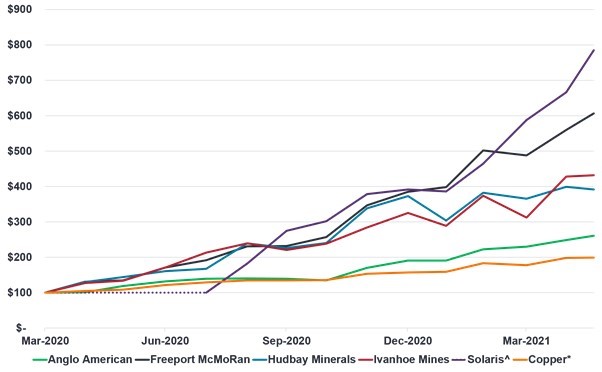
Source: Bloomberg, Janus Henderson Investors. As at 23 May 2021. *LME Copper 3 Month Rolling Forward. ^Solaris listed in July 2020 and therefore shows no change from March to July 2020. Past performance is not a guide to future performance. References made to individual securities should not constitute or form part of any offer or solicitation to issue, sell, subscribe or purchase the security.

We see attractive opportunities in copper producers, developers and explorers. While there may be shorter-term volatility in copper and share prices, we are witnessing a long-term trend driven by the decarbonisation of the global economy, while large sources of new supply will be slow, expensive and difficult to bring to the market.

The Anthropocene Epoch is used to describe the current period in Earth’s geologic history when human activity has induced a significant impact on the planet. As we reverse this impact through a new green industrial revolution that offers cheap, clean energy, copper is very much part of the solution.


Tal Lomnitzer is a Senior Investment Manager in the Global Natural Resources team at Janus Henderson. This article does not in any way constitute advice or an invitation to invest. It is solely for information purposes and subject to change without notice.


  •   9 June 2021
  • 7
  •      
  •   
7 Comments
Marie Elliot
June 09, 2021

What about Australian copper producers.????

Marie.

Tim
June 18, 2021

Castillo Copper (CCZ) has some promising tenements Marie, with another drilling program under way.

Jim
June 09, 2021

Isn't the Statue of Liberty made of copper? Sounds like a good source - easy to access, and near a major market. They could break off a bit at a time.

Trevor
June 15, 2021

Jim !!
It was a GIFT from the French people to the American people !!
That would not be very tactful.......besides which it is awfully THIN copper sheeting !.
.
"The total weight of copper in the Statue is 62,000 pounds (31 tons) and the total weight of steel in the Statue is 250,000 pounds (125 tons). Total weight of the Statue's concrete foundation is 54 million pounds (27,000 tons).
The copper sheeting of the Statue is 3/32 of an inch thick or 2.37mm."
For example : a wind turbine has only about 600 tonnes of concrete , 200 tonnes of steel , and somewhere between
2 to 6 tonnes of copper......so you could [theoretically] make only 5 decent sized "windmills" with the copper content !
.
I'd rather NOT recycle "her" ..."she" looks much better as an ornament than a bunch of electrical equipment !
"she" is an American Icon , a symbol and a light-house and a lightning conductor all in one ! Magnificent !
And besides which , "she" has lasted MUCH LONGER than any of those other "electrical eye-sores" ever will !

CC
June 09, 2021

OZ Minerals for me

BeenThereB4
June 09, 2021

I can't sleep without my Oz Minerals, which is a producer with long-life resources

Could also consider Sandfire

Bakker
June 10, 2021

AIS comes to mind ...also a potential gold kicker.


Leave a Comment:

RELATED ARTICLES

Avoiding destructive M&A and hype cycles in mining

Uranium and the fear of running out

5 big trends shaping markets for the next decade

banner

Most viewed in recent weeks

Australian stocks will crush housing over the next decade, 2025 edition

Two years ago, I wrote an article suggesting that the odds favoured ASX shares easily outperforming residential property over the next decade. Here’s an update on where things stand today.

Australia's retirement system works brilliantly for some - but not all

The superannuation system has succeeded brilliantly at what it was designed to do: accumulate wealth during working lives. The next challenge is meeting members’ diverse needs in retirement. 

Get set for a bumpy 2026

At this time last year, I forecast that 2025 would likely be a positive year given strong economic prospects and disinflation. The outlook for this year is less clear cut and here is what investors should do.

Building a lazy ETF portfolio in 2026

What are the best ways to build a simple portfolio from scratch? I’ve addressed this issue before but think it’s worth revisiting given markets and the world have since changed, throwing up new challenges and things to consider.

Meg on SMSFs: First glimpse of revised Division 296 tax

Treasury has released draft legislation for a new version of the controversial $3 million super tax. It's a significant improvement on the original proposal but there are some stings in the tail.

The 3 biggest residential property myths

I am a professional real estate investor who hears a lot of opinions rather than facts from so-called experts on the topic of property. Here are the largest myths when it comes to Australia’s biggest asset class.

Latest Updates

Investment strategies

Building a lazy ETF portfolio in 2026

What are the best ways to build a simple portfolio from scratch? I’ve addressed this issue before but think it’s worth revisiting given markets and the world have since changed, throwing up new challenges and things to consider.

Investment strategies

21 reasons we’re nearing the end of a secular bull market

Nearly all the indicators an investor would look for suggest that this secular bull market is approaching its end. My models forecast that the US is set for 0% annual returns over the next decade.

Property

13 million spare bedrooms: Rethinking Australia’s housing shortfall

We don’t have a housing shortage; we have housing misallocation. This explores why so many bedrooms go unused, what’s been tried before, and five things to unlock housing capacity – no new building required.

Investment strategies

Market entry – dip your toe or jump in all at once?

Lump sum investing usually wins, but it can hurt if markets fall. Using 50 years of Australian data, we reveal when staging your entry protects you, and when it drags on returns. 

Investment strategies

The US$21 trillion question: is AI an opportunity or excess?

It has been years since the US stock market has been so focused on a single driving theme, and AI is unquestionably that theme. This explores what it means for US and global markets in 2026.

Economy

US energy strategy holds lessons for Australia

The US has elevated energy to a national security priority, tying cheap, reliable power to economic strength, AI leadership, and sovereignty. This analyses the new framework and its implications for Australia.

Strategy

Venezuela’s democratic roots are deeper than Trump knows

Most people know Maduro was a dictator and Venezuela has oil. Few grasp the depth of suffering or the country’s democratic history - essential context as the US ousts Maduro and charts Venezuela’s future. 

Sponsors

Alliances

© 2026 Morningstar, Inc. All rights reserved.

Disclaimer
The data, research and opinions provided here are for information purposes; are not an offer to buy or sell a security; and are not warranted to be correct, complete or accurate. Morningstar, its affiliates, and third-party content providers are not responsible for any investment decisions, damages or losses resulting from, or related to, the data and analyses or their use. To the extent any content is general advice, it has been prepared for clients of Morningstar Australasia Pty Ltd (ABN: 95 090 665 544, AFSL: 240892), without reference to your financial objectives, situation or needs. For more information refer to our Financial Services Guide. You should consider the advice in light of these matters and if applicable, the relevant Product Disclosure Statement before making any decision to invest. Past performance does not necessarily indicate a financial product’s future performance. To obtain advice tailored to your situation, contact a professional financial adviser. Articles are current as at date of publication.
This website contains information and opinions provided by third parties. Inclusion of this information does not necessarily represent Morningstar’s positions, strategies or opinions and should not be considered an endorsement by Morningstar.