Register For Our Mailing List

Register to receive our free weekly newsletter including editorials.

Home / 656

Central banks need higher inflation targets

In 1971, an uncle of Don Brash, the governor of the Reserve Bank of New Zealand from 1988 to 2002, invested the proceeds from selling his fruit farm in 18-year government bonds yielding 5.4%. At that time, the uncle’s NZ$30,000 could buy 11 four-cylinder cars.

But when the bonds matured in 1989 the NZ$30,000 could buy only one of those cars. Inflation, of course, had killed the bond investment’s purchasing power.

Brash used this and other anecdotes to explain how the social injustices of inflation prompted the RBNZ to a world first in 1990 when New Zealand’s inflation was 8%. That year the central bank and the government formalised an inflation target between 0% and 2%. The pact said the goal must be met by 1992.

The RBNZ’s success in crushing inflation to below 2% in less than half the time prompted politicians the world over to gift central banks the autonomy to meet inflation targets of around 2%. – about 150 of the world’s 200-odd central banks are judged to be depoliticised inflation fighters.

The move to ‘independent’ central banking ushered in decades of price stability (even if the coincidental rise of China and technological advancements helped). Such became their aura, central bankers epitomised the Davos ideal of a world run by the technocratic elite.

Those days are gone for the foreseeable future. The Israeli-US attack on Iran has sparked an inflation shock, foremost so far from higher energy prices, while impeding economic growth. The re-emergence of the 1970’s curse of ‘stagflation’ will expose the social and political limits of monetary policy as an inflation-fighting tool.

Higher interest rates are an inadequate macro-economic weapon to control prices because they only target indebted businesses and consumers, notably mortgaged families in the case of the latter – about one-third of households in Australia.

If the object is to reduce demand to anchor the public’s outlook for inflation and thus avoid a wages-price spiral, measures such as fiscal tightening are needed to spread the burden of taming inflation. Otherwise, interest rates need to rise to levels that cripple the indebted to achieve the same reduction in demand.

As the economic, political and social costs of primarily relying on monetary policy to combat inflation manifest, policymakers will seek other solutions. Part of the conundrum to solve is that monetary policy is innately political. Monetary settings including inflation goals must resolve the competing interests of debtors and creditors and savers and spenders. When inflation is elevated, the conflict of interests intensifies to a trade-off between the future jobless against reduced inflationary pain for others – essentially the question becomes how high might be an acceptable rate of unemployment.

One appealing solution might be to lift inflation targets so the blows to the indebted, employment levels and economic growth can be softer.

One way to do that would be to raise inflation targets to, say, 4%. In 2020, the Federal Reserve veered in this direction when it scrapped a 2% inflation ceiling for an average target of 2%. That meant the US central bank would let inflation exceed 2% “for some time” if it had undershot that figure. Such higher inflation targets would ease the monetary-policy squeeze and erode real debt burdens.

While many central banks only target low inflation, some including the Federal Reserve and the Reserve Bank of Australia have two main goals – tame inflation and full employment – that in conventional economics are mutually exclusive. A way to formalise this trade-off would be to target nominal gross domestic product.

Nominal GDP is the dollar value of an economy’s output before it is adjusted for inflation to derive real GDP. Economists suggest central banks target, say, 5% for nominal GDP, where the ideal outcome would be 2% inflation and 3% real GDP growth.
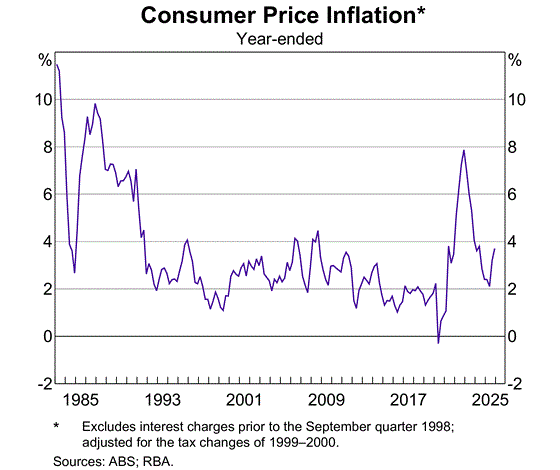
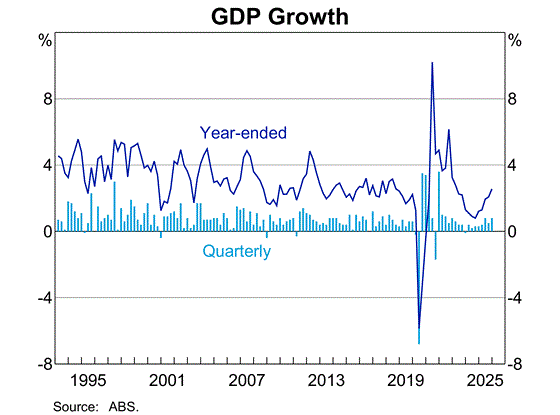
Among advantages, targeting nominal GDP implicitly contains ‘forward guidance’ and lowers the risk of boom-bust cycles by avoiding the rigidity whereby inflation close to 0% pressures central banks to cut rates even if the economy is thriving. The target better copes with shocks because it tolerates faster inflation when economies are struggling. Inflation, in theory, could reach 7% if the economy is shrinking 2% in real terms.

But the reverse applies too. Inflation above 5% demands shrinking real GDP, which is politically difficult to even articulate let alone implement (especially when high unemployment risks among other damage a housing crash that would threaten the banking system).

The threat of a surge in unemployment due to the energy, food and other price shocks (on top of any blows to employment from the use of artificial intelligence) makes it likely that in coming times politicians will raise inflation targets in some way. If the coming hit to economic growth is severe enough, policymakers might even suspend inflation goals. Whatever happens, no gentle solution to today’s inflationary shock looms.

Raising inflation targets has drawbacks, to be sure. Such moves unmoor inflation expectations as an inflation goal raised once can be lifted again. Targeting nominal GDP has additional disadvantages in that it’s hard to explain to the public, and central banks might not allow inflation to rise too high even if the economy is contracting. Perhaps inflation targets might only need a little loosening as inflation is not headed towards doubt-digits as it did in the 1970s. The antics of President Donald Trump against the Fed might make it harder for the US central bank to raise its inflation target without looking like Trump’s patsy. However the Fed tries to preserve its credibility (or not), policymakers know the public prioritise jobs over inflation-busting.

In the 1990s, inflation targets of 2% were the solution. Today’s war-driven shocks, erratic US policymaking, high indebtedness and darkening economic outlook suggest more flexible inflation targets are needed.


Michael Collins is a freelance writer and editor, economist, and investment specialist. Republished with permission from the author’s Substack newsletter @denouementwatch.


  •   1 April 2026
  • 4
  •      
  •   
4 Comments
James Davey
April 02, 2026

At the moment governments are incentivised to create inflation and do so to the best of their ability.
This is due to bracket creep.
Index income tax brackets (along with stamp duty, land tax et al) and watch inflation fall.

2
Former Treasury policy maker
April 05, 2026

I think that bracket creep incentivised governments to cut income tax rates e ery few years in an attempt to win votes. If it incentivised them to create inflation then (a) they would never cut tax rates and (b) they wouldn't have given central banks the independence to run monetary policy to contain inflation.
The idea that governments prefer inflation is nonsense.

Dudley
April 02, 2026

"A way to formalise this trade-off would be to target nominal gross domestic product.":
How?
'loose' money, negative real net bank deposit interest rates, 'forces' spending of bank deposits.
May as well waste it on consumer fluff as give (inflation - nominal interest) to bank shareholders.
'tight' money, positive real net bank deposit interest rates, 'entices' saving in bank deposits.
= (1 + (1 - Tax%) * Nominal%) / (1 + Inflation%) - 1
How to 'loosen' or 'tighten' on command?


Leave a Comment:

RELATED ARTICLES

Shares rebound on hopes of war ending, but stalemate the likely outcome

Why we believe bonds are now beautiful

Reserve Bank has both a date and data dilemma

banner

Most viewed in recent weeks

Testamentary trusts post-budget: Estate planning, tax reform and the ‘death tax’ debate

Proposed Budget changes to taxation are casting new uncertainty over testamentary trusts, prompting closer scrutiny of estate planning structures and the real implications of reforms still taking shape.

How to minimise tax with a will

Inheritance tax implications in Australia may surprise some, as poor estate planning without proper wills or trusts can lead to costly tax bills and delays for beneficiaries.

High quality businesses are on sale

Beneath the dominance of the ASX's largest stocks, much of the market has been left behind. High-quality companies are now trading at levels rarely seen, offering opportunities for investors willing to look deeper.

Meg on SMSFs: The CGT changes don’t impact super but what about Div 296 tax decisions?

New CGT rules could tip the scales in the super vs non-super debate. For those facing the Division 296 tax, the case for withdrawing has gotten more complex. A "comparison rate" tool may help assess decisions.

The strange effect of the 30% minimum capital gains tax

The 30% minimum tax on capital gains sits at the heart of the budget's proposed reforms. Yet the mechanics reveal anomalies that introduce unexpected distortions that raise questions about its design.

Welcome to Firstlinks Edition 667 with weekend update

The downfall of the giant and three lessons for investors.

  • 18 June 2026

Latest Updates

Latest from Morningstar

Ranking three common retirement strategies

The defining challenge of retirement isn't just about building wealth, it's about converting your lifetime savings into sustainable income. A holistic understanding of different strategies can improve long-term outcomes.

Economy

Was life really better in the good old days?

Are we worse off than previous generations? Lately, there seems to be a heightened level of angst that economic conditions are getting harder and that the two-party political system (and maybe democracy too) is failing voters.

Retirement

Australia has saved $4.5 trillion for retirement. Here's what matters more

Most Australians approaching retirement can tell you the exact dollar value of their super account. But success depends on more than a sizeable balance. Here's four key questions to ask yourself at the start of the financial year. 

Who gains in an AI-supercharged economy?

AI is already reshaping the economy, but companies building transformative technologies rarely capture the greatest long-term value. Instead, those benefits accrue to the users. We may well see this pattern reproduced. 

Taxation

Div 296's million-dollar reset worth $25,000

The 'cost base reset' for the new super tax is being sold as protection for pre-July gains. A worked example shows $1M of protection is worth about $25,000, and the real deadline has not passed.

Latest from Morningstar

The forecasting fix that Wall Street missed

Asking whether markets are overpriced may be the wrong question. New research suggests that traditional valuation metrics used to forecast returns may have been misread. Here are five takeaways for investors.

Investment strategies

Should a fund manager invest their own money differently?

Investors often like the idea that fund managers should invest client money exactly as they invest their own. But reality is more complicated. Unique circumstances make a different approach rational and, at times, beneficial.

Sponsors

Alliances

© 2026 Morningstar, Inc. All rights reserved.

Disclaimer
The data, research and opinions provided here are for information purposes; are not an offer to buy or sell a security; and are not warranted to be correct, complete or accurate. Morningstar, its affiliates, and third-party content providers are not responsible for any investment decisions, damages or losses resulting from, or related to, the data and analyses or their use. To the extent any content is general advice, it has been prepared for clients of Morningstar Australasia Pty Ltd (ABN: 95 090 665 544, AFSL: 240892), without reference to your financial objectives, situation or needs. For more information refer to our Financial Services Guide. You should consider the advice in light of these matters and if applicable, the relevant Product Disclosure Statement before making any decision to invest. Past performance does not necessarily indicate a financial product’s future performance. To obtain advice tailored to your situation, contact a professional financial adviser. Articles are current as at date of publication.
This website contains information and opinions provided by third parties. Inclusion of this information does not necessarily represent Morningstar’s positions, strategies or opinions and should not be considered an endorsement by Morningstar.