Register For Our Mailing List

Register to receive our free weekly newsletter including editorials.

Home / 239

Five ways Australian super is a global outlier

The most obvious expectation is that Australian superannuation should have a similar asset allocation as the retirement money in other developed countries. Major asset managers are global, consultants advising big super funds are global businesses, finance executives study the same markets and theories, and investment markets follow a herd mentality. Surprisingly, the differences are stark.

Willis Towers Watson's not-for-profit initiative, The Thinking Ahead Institute, has issued its ‘Global pension assets study 2018’ based on 22 pension markets with assets of USD41 trillion, showing Australia has been the fastest grower over the last 20 years, up 12.1% per annum. This is driven by mandated contributions and dominance of defined contribution schemes. Note that although the study refers to 'pensions', in Australia's case, it includes the entire balance in superannuation funds (pre and post retirement).

What’s most notable is how Australia is an outlier in many important ways, including:

  • The highest allocation to equities at around 50% (same as the US) of the 22 countries, with Switzerland and Netherlands as low as 33% and Japan 30%. What do the Gnomes of Zurich know that we don’t?

Asset allocation and DB/DC split in 2017 by country
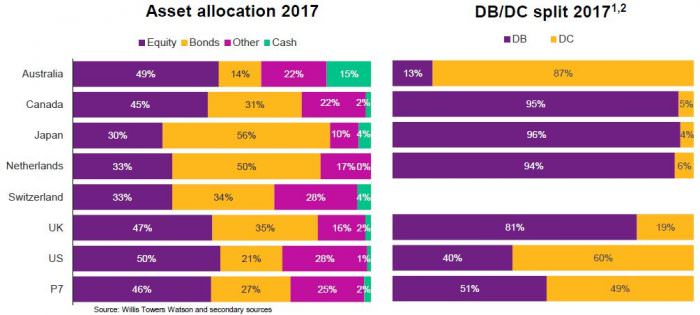
Equity markets are usually more volatile and subject to larger drawdowns than bonds, leaving Australian savings more exposed to the vagaries of the market. Countering this worry is that fact that shares offer better long-term returns, and with increasing longevity, pensions need to last 30 to 40 years, not the 10 to 20 years of the past. Australia also has relatively high dividend yields and the benefits of franking credits.

(The Australian data uses the ATO's reports on asset allocations, which have shortcomings as documented here, especially in not recognising SMSF exposure to global equities).

The concern about capital protection is one reason why many MySuper funds are ‘target date’ or ‘lifecycle’ funds, where the defensive or bond allocation increases with age.

There is also an issue with sequencing risk, where the market falls heavily shortly before retirement, when pension balances are at their highest, about to face withdrawals to fund a retirement, and with little ability to top up.

For example, on 18 January 2016, the Chairman of the Future Fund and former Treasurer, Peter Costello, wrote in the Herald-Sun about the risk of investing too much superannuation money into shares, including:

“The compulsory superannuation system has hooked the earnings and savings of millions of Australians into the stock market. I don’t think it was a conscious decision. It started off small and now it has grown big. Stocks are at the riskier end of the investment universe. Government policy has directly hooked the wealth of individual citizens to rises and falls in share prices.

Our stock market is still 30% below its level of eight years ago. There’s a lot of lost years for people to make up and a lot of lost wealth. You can see why people prefer to put their voluntary savings in less volatile assets like residential housing. They’re more careful with their money than the Government is.”

  • The highest allocation to cash, at a heady 15%, when cash rates are negative in real terms, in contrast to The Netherlands at nil and a global average of only 2%. Do Australian investors use their ‘risk budget’ on equities and compensate by holding lots of cash? There is probably a distortion that explains some of the difference: the Australian numbers include SMSFs, a uniquely Australian vehicle which comprises one-third of all superannuation balances. SMSF trustees are individuals, notoriously conservative and protecting their own capital with cash and term deposits. The Australian number is being compared with predominantly institutional investors in other countries.

  • The lowest allocation to bonds at only 14%, versus the global industry average of 27% and a country like The Netherlands as high as 50%. Some of these countries have negative interest rates on their government bonds, although they have a far more active non-government market than Australia. And note previous comment about SMSF allocations.

  • The highest proportion of assets in defined contribution schemes (where the amount invested is defined) rather than defined benefits (where the final benefits of the scheme are defined). Defined contributions require the investor to decide how money will be invested (although most are in defaults and do not make an explicit decision on how the money is managed). It is the investor who takes the full risk of the outcome, rather than receiving the protection of a pension with the risk borne by an institution. Australia has only 13% of assets in defined benefits versus over 94% in Canada, Japan and The Netherlands, as shown above.

  • Australia’s system is second only to The Netherlands in the ratio of pension assets to GDP, showing the maturity of our compulsory superannuation system relative to the size of our economy. Pension assets now stand at 138% of GDP. This looks like it’s up from 114% in 2007, but the 2017 data includes SMSFs.
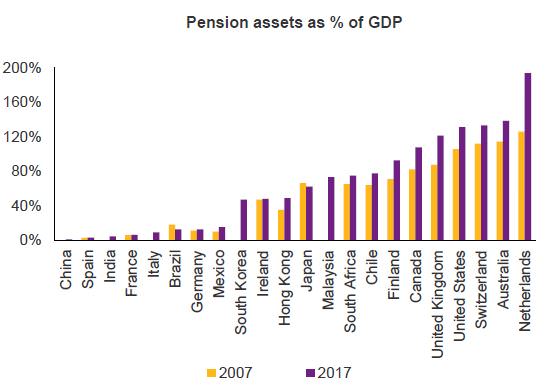
Other comments by the Thinking Ahead Institute include:

  • Global institutional pension fund assets in the 22 major markets reached USD41 trillion at year end 2017, increasing USD5 trillion over the year.

  • With DC models in the ascendancy, it is important that governance issues and the shift in risk on to the end-saver are closely monitored.

  • Reduced home bias for equities in the last 20 years, falling to 41% in 2017 from 69% in 1998. Private assets rose from as little as 4% of allocations in 1997 to around 20% today, showing a sophistication of strategies in allowing funds to go beyond traditional means of diversification.


Graham Hand is Managing Editor of Cuffelinks. The Thinking Ahead Institute is a global not-for-profit member organisation whose aim is to influence change in the investment world for the benefit of savers. The Institute is an outgrowth of Willis Towers Watson Investments’ Thinking Ahead Group. The full study is linked here.


  •   7 February 2018
  • 13
  •      
  •   
13 Comments
Dean
February 12, 2018

According to Costello, "Our stock market is still 30% below its level of eight years ago". Perhaps, but this only parallels the stock market investment experience of someone who threw away all their dividends as they received them. What on earth is he doing with the Future Fund's dividends if he doesn't regard them as part of investment return?

Joost Daalder
February 15, 2018

Sure, dividends are part of the return, and they are fairly high, in Australia. Nonetheless, growth in the Australian share market has been exceptionally poor since the crash of 2007-8 which left someone simply invested in the index just over 50% less well off once the low had been reached. Thus this fact is a very strong argument for NOT having too much money in shares, unless one is willing and able to sell them at a high point (in this case before the end of 2007). I did so myself, but would not expect all investors to pick the highs and lows accurately - most of them don't, and are well advised to be careful with their exposure to shares.

David Knox
February 12, 2018

We may be outliers but I suggest we are leading the pack and the world will follow. One of the reasons for a higher allocation to bonds in some countries is their DB pensions where the sponsoring employer want to hedge their future payments and the potential impact on their balance sheet of future interest rate movements. Our emphasis on DC is that we moved away from DB before the rest of the world. They are now following! So my argument is that we are not an outlier but a leader.

Ashley
February 14, 2018

Don’t forget that super is only a fraction of what people consider their asset they will live off in retirement - that includes equity in the family house, their businesses, investment properties, holiday house, inheritance, etc.

SMSF Trustee
February 14, 2018

Don't forget that what Ashley has said is true for perhaps a fraction of people. For the vast majority who aren't in the same privileged position as he is and I am, super is a HUGE component of what they'll live on. Not everyone has an investment property, a holiday house and a big inheritance to rely on!

James
February 14, 2018

Sadly, most people, not including I suspect readers of Cuffelinks, have woefully inadequate projected super balances by retirement age, very few worthwhile assets beyond the family home, and a fancifully hopeful investment in optimism that present and future governments will look after them!
People need to save and invest more for their own future. Relying on the government, run by politicians and bureaucrats that couldn’t run a corner store is absurd!

David
February 14, 2018

We also need to take into account that many European countries still have legislated minimums for bond holdings in pension funds.

Anon
February 15, 2018

If you wish to allocate funds into bond market you need to have a bond market in the first place, here in Australia there is no bond market to speak of, Treasury Federal government treasury bills not withstanding.

Graham Hand
February 15, 2018

Hi Anon, it's not correct there is no domestic bond market to speak of and there are many ways to gain exposure to bonds. You can:
1. Invest in a managed fund
2. Invest in a LIC or ETF on the ASX
3. Have a relationship with a fixed income broker who services 'retail' clients
4. Buy a listed exchange traded bond (XTB) on the ASX.

Cheers, Graham

Jason
February 19, 2018

Great stuff Graham

Can't help but think culture and tradition (the way we did things yesterday is the way we do them today) still play a big part in how capital is invested and whether operating a defined benefit v. defined contribution structure.

How else can you explain Japan's position of a very heavy weighting to bonds that will deliver next to no return and Europe's love of defined benefits but lack of funding for them.

Nearly every country acknowledges the issues of an ageing population on the sustainability of defined benefit schemes, but clearly few have bothered to do much about it.

On these fronts I think Australia being an outlier is a good thing.

Ramani
December 20, 2018

A key distinction is the way we slow cook super in tax over decades.
Unlike most countries where retirement savings and their accumulation are not taxed until withdrawn (and then at the marginal, presumably lower post-retirement rates) we have created a complex beast that never fails to attract the attention of treasurers looking for revenue from captive savers. Add our innovation of 'salary sacrifice' where otherwise taxable income can be hallucinated as pretax, the drama is complete.

Steve
December 20, 2018

Actually Graham, based on the chart under Point 1 of your article, it looks to me like the "Gnomes of Zurich" are the outliers as regards exposure to equities.

shaun
December 21, 2018

While there is some interesting information in this article, it completely glosses over the fact that Defined Benefit funds require a higher degree of bonds in their "immunisation portfolio", which is used to match the liabilities of the funds. The growth component is therefore a smaller component of the overall portfolio. Only a relatively small component of domestic superannuation funds are Defined Benefit. It would likely be somewhat more insightful to extract or compensate for these differences and then compare.


Leave a Comment:

RELATED ARTICLES

The currency bet you didn’t know you made

Are SMSFs getting too much of a free ride?

Three underrated investment risks in retirement

banner

Most viewed in recent weeks

Why spending more in early retirement can improve lifetime income

Conventional wisdom encourages retirees to preserve superannuation. But if those likely to qualify for the Age Pension later in life spend a little more today, it may deliver higher lifetime income and a more stable retirement.

Testamentary trusts have secured the CGT exemption

Treasury’s latest CGT reform draft delivers a win for testamentary trusts and deceased estates, exempting estate-derived gains from the 30% floor. However, questions on death and divorce rollovers remain unresolved.

Meg on SMSFs: What do we think about reversionary pensions these days?

Reversionary pensions have long been a staple of SMSF estate planning, but are they still the best option? Meg Heffron revisits a once-clear favourite and asks whether changing super rules have shifted the balance.

Is it time to bail on Australian stocks?

For generations, Australian investors have backed banks, miners and dividends. But has that loyalty come at a cost? A look at the numbers raises an uncomfortable question about where future returns will come from.

Testamentary trusts survived the trust tax. The drafting battle has just begun.

The fight over testamentary trusts looked settled. Then the draft legislation arrived. Hidden in a technical detail is a question that could force many families to rethink wills they thought were already future-proof.

How does the 4% rule stack up?

The 4% rule has long been retirement's gold standard. But after a difficult period for investors, fresh analysis suggests a more conservative approach may significantly improve the chances of making savings last.

Latest Updates

Planning

How the typical Australian Family could save $844,350 in taxes

The value of a testamentary trust is not determined by wealth alone. Depending on circumstances, it can reduce the tax burden on inherited income, create efficiencies and help build intergenerational wealth.

Superannuation

There's a reason why your super is locked up until your 60s

For decades, it seemed settled. Then one controversial idea reignited a debate that could reshape the financial future of millions. The real question isn’t who’s right or wrong, but whether a long-held assumption deserves another look.

Property

The housing slide could become a crash

House prices are sliding across Australia, yet the most dangerous ingredient for a housing crash is still missing. If job losses surge amid growing economic risks, today's correction could become a historic property downturn.

Retirement

Under-retiring: The greatest retirement risk in a generation

Two retirees. Similar savings. Completely different lives. New research from Challenger reveals why some Australians confidently spend in retirement while others hold back and the overlooked factor shaping retirement decisions.

Five risks to watch in markets

Things you may often hear are: a recession is around the corner, markets are overpriced, the AI sector is about to flop at any moment. It’s like the never-ending laundry pile that sits in my house, it never really disappears.

Investment strategies

Do you qualify as ‘rich’?

What does it mean to be 'rich'? For something so universally desired, it is surprisingly difficult to define. That ambiguity creates a challenge for investors and raises a bigger question about what financial success really looks like.

Investment strategies

If you’re worried about your bond portfolio, you’re missing the point

Most investors think they know what bonds are for. But when markets turn volatile, a surprising misunderstanding can lead to costly decisions. Here’s the overlooked lesson that could change how you view your portfolio.

Sponsors

Alliances

  • ASA-Logo-RGB-ActiveGreen-web.png

© 2026 Morningstar, Inc. All rights reserved.

Disclaimer
The data, research and opinions provided here are for information purposes; are not an offer to buy or sell a security; and are not warranted to be correct, complete or accurate. Morningstar, its affiliates, and third-party content providers are not responsible for any investment decisions, damages or losses resulting from, or related to, the data and analyses or their use. To the extent any content is general advice, it has been prepared for clients of Morningstar Australasia Pty Ltd (ABN: 95 090 665 544, AFSL: 240892), without reference to your financial objectives, situation or needs. For more information refer to our Financial Services Guide. You should consider the advice in light of these matters and if applicable, the relevant Product Disclosure Statement before making any decision to invest. Past performance does not necessarily indicate a financial product’s future performance. To obtain advice tailored to your situation, contact a professional financial adviser. Articles are current as at date of publication.
This website contains information and opinions provided by third parties. Inclusion of this information does not necessarily represent Morningstar’s positions, strategies or opinions and should not be considered an endorsement by Morningstar.