Register For Our Mailing List

Register to receive our free weekly newsletter including editorials.

Home / 314

Four foreign exchange secrets for travelers

Each year like clockwork, when the Australian winter sets in, my Facebook newsfeed begins to fill with pictures of Hawaiian or European summer destinations. With the July school holidays upon us, this process is well underway and conversations with friends inevitably turn to holiday check lists: where is everyone going, have they booked accommodation and what fun activities are planned for the kids?

A much less exciting item on the check list for most, but one that deserves more attention, is managing currency before you go on an overseas trip. It is often forgotten, and people miss out on what can be significant amounts of money, or at least enough to encourage a splurge at a particularly good restaurant.

Here are my top four foreign exchange tips to consider before travelling overseas:

1. Plan around currency volatility

Leaving exchanging currency to the last minute means you are at the mercy of notoriously unpredictable currency fluctuations. A Twitter post from the US President can move currency markets several percentage points overnight whilst many overseas trips are planned months in advance. People should watch how the Australian dollar sits in comparison with the country they are visiting and exchange currency when the rate looks strong.

This can be done via the traditional method of visiting a foreign exchange bureau or through the use of a multi-currency account. Citi’s Global Currency Account holds money in 10 currencies and gives the flexibility to transfer between them or externally at any time, to take advantage of favourable rates. It’s linked to a debit card and knows your location, so you can pay in the correct currency via the card when you travel, or withdraw money from the card when you are ready.

Similar accounts exist at other international banks and at fintech companies like OFX and Transferwise. Local banks offer comparable products, but these normally come with higher fees and wider currency spreads. The ‘spread’ is the difference between the price which you can sell the currency at (the ‘bid’) and the price which you can buy the currency for (the ‘ask’).

2. Factor in explicit and implicit fees

Ensure you are factoring explicit and implicit fees when you are choosing where to exchange currency. Explicit fees include account fees, ATM withdrawal fees, card load, telegraphic transfer fees, while an implicit fees is the foreign currency spread. Many banks are guilty of promoting low explicit fees and assume people won’t calculate the implicit fees and work out they are being ripped off. They can do this because foreign exchange is still an area many struggle to understand, and part of this is because of the jargon involved (like the ‘spread’, ‘bid’, and ‘ask’ explained earlier).

The World Bank has found that the average cost of sending money from Australia (7.68% of the money sent in the world) is significantly higher than the G20 average. On a hotel booking of $3,000, the average cost of $230 far outweighs the cost of an international ATM withdrawal.

Average cost of remitting from G20 countries
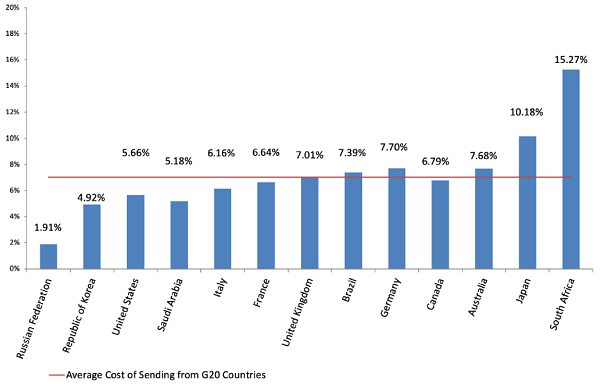
Source: World Bank, Remittance Prices Worldwide June 2019

3. Avoid the traps

The worst trap of all is exchanging money at the airport. A study by News Corp and The Currency Shop showed that on A$2000, travellers can lose as much as $350 by exchanging cash at the airport. While it might be convenient, it’s going to cost you.

Another way travellers get confused is when they are asked whether they want to pay in their own currency or the currency of the country they are in. If you pay in your own currency, the merchant or ATM operator will charge a foreign exchange fee at a rate they determine.

Prepaid travel cards can also be a trap. They often come with a range of fees e.g. for loading the card, using at an ATM or closing the account. It’s important to consider how these different fees will impact your budget overall.

4. Use technology to your advantage

My colleague Matthew Hayja wrote a piece for Cuffelinks called: “Retail FX: the last bastion of no competition”. While this remains largely true, there are some technological developments disrupting the FX space. Fintech players like Transferwise, Currency Fair and Worldremit specialise in small payments for individual customers. Using an online business model, they have low overheads and offer competitive rates.

Are we saying this is a reason not to transact with Citi? International banks have stepped into the ring to compete too. The rates on Citi’s Global Currency Account sit better than the domestic big four banks but slightly higher than the fintechs, with at 1.5% spread on USD exchanges. The currencies are linked directly to a Citibank debit card, meaning users can switch between currencies instantly via their mobile app and pay with their card when travelling. There are no ATM fees charged by Citibank when using local currency.

It’s worth doing your homework

Ultimately, the take-out for those about to head off overseas, is to do your homework before you go and be wary of traps that can cost you money. Hopefully, there will be continued disruption in the field of FX and providers will be forced to offer consumers more options that make it easier to go overseas and ‘spend like a local’.


Marcus Christoe, Head of Banking and Wealth Management Product at Citi Australia, a sponsor of Cuffelinks. This article is general information and does not consider the circumstances of any individual.

For other articles by Citi, see here. You can also view Citi’s guide to FX investing here.


  •   10 July 2019
  • 8
  •      
  •   
8 Comments
Frank
July 11, 2019

"exchange currency when the rate looks strong."

We're not FX traders. The exchange rate at a point in time is a market equilibrium, how do we know if a currency will rise or fall from that point?

Adam
July 11, 2019

This article fails to mention the single best way to minimise excess fees when travelling internationally- the ING Orange Everyday bank card.

With a few caveats like having a minimum monthly deposit and needing to make 5x tap and go transactions each month, it will completely refund any and all foreign ATM fees. I can't speak for fx spreads, but if the 2 conditions mentioned above are met the previous month, there is no better way to access cash abroad.

David
August 12, 2019

Preloading a travel card with different currencies usually involves higher fees and bigger spreads. Plus you might as well toss a coin because no one can predict the direction of a currency. Might as well keep the fees low and stick with the rate of the day.

Adam, agree 100% on the ING Account for those debit card transactions and ATM withdrawals, and if you want a credit card, the 28 Degrees MasterCard.

SMSF Trustee
July 11, 2019

And be realistic. How much are you going to actually spend while travelling and how much difference does the exchange rate really make to that?

Most people have paid for or locked in their hotel costs and transport, so we're talking meals and shopping mostly. For every A$1,000 you will spend, a 10% FX rate difference amounts to $100. Is that really enough to make you want to go to all the effort of doing the things this article suggests? Especially when it could just as easily go the other way and become $100 cheaper!

If you answer 'yes, $100 makes a big difference' then the suggestion about buying a bit of foreign currency each week over a few weeks or months before your trip is probably the best risk management strategy for you. Lots of options now, apart from the sponsored suggestion. All the banks have Travel Money cards, so does Qantas and the Post Office, where you can store several currencies.

Another suggestion that I have is this: don't buy too much FX. If you don't spend it and want to convert it back then you'll automatically lose around 10% of your A$ value. Better to buy a little less than you think you'll need and top up on a card during the trip, than having to switch back when you get home.

Irene
August 12, 2019

Agreed with ‘SMSF Trustee’. Unless you are doing backpack travel and not locked or paid your accommodation, transport or tours in advance. I always pay the above in advance before I go overseas, and the cash you need is really minimal.

Rod
July 11, 2019

Also does not mention the HSBC Global multi-currency acct with debit card. Cheers.

Gary
July 11, 2019

Agree with Adam's comment about the ING Orange card - I have used it overseas a number of times and not only is it the cheapest way to get local currency, but it also accesses the most favourable rates. If you use it online for any overseas transactions, they also refund any fees (unlike the card I have with one of the 4 big banks!)

BB
July 11, 2019

28 degrees master card has always served me well? No fees and FX conversion at the MasterCard wholesale rate.

Sure, it’s credit and not cash but depending on your destination, that’s unlikely to be an issue.


Leave a Comment:

RELATED ARTICLES

The merits of holding some cash in US$

Retail FX: the last bastion of no competition?

banner

Most viewed in recent weeks

Why have Australian living standards 'fallen' and how do we fix it?

For the last few years there has been much talk of a 'cost-of-living' crisis in Australia and of 'falling living standards'. Lately this has flared up again with the pickup in inflation resulting in a renewed fall in real wages.

Will you run out of money in retirement?

Fear of running out has become a defining retirement anxiety. Why do some retirees die with substantial wealth while others deplete their nest egg? Evidence suggests the answer is more complicated than we think. 

Four options for an income investor’s next dollar

What if Australia’s golden age of dividends is ending? Rather than overhaul your portfolio, it may be worth considering where new capital can work harder. I discuss four income strategies and the trade-offs behind each.

Why spending more in early retirement can improve lifetime income

Conventional wisdom encourages retirees to preserve superannuation. But if those likely to qualify for the Age Pension later in life spend a little more today, it may deliver higher lifetime income and a more stable retirement.

The investment that sidesteps the new tax traps

Tax rules have changed, but many investors are still using yesterday’s strategies. Insurance bonds may offer advantages for those seeking greater control, tax efficiency and certainty about their wealth.

Testamentary trusts have secured the CGT exemption

Treasury’s latest CGT reform draft delivers a win for testamentary trusts and deceased estates, exempting estate-derived gains from the 30% floor. However, questions on death and divorce rollovers remain unresolved.

Latest Updates

Shares

Is it time to bail on Australian stocks?

For generations, Australian investors have backed banks, miners and dividends. But has that loyalty come at a cost? A look at the numbers raises an uncomfortable question about where future returns will come from.

Investment strategies

Making a case for the 40 year mortgage

The housing debate tends to focus on prices, interest rates and deposits. Yet an overlooked feature of the mortgage itself could help buyers enter the market sooner without abandoning prudent lending standards.

SMSF strategies

Red flags to watch out for when considering an SMSF

Thinking about an SMSF? Before you sign anything, learn how to spot the difference between genuine advice and a sales pitch, understand the real costs, and avoid the compliance mistakes that attract ATO attention.

Investment strategies

Not all income is created equal

Market conditions are shifting as familiar yield sources quietly lose momentum. Australian public credit may be the most compelling source of income in today's market but many investors haven't noticed the shift. 

Investment strategies

The market paid for change, not comfort

Reporting season has delivered a clear message: the market is no longer paying simply for quality, resilience or an earnings beat. It is paying for change in earnings expectations and the outlook ahead. 

Investment strategies

Will AI destroy investor capital?

Some of history's most important innovations changed the world while leaving investors much poorer. As trillions pour into AI, a familiar pattern may be emerging, one that rewards society far more generously than capital.

ASX reporting season: Signals, surprises, stock stories

August reporting season delivered strong earnings and bigger-than-expected dividends, but beneath this, a more nuanced story emerged. First Sentier Investors’ David Wilson and Christian Guerra unpack the key trends.

Sponsors

Alliances

  • ASA-Logo-RGB-ActiveGreen-web.png

© 2026 Morningstar, Inc. All rights reserved.

Disclaimer
The data, research and opinions provided here are for information purposes; are not an offer to buy or sell a security; and are not warranted to be correct, complete or accurate. Morningstar, its affiliates, and third-party content providers are not responsible for any investment decisions, damages or losses resulting from, or related to, the data and analyses or their use. To the extent any content is general advice, it has been prepared for clients of Morningstar Australasia Pty Ltd (ABN: 95 090 665 544, AFSL: 240892), without reference to your financial objectives, situation or needs. For more information refer to our Financial Services Guide. You should consider the advice in light of these matters and if applicable, the relevant Product Disclosure Statement before making any decision to invest. Past performance does not necessarily indicate a financial product’s future performance. To obtain advice tailored to your situation, contact a professional financial adviser. Articles are current as at date of publication.
This website contains information and opinions provided by third parties. Inclusion of this information does not necessarily represent Morningstar’s positions, strategies or opinions and should not be considered an endorsement by Morningstar.