The inventors of artificial intelligence (AI) have variously promised the transformation of civilisation, a cure for cancer, the code to ageing, limitless clean energy, economic abundance, personalised medicine, and the ability to compress decades of scientific research into weeks by automating complex discovery.
All that might eventually be true – although I have serious doubts – and yet it could still end in financial catastrophe. Indeed, history demonstrates these two outcomes are not mutually exclusive.
The history of technological breakthroughs is littered with revolutionary innovations that transformed society while simultaneously destroying the capital of the investors who overpaid to build them.
Britain’s 1840s railway mania built essential national infrastructure, but ruined the original shareholders. The late-1990s fibre-optic and dot-com boom altered global communications forever, but that was followed by a devastating market crash. Today, AI appears to be following the same historical script, with excitement beginning to give way to financial accountability.
In the first stage of the boom, equity markets reward technology companies almost indiscriminately – in today’s market, for attaching themselves to the AI narrative. But markets eventually shift from asking what a technology can do to demanding a concrete answer to the question of who’s actually going to make an adequate return on the capital deployed.
The US$750 billion dream
The spending underway is no longer merely a sector-specific phenomenon; it’s morphed into a proper macroeconomic event. A common misconception suggests that US$3.7 trillion has already been spent on AI. That figure originates from a projection by global consulting firm McKinsey, estimating that total data-centre capital expenditure could require between US$3.7 trillion and US$7.9 trillion (with a central scenario of US$5.2 trillion) between 2025 and 2030.
Despite that confusion, the actual current numbers are equally staggering.
In calendar 2026 alone, the four major cloud hyperscalers - Microsoft, Amazon, Alphabet, and Meta - are contemplating approximately US$735 billion to US$760 billion in capital expenditure. Microsoft expects roughly US$190 billion in capital spending, Amazon has lifted its forecast to US$220 billion, Alphabet anticipates US$195 to US$205 billion, and Meta projects US$130 to US$145 billion. While not exclusively dedicated to AI, each company explicitly cites AI and cloud infrastructure as the primary driver.
Worryingly, this race to spend is now testing the limits of their balance sheets. For two decades, Big Tech operated as an extraordinarily cash-generative, asset-light industry enjoying high-margin monopoly returns. Indeed, I remember writing years ago about how these companies’ returns on equity actually increased as their equity grew. They were like bank accounts where interest rates would rise as the bank balance grew.
But today, those same companies are becoming capital-intensive, requiring endless ongoing reinvestment. Far from being a 30-year toll road, AI hardware suffers from severe obsolescence. Servers and networking equipment are depreciated rapidly: Microsoft depreciates equipment over two to six years, Meta over five to 5.5 years, and Amazon over five to six years.
This reality is now showing up on income statements. Microsoft’s depreciation expense surged 56 per cent year-on-year from US$22.0 billion in FY25 to US$34.3 billion in FY26. In the first half of 2026, Alphabet’s property-and-equipment depreciation rose from US$9.5 billion to US$13.6 billion, Meta’s climbed from US$8.1 billion to US$11.7 billion, and Amazon Web Services (AWS)-allocated depreciation at Amazon jumped from US$9.2 billion to US$15.4 billion.
Companies have to generate sufficient incremental profit not merely to pay electricity bills, but also to recover hundreds of billions of dollars tied to rapidly depreciating assets.
Collapsing costs and drained moats
And while costs are exploding, the unit price of intelligence is collapsing. Stanford University’s AI Index, which tracks the development and use of AI, revealed that the inference cost for a model performing at the GPT-3.5 level collapsed from US$20 per million tokens in November 2022 to just 7 cents by October 2024 - a 280-fold decline. Prices continue to plunge, driven by aggressive discounts from model developers, including Chinese firm DeepSeek, which introduced application programming interface (API) discounts of up to 75 per cent in 2025.
Furthermore, open-source and open-weight models (such as those from American and Chinese developers) are becoming ‘good enough’ for most corporate applications. Enterprise users, like Uber - which expanded its internal AI-agent usage ninefold while keeping overall AI costs flat through efficiency gains and open-weight models - can run workloads on local hardware or cheaper alternatives rather than paying premium prices for frontier cloud models.
This creates a problem: demand for intelligence is exploding, but falling prices mean consumers and enterprise users capture the economic value while frontier providers absorb the massive costs.
And that’s one lesson the history of technology booms has taught me. More often it’s the consumer that wins – and society lunges forward – but investors lose.
The biggest problem for big tech valuations, however, is they are no longer companies with unassailable competitive moats. Alphabet, Meta, Microsoft, and Amazon once enjoyed distinct, quasi-monopolies protected by massive network effects and switching costs. Together they were a polite oligopoly. Now, triggered by the launch of ChatGPT - which temporarily delayed US recession fears by igniting an artificial capital boom - these giants have entered what veteran investor Jeremy Grantham has described as an aggressive "cage fight." They’re now invading each other’s territories in search, software, social media, and cloud, and in so doing, they are setting fire to their own capital merely to build overlapping platforms.
The cash flow crunch
Meanwhile, the arms race is burning through cash at an alarming rate. Apollo Global Management’s Chief Economist, Torsten Slok, has highlighted a severe downward trend in 12-month forward free cash flows across hyperscalers.
Figure 1. Hyperscaler Cash Burn
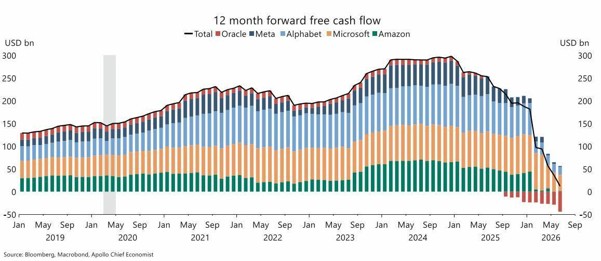
Amazon generated US$161 billion in operating cash flow to June 2026, but US$169 billion in net property expenditure drove its reported free cash flow to negative US$7.6 billion. Alphabet spent US$44.9 billion on capital expenditure in the June quarter alone and raised fresh equity, while Meta issued US$25 billion in bonds in May 2026, bringing long-term debt to nearly US$84 billion.
With borrowing surging and cash reserves dwindling, credit markets are already flagging early distress. Credit default swap (CDS) spreads, which are insurance for the buyers of hyperscalers and AI infrastructure provider debt, have widened significantly, reaching record levels as traders react to the changing picture for these companies.
Finally, these financial pressures are occuring at the same time that broader macroeconomic vulnerabilities are emerging. Heavy AI capital funding is competing directly for global capital with the US Government, which faces a US$1.9 trillion federal deficit in 2026 and public debt at 101 per cent of gross domestic product (GDP). The result is higher bond yields, which act like gravity on equity valuations.
Consequences
The AI rollover may already have begun.
Leveraged momentum trading that previously drove the AI stock rally is now fuelling a sharp unwind. This is exemplified by the collapse of former OpenAI researcher Leopold Aschenbrenner’s Situational Awareness Fund and the severe pullbacks in the share prices of semiconductor stocks.
Table 1. AI and semiconductor stocks – falls from June 2026 highs
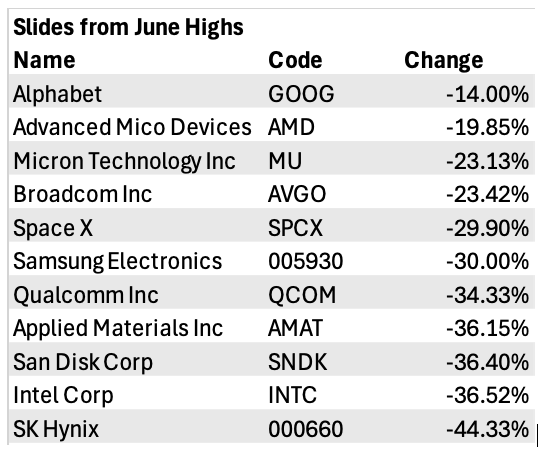
*As at 1 Sept 26. Source: Montgomery Investment Management.
Rather than a sudden single crash, markets could now face a prolonged, painful bear market.
Enterprise demand for AI tools is real. Google Cloud revenue surged 82 per cent to US$24.8 billion in Q2 2026, Azure surpassed a US$100 billion run-rate, and AWS reached US$42.2 billion with a US$496 billion backlog. But finding customers isn’t the issue.
The question is whether enterprise demand will expand enough to justify the trillions spent on infrastructure. Until you see corporations announcing broad-scale labour substitution and measurable productivity gains, and not just AI experimentation, the underlying capital the hyperscalers have invested remains exposed.
I fear the consequences of the first hyperscaler who blinks and cuts or slows its build-out. That will prompt the market to question the boom, their investment in it, and how close to the door they should be dancing.
This article is for general information only and does not constitute personal financial advice. It has been prepared without taking into account your objectives, financial circumstances or needs. You should consider the appropriateness of the information for your circumstances and seek independent financial advice if required.
Roger Montgomery is the Founder and Chairman of Montgomery Investment Management, a leading Australian boutique investment manager, which offers investors access to high-quality investment strategies in Australian equities, private credit, and digital assets. With more than 30 years’ experience in funds management and related disciplines, Roger is widely regarded as one of Australia’s most insightful professional investors and thought leaders. He is the author of the best-selling investment guide Value.able and a well-known media personality in Australia. Roger founded Montgomery Investment Management in 2010.
For more information, contact the Montgomery Team on (02) 8046 5000 or [email protected] or visit www.montinvest.com
Sign up for Roger’s insights at www.rogermontgomery.com