Register For Our Mailing List

Register to receive our free weekly newsletter including editorials.

Home / 644

10 fearless forecasts for 2026

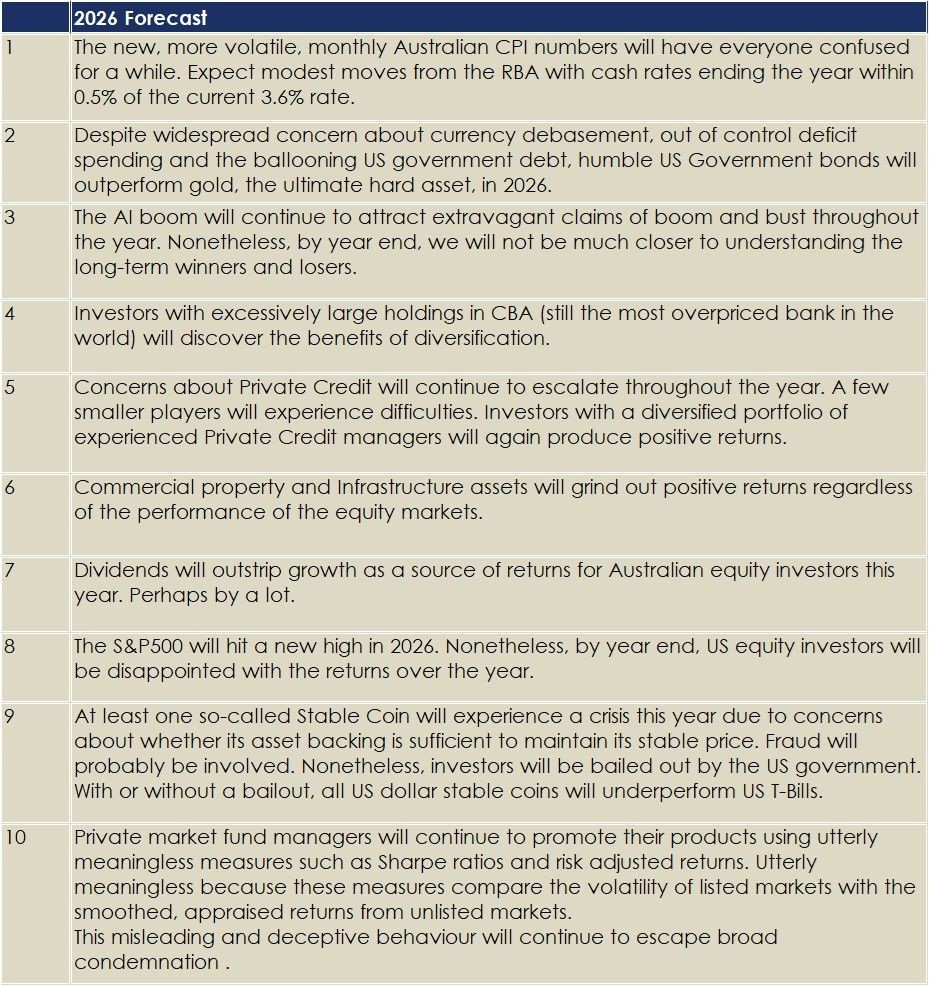
As is our custom at this time of the year, we provide 10 fearless forecasts for the year ahead.

The track record of these forecasts is pretty good as you’ll see later.

Off to the races? Unfortunately, no. These forecasts are quite different from most that you read at this time of the year. Firstly, they are quite accurate. Secondly, there are not a lot of money-making opportunities in there. Thirdly, while there are not a lot of money-making ideas, there are some ideas that may help avoid some disasters.

Reading between the lines, at the heart of the forecasts, are really just some pretty commonsense ideas.

  • Stay diversified.
  • Be careful about assets that have run hard in recent years
  • Don’t chase past returns.
  • Be sceptical when reading fund manager marketing materials – particularly those promoting past returns and using dubious risk metrics.

The idea that is categorically NOT in our list of forecasts is the one that we normally see at this time of the year which is that the author has some special insights into the year ahead and will enable the positioning of the portfolio to take advantage of that.

And, we reproduce our forecasts and the outcomes of those forecasts. This is the other thing that is different about these forecasts: we hold ourselves to account.
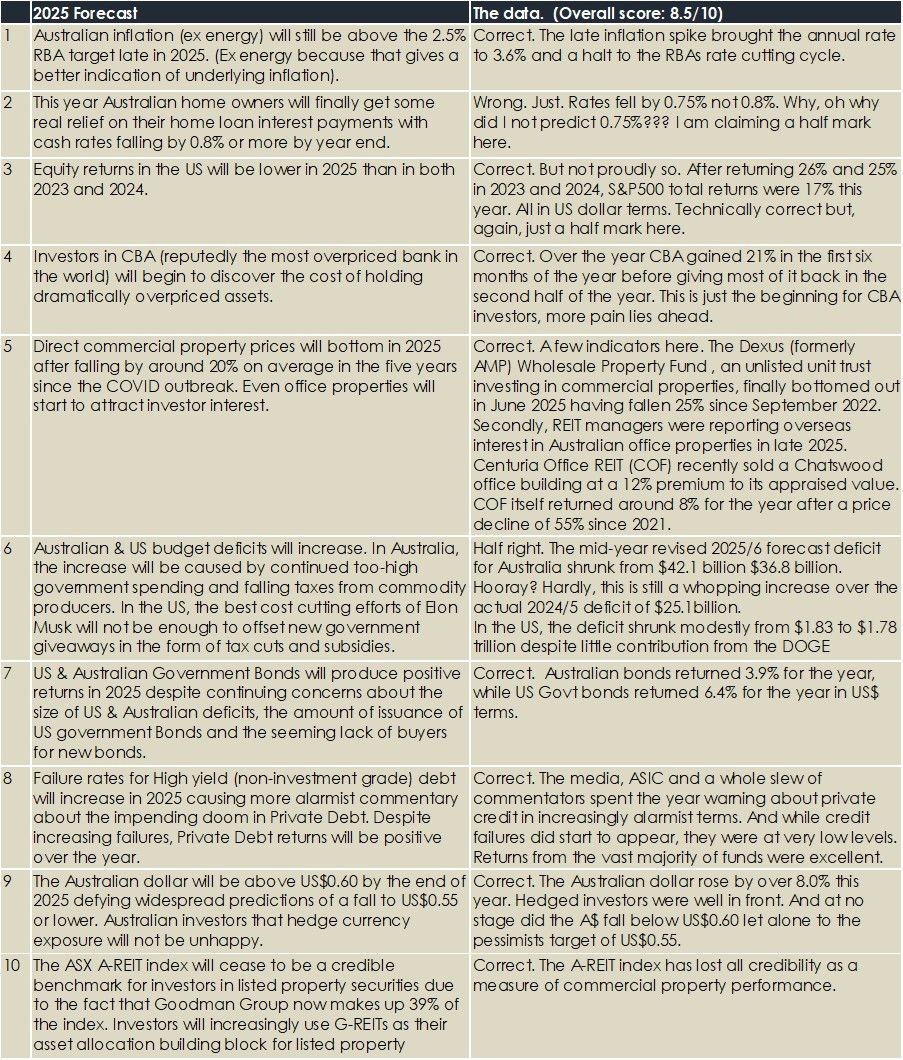
2025 forecasts in review: 8.5 out of 10

The 2025 results were healthy with three half marks reducing the score from a perfect 10 down to 8.5. Nothing wildly wrong but not quite spot on either.

While the 2025 forecasts may not have helped readers make money, we believe that they did contain quite a lot of commonsense.

Firstly, try to ignore forecasts or recommendations that are not backed by sound data.

For example, the idea that government deficits will produce high inflation and interest rates is often spruiked around. Last year we correctly forecasted that deficits will remain high but that cash rates will fall and bonds will produce reasonable returns. In fact, the data shows that there is a very weak linkage between deficits and interest rates over meaningful timeframes.

Another widely held idea is that a struggling Australian economy may cause a major fall in the Australian dollar. Again, the data simply does not support this idea. Hopefully, readers of our forecast will have resisted the urge to lift any currency hedging they may have had in place, saving money if not actually making it.

Also in that category was the suggestion that High Yield Debt will continue to produce strong returns despite all the alarmist commentary. Another example of money saved for those who continued to hold positions in High Yield Debt of various stripes despite all the chatter.

Secondly, unremarkably, we continue to be fans of diversification whether it is to rebalance wildly overpriced and over-represented assets (eg. CBA) or to add to assets that may have been through a tough time (commercial property).

Related to our strong support of diversification was our encouragement to drop A-REITs as a benchmark for commercial property and real assets. With around 40% exposure to Goodman Group, the ASX A-REIT Index is wildly undiversified and could, if followed closely, lead to some pretty bizarre behaviour. (Like the A-REIT manager who boasted in 2024 that they beat the index by being over-weight GMG! Good stock picking but terrible risk management. If GMG had gone south, it would have be terrible on both counts.)

Hopefully, nothing in the forecasts would have encouraged any reader to make any big macro bets which, in Delta’s view, more often than not, end in tears.

Finally, if while reading any of the multitude of 2026 outlook papers you do find yourself tempted to take some action, we suggest you first check out what the data says.

How have the pundits’ forecasts worked out in the past? (And not just a sampling but all of their forecasts and for every year.) Is there any data-based evidence to suggest a real connection between what is being claimed and the suggested drivers?

If you don’t have the resources to do this work yourself, dial a friend. We will be anxiously awaiting your call!
 

Tim Farrelly is Co-Chief Investment Officer and Head of Asset Allocation at Delta Portfolios.


  •   7 January 2026
  • 4
  •      
  •   
4 Comments
Kevin
January 10, 2026

The financial industry has to sell product,I have no problem there.People buy these products,I have no problem there.
People make up there own nonsense and invent there own facts,I have no problem there,it's amusing. However always stick with the facts
Your point at number four for 2025 and 2026,the much hated ( by the financial industry ) CBA,shall we look at the facts.. The well diversified portfolio,much loved by the financial industry,I realise you have to say that,know your client etc..
1 sept1991 put $10 K into a Vanguard fund. This grows to $224K by 31/10/25. Source Vanguard. Things have been reasonable since then so call it $10K grows to $250K.

$10K bought you 1500 shares in CBA ($6.66 each on market) on 22-23 Sept 1991..Without reinvesting dividends then you have 1500 X $153 ( the share price approx). $229,500.
The well diversified portfolio is ~ $250 K with dividends reinvested. The concentrated CBA is worth ~ $229,500,no dividends reinvested.What provided the best results?.

The lift factor for CBA is approx 6.7. For every 1,000 shares bought back then you have around 6,700 shares now,using the DRP. The secret.? Turn that useless noise off,and do nothing.

So 1500 X 6.7 = ?. Multiply ? by $153. That would be 10,000 ( get it roughly right) X $153 .
$1,530,000. The secret? Don't listen to a fool spouting that's not complicated enough. You have to make it complicated and get it precisely wrong.

Things I worked out a long long time ago,as above The financial industry sells products,people make up their own nonsense and invent their own facts.Fools chant saving up $1.5 million is just so much easier than paying off a loan of $10 K,it must be true ,the time machine said so.

Things I'm not going to worry about,every year for the rest of my life ( and previously).
Concentration risk
Diversification
Rebalancing.
Sequencing risk
A fool that would love to land a time machine on my head,spoiler,they don't exist ( Tinkerbell effect,if we all wish hard enough !).

Let's try and and keep somewhere near reality.Compounding takes time,it isn't based on silly headlines and predictions. How many times has CBA come down in price,from memory $34 down to $24 ( the tech wreck 2003?). $62 down to ~ $26 ( the GFC). $96 down to around $68 ( when they reached a high, 2015?) ~$110 down to ~ $60 ( COVID ). Same ~ $110 down to ~ ~ $88 ( Ukraine).

Now $192 down to ,was $150 bottom,or will it go lower?. Going right out on a limb would pull backs be normal? Have we found that out yet?
If I'm here in 2041 I think CBA will produce a great return over 50 years,2031 will do,it will probably produce a great return over 40 years.I think it will produce a better return than the diversified product that must be sold.,that's all I'm interested in,good returns.

9
Graham W
January 08, 2026

An explanation to the forecast that US government bonds will outperform gold in 2026 would be nice. I can't see it myself for many reasons. The USA added another trillion in debt in just 70 days, so over 38 trillion in bonds to pay interest on.Trump wants interest rates to go down, but who is going to invest in or even renew USA treasuries at even lower interest rates. The possibility of a capital gain in bonds seems remote and far less likely than gold increasing in value in 2026.

7
Tim Farrelly
January 11, 2026

Fair question. Your logic seems sound, what could go wrong?

Two things.

Gold may fall in price, perhaps dramatically. After all, if gold is an inflation hedge and inflation is running at 3%, or 4% or even 5%, then a gain of over 100% over the last two years is, to put it mildly, over-achieving. Gold could fall 25% from here and still will have done a fine job protecting against inflation over the past three years.

To look at this another way, is there any price at which gold is overvalued? Your logic works just as well with gold at $1000, $4000 or $40000. There have been many times in the past where speculation has driven gold to unsustainable prices which were then followed by decades of falls.

Secondly, if bond rates stay where they are now, we will earn about 4% on US bonds. So gold has to rise by another 4% to breakeven with bonds.You ask, who would buy these bonds? The most likely candidate is the US government itself. If they were to embark on another round of Quantitative Easing, we could see bond yields at 2%. If that were to occur, 10-year US Treasuries will increase in price by close to 18% for a total return of 22%. If that were to occur, then gold would have to end the year at above US$5250 to break even. ( This is NOT a forecast, just a possible scenario!)

So, theer are a few ways this forecast could work out. For better or worse we will report back next year with the result.

SGN
January 11, 2026

SGN
Well Done Kevin spot on.

2
 

Leave a Comment:

RELATED ARTICLES

CBA or global banks?

Read this before you go all in on US equities

A six-chart snapshot of June 2022 lending data

banner

Most viewed in recent weeks

Building a lazy ETF portfolio in 2026

What are the best ways to build a simple portfolio from scratch? I’ve addressed this issue before but think it’s worth revisiting given markets and the world have since changed, throwing up new challenges and things to consider.

Get set for a bumpy 2026

At this time last year, I forecast that 2025 would likely be a positive year given strong economic prospects and disinflation. The outlook for this year is less clear cut and here is what investors should do.

Meg on SMSFs: First glimpse of revised Division 296 tax

Treasury has released draft legislation for a new version of the controversial $3 million super tax. It's a significant improvement on the original proposal but there are some stings in the tail.

Ray Dalio on 2025’s real story, Trump, and what’s next

The renowned investor says 2025’s real story wasn’t AI or US stocks but the shift away from American assets and a collapse in the value of money. And he outlines how to best position portfolios for what’s ahead.

10 fearless forecasts for 2026

The predictions include dividends will outstrip growth as a source of Australian equity returns, US market performance will be underwhelming, while US government bonds will beat gold.

13 million spare bedrooms: Rethinking Australia’s housing shortfall

We don’t have a housing shortage; we have housing misallocation. This explores why so many bedrooms go unused, what’s been tried before, and five things to unlock housing capacity – no new building required.

Latest Updates

Economy

Making sense of record high markets as the world catches fire

The post-World War Two economic system is unravelling, leading to huge shifts in currency, bond and commodity markets, yet stocks seem oblivious to the chaos. This looks to history as a guide for what’s next.

Australia’s generous housing subsidies face mounting political risk

Mark Carney has spoken of a rupture in the rules based system that has governed the world since 1945. That rupture means nations like Australia will need to boost defence spending and find savings elsewhere.

Shares

Finding yield on the ASX

With ASX dividend yields now below government bond yields, investors face an upside-down market where income is scarce, growth is muted, and careful selection of bond-like stocks has never mattered more.

Investment strategies

Digging for value among ASX miners

ASX miners are back in favour after playing second fiddle to banks for years. Is it too late to get in? Here are some thoughts on the large caps such as BHP and Rio, and the hot gold mining sector.

Gold

It’s economic reality, not fear-based momentum, driving gold higher

Most commentary on gold's recent record highs focus on it being the product of fear or speculative momentum. That's ignoring the deeper structural drivers at play. 

Investment strategies

Asia in 2026: Riding AI, reform and a shifting global order

Tariff turmoil tested Asia, but AI leadership, policy easing and reform momentum are restoring investor confidence and strengthening the region’s outlook for 2026. 

Investment strategies

Investors beware: Bull markets don’t last forever

New research explains why high valuations, low dividends and bullish sentiment rarely coexist with strong long-term returns after extended bull markets. 

Sponsors

Alliances

© 2026 Morningstar, Inc. All rights reserved.

Disclaimer
The data, research and opinions provided here are for information purposes; are not an offer to buy or sell a security; and are not warranted to be correct, complete or accurate. Morningstar, its affiliates, and third-party content providers are not responsible for any investment decisions, damages or losses resulting from, or related to, the data and analyses or their use. To the extent any content is general advice, it has been prepared for clients of Morningstar Australasia Pty Ltd (ABN: 95 090 665 544, AFSL: 240892), without reference to your financial objectives, situation or needs. For more information refer to our Financial Services Guide. You should consider the advice in light of these matters and if applicable, the relevant Product Disclosure Statement before making any decision to invest. Past performance does not necessarily indicate a financial product’s future performance. To obtain advice tailored to your situation, contact a professional financial adviser. Articles are current as at date of publication.
This website contains information and opinions provided by third parties. Inclusion of this information does not necessarily represent Morningstar’s positions, strategies or opinions and should not be considered an endorsement by Morningstar.