Register For Our Mailing List

Register to receive our free weekly newsletter including editorials.

Home / 595

Clime time: Federal budget forecast errors need greater scrutiny

There is an old adage in the stock market, that a listed public company will release bad news ‘after market’ or late on a Friday, or better still, on Christmas Eve. This is based on the reasonable expectation that no one should be watching, and the financial press would have vacated their desks.

This is what makes the announcement by Australia's Department of Finance (“Finance”), on Christmas Eve 2024 - of a significantly improved “actual” budget outcome for the first 5 months of FY25 - most intriguing. The announcement was published on its website and without much fanfare.

The update contrasted with Treasury’s benign Mid-Year Budget (MYEFO) that was released by the Treasurer just a week earlier.

The differences were stark and significant for the FY25 budget position as we enter a pre-election period. Indeed, the differences highlighted that Treasury forecasts (on Budget night) have been consistently wrong over the last three years, and by big margins. Indeed, the difference between the budget forecast and the budget outcome have amounted to tens of billions of dollars representing a significant 1% to 2% of GDP. Far too large to dismiss as mere aberrations.

This is concerning because markets and investors rightly consider and then react to budget projections that are reported in both budget forecasts and outcomes. The declared positioning of Government fiscal policy will support or detract from economic growth and the confidence in the outlook for economic growth.

For instance, a 1% fiscal deficit (to GDP) will have growth repercussions that are not as significant as those of a surplus budget. Inflation fears may be stoked or dampened by declared fiscal policy and the difference between budget revenue (tax) and expenses. Interest rate guidance and the cash settings of the RBA will be adjusted and based on fiscal outcomes that support or detract from economic activity.

What did Treasury and Finance state and how were they different?

In its mid-year update Treasury forecast only a slightly improved deficit for FY25 of $26 billion (down from the May budget forecast of $28 billion). It also forecast that the budget would be unlikely to reach an annual surplus inside a decade and noting (see below) that the trajectory of the budget would further deteriorate over the next three fiscal years.
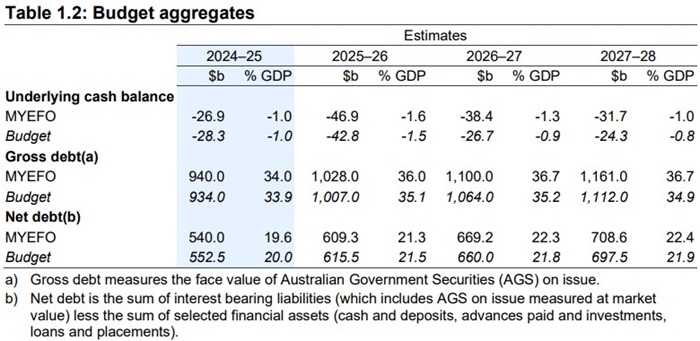

Source: Budget 2024-25 Mid-Year Economic and Fiscal Outlook 2024–25

A week later, on Christmas eve, the Finance update showed that the current year deficit for five months to November was just $5 billion and barely different to the positions seen at the same point in FY23 and FY24 which produced budget surpluses of around $20 billion.
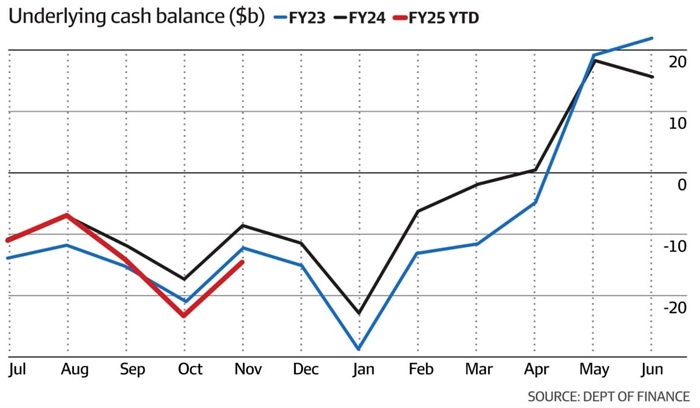
As at the end of November the 'net operating cashflow balance' was $14 billion better than forecast in the original budget (May) and the updated forecast in the MYEFO.
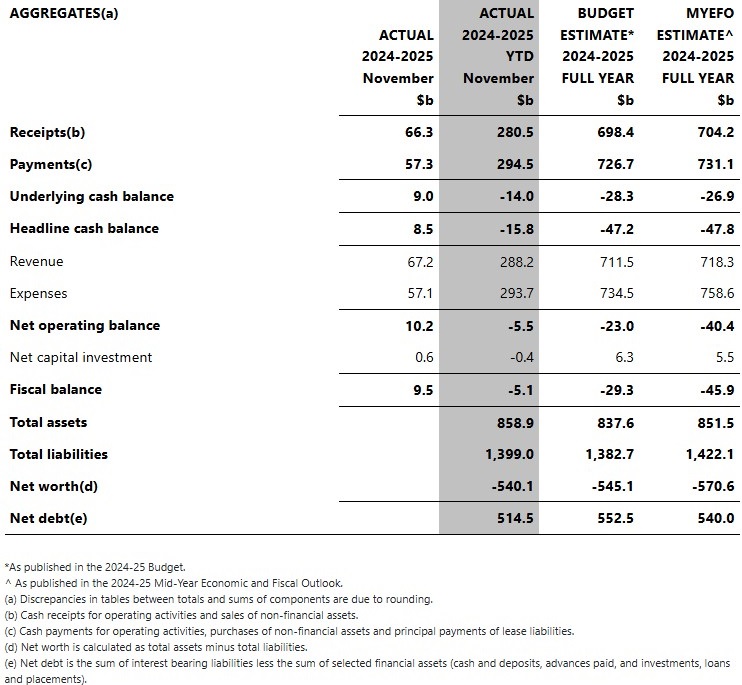

Source: Australian Government General Government Sector Monthly Financial Statements for November 2024

The improvements are seen below in the Finance report of December 2024. Year to date:

  • Total receipts were $11 billion better than expected.
  • Taxation receipts (mainly PAYG) were $8.4 billion than expected; and
  • Expenses were $2.3 billion than expected.
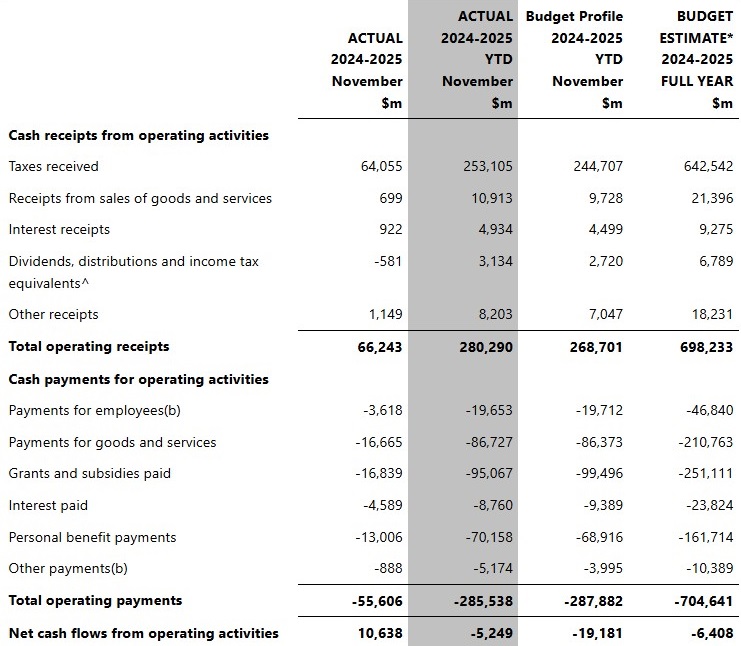

Source: Australian Government General Government Sector Monthly Financial Statements for November 2024

In summary, tax collections make up the bulk of the difference with an extraordinary $8 billion (above forecast) drawn from individual income tax payments – and that is after the tax scale adjustments of 1 July. Company taxation collections are $0.5 billion better than forecast. Notable was that the budget forecast was for company taxation collections to fall.

Therefore, what does it suggest that Treasury has wrongly forecast?

  1. Higher actual employment numbers i.e. more people are working and therefore paying PAYG. Remember the unemployment rate may rise but more people can be working. The latest employment release showed that 56,000 jobs were added to the economy in December 2024 whist the unemployment rate ticked up. Australia’s employment participation rate has never been higher. Clearly immigrants like to work!
  2. A lower AUD that holds export revenue. Treasury, like many other forecasters, do not acknowledge that the surging inflows into superannuation are driving super capital investment flows to offshore markets and weakening the AUD more so than the surging USD; and
  3. The maintenance of higher iron ore export prices which remain 50% higher than budget forecasts – a feature common in budget forecasts for at least the last five years.

I draw some conclusions from the above which will be contested by many:

  1. The tax cuts for low-income workers from 1 July should have been larger and they should have been set with an agreement for lower wage claims across the Government sector (Commonwealth and State). The elevated wage claims flowing across the economy, notably in the state government sector, are symptomatic of a poorly structured and un-coordinated wages income tax policy.
  2. Electricity rebates should have been greater than $300, and this would have driven reported inflation lower. So too would have been a reduction in petrol excises. The indexing of petrol excises without a review mechanism, after inflation has surged, is a nonsensical policy given it further adds to both the cost of living and the cost of doing business. Most current Government sector wage claims are focused on the recovery of the cost-of-living increases.
  3. There is now capacity for the Government to offer pre-election and vote buying gifts that will not upset the original forecast budget estimate ($28 billion deficit). For instance, we should expect the extension of energy rebates amongst other short-term giveaways. The Opposition can join the giveaways if it can understand what has changed in the budget outcome; and
  4. Alternatively, the FY25 budget outcome (if untouched by the Government) will be significantly better than forecast and could even approach a surplus. The Government can claim that it is a superior financial manager – but unfortunately (for them) the budget outcome will be seen after the election votes are counted.

Federal budgets have always been political documents but the discrepancies that are appearing between Treasury forecasts and actual outcomes needs greater scrutiny. This suggests that the claims of each political party, that they have better fiscal management discipline, will need to be treated with extreme scepticism in the forthcoming election.

Neither party seems capable of explaining the drivers of budget outcomes and the budget adjustment opportunity to the Australian population. Neither party have declared plans to adjust fiscal policy to check the cost of living inside a coordinated plan to lift real wage outcomes (after tax).

A proper review of the illogical (in many respects) taxation laws of Australia remains stalled leading to excessive taxation payments by workers. 

The immense growth opportunity of Australia remains untapped as politicians argue inanely with each other.


John Abernethy is Founder and Chairman of Clime Investment Management Limited, a sponsor of Firstlinks. The information contained in this article is of a general nature only. The author has not taken into account the goals, objectives, or personal circumstances of any person (and is current as at the date of publishing).

For more articles and papers from Clime, click here.


  •   22 January 2025
  • 5
  •      
  •   
5 Comments
Steve
January 24, 2025

There is no such thing as a forecast without an underlying set of assumptions. These departments like the CSIRO are government run and undoubtedly prone to assumptions that their masters push on them. End of.

Dave Roberts
January 27, 2025

The time for continuing tax cuts has passed. We want more nurses, teachers, better child care, nursing homes, hospitals and health care.
All this can only be paid for with increased taxes across the board.

David
January 28, 2025

Dave, we do need to pay taxes for all these desirable items and others besides, including the defense of the nation. However, I am reminded of the famous quote of Vladimir Ilyich Lenin when he said "the way to crush the bourgeoisie is to grind them between the millstones of taxation and inflation". Explicit taxation is one thing, but the dead hand of inflation which no one votes for, continues its distortionary effects year after year and is a cheat's way or raising government revenue.

David
January 27, 2025

John, your penultimate paragraph is spot on. One problem that we have in our tax system is that the tax scales are set in fixed $A amounts, so that over the years bracket creep nets to the state far more that was originally intended. Eventually politicians have to fix this, always too late, and expect gratitude from the tax slaves for doing so. In particular, the tax free threshold, fixed at $18,200 in 2012, is still the same 13 years later. During that period, according to ABS figures, accumulated inflation is 35%. Thus the threshold should be $18,200 x 1.35 or $24,570, and that is not compensating for the rip off in between. This effects those on lower wages more, the same people who are struggling with costs today. All thresholds in the tax scaled should be indexed annually automatically, not when government thinks it can afford it.

Tony Dillon
January 27, 2025

"Electricity rebates should have been greater than $300, and this would have driven reported inflation lower.”

That is, headline inflation would be lower, not underlying inflation that excludes temporary effects like these rebates, which the RBA has consistently said it focuses on. In any case, the rebates address the symptoms of electricity price rises, not the cause, which the government promised to address when in opposition, promising to bring electricity prices down. Instead they have gone the other way by much more. And with the rebates funded by taxpayers, it’s like taking money out of your back pocket to put in your front pocket.

And yes, the worry is that the government will try and buy votes by extending the rebates, which is fine if one assumes that subsidies, rebates, and more debt, are preferable to better energy policy and economic management.


Leave a Comment:

RELATED ARTICLES

Clime time: Australia's economic report card heading into the polls

Are we in a recession?

It's the cost of government, stupid

banner

Most viewed in recent weeks

Why spending more in early retirement can improve lifetime income

Conventional wisdom encourages retirees to preserve superannuation. But if those likely to qualify for the Age Pension later in life spend a little more today, it may deliver higher lifetime income and a more stable retirement.

It’s time for LICs to die

A high-profile dividend cut and a prominent fund manager’s apology have reignited a long-running debate. If investors can access similar exposures more cheaply and efficiently elsewhere, what exactly is keeping LICs alive?

Testamentary trusts survived the trust tax. The drafting battle has just begun.

The fight over testamentary trusts looked settled. Then the draft legislation arrived. Hidden in a technical detail is a question that could force many families to rethink wills they thought were already future-proof.

Is it time to bail on Australian stocks?

For generations, Australian investors have backed banks, miners and dividends. But has that loyalty come at a cost? A look at the numbers raises an uncomfortable question about where future returns will come from.

The new capital gains tax trap for your portfolio

Investors have long accepted one portfolio rule without much question. A major tax shift could change that calculation entirely, forcing difficult trade-offs between risk, discipline and an overlooked cost lurking beneath.

How the typical Australian Family could save $844,350 in taxes

The value of a testamentary trust is not determined by wealth alone. Depending on circumstances, it can reduce the tax burden on inherited income, create efficiencies and help build intergenerational wealth.

Latest Updates

Fixed interest

Higher yields are creating opportunities in global bonds

Bond markets are adjusting to a new reality, but not in the ways investors expect. With markets repricing and capital competing for attention, investors may need to rethink where resilience and opportunity lie. 

Economy

Are we in a recession?

What if the warning signs are already everywhere? From supermarket aisles to company failures, investors are being bombarded with recession signals. But most face a different risk that can be just as dangerous for portfolios. 

SMSF strategies

Meg on SMSFs - Division 296 actuarial certificates

The tax bill might be yours, but the event that caused it may not be. A key Division 296 calculation can sometimes attribute earnings in ways that many SMSF trustees won't instinctively expect or fully appreciate.

Property

The first impact of negative gearing reform is not the tax bill

Negative gearing changes formally begin in 2027, but the first consequences may already be here. A subtle shift is quietly influencing who can borrow, how much they can access and which property strategies still stack up.

Economy

The oil market is running out of easy answers

The biggest threat to markets may not be what investors are watching. The numbers have stopped adding up and supply is harder to measure, with forecasts becoming simple guesses. A more fragile reality is being masked.

Investment strategies

The state of investor knowledge in Australia

Australians are investing more than ever, yet a surprising divide is emerging between those building wealth effectively and those making costly mistakes. Surprisingly, the gap has little to do with income, age or starting capital.

Taxation

Complexity and capital gains

A case study shows that the ‘30% minimum CGT’ is a poorly conceived tax that adds significant complexity to an already over-complex system. A less complicated model would create a much fairer progressive tax scale.

Sponsors

Alliances

  • ASA-Logo-RGB-ActiveGreen-web.png

© 2026 Morningstar, Inc. All rights reserved.

Disclaimer
The data, research and opinions provided here are for information purposes; are not an offer to buy or sell a security; and are not warranted to be correct, complete or accurate. Morningstar, its affiliates, and third-party content providers are not responsible for any investment decisions, damages or losses resulting from, or related to, the data and analyses or their use. To the extent any content is general advice, it has been prepared for clients of Morningstar Australasia Pty Ltd (ABN: 95 090 665 544, AFSL: 240892), without reference to your financial objectives, situation or needs. For more information refer to our Financial Services Guide. You should consider the advice in light of these matters and if applicable, the relevant Product Disclosure Statement before making any decision to invest. Past performance does not necessarily indicate a financial product’s future performance. To obtain advice tailored to your situation, contact a professional financial adviser. Articles are current as at date of publication.
This website contains information and opinions provided by third parties. Inclusion of this information does not necessarily represent Morningstar’s positions, strategies or opinions and should not be considered an endorsement by Morningstar.