Register For Our Mailing List

Register to receive our free weekly newsletter including editorials.

Home / 175

Decarbonisation, energy storage and efficiency

This paper discusses current themes in the electric utility sector, specifically in decarbonisation, energy efficiency and energy storage.

Are renewables cost competitive?

The cost of onshore wind energy declined by 65% between 1988 and 2014 (according to the International Renewable Energy Agency) due to economies of scale, technology innovations and operational and maintenance improvements. Onshore wind can compete with fossil fuels, with the levelised cost of onshore wind estimated to be below €0.05 per kilowatt hour (kWh) versus coal at €0.049 / kWh and gas at €0.041 / kWh.

The expectation is that wind will continue to get cheaper as better siting, longer blades and taller towers drive productivity gains. In the UK, load factors have risen from around 34% in 2003 to around 45% in 2014. This is set to increase due to the high levels of R&D now being spent in an industry that has gone from a standing start to having key global turbine manufacturers such as Siemens, General Electric and Vestas.

Are renewables growing as part of the energy mix?

Renewable capacity additions represented about half the world’s total capacity additions in 2014, supported by:

(1) country and state decarbonisation targets eg US renewable portfolio standards (RPS) and EU carbon targets

(2) carbon taxes and UK carbon floor

(3) tax incentives eg US production tax credits and investment tax credits

(4) the social implications of burning fossil fuels such as smog, and

(5) reduced fossil fuel subsidies in countries including India, Indonesia and Spain.

We expect renewables will represent a growing portion of new generation capacity in the future, due to the above points and a lack of economically viable clean coal plants.

Is energy storage a game changer?

In short, yes. Effective energy storage can help back up intermittent renewable power and be used to power electric vehicles. Similar to renewables, the level of investment into lithium ion storage has seen prices decline dramatically. Tesla’s Gigafactory is currently producing batteries at US$190 per kWh, with an expectation of 30% reduction coming from economies of scale, reduction of waste, a closer supply chain, vertical integration and process optimisation.

Much as RPS targets were first introduced on a state by state basis in the US, some US states are now starting to commit to targets for battery storage. So far, California and Oregon have set targets for the development of storage, with Massachusetts potentially the next to implement. California has stipulated that its three large investor-owned utilities (Edison International, PG&E, and Sempra) must commit 1,324 megawatts of storage by 2024, which is around 2% of California’s peak load.

Is energy efficiency real?

Energy efficiency is having an undeniable impact on electricity consumption. Energy intensity, a measure of energy consumption per unit of gross domestic product, declined by nearly one third between 1990 and 2015. Companies in the US are tending to report flat to negative load growth. Some US states, led by California, are promoting energy efficiency by decoupling utilities’ revenues from volume usage.

The driving force behind energy reduction is more energy-efficient homes and appliances. More homes are being insulated, efficient condensing boilers are replacing standard boilers, houses are being double glazed and appliances are more efficient. This trend in energy consumption per household will continue as buildings and appliances get smarter and more energy efficient.

Make hay whilst the sun shines

Rooftop solar has declined in cost significantly. The subsidies that many countries offer encourages residential customers to install rooftop panels on their homes.

Solar photovoltaic – lower costs, higher capacity
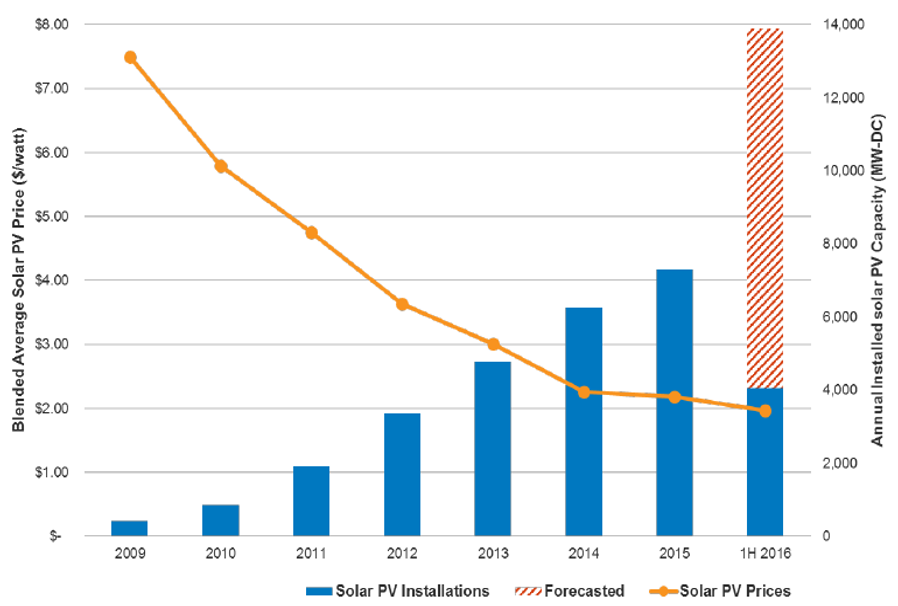
Source: Solar Energy Industries Association

However, a mismatch can occur between when solar energy is generated and when it is used. At these times, the distribution grid is used much like storage so that energy can be used when it is needed rather than when produced. For example, New York State is developing a system that compensates both the customer for excess energy sold to the grid, and the grid company for providing the transmission infrastructure to the household. New York aims to transform utilities such as National Grid and Iberdrola into distribution system platform providers, changing their responsibilities to include overseeing the interconnection of distributed resources. We believe this puts these utilities at the forefront of changes that could later be rolled out across other states with sunny climates.


Rebecca Sherlock is a Senior Investment Analyst at Colonial First State Global Asset Management. This article provides general information not specific to any investor's circumstances.


  •   29 September 2016
  • 1
  •      
  •   

RELATED ARTICLES

Electricity transmission is Australia's next problem

Momentum or rupture: has demand for oil already peaked?

Ignore solar parity at your investing peril

banner

Most viewed in recent weeks

Building a lazy ETF portfolio in 2026

What are the best ways to build a simple portfolio from scratch? I’ve addressed this issue before but think it’s worth revisiting given markets and the world have since changed, throwing up new challenges and things to consider.

Get set for a bumpy 2026

At this time last year, I forecast that 2025 would likely be a positive year given strong economic prospects and disinflation. The outlook for this year is less clear cut and here is what investors should do.

Meg on SMSFs: First glimpse of revised Division 296 tax

Treasury has released draft legislation for a new version of the controversial $3 million super tax. It's a significant improvement on the original proposal but there are some stings in the tail.

Ray Dalio on 2025’s real story, Trump, and what’s next

The renowned investor says 2025’s real story wasn’t AI or US stocks but the shift away from American assets and a collapse in the value of money. And he outlines how to best position portfolios for what’s ahead.

10 fearless forecasts for 2026

The predictions include dividends will outstrip growth as a source of Australian equity returns, US market performance will be underwhelming, while US government bonds will beat gold.

13 million spare bedrooms: Rethinking Australia’s housing shortfall

We don’t have a housing shortage; we have housing misallocation. This explores why so many bedrooms go unused, what’s been tried before, and five things to unlock housing capacity – no new building required.

Latest Updates

3 ways to fix Australia’s affordability crisis

Our cost-of-living pressures go beyond the RBA: surging house prices, excessive migration, and expanding government programs, including the NDIS, are fuelling inflation, demanding bold, structural solutions.

Superannuation

The Division 296 tax is still a quasi-wealth tax

The latest draft legislation may be an improvement but it still has the whiff of a wealth tax about it. The question remains whether a golden opportunity for simpler and fairer super tax reform has been missed.

Superannuation

Is it really ‘your’ super fund?

Your super isn’t a bank account you own; it’s a trust you merely benefit from. So why would the Division 296 tax you personally on assets, income and gains you legally don’t own?

Shares

Inflation is the biggest destroyer of wealth

Inflation consistently undermines wealth, even in low-inflation environments. Whether or not it returns to target, investors must protect portfolios from its compounding impact on future living standards.

Shares

Picking the next sector winner

Global equity markets have experienced stellar returns in 2024 and 2025 led, in large part, by the boom in AI. Which sector could be the next star in global markets? This names three future winners.

Infrastructure

What investors should expect when investing in infrastructure: yield

The case for listed infrastructure is built on stable earnings and cash flows, which have sustained 4% dividend yields across cycles and supported consistent, inflation-linked long-term returns.

Investment strategies

Valuing AI: Extreme bubble, new golden era, or both

The US stock market sits in prolonged bubble territory, driven by AI enthusiasm. History suggests eventual mean reversion, reminding investors to weigh potential risks against current market optimism.

Sponsors

Alliances

© 2026 Morningstar, Inc. All rights reserved.

Disclaimer
The data, research and opinions provided here are for information purposes; are not an offer to buy or sell a security; and are not warranted to be correct, complete or accurate. Morningstar, its affiliates, and third-party content providers are not responsible for any investment decisions, damages or losses resulting from, or related to, the data and analyses or their use. To the extent any content is general advice, it has been prepared for clients of Morningstar Australasia Pty Ltd (ABN: 95 090 665 544, AFSL: 240892), without reference to your financial objectives, situation or needs. For more information refer to our Financial Services Guide. You should consider the advice in light of these matters and if applicable, the relevant Product Disclosure Statement before making any decision to invest. Past performance does not necessarily indicate a financial product’s future performance. To obtain advice tailored to your situation, contact a professional financial adviser. Articles are current as at date of publication.
This website contains information and opinions provided by third parties. Inclusion of this information does not necessarily represent Morningstar’s positions, strategies or opinions and should not be considered an endorsement by Morningstar.