Register For Our Mailing List

Register to receive our free weekly newsletter including editorials.

Home / 647

It’s economic reality, not fear-based momentum, driving gold higher

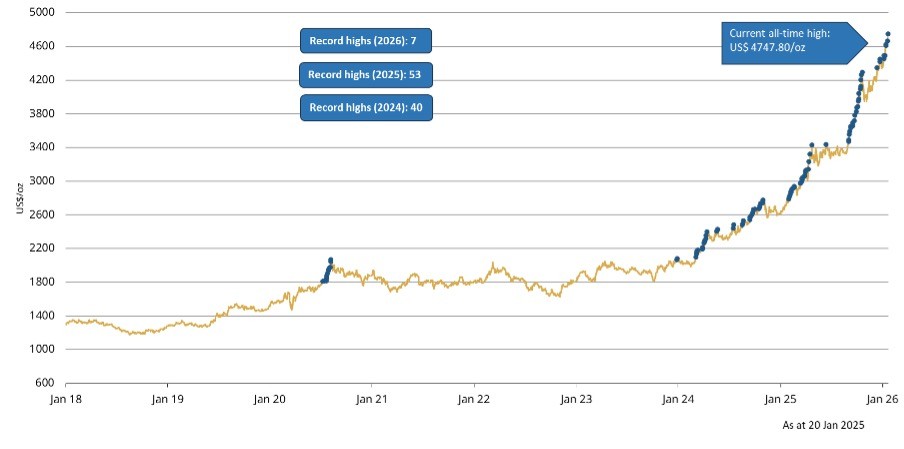
Gold entered 2026 the same way it exited 2025: at record highs. To date, the gold price has already notched seven all-time highs this year, extending a run that saw more than 53 new records in 2025 alone, totalling 95 all-time highs since 2024. For some investors, this raises an uncomfortable question: have we missed it?

In my experience, that question often reflects a misunderstanding of why gold has been performing so strongly, and what role it is designed to play in a portfolio.

Gold’s continued rally into 2026 is not being driven purely by fear, crisis headlines or short-term speculation. Its strength increasingly reflects deeper, more structural shifts in how asset classes behave, how policy is evolving, and how risk is being priced across markets – all of which shape portfolio construction and resilience.

Figure 1: Gold has reached 95 all-time-highs since 2024
All-time-highs in the LBMA PM benchmark price (US$/oz)
Momentum matters — but it’s not the whole story

There is no doubt that momentum and uncertainty have played a role in gold’s recent price. And while geopolitical tensions have further flared since the start of the year, economic events trump momentum in driving gold’s continued rally. These include expectations of US Federal Reserve rate cuts, declining real yields, and historically high levels of correlation between fixed income and equity markets.

So, while momentum-oriented investors seeking refuge have played a part, momentum alone can ignite and amplify trends but not sustain a multi-year trend – for any asset for that matter.

What underpins gold’s appeal today is a convergence of macroeconomic forces that are proving far more persistent than many investors expected: sticky inflation risks, rising sovereign debt burdens, and growing uncertainty around the effectiveness of traditional portfolio diversifiers.

These forces are further complicated by the expected change in US Federal Reserve leadership this year, an event that could materially reshape the policy reaction function and inject greater uncertainty into inflation expectations, real yields and broader market pricing.

Importantly, these are not short-lived shocks. They are slow-burn dynamics reshaping the investment landscape, and portfolios are responding accordingly.

The safe-haven trap

Geopolitical events inevitably push gold into headlines. But it’s worth being clear: while gold often responds positively to sudden shocks, those moments are rarely the best time to initiate an allocation.

The protection gold provides frequently shows up before the event, not after it. That is why we consistently caution against treating gold as a tactical trade triggered by breaking news.

Gold’s value lies less in reacting to crises and more in quietly improving portfolio resilience before correlations change and volatility rises.

Bonds lose ballast

Perhaps the most important shift for investors, particularly those managing balanced portfolios, is the changing behaviour of bonds.

For decades, government bonds offered reliable diversification against equity risk. That relationship has weakened, and in some periods broken down altogether. Rising inflation volatility, fiscal expansion and supply-heavy bond markets have altered how fixed income behaves under stress.

Many investors experienced this first-hand in recent years, when both equities and bonds declined together.

This matters because diversification is not about owning different assets - it’s about owning assets that behave differently when it matters most and shore up portfolio resilience.

Gold has historically exhibited low to negative correlation with equities over long horizons, and unlike bonds, it does not rely on a government’s ability to manage inflation, debt or deficits. Nor does gold, as a real asset, carry any counterparty risks. In a world where the interconnectedness of risks is increasingly questioned, gold’s independence matters.

Strategic allocation, not tactical timing

Aside from have we missed our chance?, another very common question we hear is: what’s the right price to buy gold?

The more useful question is: what role should gold play in my portfolio? - as you would ask of any potential portfolio asset.

Trying to time entry points after a strong rally can be counterproductive, particularly for an asset held for diversification benefits. Like any long-term asset, gold’s contribution should be assessed across market cycles, not month-to-month price moves.

This is why the World Gold Council’s research consistently frames gold as a strategic allocation, not a short-term hedge.

Across a wide range of portfolio simulations, allocations in the region of 3 to 10% have historically improved risk-adjusted returns - not because gold always rises, but because it behaves differently when other assets struggle.

Debt, deficits and the long game

While the world enters a period of geopolitical realignment - a backdrop likely to add to market volatility - a major and enduring feature of the global economy remains the scale of sovereign debt accumulation.

Major economies are running persistent deficits with limited political appetite, or ability, to materially reverse course. At some point, investors may begin to question whether bond markets are adequately compensating them for duration, inflation and fiscal risk.

Will 2026 be the year that concern becomes acute? That is impossible to forecast. But the underlying conditions are unlikely to disappear.

Gold’s role here is subtle but important. It is not a bet against any single currency or government. Rather, it acts as a portfolio anchor in environments where confidence in long-term policy outcomes is eroding.

Have investors missed the move — or missed the point?

For many investors, particularly in Western markets, the more pressing risk today may not be over-exposure to gold as a safe-haven, but persisting under-allocation as a strategic diversifier.

While we have seen Western investors reallocate to gold after decades on the sidelines - with Eastern markets continuing to play a far greater role in shaping prices - gold ownership remains modest relative to the size of global capital markets. And many portfolios still rely heavily on asset relationships that no longer behave as reliably as they once did.

Some large institutional investors, including the Future Fund have shifted course in anticipation of a new investment order, selecting assets for long-term resilience.

Seen through that lens, gold’s recent performance is less about a crowded trade, and more about a gradual reassessment of what diversification really means in a changing macro environment.

Gold does not need perfect timing to be effective

Investors who treat gold as a permanent component of their portfolio, building positions over time and rebalancing as conditions evolve, are more likely to capture its benefits than those attempting to trade short-term price movements.

That discipline matters even more after strong performance. Gold’s role is not to predict the next shock, but to help portfolios endure whatever comes next.

In an environment defined by policy uncertainty, rising debt and fragile diversification, gold’s value increasingly lies in disciplined portfolio construction rather than reactive positioning.


John Reade is a Senior Market Strategist, at World Gold Council, a sponsor of Firstlinks. This article is for general informational and educational purposes only and does not amount to direct or indirect investment advice or assistance. You should consult with your professional advisers regarding any such product or service, take into account your individual financial needs and circumstances and carefully consider the risks associated with any investment decision.

For more articles and papers from World Gold Council, please click here.


  •   28 January 2026
  • 12
  •      
  •   
12 Comments
Kevin
January 30, 2026

There was an interesting call to the local radio station yesterday .They have their financial guy on giving advice ,yesterday was the stockbroker.Somebody called and said in 1990 he bought a 1kg bar of silver ( he spoke slowly,I thought he was going to say gold) for just over $400.What would that be worth now? The guy checked and said around $5,600,are you going to sell it. The answer was no,he would have to pay CGT,he'll have a gin and tonic in celebration. Conversion then roughly an ounce of gold for a kilo of silver? I wonder if it is still roughly the same now. I have no interest in either of them

Being a broker he is always pushing the compounding side of it,reinvest dividends constantly.He said you would have been far better off buying $400 worth of shares in Wesfarmers,local bias there.He was asked what would they be worth now,he said I'll have to check that,I'll give you the answer next time I'm in.

I did a quick bit of mental arithmetic,WES could be bought for $2 a share in 1990,so 200 shares.That would grow to around 1,000 shares now,perhaps a few more. So call it 80 to $90K. Compounding it a different way then their 40 year return was just over 19% per annum when they did their calculations for the 40 year anniversary .So at 19% that $400 is ~ $176K now. He usually comes back with an answer when he says he'll check it so see if the answer is anywhere between $80K and $180K.

Our jealous fool with the time machine will now be rushing to the scene of the emergency

Dudley
January 30, 2026


Those without a time machine dream of shares they did not have and never will.

$2 actually invested in a private company's shares in 1999 had a Compound Annual Growth Rate of 59%.

1
Graham W
January 30, 2026

Like Kevin, I heard the radio financial guy (share broker) tell a caller he was ostensibly better having investing $400 in Wesfarmers than buying a kilo of silver. I was tempted to also ask the share guy to do a comparison of investing a $100,000 in gold bullion in 2010 rather than buying Wesfarmers shares.I bought my gold in a SMSF, no CGT if realised in pension phase .In 2010 $100k bought 70 ounces of gold that is worth around $520,000 currently. No holding costs or fees to pay in the SMSF. The main purpose to buy gold for me was was no counter party risk and long term protection of then 10 % of an investment strategy. Wesfarmers were around $30 a share back then and around $83 currently. So a share value of say $280,000 today versus $520,000 in gold. Yes there were dividends, but it would be human nature not to spend the dividends. Be nice to know the actual results, but the asset protection of bullion is still a strategy of great importance.I think the kilo guy is well ahead as it was unlikely in 1990 that a share broker would deal with him for a $400 account. He just went out and bought his kilo and kept it safe.

Kevin
January 31, 2026

That is amazing,and amazingly wrong. Phil the broker didn't say don't reinvest the dividends,he said the opposite reinvest the dividends.The difference will be huge.

You don't spend your lifetime saying you can't do that,you spend your lifetime saying I can do that.

I can help you with your $100K in 2010,but you'll just say the opposite,as you have.Don't reinvest the dividends. Your $30 a share is bang on for me. Margin loan statements give end of July 2009 $25.84 a share. End of Dec 2009 $31.20 a share.End of June 2010 $28.65 a share,so $30 is bang on for me. So you got 3300 shares for your $100K,keep it simple..Let the fool get everything precisely wrong.

I'd be working on doubling your shareholding in WES every 15 years using the DRP..End of sept 2018 WES is at $49.85. As I've said before from mid 2007 to ~ mid 2016 ,apart from crashing , it was $50 a share..That's my memory getting it wrong,thinking COL was spun out in 2016,and WES took off.

2018 is important,COL was spun out on a 1 for 1 basis.So if you take a ~ 50 % increase in your shareholding from 2010 to Nov 2018 you have ~ 5000 shares in WES @ ~ $50 each. $100K to $250K in ~ 8 years A good return.

Light the blue touch paper and stand back.31/12/2018 WES is at $41.40 a share and COL is at $14.84.You've got 5,000 shares in WES and 5,000 shares in COL. There's your FU money,I'm out. ~ $281k in shares and sitting on your arse collecting dividends for the rest of your life probably.Most of it tax free as it is kept outside of super and franking credits are refunded when you do your tax return..

Today I'll take your $83 a share for WES and add on ~$21 for COL,I don't look at prices.You've got exactly the same amount of shares in each company so your $281K has grown to $520K,and cash coming in every year for party,party,party .For a cruise around the world perhaps,or to buy gold with it ,whatever you want to do.

Let the fool get everything precisely wrong,and!
What about the Japanese market !
What about rebalance !
What about concentration risk !
What about sequencing risk !
The fool is there to entertain us,what about the time machines,time machines are very important.You should never even dream of investing if you haven"'t got a time machine.

They make up their own nonsense and invent their own facts.

I've met the stockbroker a few times,nice bloke,always happy to try to get the message of compounding across

1
Graham W
February 01, 2026

Kevin, I did not foresake investing $100k in shares for bullion. I just thought Phil the share broker was a little single minded in pushing his vested interest in shares . Back in 2010,my personal investment ratio was 60% shares 30% cash and bonds and 10 % in bullion. So the really fair comparison is comparing a $100k in gold with a similar amount invested in fixed interest over the that 15 year time period. That is on a million dollar prtfolio, $100k less in fixed interest and replaced with gold. Guess I am happy in 2026 with that and not amazingly wrong with the results. I always had the prime interest in having a portion of my family's funds in the safety that gold provides and that it is now being realised world wide. Of course to invest in bullion back then I needed a SMSF to provide the funds to buy the gold.

Kevin
February 02, 2026

Well,the phone went ping.Hot on the bike so have a rest and a drink in the shade,check what the ping is.Usually I wouldn't check the ping,I'm busy ,go away.

The ping is ,you might like this podcast. Mr Bunning,Sunday extra on radio national yesterday,20 minutes long. Some really good history there,corporate raiders, the struggle to get the company going against UK multinationals,borrowing money( leverage). Teaching people in Changi POW camp of his vision for Bunnings,his diary kept from those days. A history professor from UWA has written a book about him,I'll have to read that.

Or we have our jealous fool,a man of astonishing incompetence,stupidity and self delusion.None of it is real,it's all about the time machines ( spoiler,they don't exist ).

Have a listen to it Graham,you might like it.The bike ride is called off,too hot, we'll jump on the train and go home.

Dudley
February 02, 2026


"time machines ( spoiler,they don't exist )":

We will all just have to invest or not in the present then.

'Past performance is not a reliable indicator of future results.'

Dudley
January 31, 2026


"do a comparison of investing a $100,000 in gold bullion in 2010 rather than buying Wesfarmers shares":

DIY indexed to 100, ADJ for splits & dividends:
https://www.marketindex.com.au/asx/wes/advanced-chart
https://goldprice.org/gold-price-australia.html

Simplest both bought 2010 by Super fund in disbursement mode, no tax. Valued in 2026.
WES: 912 (+/- a bit).
AU: 550 (+/- a lot).

The interesting bit; the values in 2042.

Kevin
February 02, 2026

The algorithms are following me. First a podcast about Mr Bunning ( Wesfarmers). Then an article from barefoot investor,I've vaguely heard of him.

Somebody wrote to him saying his grandfather bought 2 X 1 kg silver bars in 1987 at a cost of $701 that he had scraped together. An investment for his grandchildren that they have only found now. Should they sell these bars and put the money into the stock market.

His answer the bars are now worth $10,200,they would have to pay CGT and a high spread that the dealer would charge. If he had put that $701 into an index fund ( and ticked the DRP box) that fund would now be worth $20,200 and produce a net income of ~ $800 to spend,reinvest etc. Barefoot knows what he would do.

On a bike ride we usually tidy up,pick up empty coke cans,bottles etc and then donate them to charity at the end of the month. Wasted precious time there.Starting tomorrow we are looking for 1 kg silver bars lying around to donate them to charity at the end of the month.They must be lying around everywhere ,waiting to be discovered.

Dudley
February 03, 2026


"that fund would now be worth $20,200 and produce a net income of ~ $800":

What shares to buy today, without the imaginary time machine to check imaginary future returns and prices and without counting on repeat of past returns and prices?

Graham W
February 03, 2026

People who bought say kilo bars of silver in the eighties were doing their best. Not many share brokers would open an account for $400 and I am sure investing in an index fund back then was as easy as finding a mermaid.


Leave a Comment:

RELATED ARTICLES

After a stellar 2025, can gold shine again next year?

Gold’s role in portfolios amidst rising interest rate volatility

Is gold a growth or defensive asset?

banner

Most viewed in recent weeks

Building a lazy ETF portfolio in 2026

What are the best ways to build a simple portfolio from scratch? I’ve addressed this issue before but think it’s worth revisiting given markets and the world have since changed, throwing up new challenges and things to consider.

Get set for a bumpy 2026

At this time last year, I forecast that 2025 would likely be a positive year given strong economic prospects and disinflation. The outlook for this year is less clear cut and here is what investors should do.

Meg on SMSFs: First glimpse of revised Division 296 tax

Treasury has released draft legislation for a new version of the controversial $3 million super tax. It's a significant improvement on the original proposal but there are some stings in the tail.

Ray Dalio on 2025’s real story, Trump, and what’s next

The renowned investor says 2025’s real story wasn’t AI or US stocks but the shift away from American assets and a collapse in the value of money. And he outlines how to best position portfolios for what’s ahead.

10 fearless forecasts for 2026

The predictions include dividends will outstrip growth as a source of Australian equity returns, US market performance will be underwhelming, while US government bonds will beat gold.

13 million spare bedrooms: Rethinking Australia’s housing shortfall

We don’t have a housing shortage; we have housing misallocation. This explores why so many bedrooms go unused, what’s been tried before, and five things to unlock housing capacity – no new building required.

Latest Updates

3 ways to fix Australia’s affordability crisis

Our cost-of-living pressures go beyond the RBA: surging house prices, excessive migration, and expanding government programs, including the NDIS, are fuelling inflation, demanding bold, structural solutions.

Superannuation

The Division 296 tax is still a quasi-wealth tax

The latest draft legislation may be an improvement but it still has the whiff of a wealth tax about it. The question remains whether a golden opportunity for simpler and fairer super tax reform has been missed.

Superannuation

Is it really ‘your’ super fund?

Your super isn’t a bank account you own; it’s a trust you merely benefit from. So why would the Division 296 tax you personally on assets, income and gains you legally don’t own?

Shares

Inflation is the biggest destroyer of wealth

Inflation consistently undermines wealth, even in low-inflation environments. Whether or not it returns to target, investors must protect portfolios from its compounding impact on future living standards.

Shares

Picking the next sector winner

Global equity markets have experienced stellar returns in 2024 and 2025 led, in large part, by the boom in AI. Which sector could be the next star in global markets? This names three future winners.

Infrastructure

What investors should expect when investing in infrastructure: yield

The case for listed infrastructure is built on stable earnings and cash flows, which have sustained 4% dividend yields across cycles and supported consistent, inflation-linked long-term returns.

Investment strategies

Valuing AI: Extreme bubble, new golden era, or both

The US stock market sits in prolonged bubble territory, driven by AI enthusiasm. History suggests eventual mean reversion, reminding investors to weigh potential risks against current market optimism.

Sponsors

Alliances

© 2026 Morningstar, Inc. All rights reserved.

Disclaimer
The data, research and opinions provided here are for information purposes; are not an offer to buy or sell a security; and are not warranted to be correct, complete or accurate. Morningstar, its affiliates, and third-party content providers are not responsible for any investment decisions, damages or losses resulting from, or related to, the data and analyses or their use. To the extent any content is general advice, it has been prepared for clients of Morningstar Australasia Pty Ltd (ABN: 95 090 665 544, AFSL: 240892), without reference to your financial objectives, situation or needs. For more information refer to our Financial Services Guide. You should consider the advice in light of these matters and if applicable, the relevant Product Disclosure Statement before making any decision to invest. Past performance does not necessarily indicate a financial product’s future performance. To obtain advice tailored to your situation, contact a professional financial adviser. Articles are current as at date of publication.
This website contains information and opinions provided by third parties. Inclusion of this information does not necessarily represent Morningstar’s positions, strategies or opinions and should not be considered an endorsement by Morningstar.