Register For Our Mailing List

Register to receive our free weekly newsletter including editorials.

Home / 388

November 2020 was an historic month for ETFs

This article is an extract from the BetaShares Australia ETF Review for November 2020. There are now 257 Exchange Traded Products trading on ASX and Chi-X.

Firstlinks regularly includes monthly and quarterly ETF reviews in its Education Centre, and we are highlighting ETFs this month due to the historic milestones:

  • November 2020 saw industry records broken for absolute Funds Under Management (FUM), absolute dollar monthly FUM growth, annual growth in FUM and largest net flows on record amongst others
  • A notable event this month was the conversion of Magellan’s Global Fund into an ‘Open Class’ structure which permits applications and redemptions both on and off market. The entire $13.5 billion in that strategy has been ‘ported’ across to the ETF industry data. We’ve included the converted fund for FUM purposes in the numbers below but, given it’s a structural change not a net flow, have excluded from the monthly flow figures
  • Including this conversion the industry’s market cap is now $92.3 billion, although, even without it, the industry rose to a record high of $78.7 billion, representing an almost $5 billion monthly FUM increase, smashing the previous record of $4.1 billion recorded in January 2020
  • For the third month in a row, the Australian ETF industry broke its all-time net flows record, receiving $2.5 billion of net flows, surpassing the previous record from last month ($2.3 billion)
  • Including the Magellan conversion, industry growth over the last 12 months has been 52%, representing absolute growth of $31.6 billion over this period
  • With sharemarkets rallying strongly in November, we saw an almost even mix between asset value appreciation and net new money.
  • Trading value remained strong with ~$8.3 billion traded which represented a 19% month-on-month growth
  • Three new products were launched this month, all of which were Active ETFs. Apart from Magellan’s conversion, new funds were launched by Munro and Loftus Peak in the global equities space
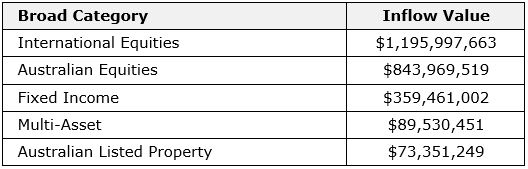
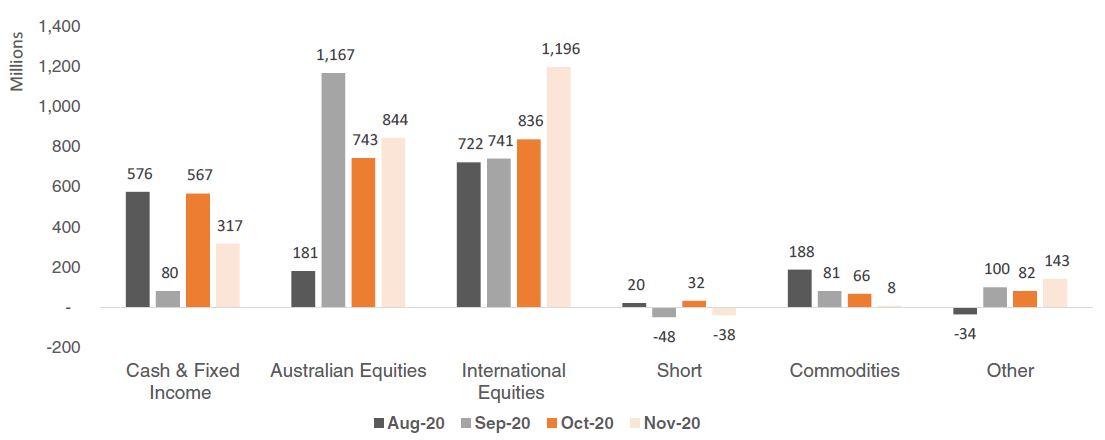
  • As has been the case since the COVID crisis, equities exposures dominated net flows this month, and this month, particularly the case with international equities ($1.2 billion of net flows).
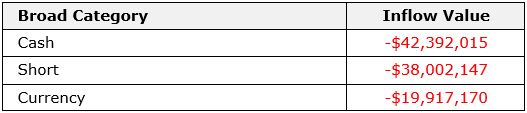
  • We saw outflows in cash and short exposures, both of which may be the result of markets rallying and investors positioning for a risk-on allocation.

Figure 1: Australian ETP Market Cap: August 2001 – November 2020
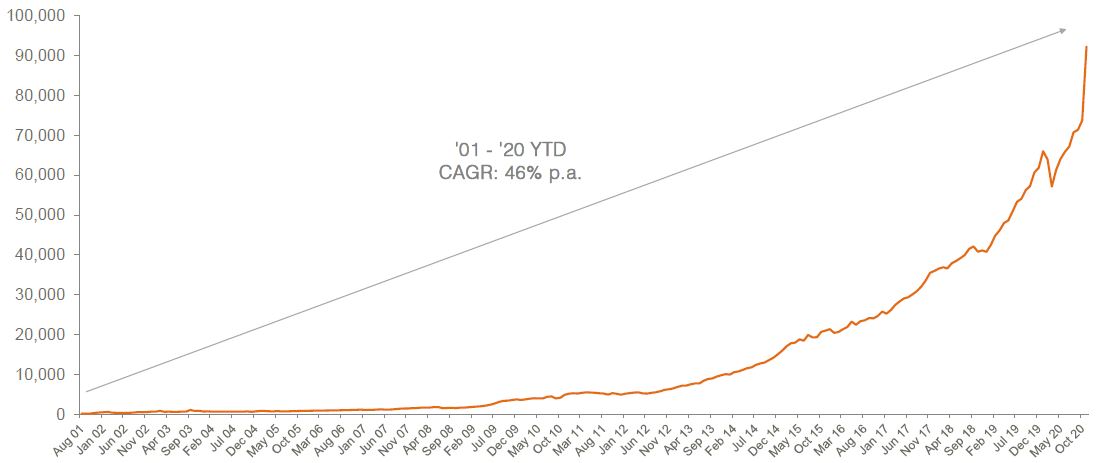
CAGR: Compound Annual Growth Rate. Source: ASX, Chi-X, BetaShares. Note, in November 2020, Magellan restructured a large international unlisted exposure to an open class structure and this fund (MGOC) will be included in ETF figures going forward.

Top 10 Products: November 2020

By Market Cap
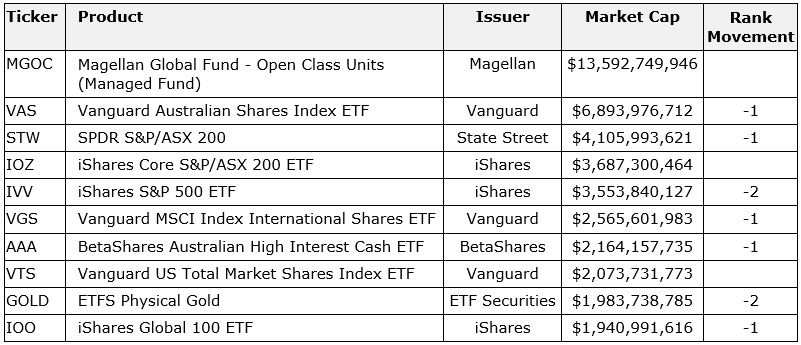
Other products with > $1B AUM: VAP, VEU, IAF, VAF, VHY, QUAL, MVW, NDQ, VGAD, A200

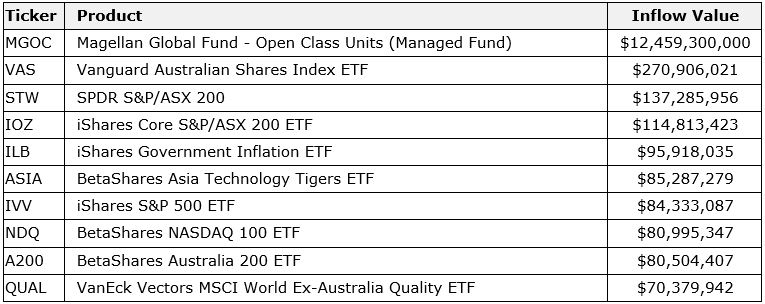
Top 10 Inflows (by $) - Month
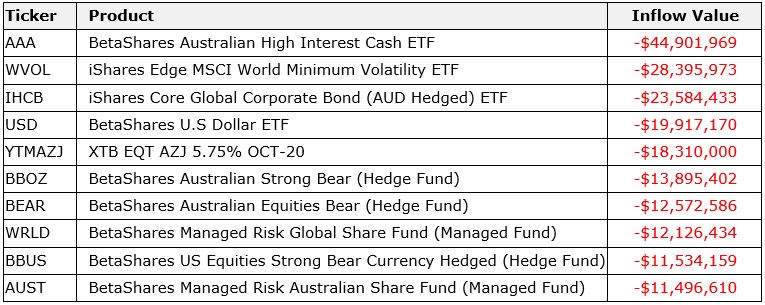
Top 10 Outflows (by $) - Month
Top 5 Category Inflows (by $) – November 2020
Top Category Outflows (by $) – November 2020
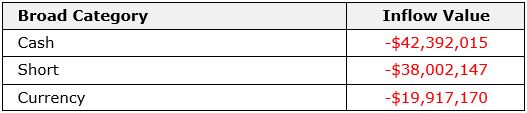
Figure 2: ASX ETF Flows by Asset Class - Last 4 Months (A$m)
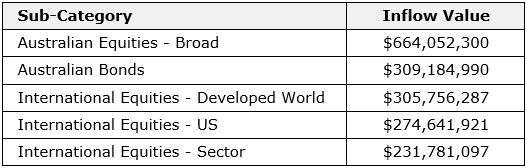
Top 5 Sub-Category Inflows by ($) – November 2020
Top Sub-Category Outflows by ($) – November 2020
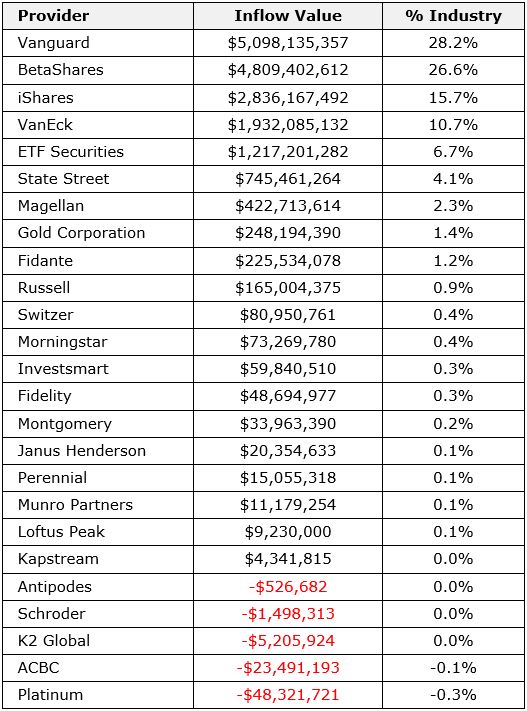
ETF Issuer Flows – YTD 2020
 

  •   16 December 2020
  •      
  •   


Leave a Comment:

RELATED ARTICLES

It pays to look under the hood of ETFs

Global ETF trends coming soon to Australia

Six charts on how Australians invested in 2022 and why

banner

Most viewed in recent weeks

Ray Dalio on 2025’s real story, Trump, and what’s next

The renowned investor says 2025’s real story wasn’t AI or US stocks but the shift away from American assets and a collapse in the value of money. And he outlines how to best position portfolios for what’s ahead.

Making sense of record high markets as the world catches fire

The post-World War Two economic system is unravelling, leading to huge shifts in currency, bond and commodity markets, yet stocks seem oblivious to the chaos. This looks to history as a guide for what’s next.

3 ways to fix Australia’s affordability crisis

Our cost-of-living pressures go beyond the RBA: surging house prices, excessive migration, and expanding government programs, including the NDIS, are fuelling inflation, demanding bold, structural solutions.

Is there a better way to reform the CGT discount?

The capital gains tax discount is under review, but debate should go beyond its size. Its original purpose, design flaws and distortions suggest Australia could adopt a better, more targeted approach.

How cutting the CGT discount could help rebalance housing market

A more rational taxation system that supports home ownership but discourages asset speculation could provide greater financial support to first home buyers.

Welcome to Firstlinks Edition 648 with weekend update

This is my last edition as Editor of Firstlinks. I’m moving onto a new role though the newsletter will remain in good hands until my permanent replacement is found.

  • 5 February 2026

Latest Updates

Property

The 5% deposit scheme is bad for homeowners and Australia

An ‘affordability’ scheme making the county more vulnerable to economic shocks and contributing to the deteriorating financial situation of everyday Australians.

Investment strategies

Is defensive the new offensive?

Relatively boring, unglamorous, defensive stocks like Kroger and Allstate have quietly outperformed gilded tech giants, offering steady growth, visibility, and resilient returns in a market captivated by AI and flashier industries.

Shares

How the RBA scores on its inflation goal

The Reserve Bank continues to face criticism from all sides. A reminder of the RBA's mandate and a review of their track record in maintaining price stability since the early 1990s.

Investment strategies

Levered credit: A late cycle ingredient for drawdown pain

As credit spreads normalised through 2025, yield‑hungry investors have turned to leverage for high returns, uncomfortably echoing pre‑GFC behaviours. Investors need to be careful to understand the true risk‑return trade‑off.

Planning

The more things change… longevity just goes on increasing

Australia needs a major shift in longevity awareness, attitudes and behaviour if, as a community, we are to reap the benefits of increasing longevity. Adopting a national strategy is well overdue.

Property

The improving outlook of Australian commercial real estate

The sector is positioned to benefit from defensive and resilient income streams supported by embedded rental increase opportunities. 

Property

Seize hidden opportunities among 50+ home buyer schemes in Australia

There is a laundry list of government schemes to help Australian's struggling with housing affordability. Savvy buyers should take advantage to break into the property market.

Sponsors

Alliances

© 2026 Morningstar, Inc. All rights reserved.

Disclaimer
The data, research and opinions provided here are for information purposes; are not an offer to buy or sell a security; and are not warranted to be correct, complete or accurate. Morningstar, its affiliates, and third-party content providers are not responsible for any investment decisions, damages or losses resulting from, or related to, the data and analyses or their use. To the extent any content is general advice, it has been prepared for clients of Morningstar Australasia Pty Ltd (ABN: 95 090 665 544, AFSL: 240892), without reference to your financial objectives, situation or needs. For more information refer to our Financial Services Guide. You should consider the advice in light of these matters and if applicable, the relevant Product Disclosure Statement before making any decision to invest. Past performance does not necessarily indicate a financial product’s future performance. To obtain advice tailored to your situation, contact a professional financial adviser. Articles are current as at date of publication.
This website contains information and opinions provided by third parties. Inclusion of this information does not necessarily represent Morningstar’s positions, strategies or opinions and should not be considered an endorsement by Morningstar.