Register For Our Mailing List

Register to receive our free weekly newsletter including editorials.

Home / 86

Our industry has a problem

“It is difficult to get a man to understand something, when his salary depends on his not understanding it.”  Upton Sinclair, Author and Journalist (1878-1968)     

Towers Watson is a global consulting company with over 14,000 associates. A few months ago, they published the results of a survey which had some worrying conclusions. The publication was called ‘Our industry has a problem: the investment industry has been built by the intermediaries for the intermediaries’.

(My interview with the author of the report, Tim Hodgson, appears in the next article in Cuffelinks).

It is worth reading the full report as it is only a few pages, but here are some highlights. To many Australians involved in the superannuation industry with fiduciary obligations of acting as a trustee, the results will be disturbing.

Is the industry for the intermediaries or the end investors?

In the survey, the first statement (which is repeated in the poll on our website) was:
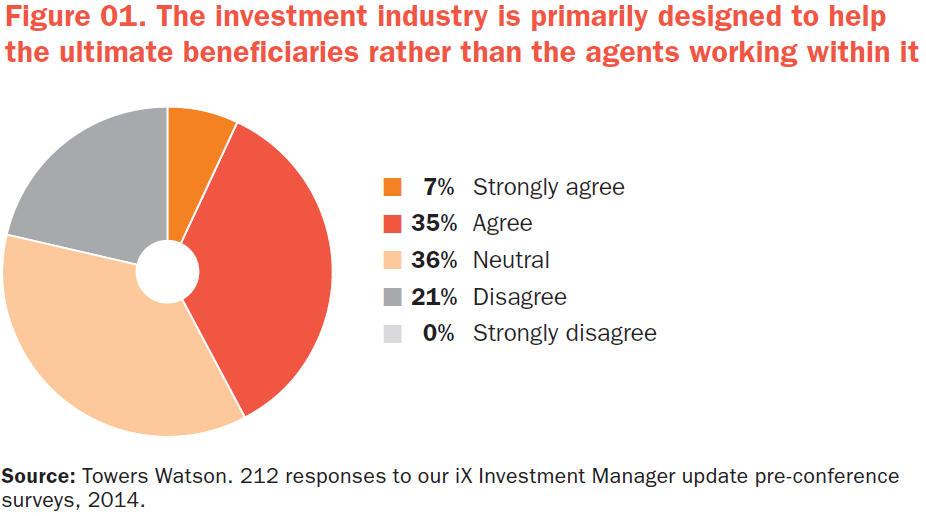
These are the responses from 212 employees in UK- and US-based asset management organisations. Amazingly, a minority of only 42% agreed that the investment industry is designed to help the end customers. This low level of agreement is a terrible indictment on the perceptions of certain people in the US and UK, and let’s hope it would be much higher in Australia. As Towers Watson says, other surveys show financial services is the least trusted industry (for example, the 2014 Edelman Trust Barometer), suggesting the end saver knows what the industry thinks of them.

In searching for the reasons the industry has a problem, Towers Watson also asked whether too much effort is spent searching for alpha (performance above the market), and only 18% agreed with this, with 14% neutral.

Then an interesting question followed that is not often discussed by the industry:
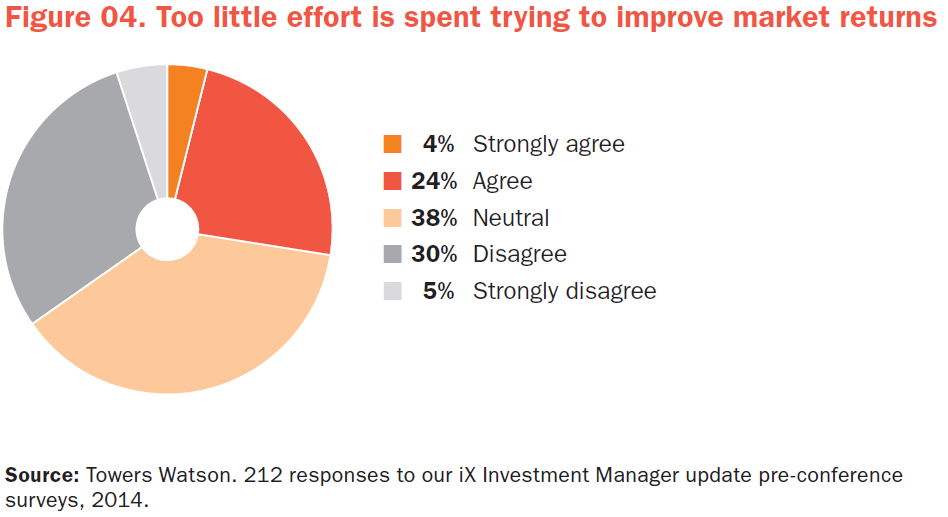
So 28% agreed the industry does not put effort into improving market returns (not alpha), with a large 38% neutral. That leaves only 35% who disagreed.

This is worth pondering. How could the industry improve market returns (this is not a question on market outperformance)? After all, this is what sustainability and fiduciary responsibilities are supposed to achieve. Some ways to improve market returns include ensuring as much of the market return goes to end investors as possible rather than intermediaries, minimising other leakages such as transaction costs, and greater constructive engagement with corporate management (which might in turn include reducing excessive compensation of executives).

Short-termism

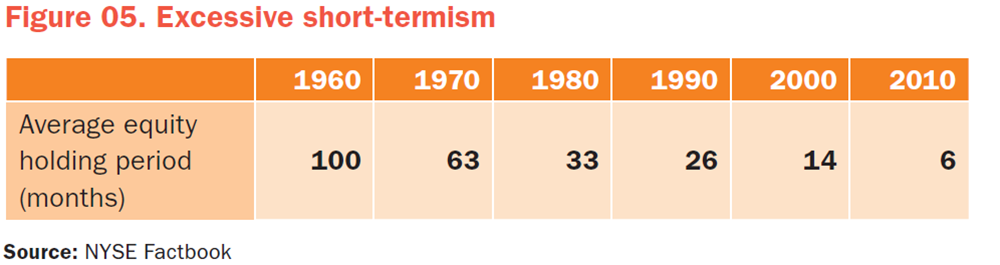
The other reason for the industry’s problems is short-termism, which is value destructive because it leads to higher costs and over-reaction to noise. According to New York Stock Exchange data, the average equity holding period has fallen from 100 months in 1960 to 6 months now.
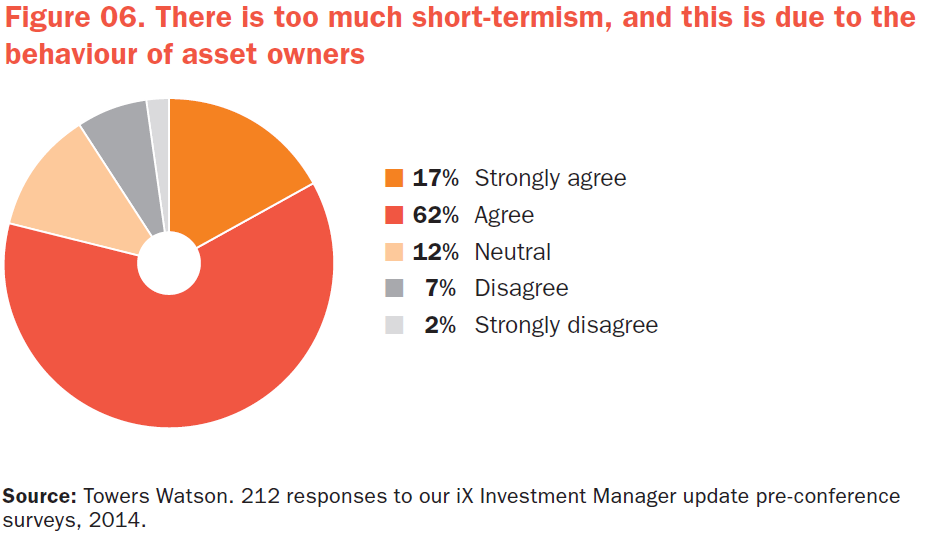
A surprising 79% of responses said there is too much short-termism, but blamed the asset owners (not the asset managers). This might be managers on the receiving end of being fired after a period of poor performance. But it’s interesting to see such a high proportion criticise short-termism, when the daily reporting of prices and immediate market responses is endemic in the industry.

Conclusions

Towers Watson makes a chunk of its living from the investment management business, and yet it reports this most critical and damning of positions:

“In our opinion, the value proposition that customers need is well-structured, fairly priced, and honestly and skilfully delivered investment outcomes. We believe the industry is falling short on all of these aspirations.”

It is not due to one problem. Asset managers work for themselves not their end customers, there’s too much focus on alpha and not enough on improving market returns, and the industry is obsessed with short-termism. We have a lot to answer for while we pay ourselves so well.


Graham Hand was General Manager, Capital Markets at Commonwealth Bank; Deputy Treasurer at State Bank of NSW; Managing Director Treasury at NatWest Markets and General Manager, Funding & Alliances at Colonial First State.


  •   31 October 2014
  • 2
  •      
  •   

RELATED ARTICLES

Summary of LIC performance over a solid year

Choosing managers should not ignore tax impact

banner

Most viewed in recent weeks

Australian stocks will crush housing over the next decade, 2025 edition

Two years ago, I wrote an article suggesting that the odds favoured ASX shares easily outperforming residential property over the next decade. Here’s an update on where things stand today.

Australia's retirement system works brilliantly for some - but not all

The superannuation system has succeeded brilliantly at what it was designed to do: accumulate wealth during working lives. The next challenge is meeting members’ diverse needs in retirement. 

Get set for a bumpy 2026

At this time last year, I forecast that 2025 would likely be a positive year given strong economic prospects and disinflation. The outlook for this year is less clear cut and here is what investors should do.

Building a lazy ETF portfolio in 2026

What are the best ways to build a simple portfolio from scratch? I’ve addressed this issue before but think it’s worth revisiting given markets and the world have since changed, throwing up new challenges and things to consider.

Meg on SMSFs: First glimpse of revised Division 296 tax

Treasury has released draft legislation for a new version of the controversial $3 million super tax. It's a significant improvement on the original proposal but there are some stings in the tail.

The 3 biggest residential property myths

I am a professional real estate investor who hears a lot of opinions rather than facts from so-called experts on the topic of property. Here are the largest myths when it comes to Australia’s biggest asset class.

Latest Updates

Investment strategies

Building a lazy ETF portfolio in 2026

What are the best ways to build a simple portfolio from scratch? I’ve addressed this issue before but think it’s worth revisiting given markets and the world have since changed, throwing up new challenges and things to consider.

Investment strategies

21 reasons we’re nearing the end of a secular bull market

Nearly all the indicators an investor would look for suggest that this secular bull market is approaching its end. My models forecast that the US is set for 0% annual returns over the next decade.

Property

13 million spare bedrooms: Rethinking Australia’s housing shortfall

We don’t have a housing shortage; we have housing misallocation. This explores why so many bedrooms go unused, what’s been tried before, and five things to unlock housing capacity – no new building required.

Investment strategies

Market entry – dip your toe or jump in all at once?

Lump sum investing usually wins, but it can hurt if markets fall. Using 50 years of Australian data, we reveal when staging your entry protects you, and when it drags on returns. 

Investment strategies

The US$21 trillion question: is AI an opportunity or excess?

It has been years since the US stock market has been so focused on a single driving theme, and AI is unquestionably that theme. This explores what it means for US and global markets in 2026.

Economy

US energy strategy holds lessons for Australia

The US has elevated energy to a national security priority, tying cheap, reliable power to economic strength, AI leadership, and sovereignty. This analyses the new framework and its implications for Australia.

Strategy

Venezuela’s democratic roots are deeper than Trump knows

Most people know Maduro was a dictator and Venezuela has oil. Few grasp the depth of suffering or the country’s democratic history - essential context as the US ousts Maduro and charts Venezuela’s future. 

Sponsors

Alliances

© 2026 Morningstar, Inc. All rights reserved.

Disclaimer
The data, research and opinions provided here are for information purposes; are not an offer to buy or sell a security; and are not warranted to be correct, complete or accurate. Morningstar, its affiliates, and third-party content providers are not responsible for any investment decisions, damages or losses resulting from, or related to, the data and analyses or their use. To the extent any content is general advice, it has been prepared for clients of Morningstar Australasia Pty Ltd (ABN: 95 090 665 544, AFSL: 240892), without reference to your financial objectives, situation or needs. For more information refer to our Financial Services Guide. You should consider the advice in light of these matters and if applicable, the relevant Product Disclosure Statement before making any decision to invest. Past performance does not necessarily indicate a financial product’s future performance. To obtain advice tailored to your situation, contact a professional financial adviser. Articles are current as at date of publication.
This website contains information and opinions provided by third parties. Inclusion of this information does not necessarily represent Morningstar’s positions, strategies or opinions and should not be considered an endorsement by Morningstar.