Register For Our Mailing List

Register to receive our free weekly newsletter including editorials.

Home / 218

The indignity of a modest retirement

Australians living on modest budgets, that is, those living close to or at pension level, are suffering the greatest additional cost imposts in retirement, according to new figures released by the Association of Superannuation Funds (ASFA). The calculations distinguish between 'modest' and 'comfortable' living, with the comfortable standard budget affording a much more dignified existence for Australian retirees.

ASFA Retirement Standard (RS) June 2017 quarter figures show couples aged around 65 living a comfortable retirement need to spend $60,063 per year and singles $43,695, up 0.2% on the previous quarter. The modest retirement budget has much to be modest about and is at near pension level subsistence, with singles needing to spend $24,270 and couples $34,911.

Modest retirement level suffers higher increase in costs

The annual increase in living costs at the modest level was in each case higher than at the comfortable level, reflecting the greater relative importance of electricity, health care and council and water rates in the modest budgets. The annual increase was 1.5% for comfortable and 2.1% for modest. These compare to 1.9% for the general Consumer Price Index (CPI).

The cost of retirement over the most recent quarter only increased by a relatively small amount, but many retirees are still finding it difficult to achieve a comfortable standard of living. Too many people are living without enough super, especially women. Australian retirees living at the basic level are doing it tough meeting costs of living. Financial support and literacy are part of the solution and super funds across the country can help members sort out their retirement living planning.

People need to be retirement-ready by saving for the sort of life they want to live. The magic of compound interest and tax savings in super can help lift living experiences in later life. Retirees now and in the future need super to increase and be safeguarded.

Living costs for retirees by capital city

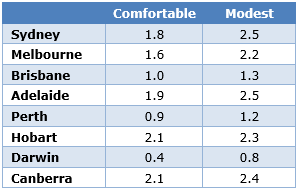
Cost increases for retirees were highest in Sydney, Adelaide, Hobart and Canberra, while Darwin, Perth and Brisbane had the lowest average overall price increases.

In Sydney, a 3.8% increase in food costs, a 12.5% increase in electricity costs and a 5.1% increase in health costs were higher than average increases in the retirement budgets.

Annual increase in retiree living costs by capital city
Updated retirement standard costs

While seasonal fruit and domestic holidays were more affordable, critical costs of power, health care and rates and water bills continue to be a big cost issue for many retirees.

The most significant price increases in the June 2017 quarter contributing to increases in annual budgets for retirees were for medical and hospital services (4.1%) reflecting the annual increase in private health insurance premiums on 1 April. The most significant offsetting price falls were for domestic holiday travel and accommodation (-3.2%), automotive fuel (-2.5%) and fruit (-4.4%).

Fluctuations in world oil prices continue to influence domestic fuel prices. During the June quarter, automotive fuel prices fell in April (-0.8%), rose in May (+0.2%) and fell in June (-0.6%). Overall, food prices fell 0.2% in the March quarter. Clothing and footwear prices fell 0.3% as a result of sustained periods of specials.

Budgets for various households and living standards for those aged around 65

(June quarter 2017, national)
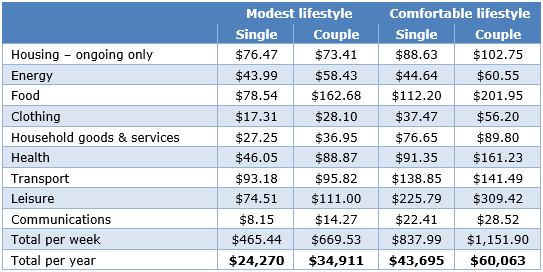
The figures in each case assume that the retiree/s own their own home and relate to expenditure by the household. This can be greater than household income after income tax where there is a drawdown on capital over the period of retirement. Single calculations are based on female figures. All calculations are weekly, unless otherwise stated.

The difference in enjoyment of retirement years is stark between modest and comfortable (and both sets of numbers assume the retirees own their own home). The most striking difference is the amount available for leisure activities and health. Superannuation should be taken more seriously by those who seek a comfortable retirement. Inflation may seem to have stabilised, but costs are increasing for retirees on smaller budgets especially as the essentials become more expensive.


Dr Martin Fahy is Chief Executive Officer at the Australian Superannuation Funds Association. Costs and summary figures can be accessed via the ASFA website. The ASFA Retirement Standard Calculator can be used to obtain a breakdown of the Retirement Standard budgets for each state. Australians can find out more about superannuation on the Super Guru website.


  •   7 September 2017
  • 5
  •      
  •   
5 Comments
Ashley
September 07, 2017

Good reminder that retiree inflation is not CPI inflation, but some of those ASFA lifestyle expenses are far too low– eg $78.54 per week for food – that’s $10 per day across 3+ meals per day (including coffee, snacks, drinks, etc)

peter
September 07, 2017

Ashley I can live below $10 per day for food, and I eat well. The trick is to prepare your own meals, and not rely on restaurants, take-away or prepared packaged meals.

James
September 07, 2017

It's good that you can. However, many of us would prefer to not have to live like that and to not have to rely on the pension....now if only the government would stop dipping their hands into the superannuation honey pot

eric wells
September 08, 2017

Reading the responses was interesting. I say, research companies thoroughly, buy in the dips, and they will do the rest.

ken
September 30, 2017

it is worse for those who don't own their home and have the full age pension directly reduced by having an income stream assets and income test imposed. It is also not feasible to buy a property to get a larger pension because the amount left over for living cannot be supplemented with more income stream withdrawals without further reducing the government pension. (using my own case and the centrelink FIS officer's projections). FOr non homeowners it is impossible to make rational decisions without affecting the government age pension which perversely gets in the way of other decisions to buy a house, say.


Leave a Comment:

RELATED ARTICLES

How much does it really cost to raise a child?

It's the cost of government, stupid

Recent age pension changes impact non pensioners too

banner

Most viewed in recent weeks

Building a lazy ETF portfolio in 2026

What are the best ways to build a simple portfolio from scratch? I’ve addressed this issue before but think it’s worth revisiting given markets and the world have since changed, throwing up new challenges and things to consider.

Get set for a bumpy 2026

At this time last year, I forecast that 2025 would likely be a positive year given strong economic prospects and disinflation. The outlook for this year is less clear cut and here is what investors should do.

Meg on SMSFs: First glimpse of revised Division 296 tax

Treasury has released draft legislation for a new version of the controversial $3 million super tax. It's a significant improvement on the original proposal but there are some stings in the tail.

Ray Dalio on 2025’s real story, Trump, and what’s next

The renowned investor says 2025’s real story wasn’t AI or US stocks but the shift away from American assets and a collapse in the value of money. And he outlines how to best position portfolios for what’s ahead.

10 fearless forecasts for 2026

The predictions include dividends will outstrip growth as a source of Australian equity returns, US market performance will be underwhelming, while US government bonds will beat gold.

13 million spare bedrooms: Rethinking Australia’s housing shortfall

We don’t have a housing shortage; we have housing misallocation. This explores why so many bedrooms go unused, what’s been tried before, and five things to unlock housing capacity – no new building required.

Latest Updates

3 ways to fix Australia’s affordability crisis

Our cost-of-living pressures go beyond the RBA: surging house prices, excessive migration, and expanding government programs, including the NDIS, are fuelling inflation, demanding bold, structural solutions.

Superannuation

The Division 296 tax is still a quasi-wealth tax

The latest draft legislation may be an improvement but it still has the whiff of a wealth tax about it. The question remains whether a golden opportunity for simpler and fairer super tax reform has been missed.

Superannuation

Is it really ‘your’ super fund?

Your super isn’t a bank account you own; it’s a trust you merely benefit from. So why would the Division 296 tax you personally on assets, income and gains you legally don’t own?

Shares

Inflation is the biggest destroyer of wealth

Inflation consistently undermines wealth, even in low-inflation environments. Whether or not it returns to target, investors must protect portfolios from its compounding impact on future living standards.

Shares

Picking the next sector winner

Global equity markets have experienced stellar returns in 2024 and 2025 led, in large part, by the boom in AI. Which sector could be the next star in global markets? This names three future winners.

Infrastructure

What investors should expect when investing in infrastructure: yield

The case for listed infrastructure is built on stable earnings and cash flows, which have sustained 4% dividend yields across cycles and supported consistent, inflation-linked long-term returns.

Investment strategies

Valuing AI: Extreme bubble, new golden era, or both

The US stock market sits in prolonged bubble territory, driven by AI enthusiasm. History suggests eventual mean reversion, reminding investors to weigh potential risks against current market optimism.

Sponsors

Alliances

© 2026 Morningstar, Inc. All rights reserved.

Disclaimer
The data, research and opinions provided here are for information purposes; are not an offer to buy or sell a security; and are not warranted to be correct, complete or accurate. Morningstar, its affiliates, and third-party content providers are not responsible for any investment decisions, damages or losses resulting from, or related to, the data and analyses or their use. To the extent any content is general advice, it has been prepared for clients of Morningstar Australasia Pty Ltd (ABN: 95 090 665 544, AFSL: 240892), without reference to your financial objectives, situation or needs. For more information refer to our Financial Services Guide. You should consider the advice in light of these matters and if applicable, the relevant Product Disclosure Statement before making any decision to invest. Past performance does not necessarily indicate a financial product’s future performance. To obtain advice tailored to your situation, contact a professional financial adviser. Articles are current as at date of publication.
This website contains information and opinions provided by third parties. Inclusion of this information does not necessarily represent Morningstar’s positions, strategies or opinions and should not be considered an endorsement by Morningstar.