Register For Our Mailing List

Register to receive our free weekly newsletter including editorials.

Home / 392

Welcome to Firstlinks Edition 392

  •   28 January 2021
  • 6
  •      
  •   

Weekend market update: Stockmarkets have been strong since November but that came to a halt last week due to stimulus delays and doubts about vaccines. Hedge fund activity in the wake of the GameStop frenzy also weighed on the market, and both the S&P500 and NASDAQ were down 2% on Friday. This took the US index loss for the week to 3.3%. Australia started well on Friday, up 0.6% by midday, but the S&P/ASX200 closed down 0.6% by the end of the day. It left January with a small gain of 0.3%.  

***

Australia's share market has experienced the ripple effect of the US GameStop controversy, closing lower for a third consecutive day as US hedge funds sold stock to recover huge losses.
The ASX indices were higher by 0.6 per cent at 1200 AEDT after a good lead from Wall Street, but fell in the second half of Friday's session.
The S&P/ASX200 benchmark index closed lower by 42.3 points, or 0.64 per cent, to 6607.4.
The All Ordinaries closed lower by 46.7 points, or 0.68 per cent, at 6870.9.

When we wrote about Robinhood and Reddit investors in June last year, it was not expected that their activities would ramp up to another extreme level. Fuelled by stimulus cheques and social media stories of instant wealth, thousands of new participants in the US are speculating in a way the market rarely sees. Think Dutch tulips in 1637, South Sea Bubble in 1711, the Japanese stock market in the 1980s, Alan Greenspan's 'irrational exuberance' of 1996, the dot coms of 2000 and US housing before the GFC.

When a stock like GameStop rises 125% in five days, 300% in a month and 1,900% in six months, and it's a video game retailer with declining sales, speculators have no regard for the underlying business. In less than a year, GameStop's market value rose from $US200 million to over $25 billion at one stage.

It is already a case study in the power of unified individual investors. Thousands of people are joining Reddit groups, deciding to buy a stock and take on the professional hedge fund shorts, who are then forced to buy to cover their positions. There are also losers as GameStop fell 60% in an hour before resuming its rise. The US market has never seen options and retail activity at this level before. 

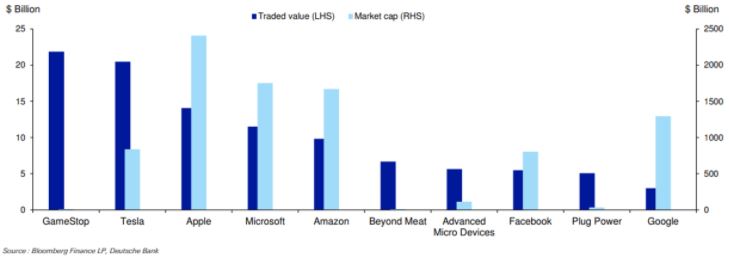
But it's not only smaller investors who have jumped aboard. Many large portfolio managers, hedge funds and professional traders have joined in, such that on one day, 26 January, this small company was the most actively-traded stock in the US by value, plotted here with the market cap of each company. 
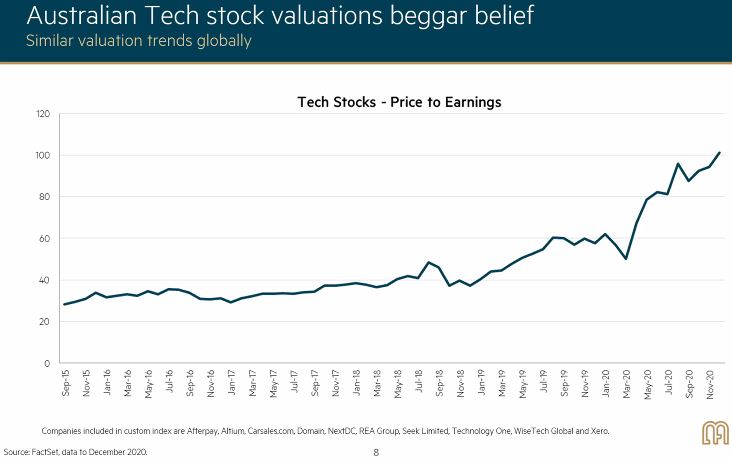
Obviously, GameStop is not the same type of company as Australian tech winners such as Afterpay, Xero, WiseTech and Altium, which are real businesses with share prices riding a wave of optimism. But they are causing a performance problem for some of our more respected fund managers who use fundamental analysis. They can't match the growth market rise and are forced to explain their 'underperformance' to their clients. A fund manager with a long history such as Maple-Brown Abbott is using the following chart, among others, to show how a custom index of Australian tech stocks has reached a Price/Earnings ratio over 100 which 'beggars belief'. These managers will benefit when the market finally rotates from growth to value.
This week, we look at the difficulty facing investors who attend fund manager presentations for insights into the quality of the manager. Performance is in the past and there is no way of knowing whether the manager will deliver in future. In addition, every presentation makes a good case for support leaving investors with unlimited choices.

Kate Howitt describes the investor dilemma of deciding whether to participate at elevated prices in the risky game of speculation as a 'Breaking Bad' moment. Spoiler alert, that does not end well for the main character but financial markets are not at that point.

Nobody could accuse Warren Buffett of taking a short-term, speculative view on the market, but even he and Charlie Munger went into their first IPO for years by investing in Snowflake. And they have a big position in Apple. James Gard look at Buffett's portfolio in 2020, where not everything went as well as the tech exposures.

Olivia Engel sees a return to some normality in 2021, where a company's share price better reflects its business fortunes, and she identifies the sectors and themes she expects to pay off. Likewise, the renewed optimism that our major banks have withstood the worst of the pandemic is reflected in recent price rises, and KPMG runs its ruler over the resilience of bank balance sheets.

During the pandemic, while some people enjoyed business and market success, many others have struggled. One way to stimulate the economy is through more social housing, and Matthew Tominc suggests ways this can be done while still meeting the reasonable investment return needs of savers.

The Minister for Superannuation, Financial Services and the Digital Economy, Senator Jane Hume, turned up the temperature in the super debate with a piece in The Australian Financial Review on 22 January 2021. It started with a strange comparison between retirement savings and a bikini:

"We all tend to make the most of our best assets ... If you have a fabulous bikini body, surprise, surprise, you tend to wear bikinis. It’s human nature to make the most of what we’ve got. Except, strangely, when it comes to our retirement savings."

Anyway, she highlighted that many retirees live unnecessarily frugal lives and die with most of their savings intact. The challenge for policymakers is:

" ... how to improve the confidence of retirees to use their savings more efficiently to enjoy a better standard of living."

It's a debateable definition of efficiency, with Senator Hume promoting the availability of reverse mortgages and the age pension to cover a loss in savings.

"For example, as superannuation balances decline over time the social security safety net available to all Australians will kick in, providing a part pension that scales up as superannuation balances are drawn down."

I'm guessing most readers of Firstlinks do not plan to draw on an age pension, but future increases in Superannuation Guarantee are clearly in jeopardy. Roger Cohen offers his view on whether this is the correct policy.

With the recent rise in the CPI, the ATO has announced the first increase in the Transfer Balance Cap (TBC) from $1.6 million to $1.7 million from 1 July 2021. Only people who start a pension after that date will be eligible for the higher cap. Super is already complicated enough and soon we will have TBC amounts specific to particular people.

This week's White Paper from Franklin Templeton looks at a product that is at the centre of a battle between improving standards of living and decarbonising national economies.

Graham Hand, Managing Editor


Latest updates

PDF version of Firstlinks Newsletter

Australian ETF Review from Bell Potter

ASX Listed Bond and Hybrid rate sheet from NAB/nabtrade

Indicative Listed Investment Company (LIC) NTA Report from Bell Potter

LIC Monthly Report from Morningstar

Plus updates and announcements on the Sponsor Noticeboard on our website


  •   28 January 2021
  • 6
  •      
  •   
6 Comments
Phil Preston
January 27, 2021

Hey Graham, of most interest in the Reddit thing is that my 18yo son thinks its awesome - event though he doesn't quite understand what's going on - and I mention this because it has created an opportunity for us to start a conversation about investing!

Eve
January 27, 2021

Hey Phil, my son (a gamer) thinks it’s funny, he did the research so that he does understand what’s going on - we’ve had some good, long conversations about investing as a result too. Brilliant opportunity to talk to your kids.

Chris
January 30, 2021

All he has to know Phil, are two words. Andrew Lahde. That it doesn't matter if he doesn't go to prep school, Yale, get a Harvard MBA and then rise to the top of the best companies, because even that is no guarantee of an advantage; in fact, it can actually be a hindrance. “If you have a 150 IQ, sell 30 points to someone else. You need to be smart, but not a genius”.

Chris
January 29, 2021

"speculators have no regard for the underlying business". Which includes the short sellers, who are the original root of the problem. The way that I see it, they got taken on at their own game of talking down a company and leveraging to the eyeballs in their positions, they lost badly and are now crying, kicking and screaming like a spoiled brat to whoever will listen to them from the SEC or politicians.

My opinion is that as a broker, RobinHood will likely get sued and/or fold after this for what they have done to limit purchase volumes (blaming "SEC Regulations", which (a) is not the point of a free market and (b) I never saw anyone limiting purchase volumes of individual stocks during the GFC or otherwise...), and not even their big tech friends deleting negative reviews will save them. They have been caught red handed and the whole ensuing cover up attempt stinks.

Geoff
January 30, 2021

Hmm! .... Not all "short sellers" are hedge funds. Generally, in commodity markets, the shorts are the producers.
Anyone who buys anything generally has a view, and that would make them a "speculator" as no one has perfect knowledge, in what has been long suspected, but now known to be "imperfect" markets.
Ahh well back to Samuelson, econ 101 and a re-write of investment theory.
... just my 2c worth

Chris
January 30, 2021

Respectfully Geoff, nowhere in my comment did I say "Hedge Funds"...but we both know in general terms, who I am referring to; "big money" versus the "poor old little guy" / retail trader. And I think that the irony is hilarious, that when the boot is on the other foot, and not from another 800 pound gorilla, but rather, an opponent that, let's be honest, Wall Street has considered with disdain - "the dumb money".

Does no one see the irony that for years, traders have treated Wall Street like their own personal casino, and when it goes wrong, they now somehow don't like it ? Well, that's too bad, because it's meant to be a free market, one that doesn't care who or what you are, only that you are smarter than someone else on the other side of that trade. To me, it is the most pure, ultimate IQ game.

"Speculator" is too broad a term to apply to just anyone who buys something. I may have my own reasons for buying something ("regard for the underlying business") or I might need it. For example, I buy something from the supermarket, then it gets put on special the next week. I didn't know that, but I wasn't necessarily speculating; I might have needed it there and then when I bought it, or I might have liked it.

Think toilet paper - it might even be a popular product and someone buys all available supply for themselves with no intention of selling or trading it. I didn't talk it down so that I could sell it, then return the same thing to the holder the week after and purely to make money, which is the definition of shorting. It also adds no value to the original holder (they get their "thing" back regardless) or the buyer (who obviously wanted it without appreciating it could go cheaper or to "zero") and in fact, the value of the underlying company can go to zero and go bust, hence this other buyer could then hold something that is considered "worthless". The same thing doesn't happen in a long position; rubbish can be bid up to any level, conceivably.

No one ever complains to the SEC / ASIC when the opposite happens and a stock goes up. And no one would be there to say to the retail investor "oh, hey, I'm sorry, you lost money or blew yourself up on a leveraged position / CFD / options because those big institutions took the other side of your trade, please have a bailout / stop the market / get your local Senator involved / restrict trade in that security". The whole thing is so one sided right now in the MSM, I could fall off the edge of it. The culture of Michael Lewis's "Liars Poker" must still hold true to some degree ?

Saagar Enjeti explains this episode so much more eloquently than I ever could and makes some very interesting comment about how the reasonable person may believe / perceive there could be conflicts of interest between such people and the political class.


Leave a Comment:

banner

Most viewed in recent weeks

It’s time for LICs to die

A high-profile dividend cut and a prominent fund manager’s apology have reignited a long-running debate. If investors can access similar exposures more cheaply and efficiently elsewhere, what exactly is keeping LICs alive?

Testamentary trusts survived the trust tax. The drafting battle has just begun.

The fight over testamentary trusts looked settled. Then the draft legislation arrived. Hidden in a technical detail is a question that could force many families to rethink wills they thought were already future-proof.

The new capital gains tax trap for your portfolio

Investors have long accepted one portfolio rule without much question. A major tax shift could change that calculation entirely, forcing difficult trade-offs between risk, discipline and an overlooked cost lurking beneath.

The retirement scorecard: how many of these questions can you answer?

From the maths of retirement, estimating spending and picking the right asset allocation to survive a poor decade, here are the questions every retiree – current or future – should be able to answer for themselves.

How the typical Australian Family could save $844,350 in taxes

The value of a testamentary trust is not determined by wealth alone. Depending on circumstances, it can reduce the tax burden on inherited income, create efficiencies and help build intergenerational wealth.

The housing slide could become a crash

House prices are sliding across Australia, yet the most dangerous ingredient for a housing crash is still missing. If job losses surge amid growing economic risks, today's correction could become a historic property downturn.

Latest Updates

Testamentary trusts: Treasury has picked the wrong reading

A decades-old estate planning tool has survived one tax crackdown only to be caught by another. The surprise isn't who the reform is targeting, but who could end up paying the price for drafting choices made years ago.

Latest from Morningstar

Does an American retirement rule work for Australians?

The 4% rule has survived decades of scrutiny, but Australia's retirement system changes the equation in ways most overlook. Before accepting or rejecting this rule of thumb, it pays to understand what really drives retirement outcomes.

Shares

Glencore lands on the ASX. Should BHP and Rio shareholders switch?

A coal-heavy miner with governance concerns isn't the obvious choice for investors. Yet, Glencore's ASX listing may offer something BHP and Rio can't. The challenge is working out whether the opportunity outweighs the risks.

Why does the system treat capital gains and losses differently?

Investors are often told not to let tax policy drive their investment decisions. Yet, under the new CGT rules, portfolio construction, volatility and even how assets are owned may have an outsized impact on their final outcome.

Economy

Three common sense reforms that Australia needs

What do frozen bank accounts, mortgage traps and pension penalties have in common? They're all symptoms of a system that makes life much harder. Yet the obvious solutions seem to have escaped the attention of Canberra.

Shares

The hidden cost of government debt for investors

Some of the important effects of rising public debt never make the headlines. Research shows the immediate effects may already be unfolding, influencing corporate behaviour in ways that many investors would never suspect.

Investment strategies

When do fundamentals matter?

Is fundamental investing losing its grip on markets? Investors continue to search for valuation-based explanations for every price move, but the dominant force behind short-term returns may be something else altogether.

Sponsors

Alliances

  • ASA-Logo-RGB-ActiveGreen-web.png

© 2026 Morningstar, Inc. All rights reserved.

Disclaimer
The data, research and opinions provided here are for information purposes; are not an offer to buy or sell a security; and are not warranted to be correct, complete or accurate. Morningstar, its affiliates, and third-party content providers are not responsible for any investment decisions, damages or losses resulting from, or related to, the data and analyses or their use. To the extent any content is general advice, it has been prepared for clients of Morningstar Australasia Pty Ltd (ABN: 95 090 665 544, AFSL: 240892), without reference to your financial objectives, situation or needs. For more information refer to our Financial Services Guide. You should consider the advice in light of these matters and if applicable, the relevant Product Disclosure Statement before making any decision to invest. Past performance does not necessarily indicate a financial product’s future performance. To obtain advice tailored to your situation, contact a professional financial adviser. Articles are current as at date of publication.
This website contains information and opinions provided by third parties. Inclusion of this information does not necessarily represent Morningstar’s positions, strategies or opinions and should not be considered an endorsement by Morningstar.