Register For Our Mailing List

Register to receive our free weekly newsletter including editorials.

Home / 669

Welcome to Firstlinks Edition 669 with weekend update

  •   2 July 2026
  • 26
  •      
  •   

Something has been bothering me.

The recent budget has produced its usual flurry of commentary (and rightfully so). However, one thing that has stood out over the last month or so, is a pervasive sense of uncertainty. Perhaps not only a product of the measures themselves, but the contradictory explanations offered by those responsible for them.

June housing market

Residential real estate underpins Australia’s wealth landscape. Whether this continues to be the most productive destination for capital is a question worth debating, and one I’m keen to hear readers’ views on. Either way, it’s no surprise that many eyes have been cast on property valuations since May 12th. Findings from Property Update show that house prices in capital cities have continued to fall over June with the monthly rate of decline now accelerating.
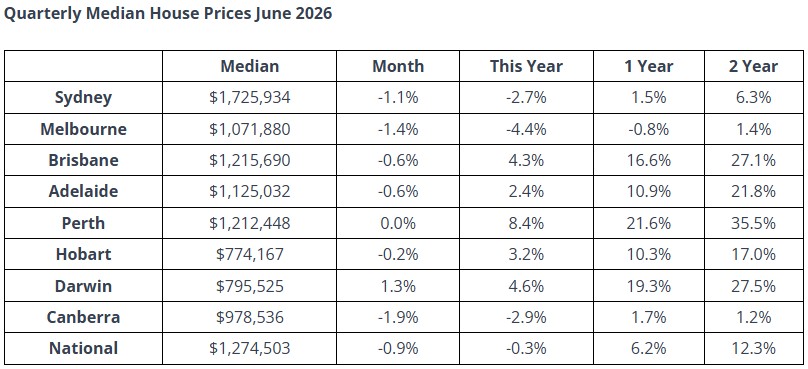

Source: Property Update. “Falling home prices accelerate over June”. 29 June 2026.

Trouble in paradise

Naturally, these headline figures have elicited fears of a housing-induced economic downturn.

When recently questioned about dwindling dwelling values and lower auction clearance rates, Housing Minister Clare O’Neil stated that "We see periods of very significant house price growth and then we see the market make a correction, and that's what we're seeing at the moment."

Indeed, O’Neil is partially correct about the cyclical nature of the Aussie housing market. But as AMP reports, the down-cycles tend to be short-lived and prices generally fall ~5%, which they view as modest. However, the point of contention here was the technical definition of "correction", which generally implies a drop of 10% in equity market terms.
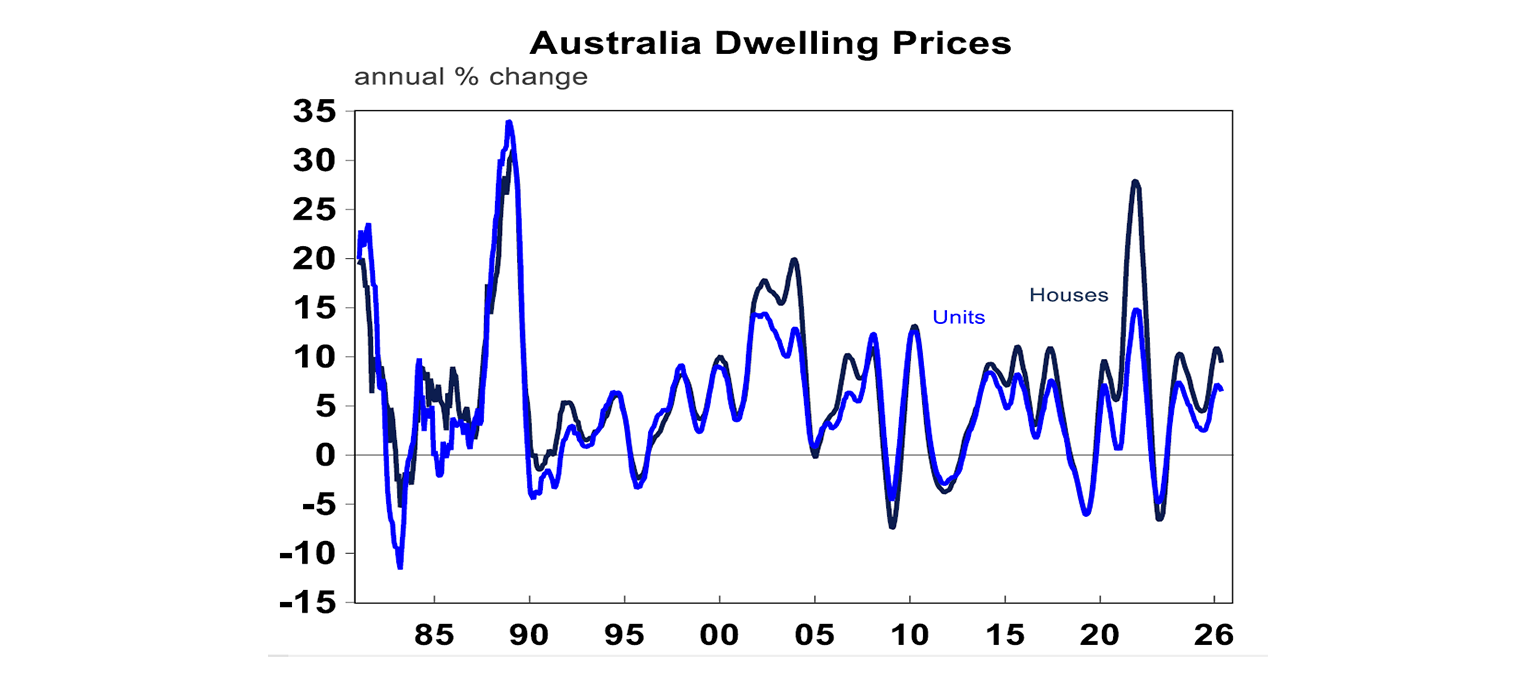

Source: AMP.

Jim Chalmers recently walked back O’Neil’s comments about a “correction”:

“We have seen a softening in house prices in recent months even before the Budget, and that’s a reflection of a whole range of factors including changes in interest rates, softness in the broader global and domestic economies, as well as any other influences from the Budget and the like.”

This diverges from the view at the beginning of this budget cycle, where it was asserted that the government were “taking pressure off the housing market, by taking a serious approach to housing…”. It would be intellectually dishonest to infer that easing some of this pressure (as described) wouldn’t reveal itself in the eventual cooling of prices.

The result of this back and forth between O’Neil and Chalmers is a muddled message that has satisfied very few. A far cry from any unilateral agreement on the future of residential property prices. But this isn’t a discussion about semantics. Importantly, I think it raises a simpler question: if affordability was the stated objective of budget measures, is a moderation in prices not a foreseeable (perhaps even necessary) outcome? And if that is not the objective, then what is?

Shadow Treasurer Tim Wilson described the situation as “complete disarray,” arguing the Government did not appear to know its own policy aim. Whether or not one agrees with that assessment, the contradiction is undeniable. It is difficult to present a policy as ambitious while simultaneously assuring other constituencies that nothing fundamental will change. In attempting to offend no one, the Government has managed to confuse everyone.

A broader note on the budget blame game

One thing the budget coverage has made painfully clear is how quickly parts of the media will reach for a generational-war narrative. Older Australians have been cast as beneficiaries of an inflated market and younger Australians as victims of it. This budget has sought to reverse this "intergenerational inequity", with the changes being framed as dramatic win for young Aussies at the expense of older investors. As though assigning fault to one age group will improve affordability for another.

As someone in the younger cohort, I understand the appeal of that storyline, but it does little to improve my own prospects or those of my peers. Vilifying predecessors who were simply beneficiaries of the economic circumstances of their time, does nothing to address the structural forces shaping today’s market. It does the opposite. It reduces a complex, long-term issue to a simplistic morality play.

Housing affordability has always been a structural issue shaped by planning constraints, construction capacity, migration flows, tax settings and decades of bipartisan decisions. It is not the product of personal virtue or personal failure. The danger in this framing is that it obscures the real issues and encourages resentment rather than understanding. Playing the generational blame game is a poor substitute for serious policy introspection.

This Budget (just like every other one before it) deserves scrutiny. Investors across all generations alike make long-term decisions based on the signals they receive. What concerns me is the mixed signalling. If the Government intends to reshape the price landscape, it should say so plainly. If it intends to preserve the status quo, then it should say that plainly. What it cannot do, is attempt both simultaneously and then expect the public to interpret the ambiguity in a constructive way.

Simonelle Mody

Also in this week's edition...

After the recent changes on SMSFs using LBRAs to purchase new residential properties, Meg Heffron explores how wide the ban really is.

It's been a tough time for Aussie equities after a long record of outperformance. Mark LaMonica examines whether the lag is a temporary setback or whether there are structural forces at play.

Tony Dillion models the 30% minimum tax on capital gains to reveal anomalies that introduce unexpected distortions.

Sam Heithersay from Fidelity discusses why the next generation of Australian equity leadership may not be found in familiar sectors.

Global growth is facing mounting pressure from all angles. Matt Reynolds from Capital Group believes AI-related investment may prove enough to reshape the outlook for markets

Many retirees pass away with their wealth intact. Joseph Darby looks at a case study from New Zealand to help determine what drives the cautionary spending behaviour.

IPO frenzy has fizzled but is yet to disappear. Director of Retirement Planning, Christine Benz shares her own investment philosophy and how a set of core beliefs can tune out distractions.

Curated by Simonelle Mody and Leisa Bell

***

Weekend market update

From Shane Oliver, AMP

Global shares saw strong gains over the last week as the oil price remained down, inflation fears subsided and slower US payrolls removed some pressure for a US rate hike. The positive global lead along with with a rebound in health care stocks saw Australian shares rise around 0.9% with gains in health, mining, IT and financial shares more than offsetting weakness in utilities and property shares. Another rotation in US shares. While the US share market remains below its recent record high this partly reflects another healthy rotation from tech to non-tech shares with the equal weighted S&P 500 reaching new highs.

Despite reduced inflation fears, bond yields actually rose slightly in the last week. Prices for metals and iron ore fell but gold and Bitcoin rose as the $US fell which also helped the $A get rise above $US0.69. So far Bitcoin appears to be holding technical support around $US60,000 following a roughly 53% fall from its October high. If it’s able to bottom here it may be seen as very positive potentially breaking out of the four year cycle of 80% falls as it matures.

Despite a rocky ride the interim US/Iran peace deal appears to be holding together with the flow of ships through the Strait of Hormuz remaining up from lows through the March-June period, despite a setback a week ago as the conflict appeared to be briefly flaring up again.

This in turn has seen oil prices fall to slightly above where they were before the War. However, scope for a further fall in the near term may be limited with the risk of some rise as the flow of ships through the Strait remains depressed and the peace deal still looks fragile with difficult to resolve issues around Iran’s desire to control the Strait, its nuclear program and the Israel/Hezbollah conflict all posing a threat with the risk it could all flare up again.

The last financial year saw another year of solid returns despite a long worry list including last year’s US tariffs and this year’s US war with Iran – but can it continue? Sure Australian shares lagged with just a 6.1% return but that was still above inflation and most bank account rates. But global shares returned around 23% in local currency terms with Japanese and emerging market shares being the star performers. Can it continue? Our assessment is that shares will continue to provide reasonable returns over the year ahead, albeit with significant bouts of volatility. The combination of sticky inflation, an upwards drift in central bank interest rates, worries about an AI bubble, huge US IPOs, political uncertainty around the US mid-terms and high risks around the Iran peace deal are likely to continue to result in a volatile ride with a high risk of yet another correction. But the absence of a recession, solid profit growth, Trump likely to pivot to more consumer-friendly policies ahead of the mid-terms and the Fed and RBA likely to cut rates next year should result in okay overall returns.

The home price downturn accelerated in June with prices falling 0.4% m-o-m and the previous two quarters revised to show declines. While the slide is being led by Sydney and Melbourne, Brisbane and Adelaide look like they will go negative soon too.

So far it’s just a flick of the top for house prices and the sort of thing you would expect when interest rates rise. National average prices are down around 1% from their high after a 26% surge over the prior three years. But the downturn likely has further to go reflecting the impact of rate hikes, low confidence, poor affordability and the move in the Budget to wind back virtually all investor property tax concessions.
 
Given the role the concessions had played in attracting investors into the property market over many years their removal has logically seen many investors retreat to the sidelines waiting for lower prices and higher rents before committing, but it also likely means that unaffected buyers will also hold back to see what happens. We now expect a 2% fall in property prices this calendar year and a 6% fall over the next 12 months, resulting in a top to bottom fall of around 7%. If unemployment rises substantially the fall is like it be greater. By the June quarter next year property prices are likely to bottom as the market starts to focus on RBA rate cuts in 2027. 
 

Housing credit growth for May is showing signs of rolling over as rate hikes hit, but as it lags actual lending commitments it’s too early to see the impact of the Budget tax changes on lending to investors.

One source of support preventing a deeper slump in property prices is the housing shortfall and this is unlikely to change anytime soon. Home building approvals fell 1.1% in May with a 7.3%mom fall in volatile unit approvals. They are trending around 204,000 at an annual rate which is up from the 2023 low but still below the Housing Accord target of 240,000 a year which is necessary to meet regular annual demand and eat into the shortfall. The rise in mortgage rates risks driving a slowing in approvals from here.

Wages growth under newly approved enterprise bargaining agreements rose a notch in the March quarter but is still around 4%. However, the pick-up in inflation and minimum and award wages risks some acceleration ahead.
 

Latest updates

PDF version of Firstlinks Newsletter

Monthly Investment Podcast by UniSuper

Listed Investment Company (LIC) Indicative NTA Report from Bell Potter

ASX Listed Bond and Hybrid rate sheet from NAB/nabtrade

Plus updates and announcements on the Sponsor Noticeboard on our website


  •   2 July 2026
  • 26
  •      
  •   
26 Comments
Simonelle Mody
July 06, 2026

Much appreciated, James. Hope all is well!

John Corbin
July 02, 2026

Look, an excellent summary of the current situation but I'll say what many observers do at home..... it's politics. A deliberate policy of confusion and obfuscation. While the chickens seek to protect their eggs, confused and squawking, the metaphoric fox circles and before the fowls know it, they are the targets. And suddenly it becomes clear, the fox is Jim in disguise and Claire actually a red herring. And what is Jim doing in cahoots with Claire? Purloining your purse.

5
Simonelle Mody
July 06, 2026

Thanks for taking the time to share your thoughts, John. Certainly no shortage of political theatre in the housing debate!

Hamish
July 02, 2026

Australia is a highly urbanized society. Melbourne would be one of the only city cities in the OECD that does have fast trains to major towns and cities so that people can purchase cheaper land to build on in rural areas and still be able to travel to Melbourne in a short time. Politicians are unlikely to invest in major infrastructure projects like rail unless they think such expenditure will win enough votes to stay in power. I used to work in London over fifty years ago. Millions of workers used to commute to work by train some who lived quite some distance from London.

Fiddling with Capital Gains Tax rates will not make land prices cheaper especially when the population increases at a faster rate than houses can be constructed.

5
lyn
July 03, 2026

Hamish, agree & they travel further now to London than 50yrs ago, Brighton & Worthing were on list then but now as far as Bristol & Bournemouth(approx 180K). Know someone who does Bournmeouth route.
Lanhilleth station (village, Ebbw Valley, Sth Wales) closed about 1962/63, reopened 2008, workers in Bristol (70Km) where property is pricey can buy 3 bedr terrace in depressed Welsh villages & towns in pretty valley for as low as 50/60,000pnds unrenovated, most homes have at least 1 window with mountain view due to topography, 24 trains/day.
Distances of course greater between towns in Australia but it's not insurmountable with very fast trains stopping only those towns as it was with limited stops Brighton to London 50yrs ago.

Rob
July 05, 2026

Hamish - have you used the rail networks in Central Europe - not only are there fast trains in Germany, Austria, Switzerland and France but you can set your watch by them - not so much so in southern and Eastern Europe - even country borders aren’t a problem in the Schengen Zone with a Euro passport. Infrastructure in Victoria should be so much cheaper than in most other Aus states as one can drive from anywhere in the state and back again in the same day. Think I know where you live?

Harry
July 05, 2026

Making housing a less attractive toi investors does make it more accessible to owner occupiers. The investment bros voicing “concern” for the plight of renters is wearing thin!??. Further, the 30% tax on trust distribution? Well, if the beneficiary has zero other income, it’s all about a maximum tax of $4,500. Trusts with tens of millions will hardly be blown up.

lyn
July 02, 2026

Ms Mody, Welcome. Your first piece is a good article,well-rounded and an easy read. Dare I say it these day?----interesting perspective from a younger person's thoughts (and female to boot). Well done.

4
PaulB
July 05, 2026

Of course you dare say Lyn and wholeheartedly agree. Welcome and congratulations Simonelle, I look forward to reading more of your articles.

1
Simonelle Mody
July 06, 2026

Thank you both for the warm welcome!

John
July 03, 2026

Congratulations on the new role.


The confusion is everywhere. No discussion of "rentvest" as potential young first-home buyers try to find a way to move to ownership. The same with removing the last opportunity for many mid-age to use super to get a home for long-term retirement. Renters treated as if they don't exist, dismissing the 1985-87 Sydney rental increases as if they are irrelevent because of shortage of supply when that is exactly the risky current situation. The nonsense of Treasury modelling the "housing market", as if such a simple beast even existed, and coming up with a $2 rental increase. Then the obvious question of why extend all this to shares, with the abomination of returning to indexation, which no major international peer uses.


The whole mess is a disgrace. Yet it lasted for a whole downside week or so in the polls. Time will tell. Some very accommodating Labor supporting media economists. We won't go to Ken Henry with his 2009 "housing supply is not about taxation changes" versus contemporary support. It would be easy to get angry for one's grand-kids but who takes any notice of 80 year-olds-they are just generational fodder to extract more from their health rebate.

4
Dudley
July 03, 2026


"No discussion of "rentvest"", "Renters treated as if they don't exist": did anyone say "SAVE"?

Home mort-gage free in 4 years or 20% 'deposit' in 8 months:
https://djm-gm.github.io

1
Simonelle Mody
July 06, 2026

Appreciate the detailed perspective, John. As a renter myself, I’m very conscious of how these contradictions land in real life. I’m equally wary of the Treasury modelling and as you say, time will tell.

Nic
July 02, 2026

Well done Simonelle. Easy to read and valuable discussion given the cross-currents of politics transporting citizens to hazy, uncharted shores. I enjoyed reading your articles, especially the "word play" with words.
Looking forward to reading more of your future articles.

3
Simonelle Mody
July 06, 2026

Thanks so much, Nic. A little word play never hurts!

Allan
July 05, 2026

Thankyou Simonelle for your balanced comment that doesn't resort to fanning the flames of intergenerational outrage.

As you allude to, each generation responds to the incentives and circumstances available to them at that time. Those circumstances are greatly influenced by our politicians and their policies, so the "intergenerational inequity" buck ultimately stops with them more than any so-called generation.

I have always found the labelling of generations to be an arbitrary and lazy way of trying to mark points in history that lie upon an ever evolving continuum.

3
Simonelle Mody
July 06, 2026

Thanks Allan, glad this resonated with you and certainly agree on that final point.

Tim
July 02, 2026

A brilliant summary - many thanks. Looking forward to future editorials!

2
Simonelle Mody
July 06, 2026

Thank you, Tim. Plenty to come!

Dere
July 05, 2026

The phrase "cry me a river' comes to mind. House prices have risen 40/60/80% over the last five years and now people are bleating about 'confusion' and 'complete disarray' because they have dropped 2% in some places? I welcome a correction and a reversion to inflation adjusted rises for property. Yes my net wealth will take a hit. But my house will 'perform' just as well as it always has - in providing a roof over my head. Everybody seems to miss that ballooning house rises are a tide that lift all boats. Insurances go up. Trades costs go up. Business costs go up. It's a vicious cycle that has a corrosive effect on society from the bottom up. Some perspective please!!

1
Simonelle Mody
July 06, 2026

Thanks for your comment, Dere. I agree that the fear around recent price drops is likely premature, especially given how significant the rises have been over the past few years. And you're right, for many people, a home's most important 'performance' metric is simply providing a roof over their head, regardless of short-term movements in net wealth.

My point was less about resisting any correction and more about the mixed policy signals that make it harder for people to plan with confidence.

Ian
July 05, 2026

The reality is that the government is masking a deliberate tax increase with the story about housing affordability.
The great Australian dream of owning your own home to raise your family was applicable when 98% of the population were in the workforce and earning by the time they're 18, Land was available close to cities and attractive features without too much competition from other buyers, and folks were buying the Home to house their family for domestic Stability with the expectation that they would pay off the house during their working years and retire on the guaranteed government pension available to all. Houses were much more modest, and frequently started quite small and added to as families grew. Quite different to today's circumstances, so policy is based on an artificial premise. Today 12% of salary earnings go to superannuation, And even owner occupied houses are bought with an eye to their investment value. Hugely oversized, making them very expensive, and with strong competition for locations close to the cities and amenities. If folks were to build/buy they are home to meet the actual family needs, they would Still be affordable now.
The thing that is missing is a realistic model for long-term rental, so that folks could rent near where they worked And / or where they Wanted to educate their kids, and purchase An investment house to rent out to live in or to sell to fund their final retirement accommodation.

1
Alvi
July 06, 2026

The only “ Confusion” about the current housing market is the creation by the media.
Prices of everything including stocks, bonds, currencies & real estate cannot go up indefinitely and are subject to demand & supply, policy changes or market corrections.
Most people who have children or grand children know we have a housing problem in Australia. If by removing “ negative gearing” as a source of investment, could help in any manner in reducing the inequities in the system - good luck , so be it.
For the few bleating about price declines , I recollect the following “ If there was a horse called SELF INTEREST in a race ALWAYS BACK IT to be a winner.
P.S. I am also currently an owner of a negative owned property.

Simonelle Mody
July 06, 2026

Hi Alvi, appreciate you sharing your thoughts. I agree that prices can’t rise indefinitely and corrections are a normal part of any market. Most people recognise that, and as you say, anyone with kids or grandkids can see the broader housing pressures clearly enough. I think the main contention that's emerged isn’t about why the system needs fixing, but how we go about doing that.

Charles
July 06, 2026

Great summary Sim and appreciate the younger cohort perspective on why vilifying predecessors doesn't address the fundamental issues at hand.
Good luck on the new gig!


Leave a Comment:

banner

Most viewed in recent weeks

How to minimise tax with a will

Inheritance tax implications in Australia may surprise some, as poor estate planning without proper wills or trusts can lead to costly tax bills and delays for beneficiaries.

Testamentary trusts post-budget: Estate planning, tax reform and the ‘death tax’ debate

Proposed Budget changes to taxation are casting new uncertainty over testamentary trusts, prompting closer scrutiny of estate planning structures and the real implications of reforms still taking shape.

Meg on SMSFs: The CGT changes don’t impact super but what about Div 296 tax decisions?

New CGT rules could tip the scales in the super vs non-super debate. For those facing the Division 296 tax, the case for withdrawing has gotten more complex. A "comparison rate" tool may help assess decisions.

High quality businesses are on sale

Beneath the dominance of the ASX's largest stocks, much of the market has been left behind. High-quality companies are now trading at levels rarely seen, offering opportunities for investors willing to look deeper.

The strange effect of the 30% minimum capital gains tax

The 30% minimum tax on capital gains sits at the heart of the budget's proposed reforms. Yet the mechanics reveal anomalies that introduce unexpected distortions that raise questions about its design.

Welcome to Firstlinks Edition 667 with weekend update

The downfall of the giant and three lessons for investors.

  • 18 June 2026

Latest Updates

Latest from Morningstar

Ranking three common retirement strategies

The defining challenge of retirement isn't just about building wealth, it's about converting your lifetime savings into sustainable income. A holistic understanding of different strategies can improve long-term outcomes.

Economy

Was life really better in the good old days?

Are we worse off than previous generations? Lately, there seems to be a heightened level of angst that economic conditions are getting harder and that the two-party political system (and maybe democracy too) is failing voters.

Retirement

Australia has saved $4.5 trillion for retirement. Here's what matters more

Most Australians approaching retirement can tell you the exact dollar value of their super account. But success depends on more than a sizeable balance. Here's four key questions to ask yourself at the start of the financial year. 

Who gains in an AI-supercharged economy?

AI is already reshaping the economy, but companies building transformative technologies rarely capture the greatest long-term value. Instead, those benefits accrue to the users. We may well see this pattern reproduced. 

Taxation

Div 296's million-dollar reset worth $25,000

The 'cost base reset' for the new super tax is being sold as protection for pre-July gains. A worked example shows $1M of protection is worth about $25,000, and the real deadline has not passed.

Latest from Morningstar

The forecasting fix that Wall Street missed

Asking whether markets are overpriced may be the wrong question. New research suggests that traditional valuation metrics used to forecast returns may have been misread. Here are five takeaways for investors.

Investment strategies

Should a fund manager invest their own money differently?

Investors often like the idea that fund managers should invest client money exactly as they invest their own. But reality is more complicated. Unique circumstances make a different approach rational and, at times, beneficial.

Sponsors

Alliances

© 2026 Morningstar, Inc. All rights reserved.

Disclaimer
The data, research and opinions provided here are for information purposes; are not an offer to buy or sell a security; and are not warranted to be correct, complete or accurate. Morningstar, its affiliates, and third-party content providers are not responsible for any investment decisions, damages or losses resulting from, or related to, the data and analyses or their use. To the extent any content is general advice, it has been prepared for clients of Morningstar Australasia Pty Ltd (ABN: 95 090 665 544, AFSL: 240892), without reference to your financial objectives, situation or needs. For more information refer to our Financial Services Guide. You should consider the advice in light of these matters and if applicable, the relevant Product Disclosure Statement before making any decision to invest. Past performance does not necessarily indicate a financial product’s future performance. To obtain advice tailored to your situation, contact a professional financial adviser. Articles are current as at date of publication.
This website contains information and opinions provided by third parties. Inclusion of this information does not necessarily represent Morningstar’s positions, strategies or opinions and should not be considered an endorsement by Morningstar.