For years, active fund managers have offered a plausible defence against the rise of passive investing.
The traditional argument for active management is that when volatility rises, stock returns diverge and uncertainty increases, skilled managers should be able to exploit inefficiencies and outperform. On the other hand, passive funds simply buy the market.
If active management was ever going to justify its fees, the first half of 2026 seemed tailor-made for that proposition. According to the latest SPIVA Australia Scorecard for H1 2026, stock dispersion rose sharply, both globally and in Australia, to levels not seen since the Global Financial Crisis.
The ongoing war in the Middle East elevated uncertainty surrounding oil prices, while AI-related growth expectations and rising long-term yields contributed to substantial performance differences across sectors and companies.
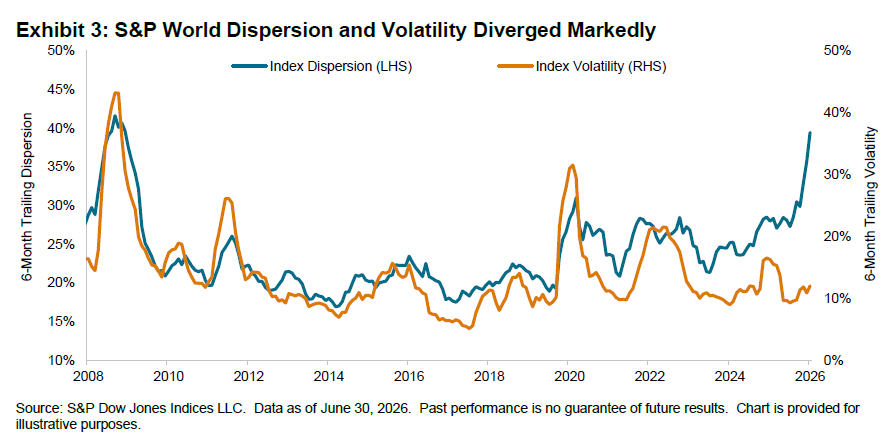
Even on the domestic front, Australian shares provided plenty of opportunities for active managers to prove their worth, with both sector and stock dispersion at decade highs. In plain terms, there was a much bigger gap between the best and worst-performing stocks. The market environment provided a ripe hunting ground for stockpickers.
Do the results tell the same story?
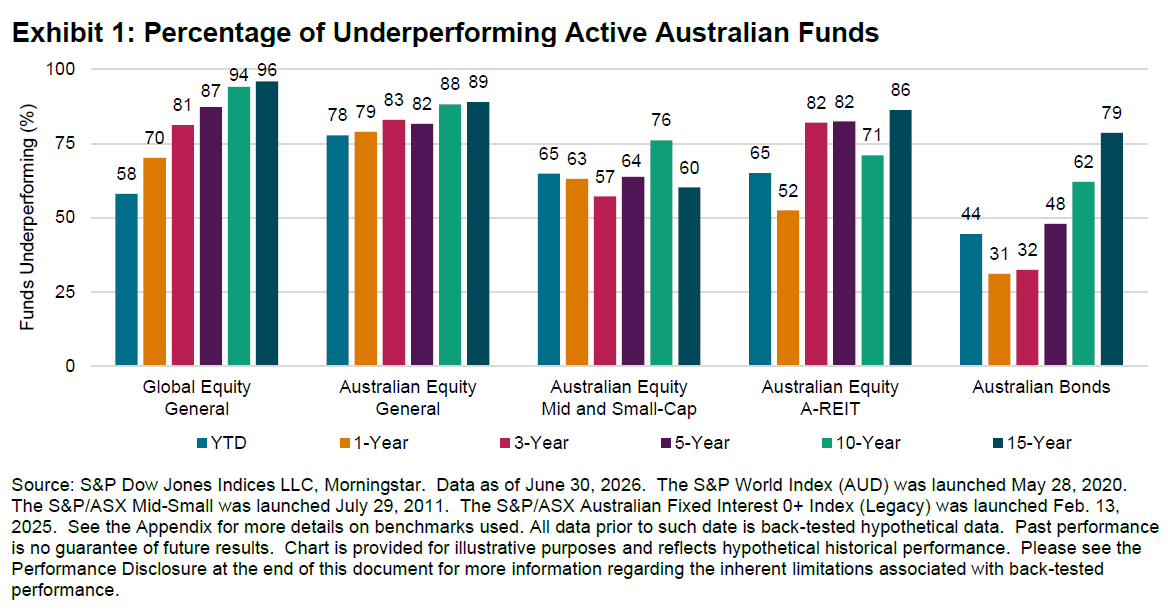
The short answer is not quite.
Despite these seemingly ideal conditions, a firm majority (78%) of Australian Equity General funds underperformed the ASX 200 in the first six months of the year. Notably, this is the second-highest underperformance rate seen since the launch of the scorecard in 2013.
Tougher conditions for bond managers
Fixed income was the one area where active managers found a better story to tell, despite facing less favourable market conditions during the first half of this year.
Australian corporate bond spreads remained near historically tight levels, which limited opportunities to add value by taking extra credit risk. A flatter yield curve also reduced the scope for managers to profit from interest rate bets. In short, many of the traditional levers active bond managers use to outperform were less effective than in recent years.
Despite these headwinds, Australian bond funds were the only category where a majority of managers outperformed their benchmark, although by a narrow margin.
The benchmark returned 2.3% in the first half of 2026, while active funds marginally exceeded that result, with average returns of 2.4%. However, the victory was hardly emphatic. The proportion of bond managers failing to beat the benchmark rose from 27% in 2025 to 44% in the first half of 2026.
The concentration conundrum
It is clear that rising dispersion alone may not be enough of a tailwind for active managers. If gains are concentrated in a shrinking number of companies, identifying winners becomes increasingly difficult, even when opportunities appear plentiful.
A potential explanation for the lacklustre results lies in the all-too-familiar concentration problem. While sector and stock dispersion widened, relatively few companies were responsible for driving overall market returns. SPIVA found that only 35% of ASX 200 stocks outperformed the index in the first six months of 2026.
Meanwhile, the combined weight of the largest 20 companies in the index increased from 61.0% to 63.4%. Naturally, as the pool of outperforming stocks narrows, the likelihood of identifying them successfully declines, which makes active stock selection more difficult.
Concluding thoughts
I don't view these results as a call to abandon active management. However, it does suggest we should be realistic about how difficult manager selection is.
SPIVA observed that among global equity funds, the rewards for choosing a winning manager were modest, while the penalties for choosing a losing manager were severe. The best-performing active funds only beat the benchmark by small margins, whereas the weakest funds lagged by much larger amounts.
The challenge is also compounded by survivorship. SPIVA found that after 15 years, more than half of funds had either merged or liquidated, meaning investors face not only the risk of selecting an underperforming manager, but also one that may not survive.
Many people approach the active versus passive debate rather plainly, by asking whether active managers can outperform. We know that some clearly can. The harder question is whether we can identify those managers beforehand.
Simonelle Mody
***
Weekend Market Update
From Shane Oliver, AMP
Global share markets fell again over the last week as both oil prices and bond yields pushed higher with more upwards pressure on central bank interest rate expectations. The Australian share market was particuarly hard hit with around a 3% fall not helped by talk of back to back hikes by the RBA on top of worries about the impact of rising oil prices, rising bond yields which act as a drag on share market valuations and falling property prices. Energy shares rose but this was offset on the ASX 200 by big falls in IT, retail, property and mining shares.
Bitcoin and gold both fell as rising bond yields and rising expectations for Fed rate hikes reduced their relative attractiveness. So far Bitcoin is holding above its 200-day moving average which is a positive sign, but gold has fallen back below its 200-day moving average. Metal and iron ore prices fell as did the $A despite a slight fall in the $US.
Oil prices are heading into a danger zone with Brent pushing near $US110 a barrel for the first time since May as the US-Iran conflict escalated further with more attacks on ships in the Strait of Hormuz, more US strikes on Iran, more retaliatory action by Iran on neighbouring countries and new Houthi attacks on Saudi Arabia. With Hormuz effectively remaining closed the risk to global oil supplies is rising as global reserves can’t be run down indefinitely. With oil now above the top of our $US70-$US100 range Trump is likely to do something – another TACO anyone? – to get them back down but the risk of a further rise is high. The hardline Iranian leadership may want to keep it going to inflict more damage on Trump politically and run the risk of what he may do after the midterms.
Particularly at risk are gas prices - with very little gas gettig out through the Strait at all and few diversions from Qatar and very low European gas stockpiles as the northern winter approaches - and refined product prices especially for diesel given a hit to Russian refineries and exports. Petrol prices in Australia at around $2.1/litre have already retraced around half the fall from their March high but are likely heading even higher with the rising global oil prices.
The past week saw another surge higher in bond yields reflecting concerns about big budget deficits in the US and elsewhere, increased corporate borrowing to fund data centre investment, worries about higher for longer inflation partly flowing from higher oil prices, a related need for central banks including the RBA to run higher interest rates for longer and a rising trend in Japanese bond yields leading to a reversal of the so-called carry trade.
Bonds are starting to get oversold suggesting a short term rally, but the risk is skewed towards a further rise in yields longer term. As US bond yields are the base for global yields their rise has continued to flow through to rising Australian bond yields made worse by strengthening expectations for RBA rate hikes.
The rise in bond yields points to: higher fixed mortgage rates; pressure on share market valuations; threats to commercial and residential property; and pressure on Federal & state budgets as borrowing costs surge.
The back up in public debt interest costs at a time when stamp duty revenue is falling due to the slump in the property market comes at a difficult time for state governments with Queensland seeing its credit rating downgraded from AA+ to AA by Standard and Poors. S&P also cited large infrastructure spending programs in Queensland including for the Olympics. The downgrade to AA could add another 0.1 to 0.15 percentage points to Queensland’s borrowing costs pointing to further pressure to cut spending for a state government philosophically averse to hiking taxes. While some of the reasons for the Queensland downgrade were beyond the state government’s control, this arguably could have been avoided if it had focussed more on containing spending after the last election. That said I am not sure that cutting its rating to the same as Victoria’s is warranted! NSW moved from AA+ (negative watch) to AA+ (stable).
The RBA is looking like its seen enough bad news on inflation and will most likely hike this month, so we have moved forward our expectation for the next hike from November to September. Since before the July CPI release, we had been expecting another rate hike this year, most likely in November. The high CPI and okay GDP data released in the last three weeks then suggested its 50/50 as to whether its September or November, but RBA communication over the last week suggests its likely to be this month. Comments by RBA Assistant Governor Hunter and Deputy Governor Hauser were decidedly hawkish – despite both coming after soft consumer and business confidence data. The clear message was that the RBA sees growth around trend, unemployment as still low and is not too fussed about the fall in home prices as they are still up 3%yoy and 50% this decade but that inflation is too high and upside risks to it appear to be materialising.
Proposals to allow access to super to cover living costs may be popular but like other “cost of living” relief measures is not the way to address the “cost of living” crisis and could make it worse. A common approach offered by all sides of politics over the last few years to the cost-of-living crisis has been to offer support via things like energy rebates, fuel tax cuts, low home deposit schemes and access to super with another proposal on the super front from a minor party in the last week. The problem with all these schemes is that they don’t solve the underlying cost of living/inflation problem and by putting more money into the hands of people could make it worse by boosting demand in the economy adding to the inflation problem and leading to even higher RBA interest rates and then leave people with less in retirement and not much to show for it. Rather, the focus should be on reducing government spending to make more room for private spending in the economy and boosting productivity with deregulation and tax reform to expand the capacity of the economy to supply goods and services without adding to inflation.
The risk of a correction in shares is high. September has been the weakest month of the year on average over the last 40 years and shares are already down – with US shares down 2.7% from their high last month, global shares down 2.8% and Australian shares down around 5.8%. There are plenty of triggers for a further correction including: rising bond yields at a time when equity risk premiums are low; potential Fed and RBA rate hikes this month; rising oil prices; worries about an AI bubble; and political uncertainty ahead of the US midterms with a Democrat win potentially flagging the risk of US tax hikes. That said, with strong earnings growth we would see any pullback as a correction rather than the start of a new bear market.
Also in this week's edition...
Thinking about an SMSF? Liam Shorte discusses red flags to watch out for before you sign anything.
For generations, Australian investors have backed banks, miners and dividends. Marcus Padley argues it's time to start looking elsewhere for growth
The housing debate tends to focus on prices, interest rates and deposits but Jade Xie thinks a 40 year mortgage might be the answer.
Zara Lyons believes the market has sent a clear message after earnings: it is no longer paying simply for quality, resilience or an earnings beat.
Helen Mason shares why she thinks Australian public credit may be the most compelling source of income in today's market.
August reporting season delivered strong earnings and larger-than-expected dividends, David Wilson and Christian Guerra unpack the key trends
Some of history's most important innovations changed the world while leaving investors much poorer. Roger Montgomery hypothesizes whether AI will destroy investor capital.
White paper of the week: How Australia Retires 2026 (Vanguard)
Curated by Simonelle Mody and Leisa Bell
Latest updates
PDF version of Firstlinks Newsletter
Listed Investment Company (LIC) Indicative NTA Report from Bell Potter
ASX Listed Bond and Hybrid rate sheet from NAB/nabtrade
Plus updates and announcements on the Sponsor Noticeboard on our website