The US midterms saw a resounding rebuke of President Trump’s policies. Democrats took control of the House and the Senate, with big wins and various governorships in Republican states.
Trump won in 2024 after “cost of living” pressures turned people against the Democrats. However, his tariff and War policies made those pressures worse, causing many who had swung to him to swing back to the Democrats. This was probably compounded by controversies surrounding immigration enforcement, the Epstein files and concerns about governance.
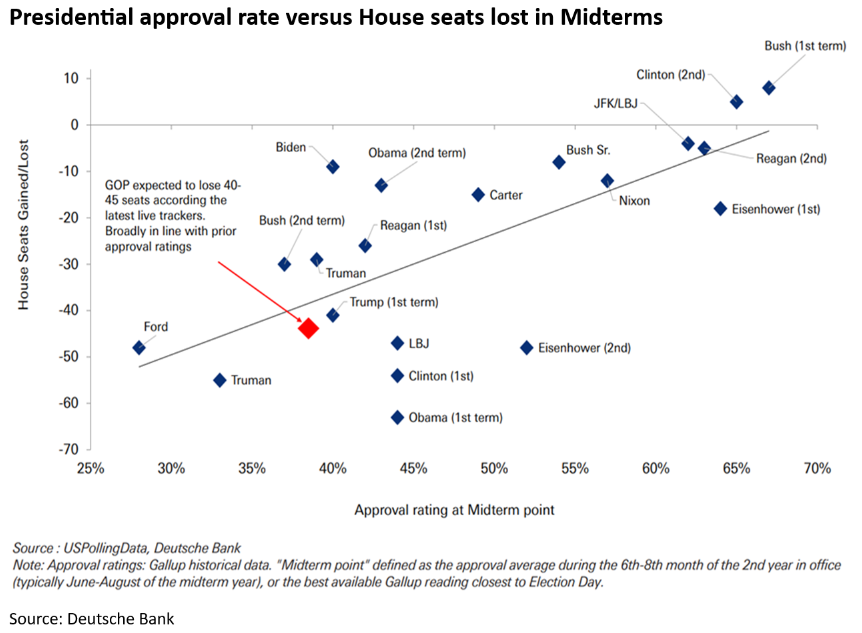
Of course, there is a danger in reading too much into the results, as presidents often lose Congress in midterms. In the chart below from Deutsche Bank, the Republican losses in the House look normal. Both Clinton and Obama lost more seats in their first term midterms and both went on to win second terms.
Implications for US economic policy
The result is likely to have several important implications for economic policy, markets and Australia.
Congress will now be a check on Trump. In particular, there are now likely to be significant inquiries into his and the Administration’s actions, including possible attempts at impeachment. Democrat control of the Senate also means Fed independence will be protected. At a high level, this highlights that US governance and democracy remains strong. Some surveys showed democracy as just as important an issue for voters as the economy.
More scrutiny and regulation of AI may emerge, particularly on data centres in states where Democrats won the governorships (Texas, Ohio, Iowa and Georgia). However, there is a danger in exaggerating this. Trump is able to veto regulations from Congress, but the states may matter more. That said, there are also still plenty of states that may welcome data centres.
There will likely be a return to brinkmanship over raising the debt ceiling (necessary by around June quarter next year) and funding the US Government (which currently expires on 11th December). In some ways this may be a good thing if it leads to a smaller budget deficit. However, hopes for lower budget deficits may prove in vain as Trump may agree with Democrats to increase some social benefits if they support more defence spending, and he is likely to veto tax hikes.
So far, markets seem relaxed. Oil prices are down on hopes Congress will bring an end to the War. VP JD Vance and other Republicans are blaming the conflict for the election loss. Meanwhile, reports suggest that the US and Iran may be edging closer to a deal again. Trump himself added that further significant strikes on Iran were “highly unlikely”. Both tariffs and the War are self-evidently not popular, although there is a chance he could double down, so another spike in tariffs and/or oil prices remains a high risk.
Implications for major asset classes
Bonds - negative
Bond yields have fallen since the midterms on the fall in oil prices and hope political gridlock will lead to a lower budget deficit.
Shares - ambiguous
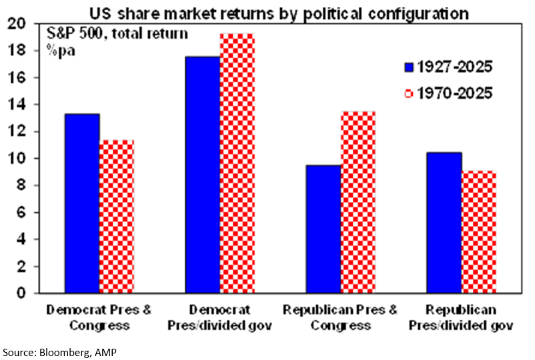
The bad news is that the combination of a Republican president and Democrat control of one or both houses of Congress has been the worst outcome for US share returns on average since 1970, with an average return of 9.1% p.a., compared to 13.5% p.a. when there is a Republican president and Congress. Of course, 9.1% is still okay!
The good news is that US shares have risen following all midterm elections since 1950 given the removal of a source of uncertainty.
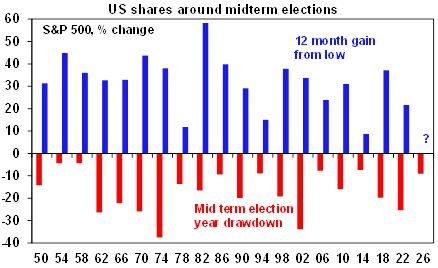
However, there may be more uncertainty this time around given the importance of the AI trade to both the US share market and recent economic growth.
So far, the US share market has had a roller-coaster reaction - initially up 1.6%, then down 4.4% on Thursday. Data centre shares sold off heavily on Thursday on fears that Democrat wins will constrain them, but earlier they had been selling off on fears that hyperscaler AI capex was excessive and uneconomic. In any case, it is unlikely to fundamentally stop their build out.
Since Thursday, there has been a recovery in US shares leaving them around where they were before the midterms.
Overall, the risk of a further correction in shares remains high, given the threats from high and sticky inflation, ongoing rate hikes, excessive public debt driving bond yields, the risk of one last spike in oil prices, the AI bubble and data centre worries, and slowing growth and rising rates in Australia.
Despite some fall in price-to-earnings ratios and more recently, a pullback in bond yields, both US and Australian shares remain expensive relative to bonds as measured by the gap between forward earnings yields and bond yields (which is a proxy for the risk premium shares offer over bonds). Of course, the risk premium has been low for years now, so it is not a great timing guide for shares.
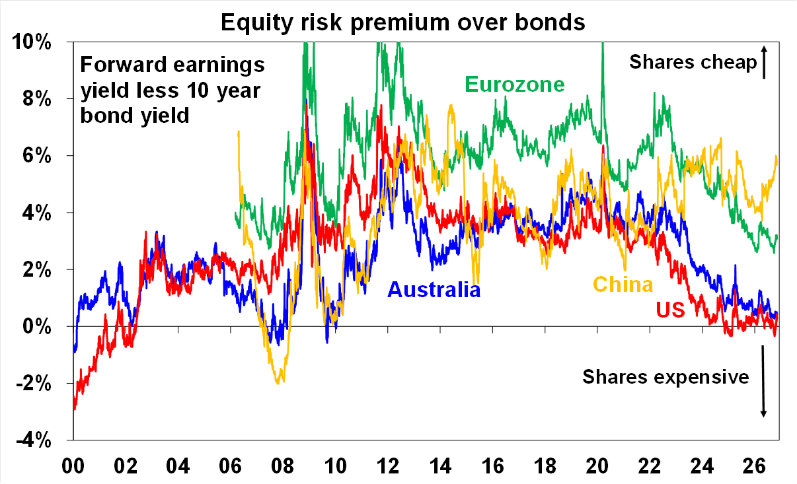
However, at this stage, strong US earnings growth (even outside tech) and no indications of a US recession suggest that any pullback in shares is more likely to be a correction, rather than a new bear market. So, we continue to see shares providing okay returns on a 6-12 month horizon.
Cryptocurrencies - negative
With Democrats likely to look closely at the Trump family’s links to the sector, the tide may be turning back towards tougher crypto regulation. Bitcoin could plausibly retain support though as an inflation hedge.
Gold and the Australian dollar - ambiguous
Much will depend on oil prices and how much further the Fed has to hike, but the midterms are ambiguous here.
Implications for Australia
While the fall in oil prices may mean less pressure on the RBA for another hike, it’s uncertain as to whether this will stick in the short term and we see no reason to alter our assessment that the RBA will leave rates on hold out to late next year.
Further weakness in both consumer and business confidence in the latest Westpac/MI and NAB surveys support our view that the RBA has likely already raised rates enough to slow demand in order to cool inflation.
At a broader level, a risk for Australia is a renewed Trump focus on disruptive foreign policy in the near term, but this should recede as Trump’s power wanes over the next two years.
Dr Shane Oliver is Head of Investment Strategy and Chief Economist at AMP. This article has been prepared for the purpose of providing general information, without taking account of any particular investor’s objectives, financial situation or needs.