Register For Our Mailing List

Register to receive our free weekly newsletter including editorials.

Home / 92

David Murray moves the goalposts

Campbell (Inquiry 1979), Wallis (Inquiry 1996) and Murray (Inquiry 2014) may all be splendid Scottish names but they will be forever etched in the history of Australian financial markets. Campbell opened our markets and Wallis gave us much of the regulatory structure, but David Murray has cast his net wider into both micro and macro issues in his 320 page (not 500 as I wrote in the newsletter) report.

This note is my initial reactions focussing on impacts for wealth management, including retirement, financial advice and superannuation. As Joe Hockey told the lock-up, you need to "read it and read it and read it" to capture all the content. So it is acknowledged that this is not a comprehensive review of the entire Report.

Joe Hockey issued the final Terms of Reference on 20 December 2013, and David Murray and his Inquiry have delivered the goods in under a year. The Final Report is available here.

Some highlights of the Report

It contains 44 recommendations, based on a test of meeting the public interest. It says the financial system has performed well since Wallis but has some weaknesses. It aims to make the system more efficient, resilient and fair, but still responsive to market forces.

Superannuation

Superannuation funds are now big businesses. The amount in superannuation surpasses the market capitalisation of all companies on the ASX and Australia's annual GDP. The Report notes super assets will probably exceed the banking system within 20 years.

The major recommendations are:

* seek broad political agreement for the overall objectives of superannuation. The Report says super does not have a consistent set of policies.

* the Government should restore the general prohibition on direct borrowings by super funds (page 86). This is a setback for the industry that has sprung up promoting borrowing to buy residential property under LRBAs. It will apply where the borrowing is used to purchase assets directly, so the broad range of managed funds and ETFs which internally gear their funds will not be affected. It will still be possible to gear a super fund but not directly.

* a formal competitive process may be needed to allocate new default fund members to MySuper products. This draws on a Grattan Institute study showing excessive superannuation fees and quoting the Chilean system where the right to manage 'default' funds is auctioned to the cheapest supplier. Another perspective on the Chilean system was provide in David Bell's article, and these problems will need to be addressed. The Report acknowledges much more work is required until a formal review by 2020 if Stronger Super is not working well.

* To assist longevity, trustees of super funds could select a comprehensive income product for retirement (CIPR) for their members, effectively pooling risk to ensure income throughout retirement. It would deliver an enduring income stream to give retirees more confidence that they can spend in retirement.

* Super funds should provide retirement income projections for members to improve engagement.

Financial advice

Although there has been enormous media and public focus on the quality of financial advice and especially the problems caused by vertically-integrated businesses (including the oft-quoted statistic that the four major banks plus AMP control 80% of Australian planners), the subject did not receive much attention in the Interim Report. However, it did contain this warning:

" There has been a tension between providing financial advice for the benefit of consumers and the product distribution role played by advisers ... The Inquiry considers the principle of consumers being able to access advice that helps them meet their financial needs is undermined by the existence of conflicted remuneration structures in financial advice."

The most significant proposal that affects the vertical integration financial advice model is to rename 'general advice' with a more appropriate, consumer-tested term. Advisers will also be required to disclose ownership structures.

The other main recommendations are:

  • introduce a targeted and principles-based product design and distribution obligation. Page 198 of the Report is worth reading in full, as it describes this obligation, including identifying the target market and recognising the product's intended risk and return characteristics in the design phase. There needs to be an agreement with distributors on how the product will be distributed. Breaches would incur significant penalties.
  • ASIC should have a 'product intervention power', which would allow products to be banned or materially changed.
  • remove impediments to product disclosure and improve fee and risk communication with consumers.
  • better align interests of financial firms with those of consumers, including remuneration structures and ensuring life insurance and stockbroking businesses do not affect the quality of advice.
  • raise the competency of financial advisers including an enhanced register of advisers.

Post-retirement income

The Report has a heavy focus on post-retirement income. The Interim Report had said:

"If superannuation benefits are not transformed into retirement income streams effectively, taxpayers ultimately carry significant risk in the form of higher Age Pension costs."
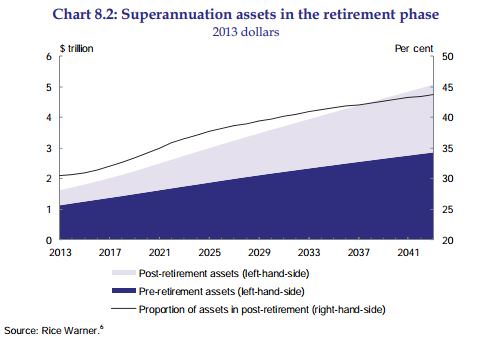
The Report argues superannuation assets are not being converted to efficient post-retirement outcomes, and the development of a CIPR as mentioned above receives high profile (see page 117).

Self Managed Super Funds (SMSFs)

SMSFs now hold about $600 billion of Australia's $1.8 trillion in superannuation with one million trustees. However, on my first read, the sector does not receive significant attention. Although SMSF borrowings are estimated at only about 1% of assets, the Report recommends removal of the ability for all super funds to borrow, including SMSFs. The argument goes that investors have many other ways outside super to lever their investments, and superannuation savings should not be put at risk by more leverage.

This is a controversial recommendation opposed by many SMSF specialists, but I support the approach. Some people need to be protected from themselves, and property spruikers will take advantage of too may people if borrowing is allowed. See my arguments here and here and my submission to the FSI here.

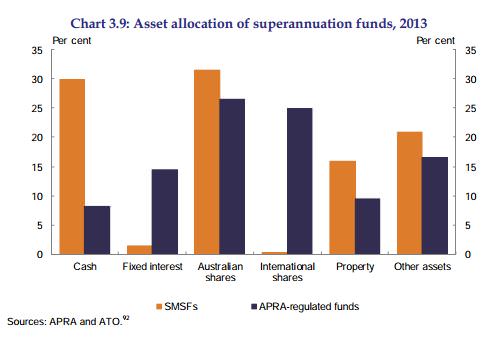
There are significant differences in asset allocation between SMSFs and large APRA-regulated funds. In particular, SMSFs hold little foreign securities but about 30% in cash. However, on first read, I could not see any recommendations on ways to address this.
Fees

Murray believes there is little evidence of strong fee-based competition in the superannuation sector, and operating costs and fees appear high by international standards. This indicates there is scope for greater efficiencies in the superannuation system.

The formal competitive process described above is designed to improve competition and efficiency in super, to be introduced by 2020 if Stronger Super is not effective (see page 101). The Report says 50% of MySuper products have fees ranging from 84bp to 117bp, and it believes there is much scope for this to fall further. If APRA-regulated funds could reduce fees by 30bp, the savings for investors would be $3.5 billion per annum.

Governance of superannuation funds

The Report also recommends a majority of independent directors on the boards of the trustees of public offer superannuation funds including an independent chair, and a strengthening of the conflict of interest requirements.


This information is general in nature and takes no account of any investor's personal financial circumstances. Investors should consider taking professional advice on their investments. There are many other aspects of the Report which will be covered in later editions of Cuffelinks.


  •   7 December 2014
  • 11
  •      
  •   
11 Comments
MIchael Clancy
December 07, 2014

Thanks for the quick summary Graham!

Peter C
December 07, 2014

Handy, you really have become a journo. Cuffelinks first re FSI. Great stuff.

Douglas
December 07, 2014

Great to see a pertinent early summary, thank you.

Richard Mews
December 07, 2014

Good summary and very quick, nothing very controversial in these parts of the Report.

Mal
December 07, 2014

One assumption inherent in income provision for retirees is that the same level of income, indexed, will be required no matter what age the person is. In fact the capacity to spend declines with age, although health costs rise a little for most. A person should be free to spend more during the early years of retirement when health and energy enable enjoyment of travel etc.

Ross Laidlaw
December 07, 2014

Thanks for the early summary, it helps when you hit the key points that could have an impact on the industry. Well Done

John Kay
December 08, 2014

The chart 3.9 shows that SMSFs have almost no exposure to International Shares. These numbers from the ATO are a total fiction. When I complete my annual SMSF tax return showing Asset Allocation any Overseas Shares held by LIC's and Managed Funds are counted as Australian Investments.
In my case I have a large investment in Vanguard Global Infrastructure fund and also in the LICs PM Global and Hunter Hall which are categorised as 100% Australian.

Tim
December 09, 2014

Good point John. Another example of ATO data fields being ambiguous and therefore useless.

SMSF Trustee
December 09, 2014

John Kay, I also have international shares in my fund. However, I don't know that even you and me combined would amount to enough to prove that the overall data that is in the table has the picture completely wrong. Just because two of us have international shares doesn't mean it's common and doesn't mean the ATO are as stupid as people want to believe.

Besides, they probably are referring to direct holdings, in which case I've no doubt the data are correct. Your funds and mine are included in the 'other assets', which probably also includes domestic share funds.

Tim
December 11, 2014

The FSI report also discussed the merits of (1) introducing an investment earnings tax on super in pension phase, (2) a higher super earnings tax rate on super balances over a certain threshold, and (3) tightening of the $540,000 NCC cap under the bring forward rule.

Yes - policy goes round in circles every 5-10 years.

Colin
December 12, 2014

Chris, I read your emails with interest - keep up the great work!

If appropriate could you comment on the following from the new report
'The Tax White Paper should consider the removal of tax barriers to a seamless transition to retirement and target superannuation tax concessions to the superannuation system’s objectives. Adjustments to tax settings and efforts to improve equity have been major contributors to superannuation policy change in the past. The Inquiry believes community concerns about these issues need to be addressed to achieve greater policy stability and long-term confidence and trust in the system.'

I have pondered over this statement and clearly missing some salient point. Are they suggesting zero tax in the accumulation phase, or taxing in the pension phase? Either way I'm not understanding why this is a 'tax barrier' from accumulation to pension? Is it not an advantageous position and encourages folks to wind down a little from their often high work hours jobs?

Any pointers you are able to provide would be appreciated.


Leave a Comment:

RELATED ARTICLES

Back to the future with Murray's super objective

banner

Most viewed in recent weeks

Australian stocks will crush housing over the next decade, 2025 edition

Two years ago, I wrote an article suggesting that the odds favoured ASX shares easily outperforming residential property over the next decade. Here’s an update on where things stand today.

Australia's retirement system works brilliantly for some - but not all

The superannuation system has succeeded brilliantly at what it was designed to do: accumulate wealth during working lives. The next challenge is meeting members’ diverse needs in retirement. 

Get set for a bumpy 2026

At this time last year, I forecast that 2025 would likely be a positive year given strong economic prospects and disinflation. The outlook for this year is less clear cut and here is what investors should do.

Meg on SMSFs: First glimpse of revised Division 296 tax

Treasury has released draft legislation for a new version of the controversial $3 million super tax. It's a significant improvement on the original proposal but there are some stings in the tail.

Building a lazy ETF portfolio in 2026

What are the best ways to build a simple portfolio from scratch? I’ve addressed this issue before but think it’s worth revisiting given markets and the world have since changed, throwing up new challenges and things to consider.

The 3 biggest residential property myths

I am a professional real estate investor who hears a lot of opinions rather than facts from so-called experts on the topic of property. Here are the largest myths when it comes to Australia’s biggest asset class.

Latest Updates

Investment strategies

Building a lazy ETF portfolio in 2026

What are the best ways to build a simple portfolio from scratch? I’ve addressed this issue before but think it’s worth revisiting given markets and the world have since changed, throwing up new challenges and things to consider.

Investment strategies

21 reasons we’re nearing the end of a secular bull market

Nearly all the indicators an investor would look for suggest that this secular bull market is approaching its end. My models forecast that the US is set for 0% annual returns over the next decade.

Property

13 million spare bedrooms: Rethinking Australia’s housing shortfall

We don’t have a housing shortage; we have housing misallocation. This explores why so many bedrooms go unused, what’s been tried before, and five things to unlock housing capacity – no new building required.

Investment strategies

Market entry – dip your toe or jump in all at once?

Lump sum investing usually wins, but it can hurt if markets fall. Using 50 years of Australian data, we reveal when staging your entry protects you, and when it drags on returns. 

Investment strategies

The US$21 trillion question: is AI an opportunity or excess?

It has been years since the US stock market has been so focused on a single driving theme, and AI is unquestionably that theme. This explores what it means for US and global markets in 2026.

Economy

US energy strategy holds lessons for Australia

The US has elevated energy to a national security priority, tying cheap, reliable power to economic strength, AI leadership, and sovereignty. This analyses the new framework and its implications for Australia.

Strategy

Venezuela’s democratic roots are deeper than Trump knows

Most people know Maduro was a dictator and Venezuela has oil. Few grasp the depth of suffering or the country’s democratic history - essential context as the US ousts Maduro and charts Venezuela’s future. 

Sponsors

Alliances

© 2026 Morningstar, Inc. All rights reserved.

Disclaimer
The data, research and opinions provided here are for information purposes; are not an offer to buy or sell a security; and are not warranted to be correct, complete or accurate. Morningstar, its affiliates, and third-party content providers are not responsible for any investment decisions, damages or losses resulting from, or related to, the data and analyses or their use. To the extent any content is general advice, it has been prepared for clients of Morningstar Australasia Pty Ltd (ABN: 95 090 665 544, AFSL: 240892), without reference to your financial objectives, situation or needs. For more information refer to our Financial Services Guide. You should consider the advice in light of these matters and if applicable, the relevant Product Disclosure Statement before making any decision to invest. Past performance does not necessarily indicate a financial product’s future performance. To obtain advice tailored to your situation, contact a professional financial adviser. Articles are current as at date of publication.
This website contains information and opinions provided by third parties. Inclusion of this information does not necessarily represent Morningstar’s positions, strategies or opinions and should not be considered an endorsement by Morningstar.