Register For Our Mailing List

Register to receive our free weekly newsletter including editorials.

Home / 135

World economy will be ‘slower for longer’

For some years, most analysts have been expecting stronger economic growth but it has failed to eventuate. The problem is that equity investors fail to recognise the market is over-heated because it has been propped up by ultra-low interest rates for so long. The big question is what happens when the US starts to increase interest rates? Slow economic growth is leading to slow earnings growth which doesn’t justify the current level of irrational optimism facing most markets.

Irrational optimism

The final phase of a bull market is typically signalled by irrational optimism. In this phase it doesn’t matter what news or data comes from the real world, the financial world can read it as positive.
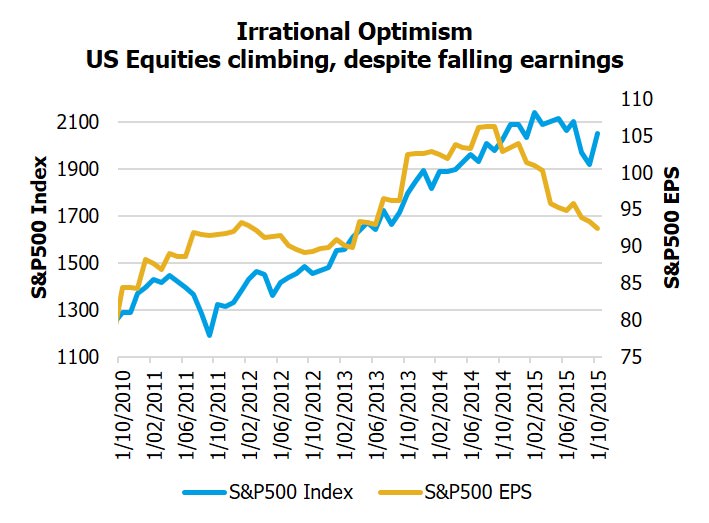
That phase is well into its final throes right now, as illustrated by October’s ‘bad news rally’. This rally started with the poor employment figures from the US, followed by concerns expressed by some of the world’s most powerful central banks about the global outlook, and then rounded off by poor earnings growth figures from US corporates.

In essence, three events that should be a signal for a weak outlook for equities instead sparked a rally. This just isn’t rational.

Irrational economists

As each year has progressed since the GFC, optimistic forecasts have been revised downwards, then the predictions for the following year are for much higher growth, and around we go again.

This year was no different. At the start of the year, the International Monetary Fund (IMF) had forecast 4.0% per annum global growth. They have already reduced that forecast to 3.1%, and the reality is more likely to be 3.0% or lower.

There are two reasons for this persistent bullish outlook. The first is job security: no Wall Street researcher or bank economist wants to publish a negative outlook unless they are very sure about it. Negative outlooks do not encourage people to borrow more money or to invest more. Even the IMF has a positive bias because they don’t want to inadvertently reduce economic growth by scaring consumers and businesses into spending less.

The second reason growth has been persistently lower than expectations is because everyone is assuming that conditions will revert to the way they were prior to the crisis. But the evidence is heavily against a return to historic averages, at least for the next ten years or more.

Three reasons to expect slower growth

Slower global growth is anticipated over at least the next decade due to:

  • The western world’s baby boomer generation retiring over the next 10-20 years means less consumer spending and lower economic output. Assuming no major increases in productivity, for example, from technology, this factor alone will push global growth down to nearly half the pace of the last 60 years.
  • Fiscal austerity across the US and Europe will continue.
  • China’s inevitable but painful transition to a consumer-led economy has reduced emerging market growth, and will do so until India is able to pick up the reins in ten years or more.

A possible fourth but unpredictable cause of lower growth stems from the challenge of ending ultra-low interest rates in the US, Europe, UK and Japan. This has helped the US economy to climb out of recession and appears to be slowly working in Europe, but it has the undesirable side effect of encouraging borrowing to invest. It supports financial markets more than the real economy and therefore the wealthy over the less wealthy.
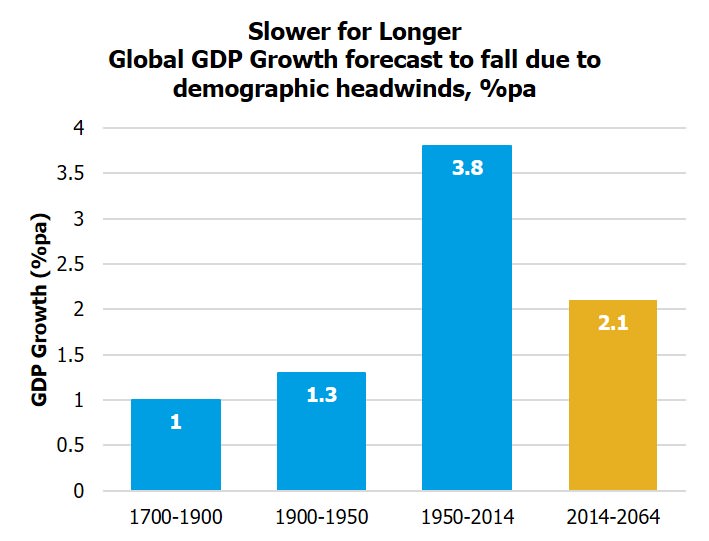
Source: FIIG Securities forecast.

At some time, central bank support must end, but markets have become addicted, so the withdrawal process could be highly volatile. Increase rates too quickly, and markets could collapse. Increase them too slowly and asset prices could rise even further, causing more damage when the bubble eventually has to burst. Witness for example the irrational response that Wall Street had in September when the US central bank decided the economy wasn’t healthy enough to increase interest rates. On the live coverage of the announcement from the Fed, Wall Street traders could be heard cheering in the background, despite the obvious negative implications.

Currency and bond markets predicting slow increase in rates

Unlike the stock market, bond markets have been telling us for some time now that growth will not return to pre-GFC rates and so interest rates will not rise to previous heights. Bond markets are currently predicting that interest rates will remain below long term averages for the next ten years at least. The US government’s 10 year bond yield is 2.02% p.a., implying their cash rates probably won’t rise above 3.5% p.a. over the next 10 years. Similarly, the Australian 10 year government bond yield is currently 2.65% p.a. which implies that the RBA’s cash rate probably won’t get above 3.75% p.a.

Similarly, currency markets have started to price in an expectation that rates will remain very low in Europe and Japan, and that even the US will keep rates much lower than the past despite its stronger economy.

The reason for this is the ‘currency wars’ raging globally, in which central banks are keeping interest rates low to keep their currencies low. A lower currency means that an economy’s exports are more competitive. The EU, Japan and China are all using this method, meaning that if the US were to increase rates rapidly, the USD would rise quickly against other currencies, their exports would become more expensive and therefore less in demand, and their economy would be hurt.

All of this adds up to interest rates being very low globally, regardless of the strength of the US economy, until Europe and Japan, and maybe even until China, can repair their economies.

Impact on Australian investors

A slower global economy and the already weak Australian economy are expected to lead to the Australian dollar falling to 65 cents. It could go lower if the slowdown in China worsens or if we have a steep housing market correction. Slower growth is also bad news for anyone expecting equity market returns to return to historic highs. Slower economic growth must lead to slower earnings growth, which eventually has to be priced in to share prices.

It’s a risky strategy to rely on bank term deposits to provide an income to live on. A slower global economy will mean that all central banks will hold interest rates very low for years. With this global backdrop, and with the Australian economy also weak, the RBA is unlikely to increase interest rates for many years to come. It is even possible that bond markets, despite setting their expectations low, are still being too optimistic about growth.

Year after year Wall Street’s equities-biased analysis predicts that growth will return, so they expect company earnings to rise, which justifies high equity prices. But year after year, they have been proven wrong.

My conclusion is that the global economy and equity earnings will remain stubbornly slower for the next decade at least. Low economic growth means bond yields will remain lower than expected. For investors, particularly those reliant on term deposit earnings or dividends to fund their lifestyle, it’s time to rethink your strategy.


Craig Swanger is Senior Economist at FIIG Securities Limited, a leading fixed interest specialist. This article is general information and does not consider the circumstances of any individual.


  •   19 November 2015
  • 4
  •      
  •   
4 Comments
Steve Darke
November 19, 2015

And the investment solution to this problem? Let me guess - fixed-interest investments? And just by coincidence you happen to work for a firm which specialises in fixed-interest investments. It's just like every time you read an article/opinion piece which urges Australian investors to invest more overseas - usually written by an international equities fund manager. Or an article extolling the virtues of the dividend-franking that accompanies Australian equities - usually written by an Australian equities fund manager. And the same for articles pushing bonds - hello Mr Bond Fund manager.
Everyone has an angle or an agenda to push. Little of what is published (and there is more published today than ever before) appears to be genuinely independent. Even in the mainstream media articles come across more as unedited press releases. I guess it saves the journalists from doing any work, though they're probably doing the jobs of four people and wouldn't have the time to write any critical analysis anyway.

Graham Hand
November 19, 2015

Response to Steve Darke, So "Everyone has an angle or agenda to push". I don't. As Editor, I try to bring a wide variety of views, which is why about 250 people have written for us. We keep it balanced, and anyone is welcome to write opposing views.

You are misunderstanding what Cuffelinks is. We are a forum where market professionals offer insights based on their area of expertise. So of course they make references to the businesses or segments they work in. An index manager will make a case for index funds and an active manager for active, which is why we run both views. If we want someone to explain ETFs, isn't is logical that we ask an ETF provider. They are the experts.

Cuffelinks tries hard to minimise product promotions, and unlike much financial media, we never reproduce press releases or promotional material. Our reader surveys show our independence is valued highly by our readers. We refuse many articles and edit others to make them as educational as possible.

Specifically on Craig's article, he does not flog fixed interest securities, he offers his views on the market. In fact, he says rates will stay low, which is hardly a promotion for fixed interest investing.

We allow people who write for us to illustrate a point with reference to a product, and many of our writers represent particular sectors. Are you seriously suggesting a small cap manager should not write about small caps? If we imposed a rule like that, we would lose a lot of our content and miss out on the subject experts. We are certainly not ramming product at you.

And a lot of content on Cuffelinks is written by people who do not have any products to promote. It is critical analysis on behalf of our readers, and we try to bring a mix of subjects every week.

Steve Darke
November 19, 2015

Thanks for your response Graham.

Just to clarify, I didn't mean to infer that Cuffelinks has an agenda - I certainly appreciate the role that you play in fostering debate.

My point was more in regards to the motives behind much of what is written and published, particularly concerning markets and investing (and I'm not singling out Cuffelinks, I mean more generally than that). Economists working for an equities manager, a bond manager, a small caps manager and a commodities manager are all likely to tell you, at every point in the investment cycle, that the best asset class is, respectively, equities, bonds, small caps and commodities. Clearly they can't all be right.

Certainly Craig does not flog or promote any products in his article, I did not say that he did. However, I would submit that his conclusion that investors reliant on dividends for income need to rethink their strategy, is at least partly biased on the basis of who he works for.

I have no problem when a small cap manager writes about small caps - that is his or her area of expertise. But when a small cap manager offers economic analysis that comes to the conclusion that the best asset to be in is small caps, that's when you need to reach for the pinch of salt. After all, what else is he (or she) going to say?

Warren Bird
November 23, 2015

I've been known over the years as a bit of an evangelist for fixed income as an asset class and I happen to share Craig's expectation of slower world growth for longer.

What I draw from that is most definitely not an argument for higher allocations to fixed income! I don't think Craig was saying that either, as his conclusion is simply to argue that equity earnings growth will be lower and that bond yields will remain low. What that means is simply that investors need to factor in lower financial asset returns across the board. Their returns on everything will be lower in this kind of world.

That may or may not mean you change your asset allocation one way or the other. For some people, who have an income target that is now not going to be met, it might be appropriate to hold more growth assets than previously; for others it might mean saving more so that the capital on which you are earning a return will be larger in the first place; for others it will mean sticking with your plan and sucking it up in relation to the lower income and total return that you earn.

In my experience fixed income experts tend to give more balanced views on allocations than equity experts who have a one track mind.


Leave a Comment:

RELATED ARTICLES

Why have Australian living standards 'fallen' and how do we fix it?

Global market growth hinges on Iran War and AI rollout

Markets without a margin for error

banner

Most viewed in recent weeks

Are you making these SMSF mistakes?

After four decades advising investors, there are a few common mistakes I've seen SMSF investors make. From holding too much cash and chasing yield to overtrading and trusting tips. Are these errors costing you?

Why have Australian living standards 'fallen' and how do we fix it?

For the last few years there has been much talk of a 'cost-of-living' crisis in Australia and of 'falling living standards'. Lately this has flared up again with the pickup in inflation resulting in a renewed fall in real wages.

Retirement spending is not one-size-fits-all

New data challenges the idea that Australians are underspending their super. The bigger issue may be helping retirees navigate complexity, make confident decisions and use their savings to support security, wellbeing and choice.

Will you run out of money in retirement?

Fear of running out has become a defining retirement anxiety. Why do some retirees die with substantial wealth while others deplete their nest egg? Evidence suggests the answer is more complicated than we think. 

Four options for an income investor’s next dollar

What if Australia’s golden age of dividends is ending? Rather than overhaul your portfolio, it may be worth considering where new capital can work harder. I discuss four income strategies and the trade-offs behind each.

The missing link in the CGT debate

A little-noticed consequence of Labor’s tax changes could have implications well beyond investors’ tax bills. The issue raises bigger questions about incentives, capital allocation and the drivers of long-term economic growth.

Latest Updates

SMSF strategies

Meg on SMSFs: What do we think about reversionary pensions these days?

Reversionary pensions have long been a staple of SMSF estate planning, but are they still the best option? Meg Heffron revisits a once-clear favourite and asks whether changing super rules have shifted the balance.

The ageing ‘crisis’ has not and will not happen

Rising age dependency is frequently treated as a warning sign for economies. But when actual workforce participation is examined, a strikingly different picture emerges about ageing, productivity and economic sustainability.

Retirement

How does the 4% rule stack up?

The 4% rule has long been retirement's gold standard. But after a difficult period for investors, fresh analysis suggests a more conservative approach may significantly improve the chances of making savings last.

Shares

Four charts that expose market concentration risk

Investors have recently been rewarded for backing market leaders, but history suggests this eventually comes at a cost. Now may be the time to review whether your portfolio is carrying unintended risks beneath the surface.

Investment strategies

The case for gearing beyond property

Most Australians gear into property but ignore shares. That may be a mistake. Used carefully, geared equity strategies can enhance long-term returns, reduce cash tied up in growth assets and support retirement income goals.

Economy

Australia's $1 trillion debt pile

The headlines exclaiming that Australian government debt has hit A$1 trillion and US government debt has hit $40 trillion has turned heads, but how serious are they really? Will Australia's mix of debt create challenges?

Economy

Has 100 years of growth made us any happier?

For decades, GDP has been the benchmark for economic success, but has it made us materially happier? If happiness does not rise in lockstep with prosperity, are we overlooking what constitutes a successful society?

Sponsors

Alliances

  • ASA-Logo-RGB-ActiveGreen-web.png

© 2026 Morningstar, Inc. All rights reserved.

Disclaimer
The data, research and opinions provided here are for information purposes; are not an offer to buy or sell a security; and are not warranted to be correct, complete or accurate. Morningstar, its affiliates, and third-party content providers are not responsible for any investment decisions, damages or losses resulting from, or related to, the data and analyses or their use. To the extent any content is general advice, it has been prepared for clients of Morningstar Australasia Pty Ltd (ABN: 95 090 665 544, AFSL: 240892), without reference to your financial objectives, situation or needs. For more information refer to our Financial Services Guide. You should consider the advice in light of these matters and if applicable, the relevant Product Disclosure Statement before making any decision to invest. Past performance does not necessarily indicate a financial product’s future performance. To obtain advice tailored to your situation, contact a professional financial adviser. Articles are current as at date of publication.
This website contains information and opinions provided by third parties. Inclusion of this information does not necessarily represent Morningstar’s positions, strategies or opinions and should not be considered an endorsement by Morningstar.