Register For Our Mailing List

Register to receive our free weekly newsletter including editorials.

Home / 136

Global index flaw has flow-on consequences

It’s not universally known (but nor is it a secret) that MSCI, the major provider of performance indices on global equity markets, understates the performance of its global indices calculated for Australian investors. On the surface you may think this doesn’t mean much, but there are actually many flow-on effects worth tens of millions of dollars.

Index calculation trickier than it seems

The job of an index calculation group is much more complex than you think. At first blush, it may seem that all they do is take the index weightings, and account for dividends, corporate actions and stock movements to get the total performance. Well, not really, especially when it comes to global indices. When one invests offshore there are a variety of taxes such as withholding taxes and stamp duties which must be paid on dividends earned in different countries.

Where it gets really complex is that different countries have different tax treaties between them which need to be accounted for. It can also depend on whether they apply to a personal or institutional investor. Should an index provider like MSCI calculate a separate index for the performance of a global equities index based on the experience of different investor types in each country around the world? They don’t because there would be many indices to calculate. Rather they calculate the performance using the most conservative set of assumptions. Of all possible combinations, they select the one that has the highest tax / lowest performance. Because Australia has many double tax treaties in place, the performance experience of an Australian investor using a passive approach would be higher (ignoring transaction and management fees).

Understatement is a significant issue

The performance understatement has averaged between 30bp to 40bp per annum. The understatement is larger when dividend yields are high, making it an even larger problem for indices on higher-yielding sectors such as REITS and infrastructure. The simple way to provide some evidence is to look at the reported gross performance of index funds against the index.

Below I have snipped the gross performance numbers for Vanguard’s International Shares Index Fund (refer to Vanguard’s website for appropriate performance disclaimers etc.). We can see that the fund has consistently outperformed the benchmark, yet it is being run in a passive manner. (The fund is the MSCI World ex-Australia Index in AUD, and Bmk means benchmark).
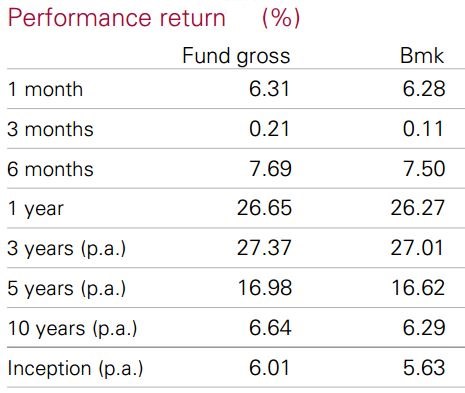
Is this valuable information or just trivia?

Consider the ways we use such performance data:

Assessing the relative merits of active versus passive investment

Global equities make up a large part of many portfolios. Across institutional super funds, the average allocation is around 20% worth up to $300 billion of capital. The debate about active or passive investing in global equities is fierce and the numbers look tight: there appears to be little outperformance on average. However, once we account for the data issue, the average global equities fund underperforms (because the index is doing better than we think). Assuming an average active management fee of 50bp (above index fees) for institutional investors, then up to $1.5 billion p.a. is the possible fee pool being spent on active global equities. How well informed and how efficient is this decision?

Calculation of performance fees or bonuses based on outperformance

Some funds charge performance fees, commonly relative to the performance of the benchmark. A fund that mirrors the holdings of the index is likely to outperform the index by say 30bp. If we assume a performance fee of 10% above index, then this results in 3bp of performance fees. This isn’t a big number in the context of an individual, where many other factors will impact more greatly upon their performance. However, the system wide costs can be large, simply because the assets under management can be so large. A fund with assets of $10 billion will unfairly earn an extra $3 million p.a. in performance fees.

Furthermore, investment staff at super funds are often paid a bonus based on performance relative to benchmark. They too participate in this free ride. There can be gaming issues if the quirk is known by some but not by all within a fund. For instance, the portfolio manager in charge of selecting global equity funds, if solely aware of the quirk, may just invest passively, outperform the benchmark and receive a handsome bonus which is undeserved, at the expense of the member (directly for an industry super fund and less directly for a retail fund).

Judging different products managed by the same fund manager.

Some global equity managers offer different risk versions of their products. It is common to see the low risk product has a higher information ratio (outperformance divided by tracking error) than the higher risk version. A common explanation is that the lower risk version is more efficiently constructed. However, it is also true that the 30bp to 40bp pick-up is more significant in the context of a low risk product.

Possible solutions to improve the index

The industry could lobby MSCI to calculate an index for Australian investors, but there may be additional cost involved for users. Fund custodians could replicate the index in their systems and estimate the performance of the index on a like-for-like basis with how they calculate fund performance. Super funds could explicitly remind the investment committee and board that there is this understatement issue when it comes to assessing the performance of global shares.

Benchmarks are more difficult to calculate than a first glance may suggest. Our industry is so big that issues like this which appear minor can have impacts which cost tens of millions of dollars. It could lead to a significant amount of management fees being spent, perhaps on an uninformed basis, on actively-managed global equities. It’s a complex system, isn’t it …?


David Bell is Chief Investment Officer at Mine Wealth + Wellbeing. He is also working towards a PhD at University of NSW.


  •   27 November 2015
  • 6
  •      
  •   
6 Comments
Peter Vann
November 26, 2015

Hi David

I'm glad that this has been raised. It is interesting how many are unaware of this issue.

My recollection from the 1990s when my team ran an indexed international equities fund is that there were two MSCI indexes, one net of with holding taxes and a gross one. We used to use the gross one and work to claim back as much of the with holding taxes as reasonably possible (unfortunately not all) so our aim was to reduce the under performance of the "better" (i.e. high return) benchmark for the clients! And reporting both gross and net, at least then one can see the success of "tax claw back".

Do MSCI still report both gross and net returns?

Cheers
Peter

cranky pants
November 26, 2015

MSCI still publishes gross returns for World ex Australia so no problems to change benchmark. an even bigger step is publishing net of Australian tax indices ....measuring all managers against an appropriate alternative like anindex portfolio, not an index, to take real world effects into account makes sense to me.

David Bell
November 26, 2015

Hi Peter Vann and Cranky Pants,

MSCI does publish a gross of dividends index but this too is a flawed benchmark to judge the active performance of fund managers. This overstates performance compared to what would be experienced by a passive investor because passive investors would pay withholding tax and the gross index does not account for this appropriately.

The true performance experience for Australian investors lies somewhere in between the net and gross indices and can only be accurately represented by a tailored index calculated based on the withholding tax experience of Australian institutional investors.

Cheers, David

cranky pants
November 26, 2015

just give some money to an index manager and use their return, calculated by your custodian after fees and taxes, as the real-world benchmark for active managers

David Bell
November 27, 2015

Dear Cranky Pants,

I appreciate your suggestion as it sounds so simple but I'm not sure it stacks up in practice. Consider the costs of investment due diligence (not all index managers are equal) and operational due diligence, legal costs on an IMA (investment management agreement), custody costs (account set-up, accounting and reporting), as well as transition costs (the money has to come from somewhere to fund this exposure). There is also the opportunity costs of active management performance foregone (assuming we believe in that, hence the need to benchmark). So say for a $100m mandate (which I will assume as the minimum size to get a mandate) and a 1% alpha (real alpha accounting for the identified flaw) then we have an expected opportunity cost of $1m pa plus a range of one-off and ongoing costs. To me this sounds like an expensive way to get true index performance data - I don't think I would do this on behalf of my members.

The problem of inaccurate benchmark performance data affects all industry participants but unfortunately your suggestion is relevant to only a small number of funds. Assume global equities makes up 25% of assets, the minimum mandate size is $100m and that, because you believe in active management but want good benchmark data you are prepared to allocate 10% of your global equities pool to a passive exposure: your idea is relevant to super funds with assets under management of $4b plus, so probably 50 out of the 250 institutional funds. I'd like to see an accessible solution for all of the industry.

Finally, the index mis-statement issue is larger for higher yielding sectors such as global property securities and listed infrastructure. So I guess if I ran with your idea I would have to have some passive exposure to each sector where this issue exists, and be large enough to meet mandate size requirements in each of these sectors which are more niche and so on... so perhaps only a few really large funds could implement your suggestion and the opportunity costs could now be in the millions!

So thanks for your suggestion but I'm not sure I'd be running with it. I'd prefer to see the index groups come out with better solutions or funds make more simple adjustments.

Cheers, David

Tortoise
November 26, 2015

I've only invested based on what fund managers report, not the index. The out performance by those like Vanguard has been evident for a while.


Leave a Comment:

RELATED ARTICLES

An obsessive focus on costs may be costing investors

Four ways to determine your international equities allocation

‘Prepare for war’ with hostile markets

banner

Most viewed in recent weeks

Why spending more in early retirement can improve lifetime income

Conventional wisdom encourages retirees to preserve superannuation. But if those likely to qualify for the Age Pension later in life spend a little more today, it may deliver higher lifetime income and a more stable retirement.

Testamentary trusts have secured the CGT exemption

Treasury’s latest CGT reform draft delivers a win for testamentary trusts and deceased estates, exempting estate-derived gains from the 30% floor. However, questions on death and divorce rollovers remain unresolved.

Meg on SMSFs: What do we think about reversionary pensions these days?

Reversionary pensions have long been a staple of SMSF estate planning, but are they still the best option? Meg Heffron revisits a once-clear favourite and asks whether changing super rules have shifted the balance.

Is it time to bail on Australian stocks?

For generations, Australian investors have backed banks, miners and dividends. But has that loyalty come at a cost? A look at the numbers raises an uncomfortable question about where future returns will come from.

Testamentary trusts survived the trust tax. The drafting battle has just begun.

The fight over testamentary trusts looked settled. Then the draft legislation arrived. Hidden in a technical detail is a question that could force many families to rethink wills they thought were already future-proof.

How does the 4% rule stack up?

The 4% rule has long been retirement's gold standard. But after a difficult period for investors, fresh analysis suggests a more conservative approach may significantly improve the chances of making savings last.

Latest Updates

Planning

How the typical Australian Family could save $844,350 in taxes

The value of a testamentary trust is not determined by wealth alone. Depending on circumstances, it can reduce the tax burden on inherited income, create efficiencies and help build intergenerational wealth.

Superannuation

There's a reason why your super is locked up until your 60s

For decades, it seemed settled. Then one controversial idea reignited a debate that could reshape the financial future of millions. The real question isn’t who’s right or wrong, but whether a long-held assumption deserves another look.

Property

The housing slide could become a crash

House prices are sliding across Australia, yet the most dangerous ingredient for a housing crash is still missing. If job losses surge amid growing economic risks, today's correction could become a historic property downturn.

Retirement

Under-retiring: The greatest retirement risk in a generation

Two retirees. Similar savings. Completely different lives. New research from Challenger reveals why some Australians confidently spend in retirement while others hold back and the overlooked factor shaping retirement decisions.

Five risks to watch in markets

Things you may often hear are: a recession is around the corner, markets are overpriced, the AI sector is about to flop at any moment. It’s like the never-ending laundry pile that sits in my house, it never really disappears.

Investment strategies

Do you qualify as ‘rich’?

What does it mean to be 'rich'? For something so universally desired, it is surprisingly difficult to define. That ambiguity creates a challenge for investors and raises a bigger question about what financial success really looks like.

Investment strategies

If you’re worried about your bond portfolio, you’re missing the point

Most investors think they know what bonds are for. But when markets turn volatile, a surprising misunderstanding can lead to costly decisions. Here’s the overlooked lesson that could change how you view your portfolio.

Alliances

  • ASA-Logo-RGB-ActiveGreen-web.png

© 2026 Morningstar, Inc. All rights reserved.

Disclaimer
The data, research and opinions provided here are for information purposes; are not an offer to buy or sell a security; and are not warranted to be correct, complete or accurate. Morningstar, its affiliates, and third-party content providers are not responsible for any investment decisions, damages or losses resulting from, or related to, the data and analyses or their use. To the extent any content is general advice, it has been prepared for clients of Morningstar Australasia Pty Ltd (ABN: 95 090 665 544, AFSL: 240892), without reference to your financial objectives, situation or needs. For more information refer to our Financial Services Guide. You should consider the advice in light of these matters and if applicable, the relevant Product Disclosure Statement before making any decision to invest. Past performance does not necessarily indicate a financial product’s future performance. To obtain advice tailored to your situation, contact a professional financial adviser. Articles are current as at date of publication.
This website contains information and opinions provided by third parties. Inclusion of this information does not necessarily represent Morningstar’s positions, strategies or opinions and should not be considered an endorsement by Morningstar.