Register For Our Mailing List

Register to receive our free weekly newsletter including editorials.

Home / 597

How to shift into pension mode

If our working years can be regarded as the time when we aim to build up our superannuation savings, our retirement years can equally be regarded as the time when we aim to spend them.

At least that’s the objective for most Australians. Which generally leads to the question: how do I start accessing my super funds when I do stop working, or maybe even before I stop working?

This article focuses on the basics, including the general eligibility rules around accessing your super and how to switch your super accumulation account to an account-based pension.

What age can I access my super?

To legally access your super, you generally need to have met a condition of release after turning 60-years-old.

You can do so by either stopping work completely (retiring) or by keeping working and starting a transition to retirement income stream (TRIS). Doing so can enable you to reduce your current working hours and use your TRIS pension payments to top up your part-time income.

In either case, you have the options of turning on a pension income stream, making a lump sum cash withdrawal, or doing a combination of both.

How do I start a pension account?

Importantly, to start accessing your super, you will need to roll some or all of it over from your accumulation account into a newly created pension account.

Those starting a TRIS continue to receive compulsory super guarantee payments from their employer (which are taxed at the normal rate of 15%) into their super accumulation account. The funds held in a pension account can be accessed, however keeping in mind that investment earnings in the pre-retirement phase are also still taxed at 15%.

Most super funds offer pension account products and different investment options, similar to their accumulation account products. Those with a self-managed super fund should contact their SMSF accountant and/or financial adviser to facilitate the super rollover and pension account conversion processes.

You may need to contact your super fund to find out their process, which is typically as simple as lodging a request with your fund by filling out a form and providing information such as how much of you super you want to roll over, and where to.

Once your funds are in a pension account you could then take some out as a lump sum. The Australian Tax Office (ATO) has mandated minimum annual withdrawal amounts, which depend on your age.

There is a limit on the maximum amount that can be transferred as a tax-free retirement income stream from super to a pension account, known as the transfer balance cap. This is currently set at $1.9 million. The ATO keeps track of how much you transfer, and if you go over the cap it will levy an excess transfer balance tax.

If you have more than $1.9 million in super you have the option of keeping the excess in your super account and paying up to 15% tax on your earnings, or you can withdraw the excess super as a lump sum.

What are the tax considerations in pension mode?

If you’re aged 60 or over and fully retired, any income earned on your pension assets is tax free and so are the pension payments you withdraw.

Also, a major advantage is that the profits from any investments sold within a pension account are completely capital gains tax free.

What are the minimum pension withdrawal amounts?

Once you’ve rolled over some or all of your super to an account-based pension you are required by law to withdraw a minimum pension amount each financial year, which is a percentage of your account balance based on your age.

For new pensions, the minimum withdrawal amount is calculated on a pro-rata basis from when a pension commences to the end of the financial year.

There are restrictions on how much can be withdrawn tax free through a TRIS in a financial year if you’re under 65, until you’ve met a condition of release. The minimum withdrawal amounts is 4% of your super balance and the maximum is 10%.

The table below shows the required minimum withdrawal rates if you're in pension phase and are fully retired.
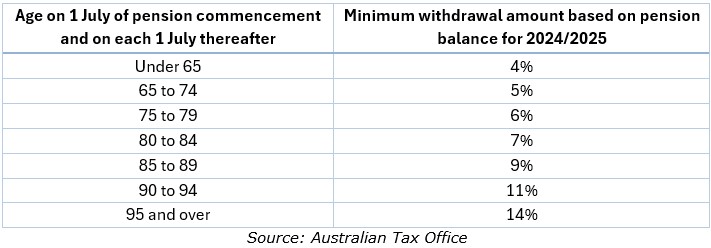
Any amounts leftover in your pension account when you die will go to your nominated beneficiaries. Depending on the type of beneficiary (reversionary, spouse, dependant or non-dependant) the amounts can be paid as an ongoing pension stream until the account runs out or as a lump sum.

Consider getting professional advice

If you’re wanting total financial flexibility in retirement, you could consider leaving part of your money in super, rolling over some of it into an account-based pension, and also withdrawing lump sums whenever you need to.

There are a range of benefits from adopting a combination of your options, although there may also be potential tax consequences for both you and your beneficiaries.

Managing the combination of a super accumulation account, an account-based pension, an Age Pension entitlement (if eligible), potential investment earnings outside of super, and irregular lump sum payments, can be highly complex.

Using the services of a licensed financial adviser is a worthwhile consideration as you weigh up all of your retirement options.


Tony Kaye is a Senior Personal Finance writer at Vanguard Australia, a sponsor of Firstlinks. This article is for general information purposes only and does not consider the investment objectives, financial situation or needs of any individual.

For more articles and papers from Vanguard Investments Australia, please click here.


  •   5 February 2025
  • 17
  •      
  •   
17 Comments
David Billinghurst
February 06, 2025

The table showing the required minimum withdrawal rates is incorrect. The rate for "85 to 89" is 9% and the missing row "90 to 94" is 11%.

See https://www.ato.gov.au/tax-rates-and-codes/key-superannuation-rates-and-thresholds/payments-from-super

James Gruber
February 06, 2025

Thanks David, that table has been corrected.

Peter Care
February 06, 2025

The other condition of release which people sometimes forget is turning 65.
Even if you are working full time you can start an account based pension at 65.
Not long ago I spoke with a former colleague who’s father is 70 and still working. It turns out his Father’s SMSF is still in accumulation.
Neither my friend or his father was aware he could commence an account based pension (and avoid paying 15% tax on contributions and earnings). He was under the impression his fund had to remain in accumulation because it was still receiving employer contributions.
I explained my situation where I had two accounts, the vast majority of my funds was in pension phase (with zero tax) and a small account in accumulation phase to receive contributions.
This is not the first time I have spoken to people who have turned 65 yet not commenced an account based pension. It seems to be because either they thought you had to wait until you reach 67 (age pension age), or when you permanently retire from the workforce before you could commence an account based pension.
So many people are unaware that turning 65 is a condition of release, even if you are still working.

Mark B
February 07, 2025

Hi Peter, I totally agree and have also spoken with a number of people who are older than 65 and not turned the pension on. Each time they went back to their relevant adviser and what do you know, turned the pension on!

Just as a clarifier the earnings are tax free but new contributions must go into a seperate accumulation account and are subject to the 15% contribution tax.

Peter Care
February 11, 2025

Yes, that is my situation, I have 2 accounts with the same super fund. The majority of my money is in the pension account, with a smaller amount in accumulation to receive contributions.

Peter Bayley
February 07, 2025

I might be idealistic, but more simplification is needed.
For example, it should be possible to top up an existing super pension account via rollover from a concurrently held accumulation super account.

Also, transferring a super pension from one fund to another fund is overly difficult as the balance must firstly go back into an accumulation account.

Finally, it annoys me that super sits outside one's will. On death superannuation should be treated like all other personal assets in one's estate and be distributed in accordance with a will. The current process of binding and non-binding nominations and having superannuation bureaucrats determining the distribution of super seems unnecessary, irksome and complex to me.

Lily
February 09, 2025

You can nominate your estate as the only beneficiary of your super account.

Darren
February 12, 2025

I agree Peter. We should be able to decide who we can leave our super to in our will, if you don't have a partner or dependents God knows how it would be sorted & maybe taxed again

john
February 07, 2025

Would anyone know the procedure for closing down an smsf and transferring the funds to an existing pension account in a separate industry fund that we also had for many years ?.? I realise the ATO portal is involved and my smsf tax accountant will be doing the necessary admin. Just that the performance of the industry fund has always been better.

Bill
February 08, 2025

The ATO has a detailed brochure on its website that is a guide to closing down a SMSF and rolling funds to an industry or public fund. Complicated process and requires a bit of work over probably 2 financial years to complete the wrap up process. I have just done this in partnership with my accountant who was new to this end of smsf process. The ATO timelines set out in the brochure seem unnecessarily daunting but do-able. Good luck.

john
February 09, 2025

Thanks very much for that Bill, very much appreciated. I already use HLB Mann Judd as the accountant and they appear very competent in the area.

Knights of Nee
February 08, 2025

Whilst on the minimum draw downs, only 7% for an 80 year old is simply ridiculous.

Govt could have simply ramped up the draw down factors, then removed the mess of Total Super Balance and the the proposed $3M tax.

Disgruntled
February 08, 2025

They should have kept the RBL's of yesteryear. Reasonable Benefits Limit

If you're going to have a TSB of any sorts, that should just be a Cap full stop. You can't go over that amount.

Superannuation went from providing retirement to becoming a wealth creation/preserving tool.

Not the fault of people taking advantage of that ability but Government allowing it.

It looks like the proposed extra tax on balances above $3M is dead in the water.

Unless Labor win the election next year, which I doubt, there is reprieve from the tax.

Sue
February 09, 2025

What about ceasing an employment arrangement on or after the age of 60?

This is also a condition of release and is rarely mentioned.

Disgruntled
February 10, 2025

Depending on the balance of my Superannuation, I may start a 2nd job not long before I'm 60, quit after I'm 60 and meet the condition of release having ceased an employment arrangement. Keep my full time job and get the 4% a year Superannuation Pension.

The other alternative, quit my job, access my Superannuation and then go back to work.

I'm 57 and currently rent and intend purchasing a home at 60 with my Superannuation. If I can afford to retire on the remaining balance, I will. If not, I will still buy a property with my Super and continue working.

Sue
February 10, 2025

Getting a second job to ‘cease’ after 60 would probably be better. Even a casual job like the Census or working at a polling booth for an election.

James
February 09, 2025

Once a condition of release has been reached, super can also be accessed as lump sums from accumulation accounts. The article suggests the only way to access funds is via a pension account.


Leave a Comment:

RELATED ARTICLES

Are you paying tax by not starting a super pension?

Moving your SMSF into pension phase

Labor is proposing a complex ‘new tax’

banner

Most viewed in recent weeks

Australian stocks will crush housing over the next decade, 2025 edition

Two years ago, I wrote an article suggesting that the odds favoured ASX shares easily outperforming residential property over the next decade. Here’s an update on where things stand today.

Australia's retirement system works brilliantly for some - but not all

The superannuation system has succeeded brilliantly at what it was designed to do: accumulate wealth during working lives. The next challenge is meeting members’ diverse needs in retirement. 

Get set for a bumpy 2026

At this time last year, I forecast that 2025 would likely be a positive year given strong economic prospects and disinflation. The outlook for this year is less clear cut and here is what investors should do.

Meg on SMSFs: First glimpse of revised Division 296 tax

Treasury has released draft legislation for a new version of the controversial $3 million super tax. It's a significant improvement on the original proposal but there are some stings in the tail.

Building a lazy ETF portfolio in 2026

What are the best ways to build a simple portfolio from scratch? I’ve addressed this issue before but think it’s worth revisiting given markets and the world have since changed, throwing up new challenges and things to consider.

The 3 biggest residential property myths

I am a professional real estate investor who hears a lot of opinions rather than facts from so-called experts on the topic of property. Here are the largest myths when it comes to Australia’s biggest asset class.

Latest Updates

Investment strategies

Building a lazy ETF portfolio in 2026

What are the best ways to build a simple portfolio from scratch? I’ve addressed this issue before but think it’s worth revisiting given markets and the world have since changed, throwing up new challenges and things to consider.

Investment strategies

21 reasons we’re nearing the end of a secular bull market

Nearly all the indicators an investor would look for suggest that this secular bull market is approaching its end. My models forecast that the US is set for 0% annual returns over the next decade.

Property

13 million spare bedrooms: Rethinking Australia’s housing shortfall

We don’t have a housing shortage; we have housing misallocation. This explores why so many bedrooms go unused, what’s been tried before, and five things to unlock housing capacity – no new building required.

Investment strategies

Market entry – dip your toe or jump in all at once?

Lump sum investing usually wins, but it can hurt if markets fall. Using 50 years of Australian data, we reveal when staging your entry protects you, and when it drags on returns. 

Investment strategies

The US$21 trillion question: is AI an opportunity or excess?

It has been years since the US stock market has been so focused on a single driving theme, and AI is unquestionably that theme. This explores what it means for US and global markets in 2026.

Economy

US energy strategy holds lessons for Australia

The US has elevated energy to a national security priority, tying cheap, reliable power to economic strength, AI leadership, and sovereignty. This analyses the new framework and its implications for Australia.

Strategy

Venezuela’s democratic roots are deeper than Trump knows

Most people know Maduro was a dictator and Venezuela has oil. Few grasp the depth of suffering or the country’s democratic history - essential context as the US ousts Maduro and charts Venezuela’s future. 

Sponsors

Alliances

© 2026 Morningstar, Inc. All rights reserved.

Disclaimer
The data, research and opinions provided here are for information purposes; are not an offer to buy or sell a security; and are not warranted to be correct, complete or accurate. Morningstar, its affiliates, and third-party content providers are not responsible for any investment decisions, damages or losses resulting from, or related to, the data and analyses or their use. To the extent any content is general advice, it has been prepared for clients of Morningstar Australasia Pty Ltd (ABN: 95 090 665 544, AFSL: 240892), without reference to your financial objectives, situation or needs. For more information refer to our Financial Services Guide. You should consider the advice in light of these matters and if applicable, the relevant Product Disclosure Statement before making any decision to invest. Past performance does not necessarily indicate a financial product’s future performance. To obtain advice tailored to your situation, contact a professional financial adviser. Articles are current as at date of publication.
This website contains information and opinions provided by third parties. Inclusion of this information does not necessarily represent Morningstar’s positions, strategies or opinions and should not be considered an endorsement by Morningstar.