Register For Our Mailing List

Register to receive our free weekly newsletter including editorials.

Home / 123

More than money

“Time is more valuable than money. You can get more money, but you cannot get more time.”

Jim Rohn, American entrepreneur and author

As we age, the value of time becomes more significant to us. What are you doing with your time? Are you spending your life well? Waking up in the morning feeling as though you can’t wait to get going into the day is energising, renewing and brings out the best. The mantra in our business is, “Do what you love and love what you do.”

We don’t need to peak in Adulthood

It doesn’t stop there, though, because most Elders (over 55’s) want to have purpose as a key part of loving what they do. Beyond the youthful days of just having fun they want to make a positive contribution as well. In fact, Ben Horowitz of VC firm Andreessen Horowitz says, “… Don’t follow your passion”, advising instead to find the thing you’re great at. This can be tricky.

If we do something that lacks purpose and conviction that has no spirit, gusto or depth, then it’s compromising our selves, whatever money is earned. Under certain circumstances we may choose compromise for a limited time, to help someone out for instance. But to live without commitment and purpose undermines our potential and dignity. Especially over 55.

Elderhood is the last of three major chunks of life – the first is Childhood followed by Adulthood. Each of these chunks has its own cycles, challenges, developmental tasks and mythology. Some of these myths and beliefs are right out of date.

The old cultural belief about lifespan isn’t relevant anymore. It needs updating. Most of us believe that Adulthood predominates in life and is the time that we reach our peak. That was the pattern for hundreds of years but life has changed. (It is only 100 years ago that the average life expectancy was 47 years; today we are just halfway at 47.)
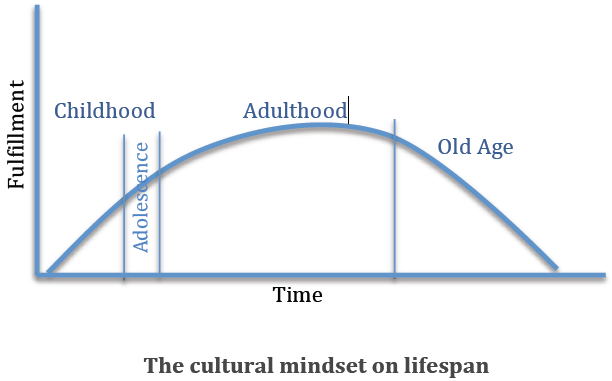
It is not a case of doubling the length of Adulthood, because as we age our physiology changes. We are no longer equipped with the same stamina or motivators. Instead it’s a matter of redefining the life stage that comes after the adult years.

Life in three chunks

Following Adulthood is the vital life-stage of Elderhood with its own distinctive challenges, tasks and purpose. Elderhood builds on and exceeds the previous life stages.

Because it is the last major life stage, when we enter it we are paying attention to time and to our life. This is a great advantage.
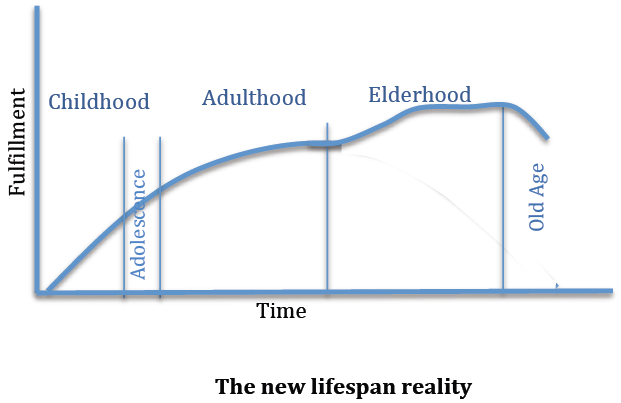
During Elderhood we have the time, opportunity and relative freedom to do what we love and find what we’re great at now. Childhood is spent learning, exploring and being socialized into the culture. In Adulthood we make our way as contemporary warriors and providers, most of us caught in traps of consumerism to some degree, if not by ourselves then by what our children want. By the time we reach Elderhood we are pretty well ready for a more authentic life that expresses our true value.

This is the time to re-discover our core purpose – what lights us up and feels compelling. Yes, our purpose expresses our values and talents plus sets a captivating challenge.

For some it may be an audacious goal in the public eye. For others a quiet reflective purpose behind the scenes is ideal – or anything else from wildly disruptive to lyrically synchronized, large or small scale. The spirit soars and you are on a journey, because what we are talking about is vocation.

Vocation

Finding your Elder-vocation takes time, although some people just ‘know’. They have always known but not dared to do it before. Whether you know or need to go on an inner search, being open to opportunity is part of the process. However, (1) opportunity is not the only part. The real source is you. The opportunities in your environment are only resonating with what was already there for you. (2) What you envisage may not exactly match the reality as it unfolds; the reality that eventuates often turns out to be better.

Ralph was an engineer joining the family-owned business as a young graduate. He really wanted to be a counsellor but was under pressure to conform in the family. Eventually he became Managing Director of the business, which had grown to 360 employees with a revenue of $183 million. He retired at 65, still yearning to work closely with people to help them with life. When Ralph was watching his grandson play a basketball match, the penny dropped. Seeing the way the coach interacted with the boys, Ralph knew he had found his thing. He felt clarity and enormous energy, like his spirit rising. He saw himself coaching disadvantaged boys, teaching them about life through playing the game and giving them a positive human experience that would change their lives. And that is precisely what he did in multiple suburbs and country regions.

The third chunk of life

Elderhood is the last third of life. That is precisely what makes it so rich. Conversely, it is also one of the reasons people try to avoid it and hang on to Adulthood. In Elderhood we are undeniably aware that our time is limited.

The notion of purpose and contribution trumps either making money our goal or serial short-term activities that have no lasting meaning. When these activities don’t resonate and renew, they leave us empty. Just something to do to fill in time.


Di Percy is a director of VogelPercy, a corporate mentor and change firm with long experience assisting many of Australia’s top businesses. Their new business arm is Third Chunk of Life, working with over 55’s. See www.thirdchunkoflife.com.


  •   20 August 2015
  • 4
  •      
  •   
4 Comments
Morgan Williams
August 23, 2015

Fantastic article Di. The notion that things really get going in terms of a life's purpose during the third stage of life is riveting. The challenge I am stuck with is the ways I can discover that purpose! I am certainly open to the process and hoping it will naturally bubble forth, or do you think there are things I can start doing now that will help?

Di Percy
August 24, 2015

It's such an individual process, all in its own time. Three questions to consider; 1) What do you really love to do, even without being paid? 2) What are you really good at? (or would like to be really good at and are willing to learn?) 3) What is the most important thing for you to experience or contribute before you die in order to feel fulfilled? There are so many distractions, try spending some time alone every day to listen to your answers - time in nature walking or just outside looking at the night sky - all can help restore personal focus on purpose. Then it just bubbles forth.

Robert Holmes
August 26, 2015

Great article. I like to think my life is like the last quarter of a big game (age 66) and I need to make all the right moves, have all my best plays ready and be ready to defend or be really positive. Like football and life you only need one big play that will win you the game.
All the best

Stephen
October 08, 2018

Love it.

I wonder whether the transition to Elderhood is not so much age dependent as it is mindset. My sense of it is that Adulthood is all about the self and those activities that are self-centred (i.e. career, car, house). I have a friend who is old enough to be in Elderhood but is clearly still operating in Adulthood. His vanity prevents him from thinking of a vocation in Elderhood. The anxiety associated with life after Adulthood haunts a lot of people (particularly those of the male gender).


Leave a Comment:

RELATED ARTICLES

Why it’s time to ditch the retirement journey

Ageing in spurts

How not to run out of money in retirement

banner

Most viewed in recent weeks

Australian stocks will crush housing over the next decade, 2025 edition

Two years ago, I wrote an article suggesting that the odds favoured ASX shares easily outperforming residential property over the next decade. Here’s an update on where things stand today.

Building a lazy ETF portfolio in 2026

What are the best ways to build a simple portfolio from scratch? I’ve addressed this issue before but think it’s worth revisiting given markets and the world have since changed, throwing up new challenges and things to consider.

Get set for a bumpy 2026

At this time last year, I forecast that 2025 would likely be a positive year given strong economic prospects and disinflation. The outlook for this year is less clear cut and here is what investors should do.

Meg on SMSFs: First glimpse of revised Division 296 tax

Treasury has released draft legislation for a new version of the controversial $3 million super tax. It's a significant improvement on the original proposal but there are some stings in the tail.

Property versus shares - a practical guide for investors

I’ve been comparing property and shares for decades and while both have their place, the differences are stark. When tax, costs, and liquidity are weighed, property looks less compelling than its reputation suggests.

10 fearless forecasts for 2026

The predictions include dividends will outstrip growth as a source of Australian equity returns, US market performance will be underwhelming, while US government bonds will beat gold.

Latest Updates

Economy

Ray Dalio on 2025’s real story, Trump, and what’s next

The renowned investor says 2025’s real story wasn’t AI or US stocks but the shift away from American assets and a collapse in the value of money. And he outlines how to best position portfolios for what’s ahead.

Superannuation

No, Division 296 does not tax franking credits twice

Claims that Division 296 double-taxes franking credits misunderstand imputation: franking credits are SMSF income, not company tax, and ensure earnings are taxed once at the correct rate.

Investment strategies

Who will get left holding the banks?

For the first time in decades, the Big 4 banks have real competition in home loans. Macquarie is quickly gain market share, which threatens both the earnings and dividends of the major banks in the years ahead.

Investment strategies

AI economic scenarios: revolutionary growth, or recessionary bubble?

Investor focus is turning increasingly to AI-related risks: is it a bubble about to burst, tipping the US into recession? Or is it the onset of a third industrial revolution? And what would either scenario mean for markets?

Investment strategies

The long-term case for compounders

Cyclical stocks surge in upswings but falter in downturns. Compounders - reliable, scalable, resilient businesses - offer smoother, superior returns over the full investment cycle for patient investors.

Property

AREITs are not as passive as you may think

A-REITs are often viewed as passive rental vehicles, but today’s index tells a different story. Development and funds management now dominate earnings, materially increasing volatility and risk for the sector.

Australia’s quiet dairy boom — and the investment opportunity

Dairy farming offers real asset exposure, steady income and long-term growth, yet remains overlooked by investors seeking diversification beyond traditional asset classes.

Sponsors

Alliances

© 2026 Morningstar, Inc. All rights reserved.

Disclaimer
The data, research and opinions provided here are for information purposes; are not an offer to buy or sell a security; and are not warranted to be correct, complete or accurate. Morningstar, its affiliates, and third-party content providers are not responsible for any investment decisions, damages or losses resulting from, or related to, the data and analyses or their use. To the extent any content is general advice, it has been prepared for clients of Morningstar Australasia Pty Ltd (ABN: 95 090 665 544, AFSL: 240892), without reference to your financial objectives, situation or needs. For more information refer to our Financial Services Guide. You should consider the advice in light of these matters and if applicable, the relevant Product Disclosure Statement before making any decision to invest. Past performance does not necessarily indicate a financial product’s future performance. To obtain advice tailored to your situation, contact a professional financial adviser. Articles are current as at date of publication.
This website contains information and opinions provided by third parties. Inclusion of this information does not necessarily represent Morningstar’s positions, strategies or opinions and should not be considered an endorsement by Morningstar.