Register For Our Mailing List

Register to receive our free weekly newsletter including editorials.

Home / 149

Oil does not have a supply side problem

Much has been written about the ‘sudden supply side problem’ in the oil market, predicated ostensibly by US shale. In our view, this doesn’t make sense. Let me explain why.

First of all, there was a not-so-sudden 'supply side problem' in the oil market for much of the past six decades. An oversupply of cheap oil was the very reason that OPEC was formed some 56 years ago, in 1960. The then foundation members – Iran, Iraq, Kuwait, Saudi Arabia and Venezuela - recognised that they possessed large quantities of oil that could be produced very cheaply, and that the best way to regulate the output and hence price, was to form a cartel.

Back in 1960, the average price paid for a barrel of oil was $US1.63, total production was 21 million barrels of oil equivalent (mboe) per day and the US produced just on 7 mboe per day – almost exactly one-third of global production. But most relevant to the current day is that spare capacity was substantial, between 42% (US Office of Oil and Gas) and 50% (Chase Manhattan Bank estimate).

By comparison, and despite the arrival of supposedly cheap shale production, the oil market today is exceptionally tight. Yes, exceptionally tight.

The latest data from the International Energy Agency (IEA) forecasts that worldwide demand for oil will average 96 mboe per day during 2016. Spare capacity – as defined by that which can be brought on stream within 30 days and produce for longer than 90 days – is in the order of 2.4 mboe per day, or approximately 2.5% of global demand.

Spare capacity has declined from around 50% to 2.5%. And alarmingly, approximately 85% of the ‘spare capacity’ resides with one country – Saudi Arabia. When demand overtakes oil supply, the dramatic hiatus in oil developments over the past two years will exacerbate the problem.

So talk of a ‘sudden supply side problem’ appears ill-founded and indeed there would now not even appear to be a supply side problem from an historical perspective.

Part of the myth around the supply side issue has been generated and perpetuated by a misunderstanding of the true all-in sustaining cost (AISC) of producing a barrel of oil. The graph from Capital Economics below is perhaps the most important graph for oil investors.
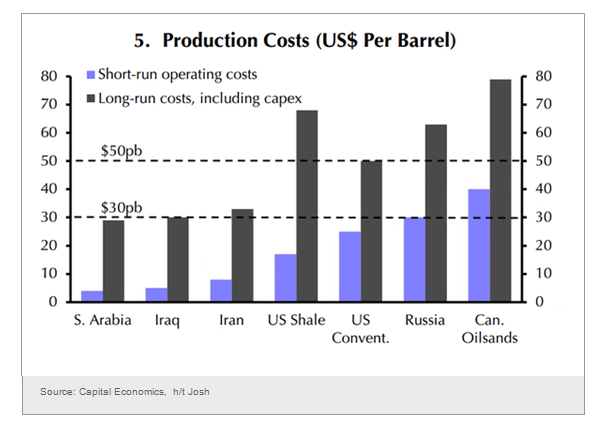
There is a quantum difference between the short-term costs of producing a barrel of oil from an existing well already tied in to existing infrastructure versus the true long-term cost, which includes sustaining capex, development capex and a host of additional costs including exploration, infrastructure and financing to name a few.

The chart shows the AISC for US shale remains in the vicinity of $US70 per barrel. Much of the current wave of shale production was funded and founded on the premise of $US100/barrel oil, so the supply side will contract at or below this level. In fact, from a peak of 9.61 mboe per day in June 2015, total US production is on the cusp of declining below 9 mboe per day.

Why has the oil price fallen by so much?

If the oil price fall is not from the natural forces of supply and demand, then what has driven the move? In summary, it has been driven by Saudi Arabia’s desire to achieve three or four goals:

  • Coerce other OPEC and non-OPEC producers into bearing some of the oil supply side restraint.
  • Cripple the existing supply of high cost production, in particular US shale and Canadian oil sands.
  • Slow the development of new production in general and high cost production in particular.
  • (Possibly) provide a turbo charge to the demand side and a headwind for renewables.

How much this last point is playing on the minds of OPEC ministers is difficult to know, but at the very least it is a nice bi-product of this ‘power play’.

When does this end?

In our view, the oil price will recover when Saudi Arabia has inflicted as much damage as it can whilst bearing as much pain as it can stomach. The second part of this equation is of paramount importance. This process has a finite time line. Saudi Arabia is the largest exporter of oil globally, so the impact of the oil price on their revenues and budget is magnified, as the chart (below) suggests.
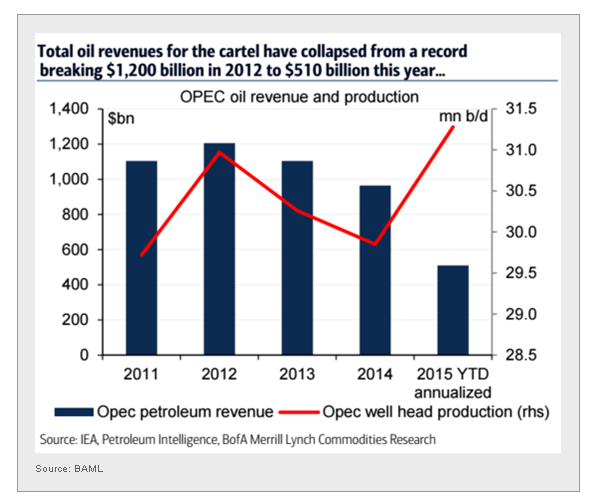
When Saudi Arabia has borne as much pain as it can, we will see this Arab leader drive an accord to re-establish order in the oil market. This time may be approaching, as supported by two factors:

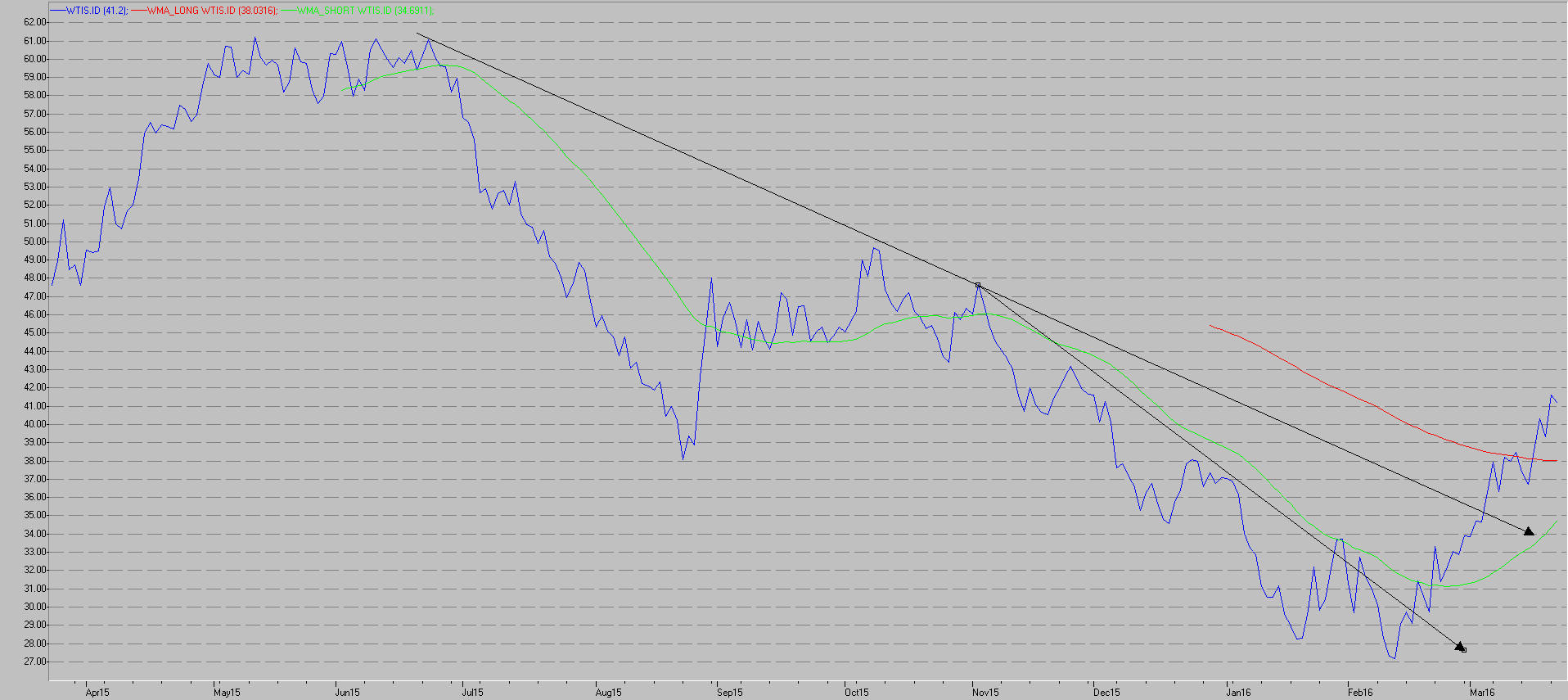
Firstly, sentiment has turned as indicated by the break in the downtrend and the upward push through both the 50 and 200 day moving averages (see chart below).
Secondly, the rhetoric emanating from the mouths of the key oil ministers and Government figureheads is undeniably softening. The move to a production freeze is the first tangible evidence of a willingness on the part of the key stakeholders to re-engage. This price fall is politically driven, so the recovery will also arise from government policy.

The key risk of course is that Russia needs to be brought into the fold (ROPEC?) and forced to abide by a supply quota. In theory, when faced with the prospect of financial oblivion versus a large increase in revenue, the choice is relatively pedestrian. The problem here is that when you go Putin’ a gun to the head of the Russian Prime Minister (pun intended) he is just as likely to say ‘pull the trigger’. They don’t call it Russian roulette for nothing!

In the investment world, there is no prize for sitting on the fence. At Katana, we have weighed up the risk-return profile and we now believe it is in our favour. Accordingly, we have been positioning ourselves to profit from a recovery in the oil sector. From this level, if we get the short-term direction wrong, then we expect the long-term fundamentals to cover our mistakes and generate a handsome return to boot.


Romano Sala Tenna is Portfolio Manager at Katana Asset Management Ltd. This article is for general information and does not consider the circumstances of any individual.


  •   31 March 2016
  • 3
  •      
  •   
3 Comments
Gary Judd
March 31, 2016

Whilst I have no expertise in oil mattersand what is being postulated may be perfectly correct, I find this article difficult to follow. What is Saudi Arabia actually doing to produce the dramatic drop in oil prices? Dumping a lot of oil on the market? The information about production costs certainly shows that it is better placed to do that than any other producer.

However the social set up within the country imposes great costs which other producers don't have, leading one geopolitical strategist to express the view that Saudi Arabia is a failing kingdom. See www.mauldineconomics.com/download/saudi-arabia-a-failing-kingdom.

Romano Sala Tenna
March 31, 2016

Yes that is precisely what Saudi Arabia is doing. SA has been the swing producer for much of the past 3+ decades, reducing production when the oil price declines beyond the desired range and vice versa on the upside.
You may wish to download a report from the US EIA website titled 'Changes in Saudi Arabia crude oil production and WTI crude oil prices'. From this graph you will note clearly that SA has reduced production on at least 5 occasions over the past 15 years to bring the market into balance : 2002, 2004, 2006/07, 2009,2013.
By contrast, when the oil price started to decline in mid 2014, SA not only failed to reduce production, but they exerted pressure on OPEC to increase.

In respect to socio-political turmoil, this is precisely the point that the article made when it was written that '...SA will inflict as much damage as it can whilst bearing as much pain as it can stomach.' This strategy is not without a price, which is why we emphasised that it has a finite life span.
Hopefully we are closer to the end than the beginning.

Matthew
March 31, 2016

Thank you. Finally some calm, rational, and measured commentary on oil prices. The graph from Capital Economics says it all. The price of a finite resource that is getting harder to find and exponentially more expensive to extract is, in the long term, only going one way, and that is up! And in the interests of full disclosure, yes I am (very) long oil.


Leave a Comment:

RELATED ARTICLES

The end of Russian oil

Oil and the storm before the really big storm

Future oil prices: it takes two to contango

banner

Most viewed in recent weeks

Warren Buffett's final lesson

I’ve long seen Buffett as a flawed genius: a great investor though a man with shortcomings. With his final letter to Berkshire shareholders, I reflect on how my views of Buffett have changed and the legacy he leaves.

The housing market is heading into choppy waters

With rates on hold and housing demand strong, lenders are pushing boundaries. As risky products return, borrowers should be cautious and not let clever marketing cloud their judgment.

Why it’s time to ditch the retirement journey

Retirement isn’t a clean financial arc. Income shocks, health costs and family pressures hit at random, exposing the limits of age-based planning and the myth of a predictable “retirement journey".

Australia's retirement system works brilliantly for some - but not all

The superannuation system has succeeded brilliantly at what it was designed to do: accumulate wealth during working lives. The next challenge is meeting members’ diverse needs in retirement. 

The 3 biggest residential property myths

I am a professional real estate investor who hears a lot of opinions rather than facts from so-called experts on the topic of property. Here are the largest myths when it comes to Australia’s biggest asset class.

Welcome to Firstlinks Edition 637 with weekend update

What should you do if you think this market is grossly overvalued? While it’s impossible to predict the future, it is possible to prepare, and here are three tips on how to best construct your portfolio for what’s ahead.

  • 13 November 2025

Latest Updates

Investment strategies

Australian stocks will crush housing over the next decade, 2025 edition

Two years ago, I wrote an article suggesting that the odds favoured ASX shares easily outperforming residential property over the next decade. Here’s an update on where things stand today.

Property versus shares - a practical guide for investors

I’ve been comparing property and shares for decades and while both have their place, the differences are stark. When tax, costs, and liquidity are weighed, property looks less compelling than its reputation suggests.

Investment strategies

What if Trump is right?

Trump may be right on two trends: nations are shifting from aspiration to essentials and from global dependence to self-reliance, pushing capital toward security, infrastructure, and energy.

Gold

After a stellar 2025, can gold shine again next year?

Gold has had a remarkable 2025, with the spot price likely to post its strongest return since 1971. This explores the key factors that will shape the outlook for the yellow metal next year, and long-term.

Superannuation

Critics of Commonwealth defined benefit schemes have it wrong

Critics like Clime's John Abernethy have questioned many aspects of defined benefit pensions for public servants. This is an attempted rebuttal, suggesting these pensions aren't the problem they're made out to be.

Infrastructure

Why airport stocks deserve a place in long-term portfolios

Aircraft constraints are holding back global air travel. Those constraints should soon ease which combined with a structural boom in travel demand could be a boon for global airport stocks.

Investment strategies

What is the future of search in the age of AI?

Search is changing fast. AI tools like ChatGPT and Google’s Gemini are reshaping how we find information, opening new opportunities for innovation, user engagement, and future revenue growth.

Sponsors

Alliances

© 2025 Morningstar, Inc. All rights reserved.

Disclaimer
The data, research and opinions provided here are for information purposes; are not an offer to buy or sell a security; and are not warranted to be correct, complete or accurate. Morningstar, its affiliates, and third-party content providers are not responsible for any investment decisions, damages or losses resulting from, or related to, the data and analyses or their use. To the extent any content is general advice, it has been prepared for clients of Morningstar Australasia Pty Ltd (ABN: 95 090 665 544, AFSL: 240892), without reference to your financial objectives, situation or needs. For more information refer to our Financial Services Guide. You should consider the advice in light of these matters and if applicable, the relevant Product Disclosure Statement before making any decision to invest. Past performance does not necessarily indicate a financial product’s future performance. To obtain advice tailored to your situation, contact a professional financial adviser. Articles are current as at date of publication.
This website contains information and opinions provided by third parties. Inclusion of this information does not necessarily represent Morningstar’s positions, strategies or opinions and should not be considered an endorsement by Morningstar.