Register For Our Mailing List

Register to receive our free weekly newsletter including editorials.

Home / 670

Was life really better in the good old days?

Key points

  • Angst about economic conditions has been running high in recent times. This is evident in chronically low consumer confidence readings and a downtrend in measures of happiness. It’s also arguably evident in the rise of populist parties globally and more recently in Australia.
  • There is no doubt that some things were better a generation or two ago. Cheaper housing stands out. But most indicators are far superior today. 
  • That said there is no denying that “cost-of-living pressures” have been a problem in recent years and a key driver behind this has been poor productivity growth. Unfortunately, there are no quick and easy fixes to this.

Lately, there seems to be a heightened level of angst that economic conditions are getting harder and that the two-party political system – and maybe democracy too – is failing voters. There seems to be a hankering for times past that some feels were better. There is no doubt that “cost-of-living” issues have become real in the post-pandemic years. This has been associated with relatively stagnant real household disposable income and poor productivity growth over the last decade. Unfortunately, there are no quick fixes to this. Rather getting productivity up requires hard-nosed economic reforms that may take years to bear fruit. But while the Australian economy does have some real challenges to address, it is worth keeping things in perspective. This note looks at how economic conditions in Australia have changed over the last half century.

Some things are worse today

The table below provides a brief comparison of economic indicators where conditions were better 25 and 50 years ago. These periods were chosen because the 1970s broadly coincided with baby boomers entering the workforce, while Millennials entered in the 2000s and Gen Z in the 2020s.
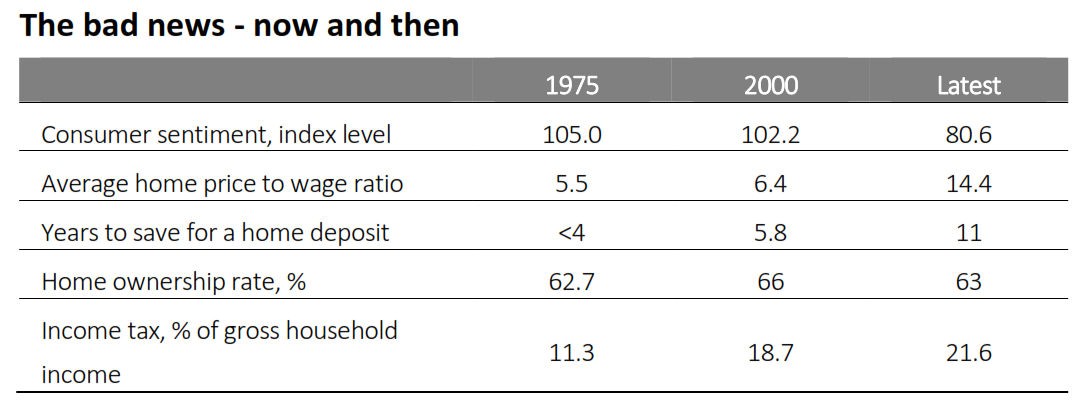

*decade average. Source: ABS, Westpac/Melbourne Institute, Cotality, AMP

The bad news is that consumer sentiment seems to be stuck around much lower levels, despite the absence of really high unemployment as seen in the recessions of the 1980s and 1990s. And associated with this over the last 20 years happiness has been trending down. From the next chart it can be seen that the trend in both has been down since around 2015, not just the last few years.
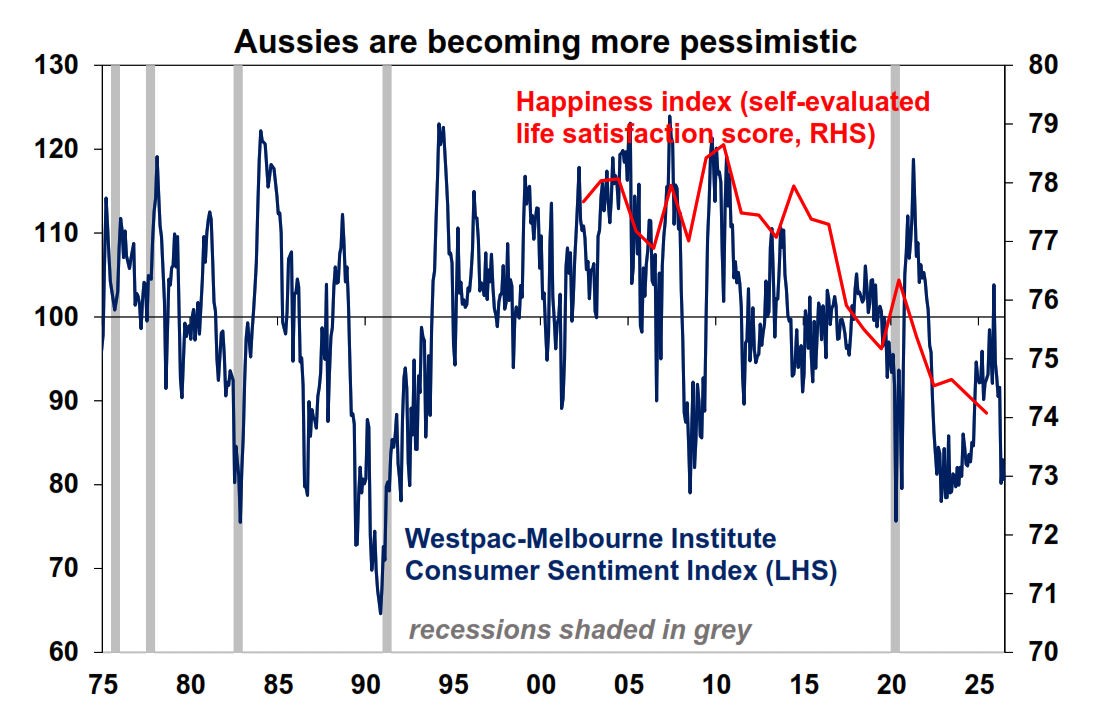

Source: World Happiness Report, Bloomberg, ABS, Westpac-Melbourne Institute, AMP

We also paid less tax as a share of our income back then. But housing is the big one - today the ratio of home prices to incomes is way above what it was 25 and 50 years ago, and it takes far longer to save for a deposit. Associated with this has been a down trend in the home ownership rate since it’s mid-1960s peak. And this arguably goes a big way to explain why younger generations may be feeling less happy today as getting a home is seen as too hard.
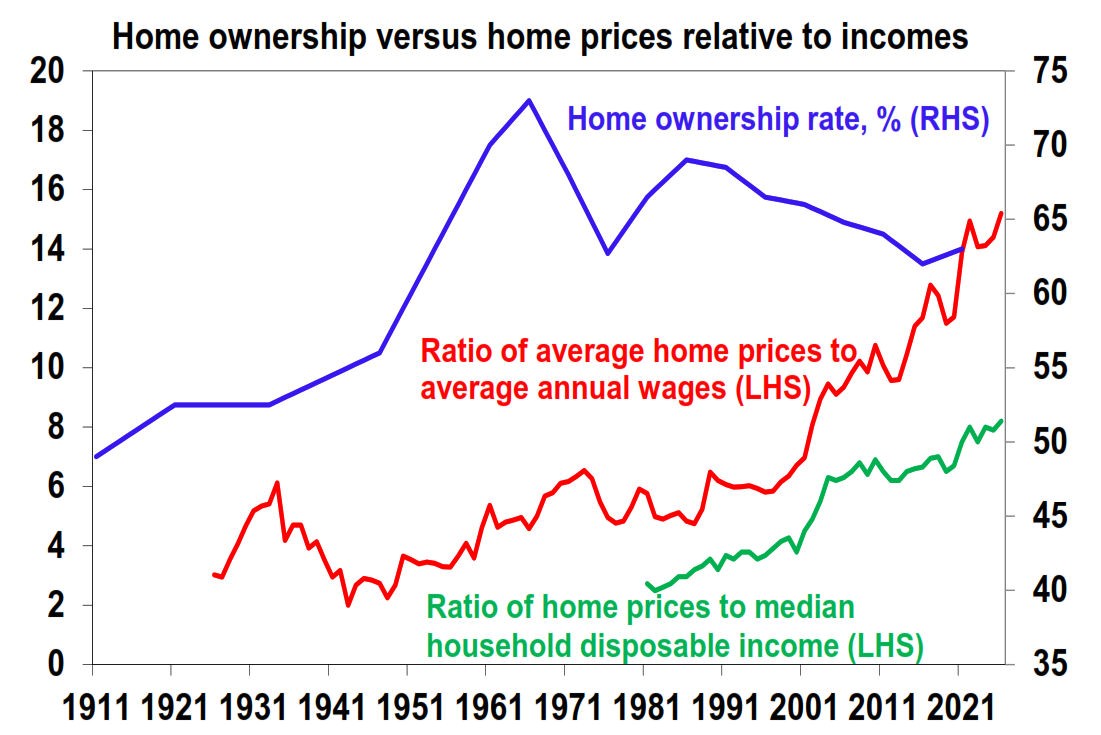

Note home ownership data is only available from 5 yearly census. Source ABS, Cotality, AMP

Of course, in the past things were also less regulated so we may have felt freer, there was a greater sense of community, there was less choice (i.e. four TV channels in the 1960s and 70s versus lots of streaming and TV options now), so less decisions to make, which resulted in less pressure. And there was no social media to bully us, rile us up or create a perpetual sense of FOMO (and in many cases relieve us of our money - though small town gossip was probably worse back then!).

But many economic indicators are far better now

Against this, virtually all other economic indicators are much better today.
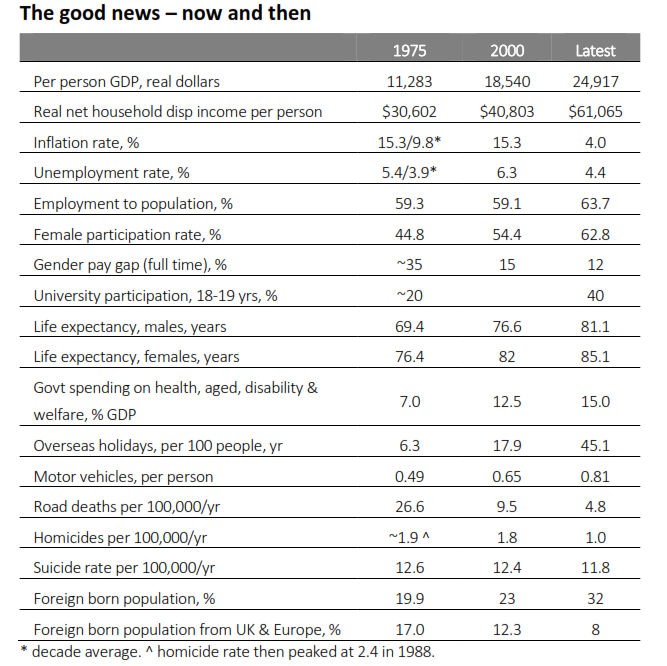

Source: ABS, PBO, AIC, BITRE, AIHW, AMP

In recent decades the economic cycle has been milder with less severe recessions, generally lower unemployment and generally lower inflation. Today we are far better off materially: real household income is double what it was 50 years ago, there is a greater share of the population in employment (~64% versus 60% in the 70s, reflecting more jobs), and the female participation in the workforce has risen (helped by better education, childcare and attitudes).
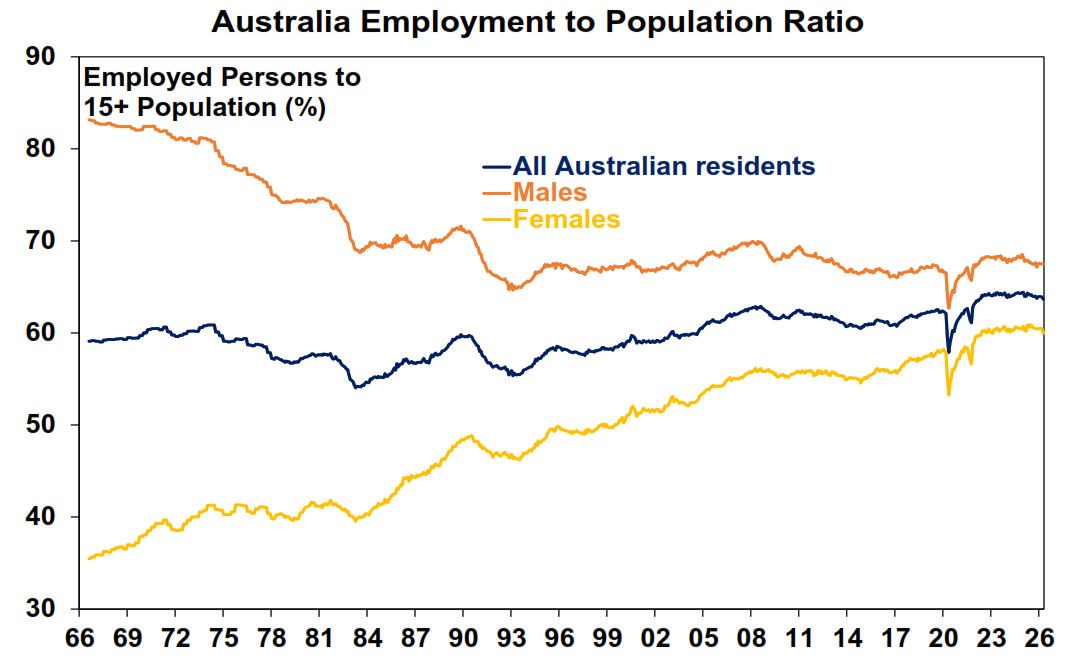

Source: ABS, AMP

With this wealth has come more discretionary spending power to devote to things like overseas holidays – 50 years ago, an average Australian had an overseas holiday once every 16 years, now it’s just a bit less than once every two years. And more gadgets like cars – where there is now nearly one for every two people – and household appliances like huge flatscreen TVs. And multiple cafes per suburb with endless choice of coffee and food compared to the burgers and instant coffee of a few generations ago.
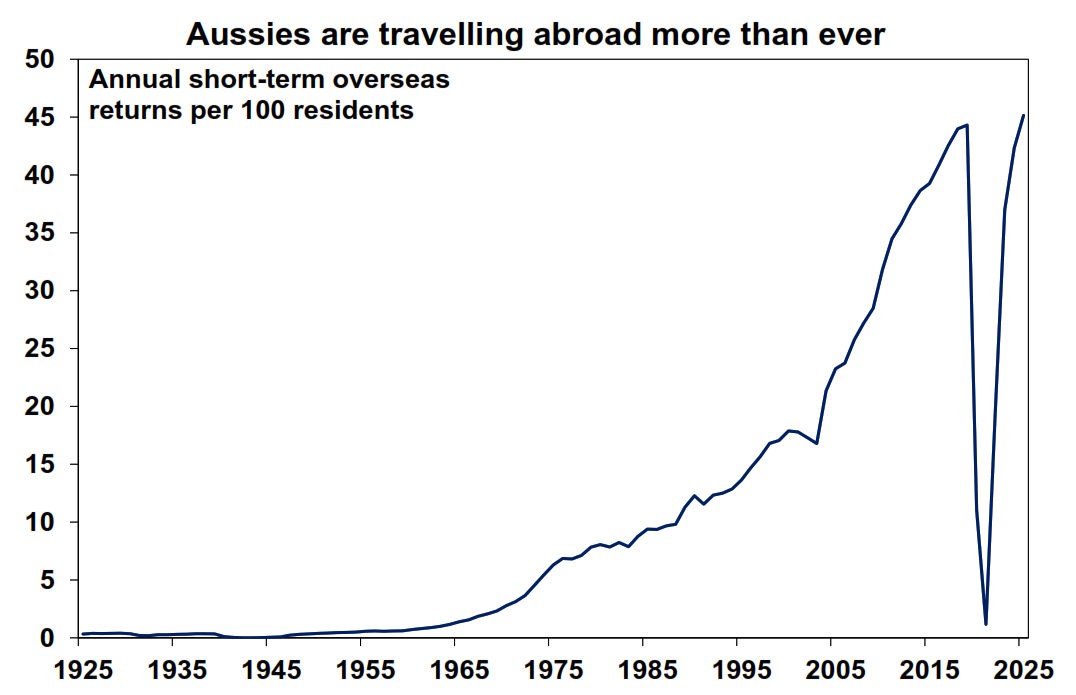

Source: ABS, AMP

But it’s also a far more equitable society. For example, female participation in the workforce has surged from being way below that of men, more girls now go on to a university education than boys and the gender pay gap has fallen sharply (albeit there is still a way to go). It’s hard to look back a generation or two ago and say things were great when opportunities for half the population (i.e. women) were way below those of the other half. At this point we here the manosphere crowd saying how guys are now discriminated against…and think come on guys “get a grip”! – don’t you realise that manosphere influencers are just telling you what you want to hear so they can get a buck out of you!
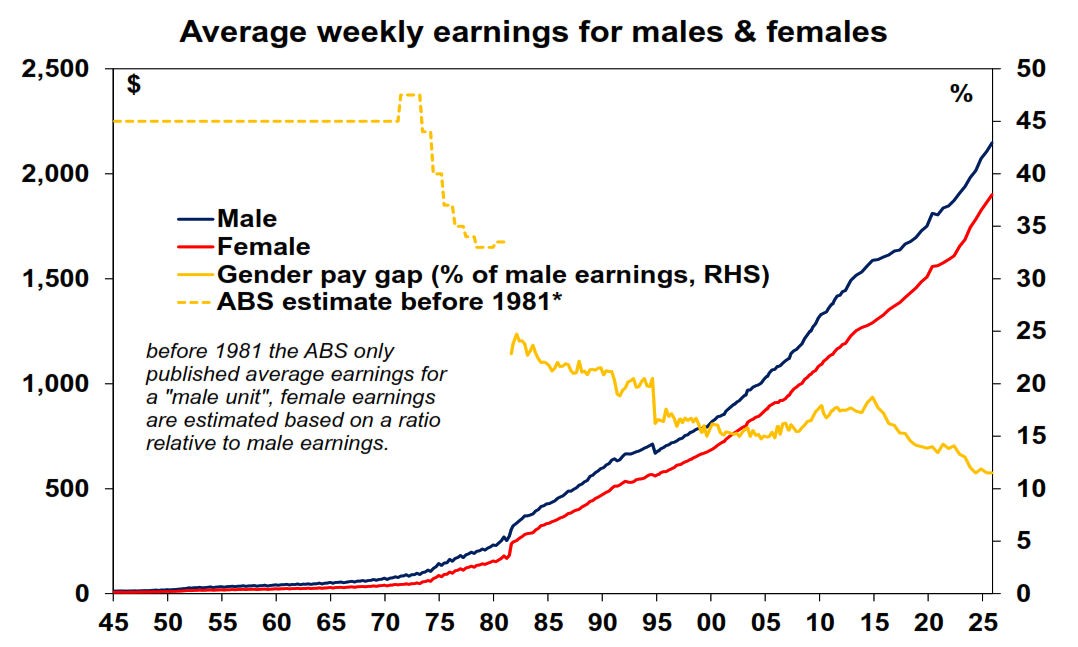

Prior to the 1971 female wages were not really surveyed but assumed to be a fixed ratio to male wages. Source: ABS, AMP

And with this surge in income and wealth has come huge medical advances which means we are living longer, active lives. (Of course, this is not to say there are not issues with obesity and too much sugar which may be starting to take a toll in the last few years!)
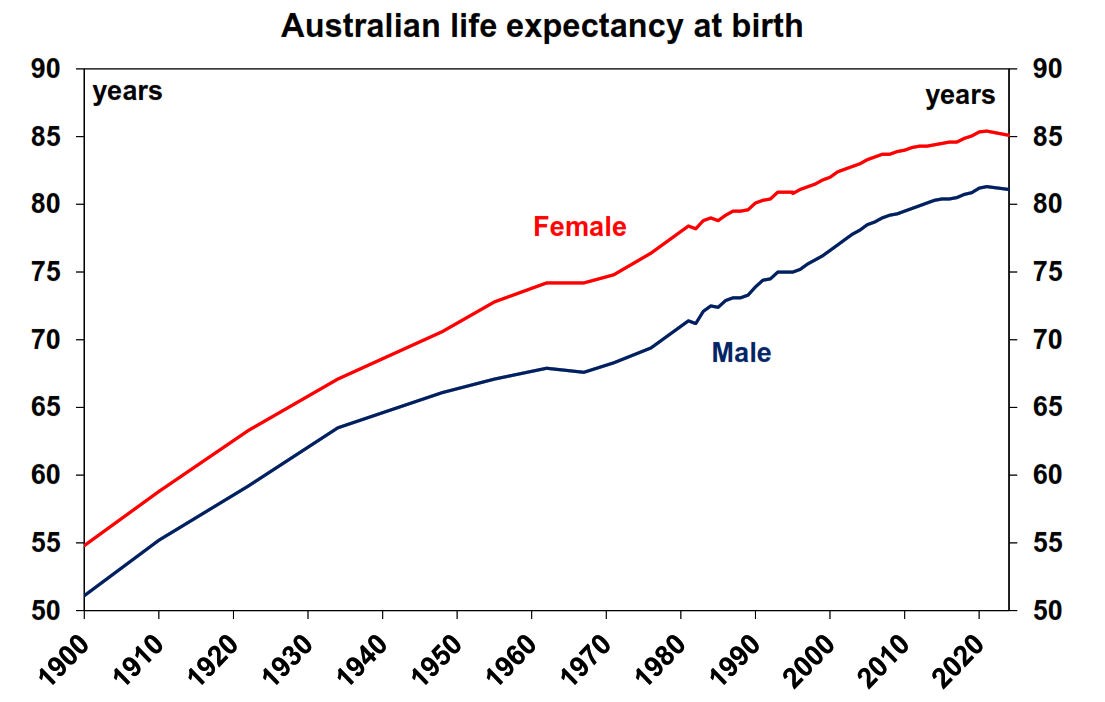

Source: ABS, AMP

While we pay more taxes as a share of income, and more is demanded of Government, the social safety net is bigger than ever. It’s seen explosive growth in the provision of spending on welfare, health, aged and disability care – which have each more than doubled as a share of GDP. And Government is mostly doing a good job of protecting us from ourselves and each other, with for instance, a collapse in road death and homicide rates.
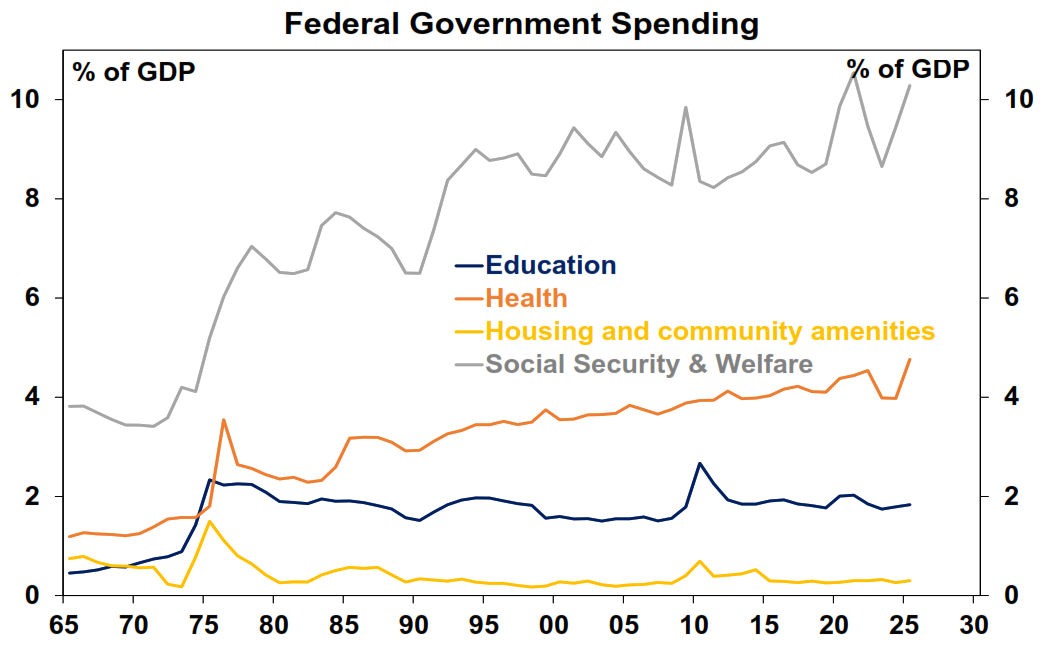

Note spending on disability care is included in Social Security & Welfare. Source: PBO, ABS, AMP

Australia is now also a far more diverse country with far more born overseas and less of those that are from a UK/European background. This has led to a richer society (e.g. more restaurants to choose from), a more innovative society and relief from the pressures of an aging population and labour shortages.
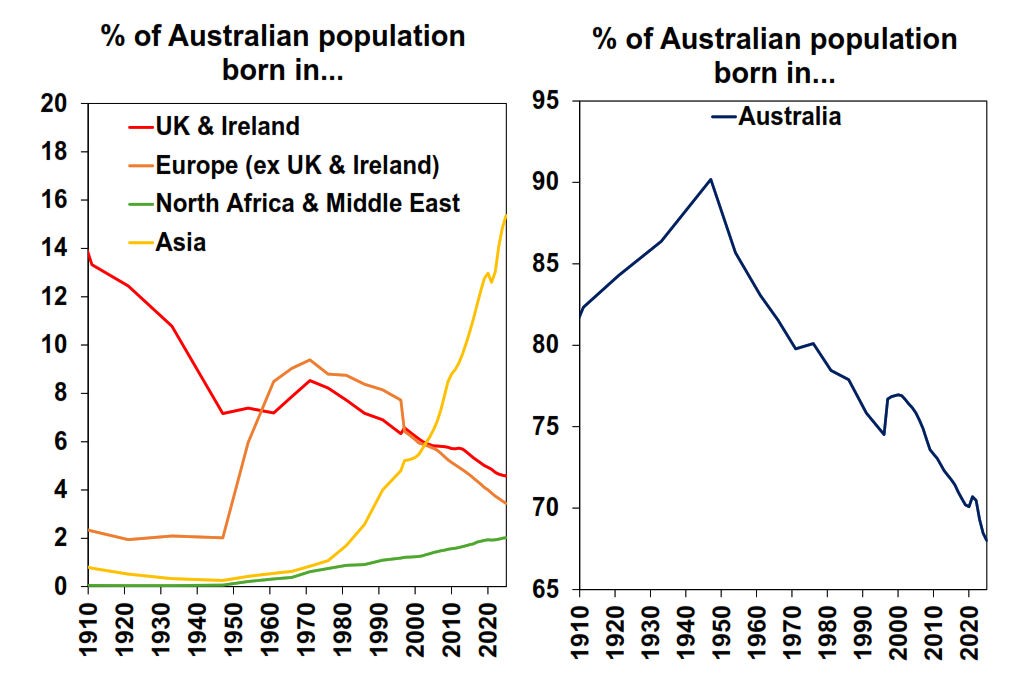

Source: ABS, AMP

Of course, immigration is once again a hot topic – it has been periodically for as long as I can remember – but for most this seems to reflect a concern about poor housing affordability.

And finally, despite all the talk to the contrary, it’s still too high but the suicide rate is around where it was 25 and 50 years ago and is in fact below its level in the pre-WW2 years, the 1960s and the late 1980-90s.
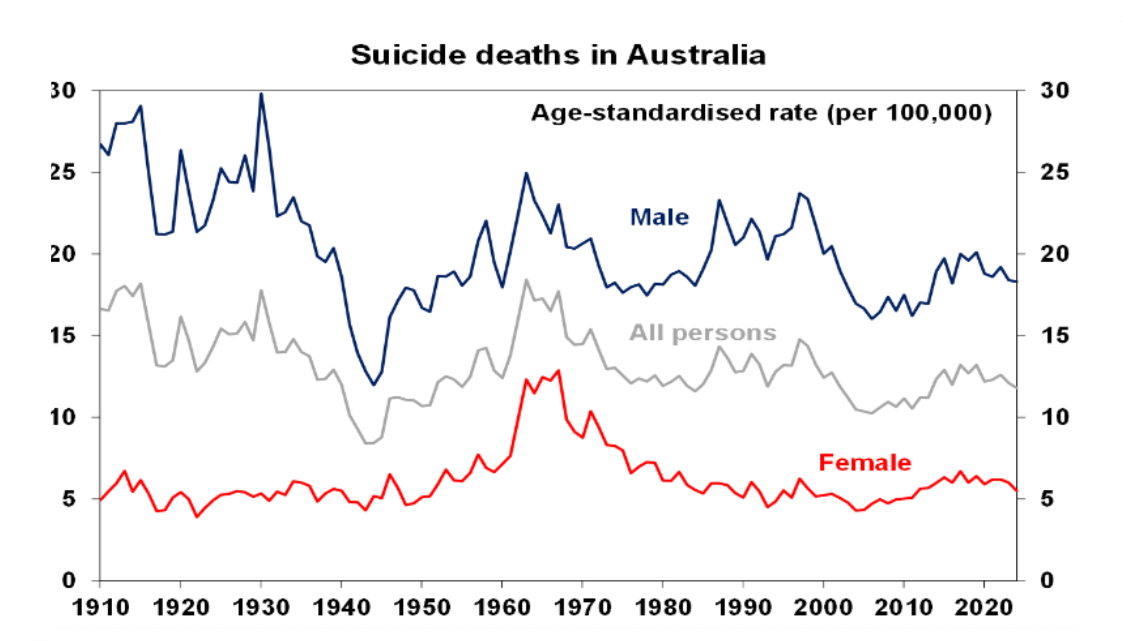

Source: AIHW, AMP

So why do people still feel miserable even with all these economic achievements?

Simply because most people nowadays weren’t around back then! Around 65% of the population was born after 1975, and 78% were either not born or too young in the 1970s to remember it clearly, so much of the hardship discussed in this note sits outside most people’s lived experience. And recency bias means that even for those who were around “back then”, the tougher times they might have had can be hard to recall after three decades of economic growth and virtually no recessions in Australia.

Recency bias and higher baseline expectations also make comparisons with 25 or 50 years ago less meaningful. At the same time, things have indeed gotten a bit worse in the last 5 years.

For example, health outcomes have improved over the long term, helped by medical advances, increased government health spending and better access to health care with e.g. higher bulk billing rates. But bulk billing fell sharply from 2022 until late last year as medical goods and services costs rose, with some surveys suggesting many people delayed medical appointments because of affordability. That marks a clear regression from 2020-2022, when the average bulk billing rate was 89%.
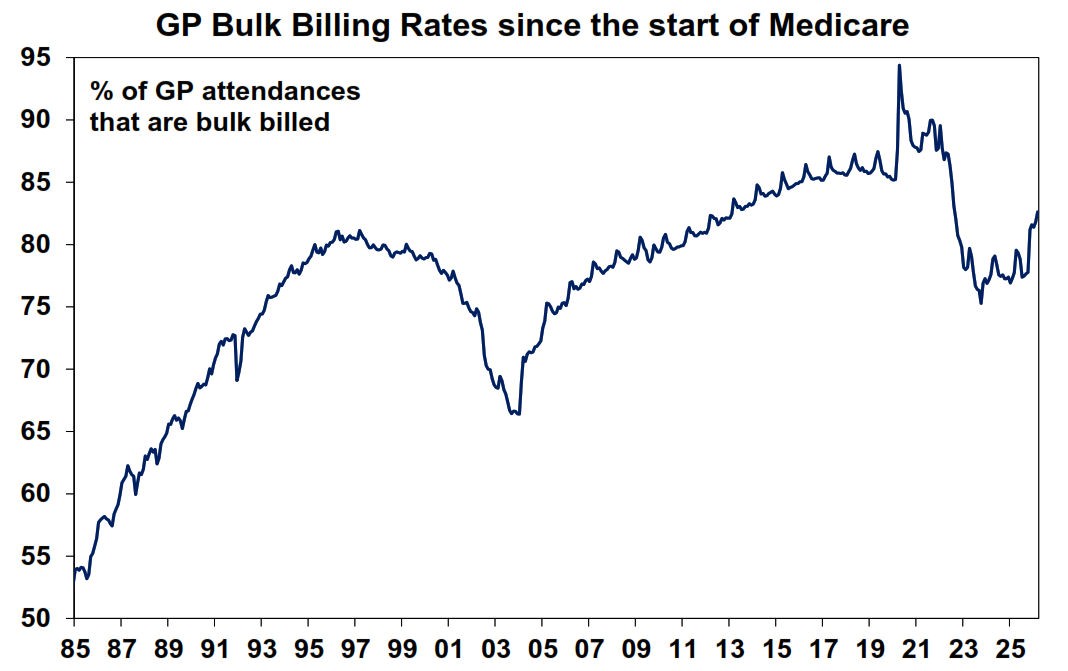

Source: AIHW, AMP

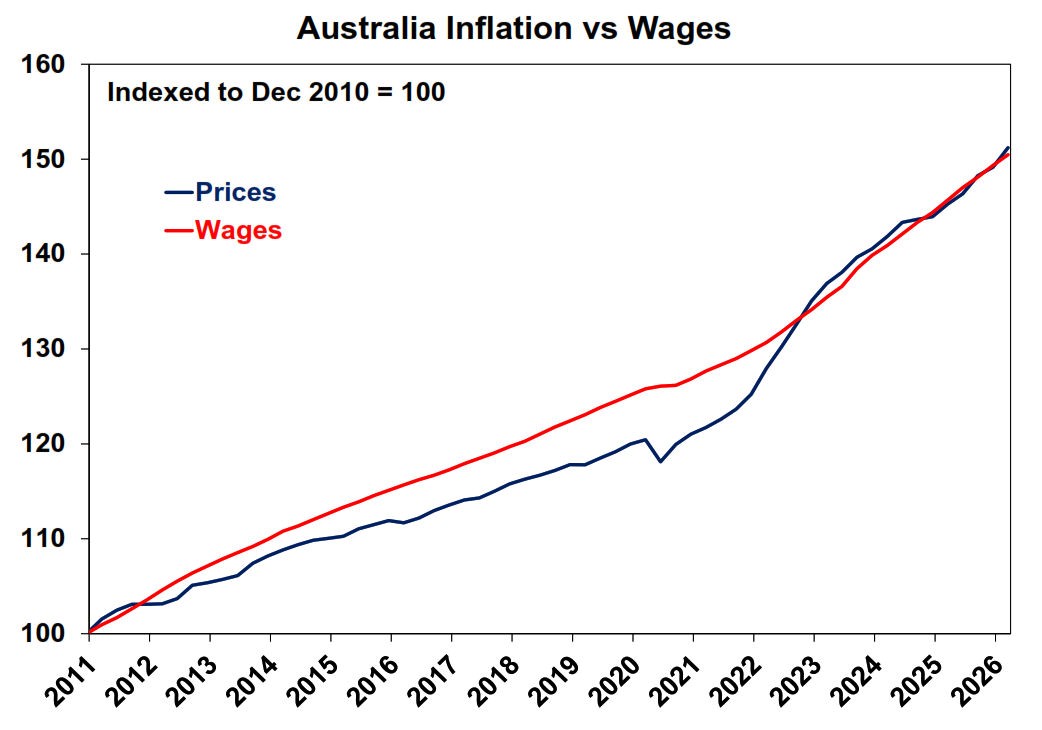
In addition, real wages have gone up significantly over the last 25 and 50 years, but the average wage earner (if they have not upskilled or changed jobs) has seen their pay lag inflation since 2021.

Source: ABS, AMP

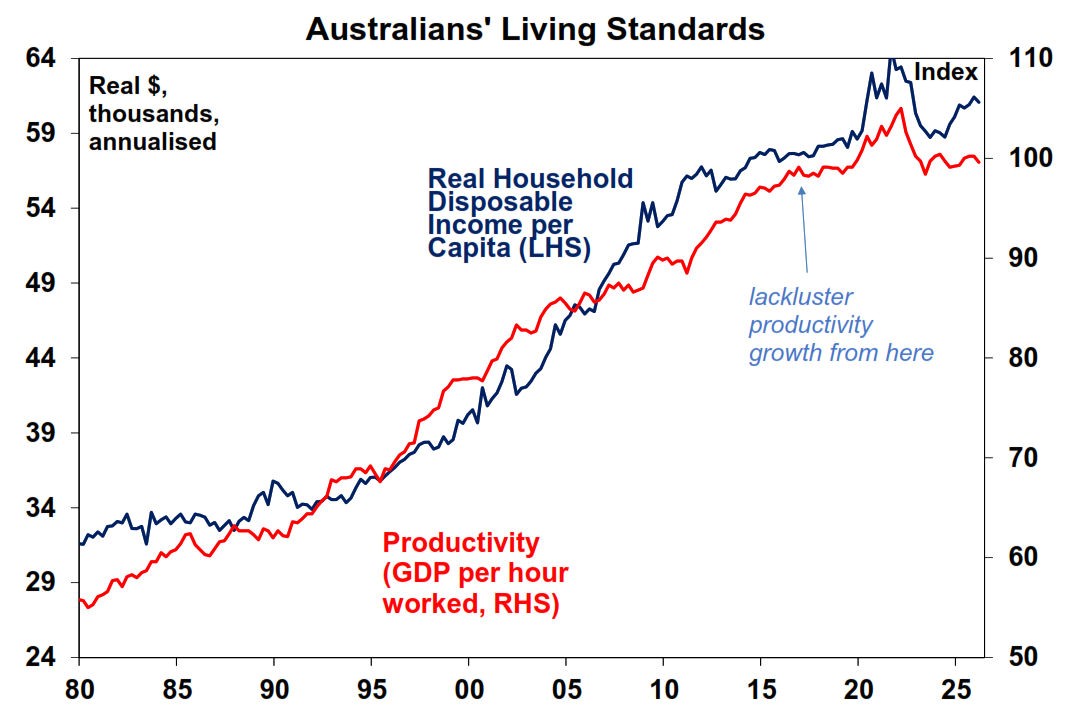
The root core of this is low productivity growth. Coincidentally, the structural decline in happiness in 2015 started around the same time productivity started stagnating.

Source: ABS, AMP

Concluding comments

None of this analysis is to deny that many are struggling with “cost of living” issues and that there is a wider malaise of dissatisfaction. Government’ need to do more to boost productivity and hence grow living standards and avoid the delusion that the answer is even more government. But we suspect a big part of the problem is poor housing affordability which leads to a growing wealth gap between the haves and the have nots – fix that with a fundamental rebalancing of underlying housing supply and demand, and a lot of the angst will likely fade. This likely involves getting the balance right on immigration but not slashing it such that it just leads to labour shortages and the economy struggling with an aging population.

Finally, we need to recognise that part of the malaise associated with poor happiness and confidence reflects a problem of success. The rise in affluence has led to higher expectations than the economy can at times deliver upon. And social media – itself a product of technological success – may be contributing to the malaise via its focus on grievance and quick hits. Finding better ways to live with this success – and recognise more “things” won’t necessarily make us happier - is probably key.


Dr Shane Oliver is Head of Investment Strategy and Chief Economist at AMP. Additional contributors: Diana Mousina, Deputy Chief Economist and My Bui, Economist. This article has been prepared for the purpose of providing general information, without taking account of any particular investor’s objectives, financial situation or needs.


  •   8 July 2026
  • 36
  •      
  •   
36 Comments
BeenThereB4
July 09, 2026

Great and timely article, Shane

Following retirement from financial services sector (at age 80) I joined Univ of 3rd Age in my leafy Melbourne suburb. With about ninety others we have a weekly session on Current Affairs.

I am surprised at how many of our people hold negative attitudes to contemporary life in Australia. Not so much harking back to "the good old days", but having poor appreciation of how our lifestyle is generally so much superior to that in other developed countries.

Regrettably, the daily grind of local and international politics largely generates "bad news" and this sways our opinions. And there is a lot of disinformation and ignorance around the traps.

27
Dr David Arelette
July 09, 2026

"If you can remember the 1960s then you were not there" memory and time are not well connected. I would add that as a child in the late 1950s and early 1960s, Australia and many migrants such as the magnificent people of Greece who risked their lives to assist our diggers, had all lived a near national death experience, and no matter religion or circumstance, my mother would enlist me to vacuum clean and put out the washing of about a dozen homes with a group of other veterans on weekends when the usually widowed mother herself was at work. Australia had enough to eat, most put off a car to own a house, Child Endowment was not a lot but it all mattered, if you did not get a Commonwealth Uni Schholarship, you went to RMIT or Swinburne after work and completed yoiur degree in a Uni when you could. Kids could see both the commitment of their parents and the great opportunities already taken up by the 25 to 30 year old cousins. Each generation has its own circumstances and opporitunities - just get on with it, it's your life not mine.

21
Jarrod
July 09, 2026

I don't think having a higher foreign-born population belongs under the categories of "positive" things. Why is falling having a smaller percentage of the foreign-born population being from UK & European a "positive" thing? What is the economic benefit? I don't get the innovation argument.

14
Foreign-born
July 09, 2026

I’m foreign born, my kids are foreign born, we are all Australians. We are not from UK or Europe. I resent that you assume we are “leaners” not “lifters”, with no economic benefit to Australia, despite not knowing anything much about us, other than that we were not born here.

We’ve made positive, productive, innovative contributions to Australia through our working lives, and paid a lot of taxes too. We’ve never drawn on welfare (now self-funded retirees).

21
6th Generation Aussie
July 09, 2026

I'm 100% with you Foreign Born. Basic economics and sociology 101 clearly outline the myriad benefits of well planned immigration...too many to list here. Australia is a nation of immigrants, and all the better for it, despite the Murdoch media & Hanson fear campaigns that abound.

13
Ben
July 11, 2026

I saw nothing in Jarrod’s comments to suggest people were learners not lifters. He just questioned why it was a benefit. After all aren’t we all the same?

10
Ivy
July 11, 2026

Foreign born here as well, we used skilled immigration scheme back in 2003-2004. Australia changed a lot, nothing to do with the country back then. We had to know English, recognized professions and skills, had funds to support us for at least 6 months, not allowed to use benefits. So much changed since then.

8
Denise
July 12, 2026

fair comment

Rose
July 13, 2026

I thank you and many others for your contribution to Australia…….where would we be without the contribution of our migrants since we got rid of the “ white Australia policy “ ……

Steve
July 12, 2026

I have long thought that migrants are a net positive. Very simply these people are proactive, they have made a huge change for them and their families and are more likely to be harder workers and value education. Those who remained at home and moaned about their situation we don't need. Only modern concern is whether many of the refugee migrants are more here for our economy. Look at the situation in Europe and the UK and you can see certain groups not willing to respect the values of their new home and that is our current problem. Wherever you come from just respect our values and we should be fine.

5
Mike
July 14, 2026

Exactly, especially the penultimate sentence, which is the elephant in the room. Leave your baggage and quarrels at the door, work hard and become part of the society. I did when I left my country and never looked back. 

We HAVE to work harder than those who are already settled here because not everyone comes here with a house to sell back home and a suitcase of money; we all came for a better life and that has it's own price of "hard work".

We HAVE to sort out our own problems more than most because we don't have Grandma, Granddad and extended family networks here to help support us, e.g. passing the kids to them for a night off.

We HAVE to work harder to establish ourselves and our reputation because whatever you did 'back there', that's nice but it doesn't count for much here (this is a common returning expat feeling too).

We put our kids through private schools and into high paying professions, so that the family network can help each other financially.

1
Will
July 09, 2026

If you look at the raw data, it tells us that we are in a cost of living crunch and a confidence crisis. On the other hand, there are record attendances at discretionary events - try buying a ticket to a pop star concert, Socceroos v Brazil game, or the State of Origin. Governments have also become savvy at feeding those that cry the loudest for welfare and represent blocks of votes. The sense of entitlement is something that was not evident in older generations.

We also have a government that is set on dividing the country and pitting one generation against another in the name of “generational inequity” and a mantra of wealth redistribution. On that, the “we changed our mind” on the broken CGT and negative gearing that the government contends is necessary for structural reform in the hottest issue of housing affordability, the government ignores the massive escalation of tax embedded in house prices. Noel Whittaker posted a recent article that estimated the tax burden to be between 33% - 41% for a home in Brisbane. Add to that the interest paid on that tax over the life of a mortgage.

So rather than blaming the boomer generation, the government should get its own house in order and cut housing taxes. The younger generation may then have a chance of getting a foot on the ladder.

14
Peter Taylor
July 15, 2026

Give the goverment credit for successfully executing a tax grab while recruiting a cheer squad from first home buyers looking at an affordability mirage with blame laid on investors rather than the goverments immigration fuelled asset price spiral.

Wages 18K tax free
CGT to be taxed from first dollar min 30% rather that at marginal tax rate but no journalist asks how this is equitable.

1
Cam
July 09, 2026

Part of the problem today is so many are told they're missing out and deserve more. Its not that there's not some truth. It makes people angry and resentful to know or believe they're missing out. We're not growing the pie, so there's a redistribution and those losing can feel angry and resentful aswell. Its created an activist class, and some of those don't know when to stop. A lot of people feel angry and we're divided. The rise in right wing parties around the western world is a visible metric.


For 1st home buyers, a huge difference is there's 2 wages now instead of 1. With nothing else changing that doubles buying power, so doubles house prices, doubles repayments v the average annual income of 1 person, etc. A couple with 2 $50k cars in the garage has their home deposit there. Historically people viewed new cars and home ownership as a choice.
I'm not swapping being a young adult in the 1990's with anyone. Though it would be nice if the odd Government policy favoured Gen X instead of being a Boomer or Gen Y/Z focus.

10
Ronald Herron
July 12, 2026

CAM says it in a nutshell, accurately describing that two incomes are now a standard. When my wife and I applied for our first two home loans there was no way that my wife`s income would even be considered, even though at the second application she was netting more in salary than I was. We did have two old cars as there was no public transport in the outer suburbs of Brisbane in the 70s. But we prospered with working hard, brought up two children of which we are very proud.
The big problem today is too many distractions like overseas trips and technology which should be helpful has escaped and is now running rampart. I do not apoligise for being a boomer and we are independent.

6
Roger
July 09, 2026

Something that is never discussed in these types of articles is pollution. Whilst I have predominantly fond memories of the sixties and seventies, I do not miss the suburban pollution we had back then - back yard incinerators, factory chimneys belching black smoke, abattoir smells drifting over the city from miles away, oil slicked creeks and rivers, litter in streets and parks, and petrochemical odours from outer suburban factories. As a society we have progressed immeasurably; don't be roped in by right wing opponents of 'green' policies and sustainability measures.

7
Michael
July 09, 2026

Having been in the workforce since the mid 1970's, there has always been housing, energy, and cost of living pressures. The big difference now is that before 2000 life was simpler, without the increasing work and social pressure caused by technology and the increase in social media.

6
John Wilson
July 10, 2026

Thank you Shane for this review over time of what has happened. There are a few other factors which have contributed to people's dissatisfaction.
There is no question that housing prices have increased. A significant part of that is due to the government: a 10% increase in cost due to introduction of GST in 2000; 4-5% stamp duty on purchases (rates unchanged, but values at which those rates apply unchanged since the 1970s), 12% compulsory superannuation (good, but adds to cost and doesn't help with standard of living).
As some commenters have noted, houses are now "better" - insulation, solar panels, better electrics, not built out of fibro! They are also bigger: the average freestanding house size in 1970 was 130 sq metres, but in 2025 it was 230 sq metres. Young people have grown up and become accustomed to their parents' house - ignoring the fact that might have been their parents' second or third house; "I want a house at least as good as the oldies'!".
A couple of comments have noted that many young couples have two breadwinners, and are able to bid up house prices. That's true. However.... Back in the good old days of 1970, the income of the wife was not considered by banks in approving housing loans!
Finally, there has been a major change in the way families work. There used to be much more assistance from uncles and aunts, grandparents etc with physical time in building and repairing houses, in providing child care (including respite from the little ****), and low cost entertainment. We lived together. Now the young family is just paying out for that.

6
Ben
July 09, 2026

Good article from Shane but what about youth unemployment, energy, government debt, petrol costs and birth rates?

4
Colin Millar
July 12, 2026


I am a carpenter. I bought my first block of dirt in 1979 for $14,000 ( cheapest block I could find). My wage at that time was $85/ week. I drew up my own building plans with help from local council. Didn’t have to put a DA in then, only a BA. Took 3 weeks to get approval. No consultants costs etc etc. I got a bank loan for $50,000 which I thought I would never pay off.The builder let me work on weekends to make it cheaper. The council gave me an interim occupation certificate when I ran out of money, so I could move into the house unfinished. It took another 5 years and a new wife to get it all completed. We loved working together on weekends, it made it feel like a real home. Total cost $70,000. We sold it 7 years after I bought the land for $173,000. This was the only way I could have been able to afford getting in the property market. Totally different scenario now. The cost of regulations , consultants, council requirements, DA plus CC , 12 months to get approval ,everything has incl landscaping has to be finished before you get the keys to move in. I feel sorry for young people now trying to start off.

4
JanH
July 12, 2026

No mention of safety. When a student, living in Melbourne during the 1960s, I could, and did, walk from friends' home to mine late at night after the trains stopped running. I would stay at the uni library until it closed at 10pm and then catch bus and train and short walk to flat on my own without being accosted. Today I wouldn't dream of walking around on my own in any regional town, or Melbourne suburb, let alone in the City at night. Even in daytime, women are assaulted and even murdered. Even young men are not safe. As for the fire bombings and shootings: unheard of back then.
We had little money, couldn't afford much, but we had fun.
I agree about house sizes. Australia has the largest homes in the world. Means we have wall-to-wall (literally) housing, no gardens or trees. The quality of life in cities is definitely worse. Young people don't want starter house with one bathroom, etc. they crave the mansion with the multiple bathrooms, picture theatres, and luxury kitchens and wonder why they can't afford a home. They need to lower their expectations and start small. We had to practice delayed gratification. Even buying clothes were on lay-by, which you paid off as you got enough money to do so. As for phones, we had to use the public pay phone. But it was normal.

4
Lyn
July 16, 2026

Gosh, I'd forgotten about lay-by clothes Jan, one saved a.s.a.p to finish lay-by. Didn't have home phone as paying a mortgage, until was 32 when one came with a job to always be available due to several 24hr work facilities. If went out, had to leave phone number of place going to.

Steve
July 12, 2026

I believe it's all about expectations. The boomers or their parents lived through some truly hard times. Depression and WW2. This clearly influenced their approach to debt and living within their means. Most people today can't survive without air-conditioning.

4
AlanB
July 12, 2026

1989: home loan mortgage interest rates reach 17.5%.
Remember that struggle?
Now what are they?

3
Dudley
July 13, 2026


"Now what are they":

Not as good until multiplied by principal. Then lending lots of money for a small rate is about as good as lending a little money for a large rate.

Peter Bayley
July 09, 2026

I’d like to see the data on electricity costs and government debt over the same period. Thanks for the interesting article.

2
Peter Morgan
July 12, 2026

No mention of toll roads (bad)
No mention of Superannuation (good & bad)
No mention of a gutted manufacturing base (good & bad)
No mention of introduction of technology (gaming and social media) & more inactive kids
Lot more graffiti, less morals & less manners (generally in society).

2
Tony
July 13, 2026

I love Shane’s eternal optimism!
Of course he’s right that the “Good old Days” are a fiction of the mind. There was always “ cost of living”
pressures but we either never noticed or stoically carried on.
The constant whinging today in the MSM and social media exaggerates it and overlooks the extremely high expectations people hold today, eg overseas trips every 2 years, 2 cars and the continuous drain on our bank account due to the costs of streaming, internet, mobile phones etc which did not exist a generation ago.
We are indeed living in wonderful times, especially in Australia.
To use the cliche, most whinging is about First World problems!

2
Francis H
July 14, 2026

Things that used to be simple 50 years ago now involve the expenditure of time and money. It now takes me a week to sort out my house insurance renewal. Ditto my power plan when it expires. Back 50 years ago we had 1 energy provider, 1 telephone provider and few insurers. It was simply a matter of writing a cheque every year, job done. As for modern cars it is simply a matter of waiting for the next thing to go wrong. My side mirror made a grating noise when it folded . Just out of warranty. Could it be repaired ? Not on you nelly. A new mirror was the answer, cost $1500. More than the cost of my first car, which had fixed mirrors. Next problem, my red camera alert voice went from some posh lady to static. Progress, now it just chimes. Manufacturer's solution , mute the alert. Why do I need a red light voice anyway as I tend to rely on my eyesight when driving. One thing, I don't have a problem filling my time in retirement dealing with all of the above. The wonderful world of choice.

2
john
July 18, 2026

You could probably write an interesting book on the subject overall

Matt
July 09, 2026

Why dont politicans present these charts and present a 10 year plan to improve, but actually WORK HARD and achieve the plan?

1
Andrew Smith
July 09, 2026

Me thinks rose colourd glassss and nostalgia are promoted over reality?

Missed two things and related to comments eg. 'It’s seen explosive growth in the provision of spending on welfare, health, aged and disability care – which have each more than doubled as a share of GDP.'

A driver missed, not immigration, but ageing and increasing longevity in our permanent population including silent gens, boomer 'bomb' and GenX when fertility fell below replacement.

Most of our 'immigration' is border churn of temporary student visa holders, Kiwis, backpackers and temp workers who fill labour market gaps.

However, like tourism (never criticised?), all temporary visitors and residents are desired by any nation to ameliorate relative tax revenue decline from working age, hence 'net financial contributors' (PAYE & GST).

Why important? We have an increasing mass of retirees on 'welfare' tugging on budgets vs fewer working age tax payers.

Exemplified by increasing old age dependency ratio trends of retirees 65+/working age 20-64 years.

In 2000 20%, now 30% and 2050 40%+ (then maybe decline somewhat post boomers); seems to correlate with house market with stagnant median values 2014-24, now prices are actually falling?

Many nations are struggling with more retirees while not wanting immigrants, but Australia manages quite well, despite similar attitudes towards 'the other'; we now come out near too on retirement income sustainability while still transitioning to super.

Further, on the latter, that's according to international ratings and comparisons vs our local RW MSM messaging ecosystem that tells us everything is sh*t and being ruined by 'immigrants' and clean energy, which one is it?

1
john
July 12, 2026

Those statistics are generally obtainable and do not take a lot of research to gather and not reflective of any substantial special expertise or knowledge. Moreover a representative of AMP does not garner much respect considering the history of AMP, especially as shown by the outcomes of the royal commission.

1
billy
July 13, 2026

I don't understand the second line of good news: household income per person. What is that?

I understand the productivity benefit of higher participation rates and the participation numbers greatly understate the significance of higher female participation in dollars. But it's not all good news.. My wife was a very happy homemaker (yes,I'm sure). My daughter seems less happy juggling home and work. The pressure to participate is much higher now, partly the economic pressure (as the cost of housing calls for 2 incomes.....chickens and eggs....) and partly the social pressure to participate.

Mark
July 14, 2026

Good article.
Perhaps the reason why there is a high participation of women in the workforce is that they HAVE TO earn a living to pay the mortgage. Women do not have a choice any more. This has caused a fundamental change in our society and the next generation will be bear the brunt of incompetent Governments and an incompetent RBA (too slow to raise interest rates)


Leave a Comment:


RELATED ARTICLES

Which generation had it toughest?

Rent inflation and the missing policy

Why is Aussie inflation so stubborn?

banner

Most viewed in recent weeks

Testamentary trusts post-budget: Estate planning, tax reform and the ‘death tax’ debate

Proposed Budget changes to taxation are casting new uncertainty over testamentary trusts, prompting closer scrutiny of estate planning structures and the real implications of reforms still taking shape.

High quality businesses are on sale

Beneath the dominance of the ASX's largest stocks, much of the market has been left behind. High-quality companies are now trading at levels rarely seen, offering opportunities for investors willing to look deeper.

Meg on SMSFs: The CGT changes don’t impact super but what about Div 296 tax decisions?

New CGT rules could tip the scales in the super vs non-super debate. For those facing the Division 296 tax, the case for withdrawing has gotten more complex. A "comparison rate" tool may help assess decisions.

The strange effect of the 30% minimum capital gains tax

The 30% minimum tax on capital gains sits at the heart of the budget's proposed reforms. Yet the mechanics reveal anomalies that introduce unexpected distortions that raise questions about its design.

Ranking three common retirement strategies

The defining challenge of retirement isn't just about building wealth, it's about converting your lifetime savings into sustainable income. A holistic understanding of different strategies can improve long-term outcomes.

Welcome to Firstlinks Edition 667 with weekend update

The downfall of the giant and three lessons for investors.

  • 18 June 2026

Latest Updates

Planning

Does your will qualify for the discretionary testamentary trust exemption?

Treasury has confirmed the exemption many families were hoping for. But buried in the fine print are two conditions that could leave some wills on the wrong side of the exemption, despite years of careful planning.

Lithium's latest drop and what it means for ASX investors

Lithium's latest sell-off has punished ASX miners as prices remain hostage to shifting expectations. The key challenge is navigating a market prone to extreme volatility despite a strong case for the long-term demand outlook.

Investment strategies

CGT reform and fund turnover: who really feels the impact?

The implications of CGT reform are far and wide. As the 50% discount gives way to inflation indexation, turnover and return profiles may become critical drivers of after-tax performance. Some strategies face a far greater hit.

Superannuation

Super was built for a very different Australia

Our retirement system was built around assumptions that no longer hold. Lower homeownership, longer lifespans and changing expectations are exposing cracks that policymakers and super funds need to address.

Retirement

Retirement in reality - 4 months in

Many people spend years planning financially for retirement but little time preparing for what comes next. Four months in, here are the surprising lessons I've learnt on finding purpose, social connection and healthy habits.

Investment strategies

After the Budget, Australia needs its own definition of quality

As tax reforms reshape investment incentives, investors should rethink what quality investing means in the uniquely concentrated Australian market, where traditional frameworks may not translate as effectively.

Datacenters are the new shale oil

Why are tech giants pouring billions into datacentres when the economics look questionable? The most dangerous words in investing may be: "everyone else is doing it". Today's AI boom has striking parallels with the shale bust.

Sponsors

Alliances

© 2026 Morningstar, Inc. All rights reserved.

Disclaimer
The data, research and opinions provided here are for information purposes; are not an offer to buy or sell a security; and are not warranted to be correct, complete or accurate. Morningstar, its affiliates, and third-party content providers are not responsible for any investment decisions, damages or losses resulting from, or related to, the data and analyses or their use. To the extent any content is general advice, it has been prepared for clients of Morningstar Australasia Pty Ltd (ABN: 95 090 665 544, AFSL: 240892), without reference to your financial objectives, situation or needs. For more information refer to our Financial Services Guide. You should consider the advice in light of these matters and if applicable, the relevant Product Disclosure Statement before making any decision to invest. Past performance does not necessarily indicate a financial product’s future performance. To obtain advice tailored to your situation, contact a professional financial adviser. Articles are current as at date of publication.
This website contains information and opinions provided by third parties. Inclusion of this information does not necessarily represent Morningstar’s positions, strategies or opinions and should not be considered an endorsement by Morningstar.