Register For Our Mailing List

Register to receive our free weekly newsletter including editorials.

Home / 386

Welcome to Firstlinks Edition 386

  •   3 December 2020
  • 1
  •      
  •   

Weekend market update: Both the S&P500 and NASDAQ posted gains of around 0.8% on Friday despite the record numbers of COVID-related deaths in the US and a weak jobs number. Over the week, the US was 1.7% higher to a new record, while Australia increased 0.5% on the back of surging iron ore prices. Rising commodity prices are pushing the $A higher, now about US$0.74 versus a March 2020 low of US$0.62.

***

Last week, I moved my home for the first time in 31 years. It was a once-in-a-lifetime opportunity to rationalise everything from books to documents to furniture, much of which we would have kept until death do us part without the move. It made me feel great sympathy for those people who are unwillingly forced to move accommodation regularly, such as renters subject to the short lease conditions in Australia. We had months to plan our move, but regularly relocating lives and schools at a month's notice must be draining. It's another dimension to the value of owning your own home which does not feature in the debate on early access to superannuation.

Most people read our articles but probably then don't go back to check the comments. Last week, our pieces on the Retirement Income Review drew over 50 comments showing the strong feelings on the Review's conclusions. This week, Jon Kalkman continues our study of the Final Report by asking whether the panel members really understand the consequences of their findings for retirees who aspire to more than the age pension.

Our feature article is investing guidance from Hamish Douglass from the sidelines of the recent Morningstar Individual Investor Conference, with three short videos and transcripts with Lex Hall. It's a fascinating time for investing with great optimism around vaccines, a clear Biden win, signs of strong growth in Australia and the question of whether 2021 will reward different styles than during the pandemic.

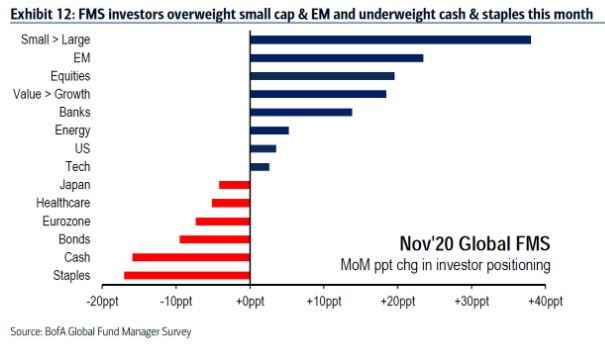
The latest Bank of America Global Fund Manager Survey (FMS) suggests professionals are positioning for change. As the chart below shows, the big moves over the first half of November 2020 were into small caps over large caps, into emerging markets, more value than growth and less defensive in cash, bonds and staples. Energy was back in favour. These moves are counter to the best positioning in 2020. The FMS growth outlook is strong, with managers rotating into previously hard-hit companies and sectors.
Also this week, we dive into the new numbers on the cost of running an SMSF versus fees on retail or industry funds. Turns out the break even is around $250,000 based on administration costs rather than investments.

Still on SMSFs, David Macri suggests that while trustees might handle their own cash and domestic equities, there are particular types of investments worth leaving to the professionals for a better outcome.

Building on this theme, the White Paper this week from BetaShares shows three global tactical trades that can be executed using ETFs listed in Australia.

When we hear an investing term such as 'growth' or 'momentum' or 'quality', it's tempting to put all funds into one bucket and assume they will perfrom in a similar way. Zunjar Sanzgiri takes a look at a popular segment of the Exchange Traded Fund (ETF) market and shows how funds with the same name differ markedly.

Then Aaron Minney makes a great point about retirement planning, showing why using average life expectancy produces misleading outcomes. All retirees and their financial planners need to consider this piece.

Finally, David Walsh delves deeper into the numbers which are supposed to show that local and global markets are seeing a big wave of Zombie companies propped up by supportive government policies.

Finally, with Australian states reluctantly opening their borders as community-based transmission is negligible, no such caution for Thanksgiving Day last week in the United States. Flightradar24 monitors jet movements, and millions of Americans honoured the tradition of celebrating the harvest. While Australia can afford to take its time watching the encouraging test results, the vaccine cannot come too quickly in a country with 280,000 deaths and 14 million cases. The US recorded its worst day for COVID deaths on record last week.

 

Graham Hand, Managing Editor


Latest updates

PDF version of Firstlinks Newsletter

ASX Listed Bond and Hybrid rate sheet from NAB/nabtrade

Indicative Listed Investment Company (LIC) NTA Report from Bell Potter

Latest LIC Quarterly Report from Bell Potter

Plus updates and announcements on the Sponsor Noticeboard on our website


  •   3 December 2020
  • 1
  •      
  •   
banner

Most viewed in recent weeks

Are you making these SMSF mistakes?

After four decades advising investors, there are a few common mistakes I've seen SMSF investors make. From holding too much cash and chasing yield to overtrading and trusting tips. Are these errors costing you?

Why have Australian living standards 'fallen' and how do we fix it?

For the last few years there has been much talk of a 'cost-of-living' crisis in Australia and of 'falling living standards'. Lately this has flared up again with the pickup in inflation resulting in a renewed fall in real wages.

Will you run out of money in retirement?

Fear of running out has become a defining retirement anxiety. Why do some retirees die with substantial wealth while others deplete their nest egg? Evidence suggests the answer is more complicated than we think. 

Retirement spending is not one-size-fits-all

New data challenges the idea that Australians are underspending their super. The bigger issue may be helping retirees navigate complexity, make confident decisions and use their savings to support security, wellbeing and choice.

Four options for an income investor’s next dollar

What if Australia’s golden age of dividends is ending? Rather than overhaul your portfolio, it may be worth considering where new capital can work harder. I discuss four income strategies and the trade-offs behind each.

The missing link in the CGT debate

A little-noticed consequence of Labor’s tax changes could have implications well beyond investors’ tax bills. The issue raises bigger questions about incentives, capital allocation and the drivers of long-term economic growth.

Latest Updates

SMSF strategies

Meg on SMSFs: What do we think about reversionary pensions these days?

Reversionary pensions have long been a staple of SMSF estate planning, but are they still the best option? Meg Heffron revisits a once-clear favourite and asks whether changing super rules have shifted the balance.

The ageing ‘crisis’ has not and will not happen

Rising age dependency is frequently treated as a warning sign for economies. But when actual workforce participation is examined, a strikingly different picture emerges about ageing, productivity and economic sustainability.

Retirement

How does the 4% rule stack up?

The 4% rule has long been retirement's gold standard. But after a difficult period for investors, fresh analysis suggests a more conservative approach may significantly improve the chances of making savings last.

Shares

Four charts that expose market concentration risk

Investors have recently been rewarded for backing market leaders, but history suggests this eventually comes at a cost. Now may be the time to review whether your portfolio is carrying unintended risks beneath the surface.

Investment strategies

The case for gearing beyond property

Most Australians gear into property but ignore shares. That may be a mistake. Used carefully, geared equity strategies can enhance long-term returns, reduce cash tied up in growth assets and support retirement income goals.

Economy

Australia's $1 trillion debt pile

The headlines exclaiming that Australian government debt has hit A$1 trillion and US government debt has hit $40 trillion has turned heads, but how serious are they really? Will Australia's mix of debt create challenges?

Economy

Has 100 years of growth made us any happier?

For decades, GDP has been the benchmark for economic success, but has it made us materially happier? If happiness does not rise in lockstep with prosperity, are we overlooking what constitutes a successful society?

Sponsors

Alliances

  • ASA-Logo-RGB-ActiveGreen-web.png

© 2026 Morningstar, Inc. All rights reserved.

Disclaimer
The data, research and opinions provided here are for information purposes; are not an offer to buy or sell a security; and are not warranted to be correct, complete or accurate. Morningstar, its affiliates, and third-party content providers are not responsible for any investment decisions, damages or losses resulting from, or related to, the data and analyses or their use. To the extent any content is general advice, it has been prepared for clients of Morningstar Australasia Pty Ltd (ABN: 95 090 665 544, AFSL: 240892), without reference to your financial objectives, situation or needs. For more information refer to our Financial Services Guide. You should consider the advice in light of these matters and if applicable, the relevant Product Disclosure Statement before making any decision to invest. Past performance does not necessarily indicate a financial product’s future performance. To obtain advice tailored to your situation, contact a professional financial adviser. Articles are current as at date of publication.
This website contains information and opinions provided by third parties. Inclusion of this information does not necessarily represent Morningstar’s positions, strategies or opinions and should not be considered an endorsement by Morningstar.